


 Not all images were able to load for printing. Please close the print window and try again.
 The Vacheron Constantin Overseas Self-Winding Ultra-Thin, with a New In-House Calibre to Fight in the Holy Trinity Sports Watch Battle
A new ultra-thin calibre replaces the legendary 1120 and pits the Overseas against the Royal Oak Jumbo and Nautilus.
The new Overseas Self-Winding Ultra-Thin 2500V is, without a doubt, one of Vacheron Constantin‘s most important releases of the year, not particularly for commercial reasons, knowing its low availability, but for credibility and relevance in a specific market, that of the high-end, ultra-thin integrated sports watch. Revealed at Watches and Wonders 2026, the model replaces the now-discontinued Overseas Ultra-Thin 2000V (presented in 2016) and introduces an entirely new manufacture movement, the calibre 2550. For collectors, this launch marks the end of an era: the legendary calibre 1120, one of the most revered ultra-thin automatic movements ever produced, finally gives way to a modern successor.
The timing for the launch of this Overseas Self-Winding Ultra-Thin is significant. Over the past few years, both the Audemars Piguet Royal Oak Jumbo, since 2022 powered by the calibre 7121 in the 16202ST, and the Patek Philippe Nautilus, in its current 5811G iteration with calibre 26-330 S C (which replaced the 324 in 2019), have evolved mechanically. Until now, Vacheron Constantin has remained the last of the so-called Holy Trinity to still rely on the historic Jaeger-LeCoultre-derived architecture, with a movement internally named calibre 1120 (produced in-house, though). With the new calibre 2550, the Overseas finally receives a thoroughly modern ultra-thin movement, restoring balance (or picking up the fight) in one of watchmaking’s most closely followed segments.
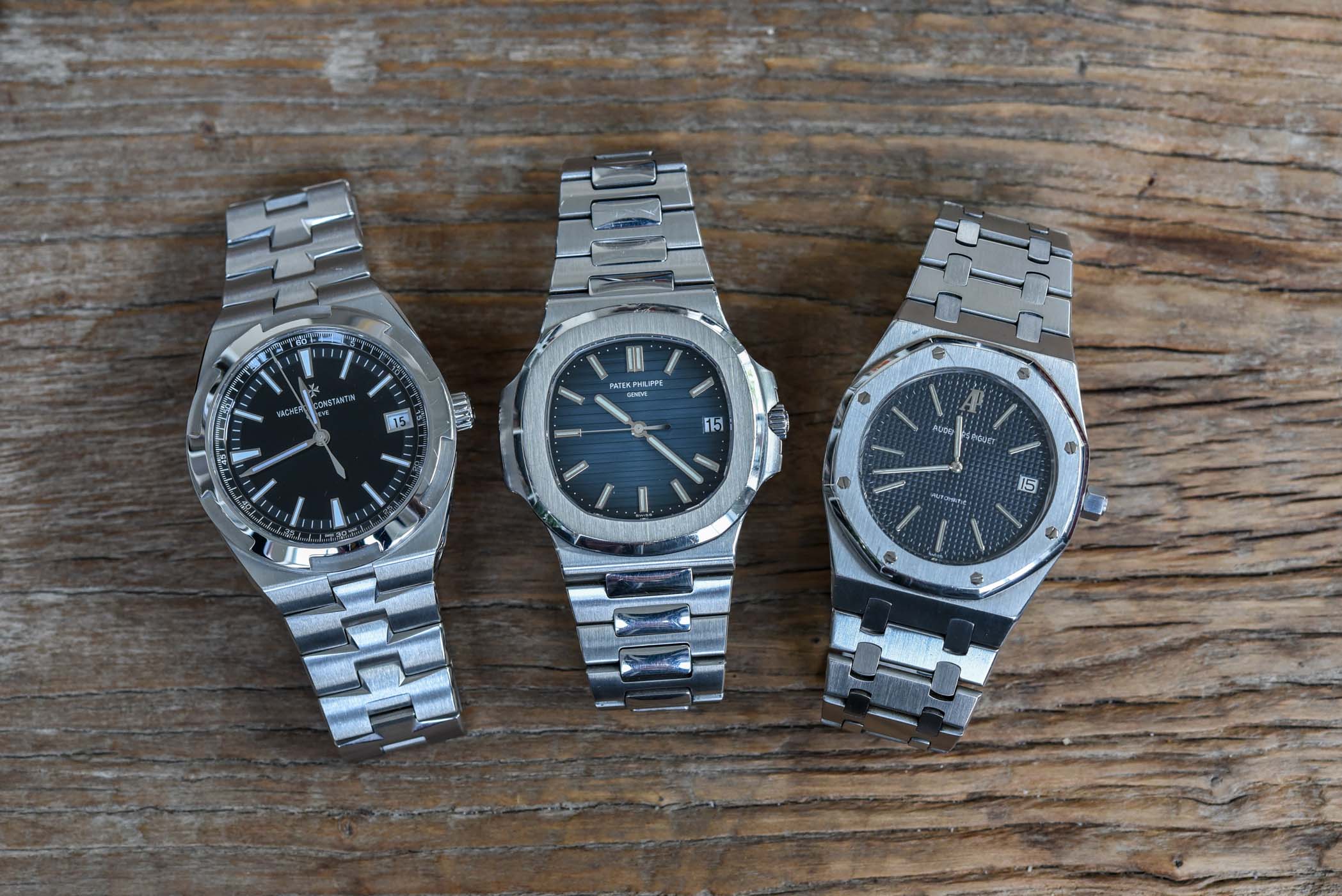
The watch’s appearance also changes. The Overseas Self-Winding Ultra-Thin 2500V is presented in a slightly smaller 39.5mm platinum case, thinner than its predecessor and, importantly, thinner than its two all-time rivals. At 7.35mm, it is substantially slimmer than the 16202ST (8.1mm) and the 5811G (8.3mm). It is paired with a striking salmon-coloured dial, a combination long cherished by collectors and associated with some of Vacheron Constantin’s most elegant modern (think Patrimony and Traditionelle collections) and vintage pieces. Let’s discover the new Overseas Self-Winding Ultra-Thin, but first, a tiny bit of history.
From the 222 to the Overseas
The origins of the Overseas can be traced back to the Vacheron Constantin 222 introduced in 1977 to celebrate the brand’s 222nd anniversary. Designed by Jörg Hysek, the watch represented Vacheron Constantin’s entry into the emerging category of luxury sports watches with integrated bracelets, a segment already defined by the Royal Oak 5402ST (1972) and Nautilus 3700 (1976).

Although stylistically distinct, the 222 shared the same core concept: a steel sports watch with refined finishing, an integrated bracelet and an elegant yet assertive design. Produced for only a few years (1977-1985), the 222 has since become one of the most coveted vintage references from the manufacture. VC reissued the 222 in 2022 in yellow gold and in 2025 in stainless steel as part of the “Historiques” collection.
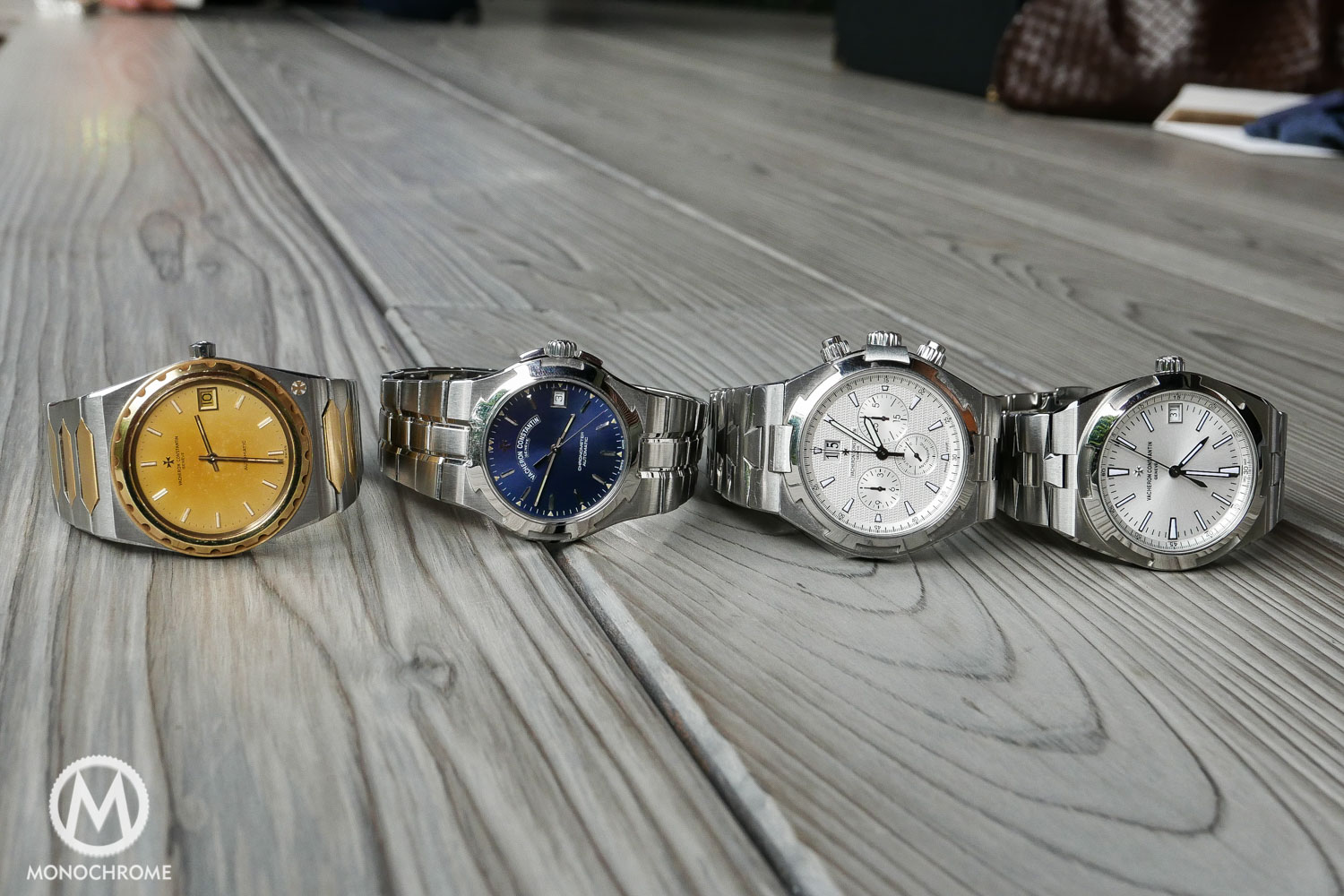
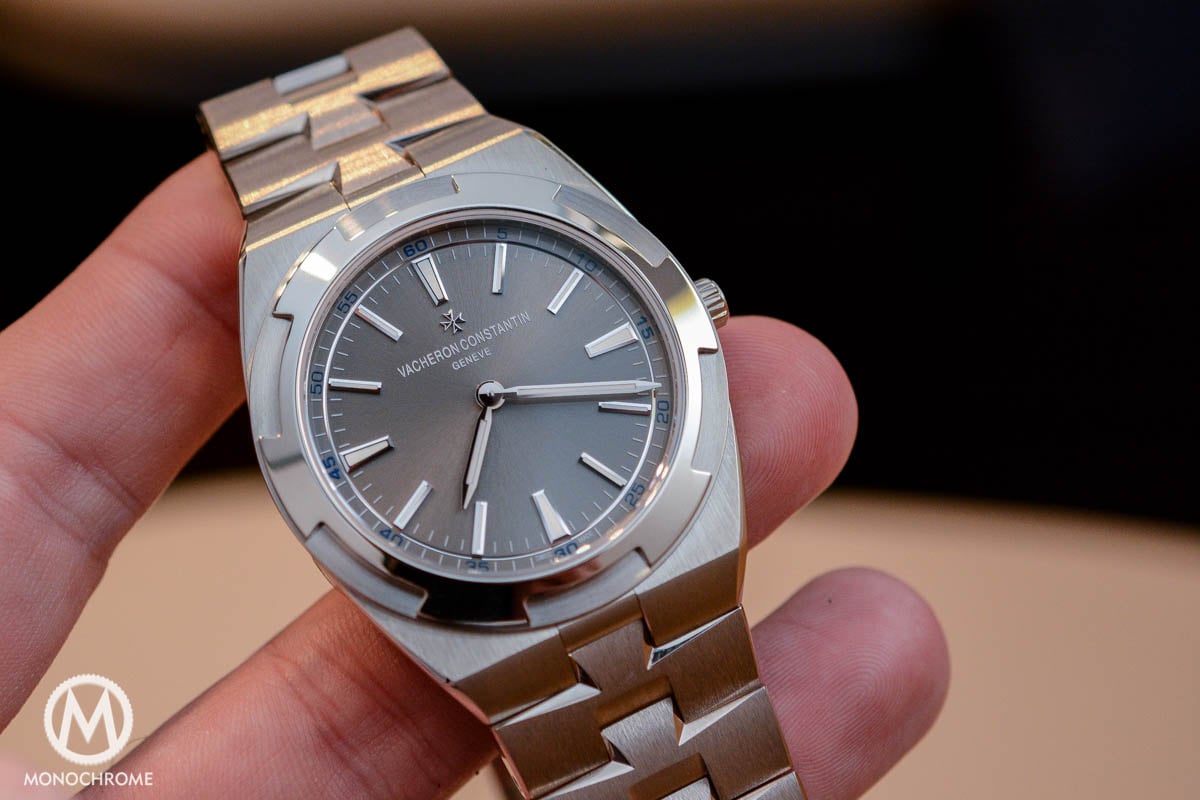
The Overseas collection, introduced in 1996, followed the 222 in spirit but developed its own identity as the bezel evolved into the now-familiar design inspired by the Maltese cross found in VC’s logo. The second-generation Overseas arrived in 2004, but the true transformation came in 2016 with the launch of the third-generation. That redesign softened the case architecture, refined the proportions and introduced one of the most practical interchangeable strap systems in the industry. Among the watches introduced that year, topping the range was the Overseas Ultra-Thin 2000V, still equipped with the same base movement as the 1977 reference 222.
The Legacy of Calibre 1120
Inside that 2016 Ultra-Thin model operated the calibre 1120, a movement that holds a special place in watchmaking history. Derived from the Jaeger-LeCoultre calibre 920 introduced in the late 1960s, it remained for decades the thinnest full rotor automatic movement ever produced, measuring just 2.45mm thick.
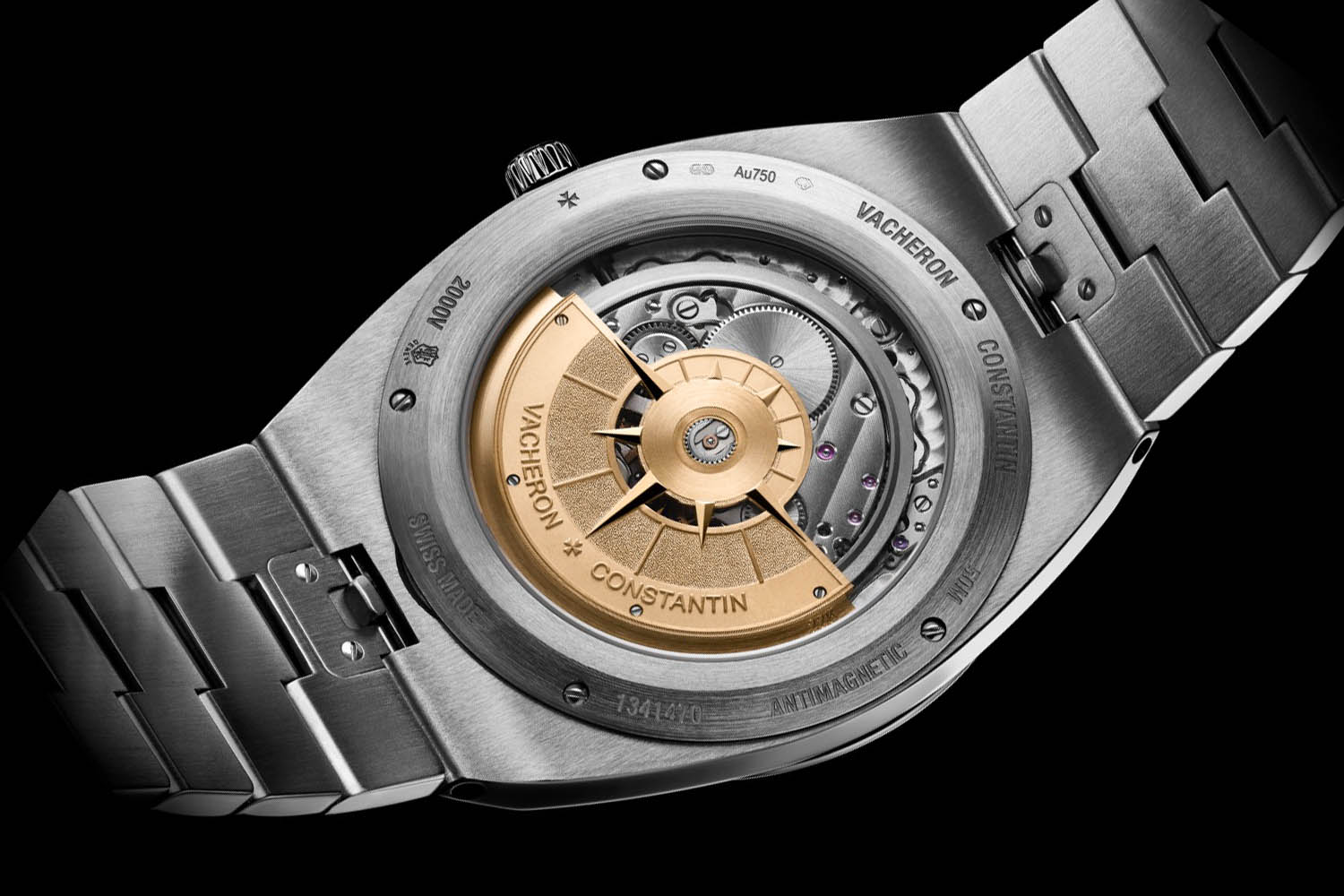
What’s important is that this base powered some of the most iconic watches in the luxury sports watch category. Variants of the movement appeared in the original Royal Oak Jumbo, from its introduction in 1972 up until the 15202ST, in the first Nautilus 3700, and numerous ultra-thin Vacheron Constantin watches. The calibre 1120 is, by the way, still used as the base for the Perpetual Calendar models in the Overseas collection… at least for now.
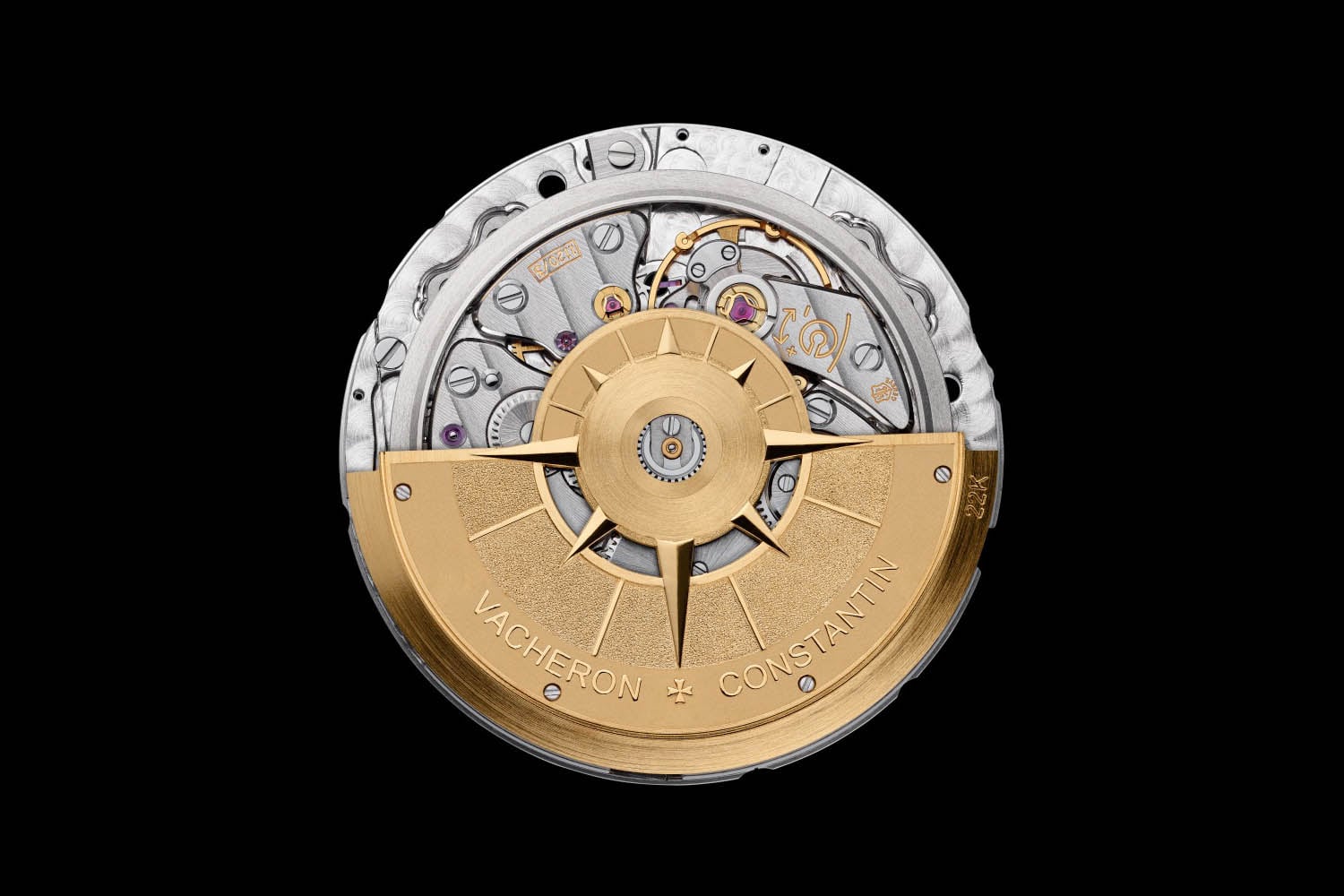
Despite its elegance and historical importance, the calibre inevitably reflected the engineering philosophy of the past. While beautifully finished and highly regarded by collectors, it required extensive manual adjustment, lacked the autonomy and robustness expected of modern movements, and features such as a stop-seconds and quick-set date. As both Audemars Piguet and Patek Philippe have moved away from this historic movement base, Vacheron Constantin now follows suit with the introduction of the new calibre 2550.
The new Ultra-Thin, Micro-Rotor Calibre 2550
Developed over seven years, the new calibre 2550 is Vacheron Constantin’s modern interpretation of the ultra-thin automatic movement. Measuring just 2.4mm thick, the calibre is even slimmer than the historic 1120, while offering significantly improved performance. It is built around three key elements: a micro-rotor integrated into the mainplate, a suspended double barrel and a compact single-level gear train.

The micro-rotor, crafted from 950 platinum, ensures efficient winding despite its reduced dimensions. The suspended double-barrel system is one of the movement’s most innovative elements. Two barrels are stacked vertically on a single axis and operate in series (a solution that feels close to Chopard’s calibre 96), allowing the movement to deliver an impressive 80-hour power reserve, remarkable for a calibre of such thickness; for comparison, AP’s calibre 7121 delivers 55 hours of power, and PP’s calibre 26-330 SC offers only 35-45 hours of autonomy. The gear train has also been completely redesigned. Arranged on a single level, the five-wheel design optimises energy transmission while maintaining structural rigidity within the ultra-thin movement.
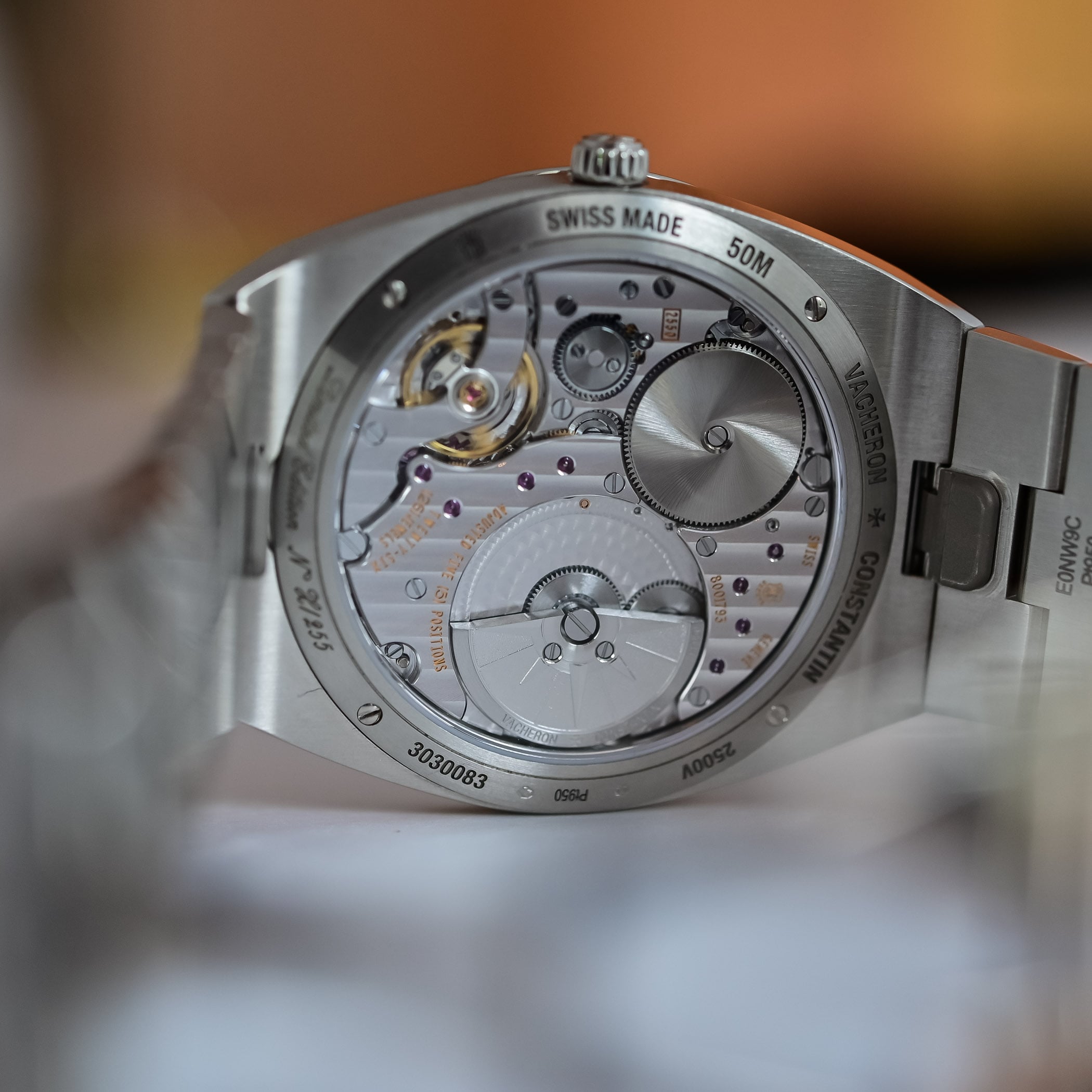
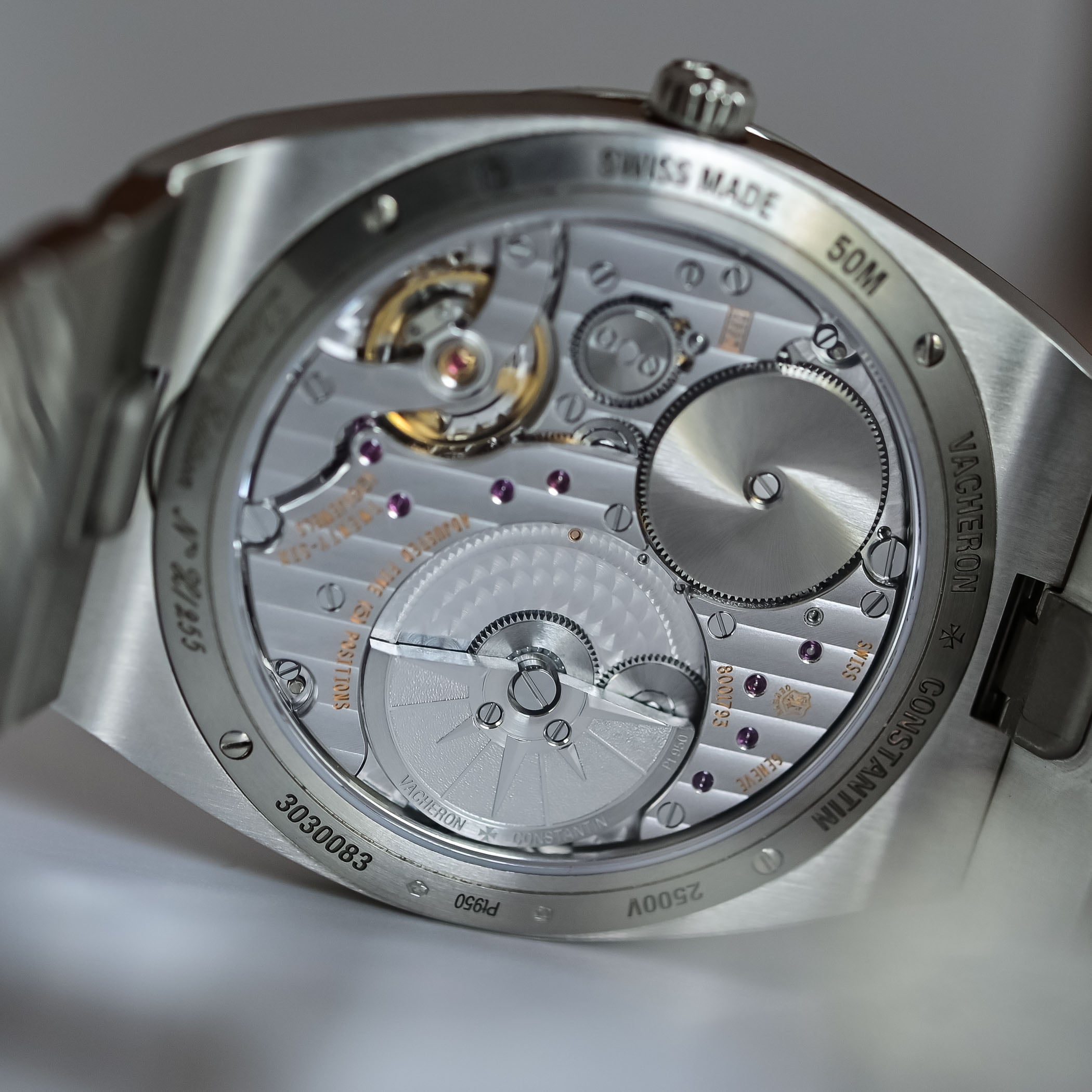
As expected, finishing remains exemplary. The calibre bears the Hallmark of Geneva and features circular-grained plates, thin Geneva-striped bridges, sunburst wheels and a beautifully decorated platinum micro-rotor engraved with a compass rose.
The Overseas Self-Winding Ultra-Thin 2500V
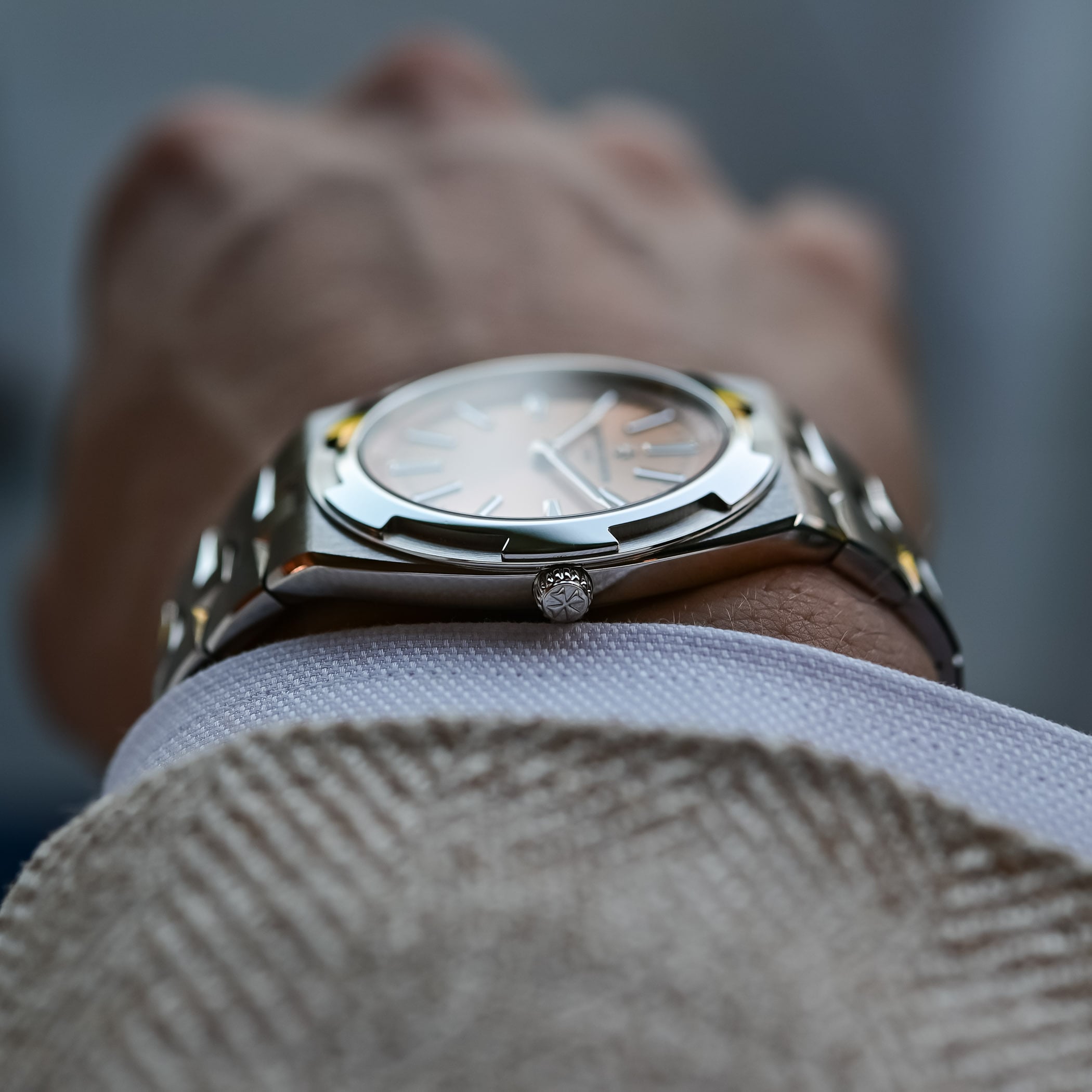
The calibre 2550 debuts inside the new Overseas Self-Winding Ultra-Thin reference 2500V/210P-H028. For the first time in the collection’s history, the watch is made entirely in 950 platinum, including the case, bracelet and clasp. The platinum used here is not a conventional alloy. Vacheron Constantin employs a 950 platinum alloy containing copper and gallium, which undergoes thermal hardening to improve scratch resistance and durability. The case measures 39.5mm in diameter and 7.35mm thick, making it the thinnest Overseas ever produced and slightly smaller than the previous white gold ultra-thin reference 2000V (measuring 40mm x 7.5mm).

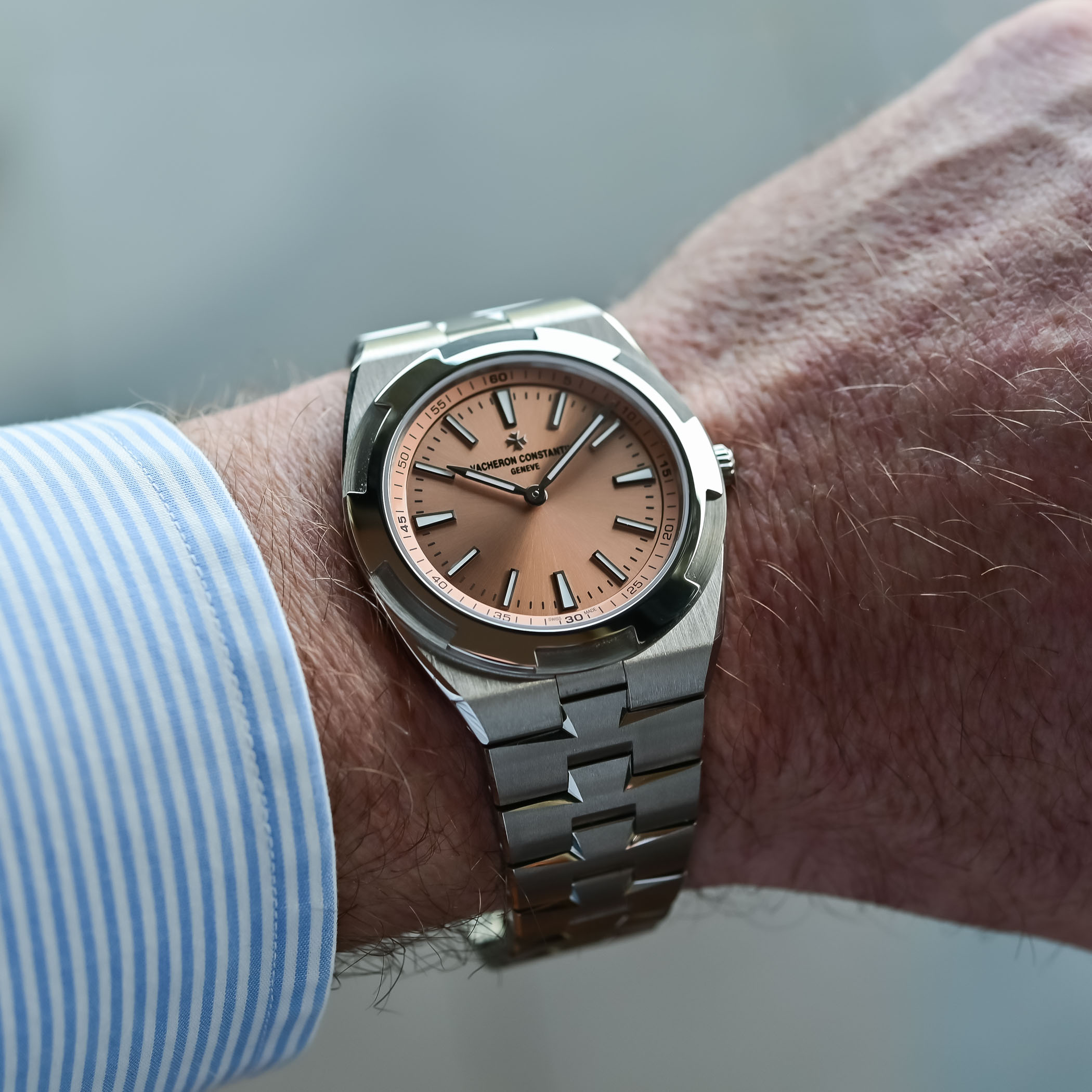
Vacheron decided to equip the new Overseas Self-Winding Ultra-Thin with a salmon-coloured lacquered dial, finished with a sunburst satin-brushed centre and a velvet-textured minute track. Among collectors and enthusiasts, a platinum case with a salmon dial has become a signature of high-end limited editions. Vacheron Constantin used this combination in several historically important models, particularly in the mid-20th century and, more recently, in complicated Traditionnelle references, such as the Traditionnelle Perpetual Calendar Chronograph Platinum. No doubt that this specific combination will be a success – in all fairness, it really looks fantastic.
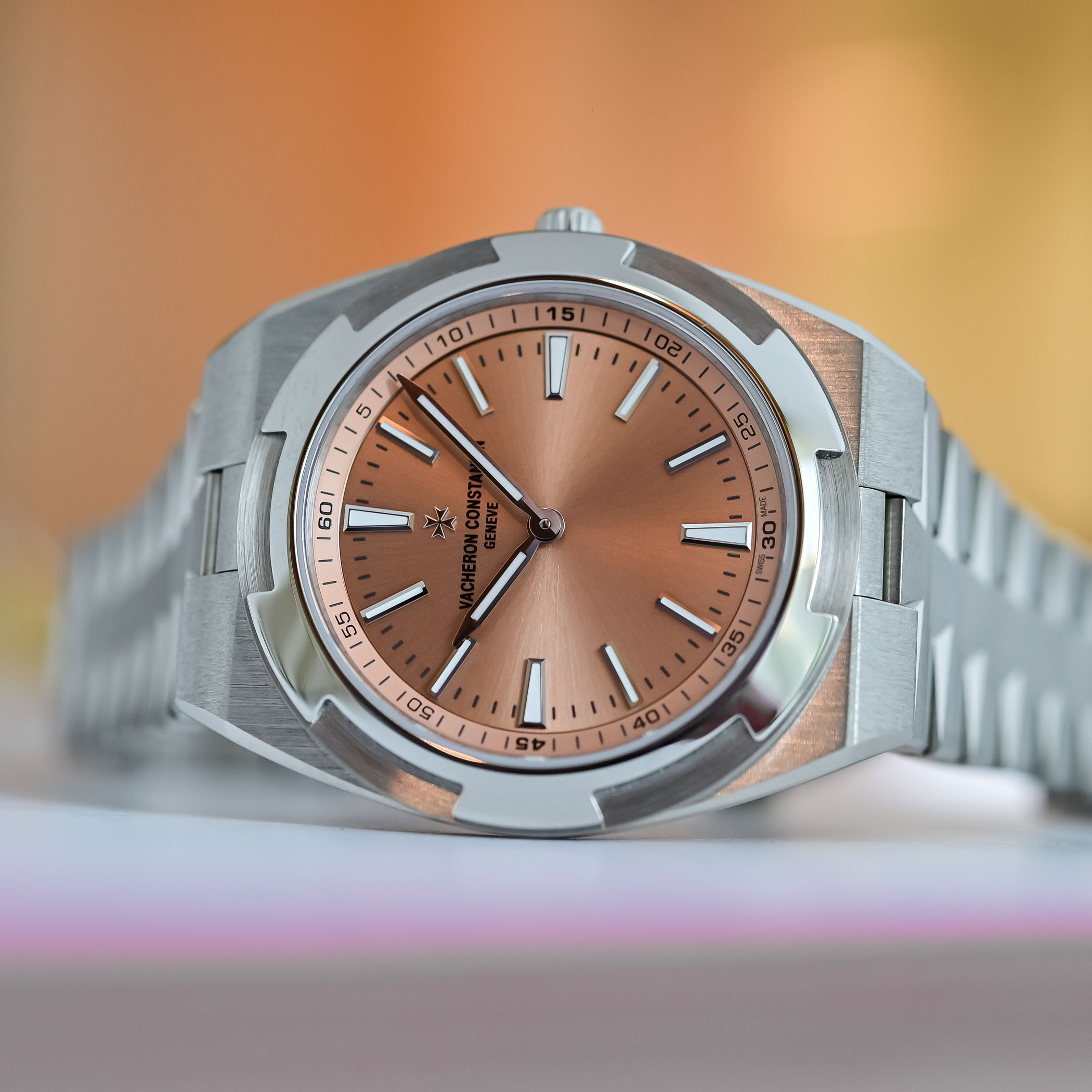
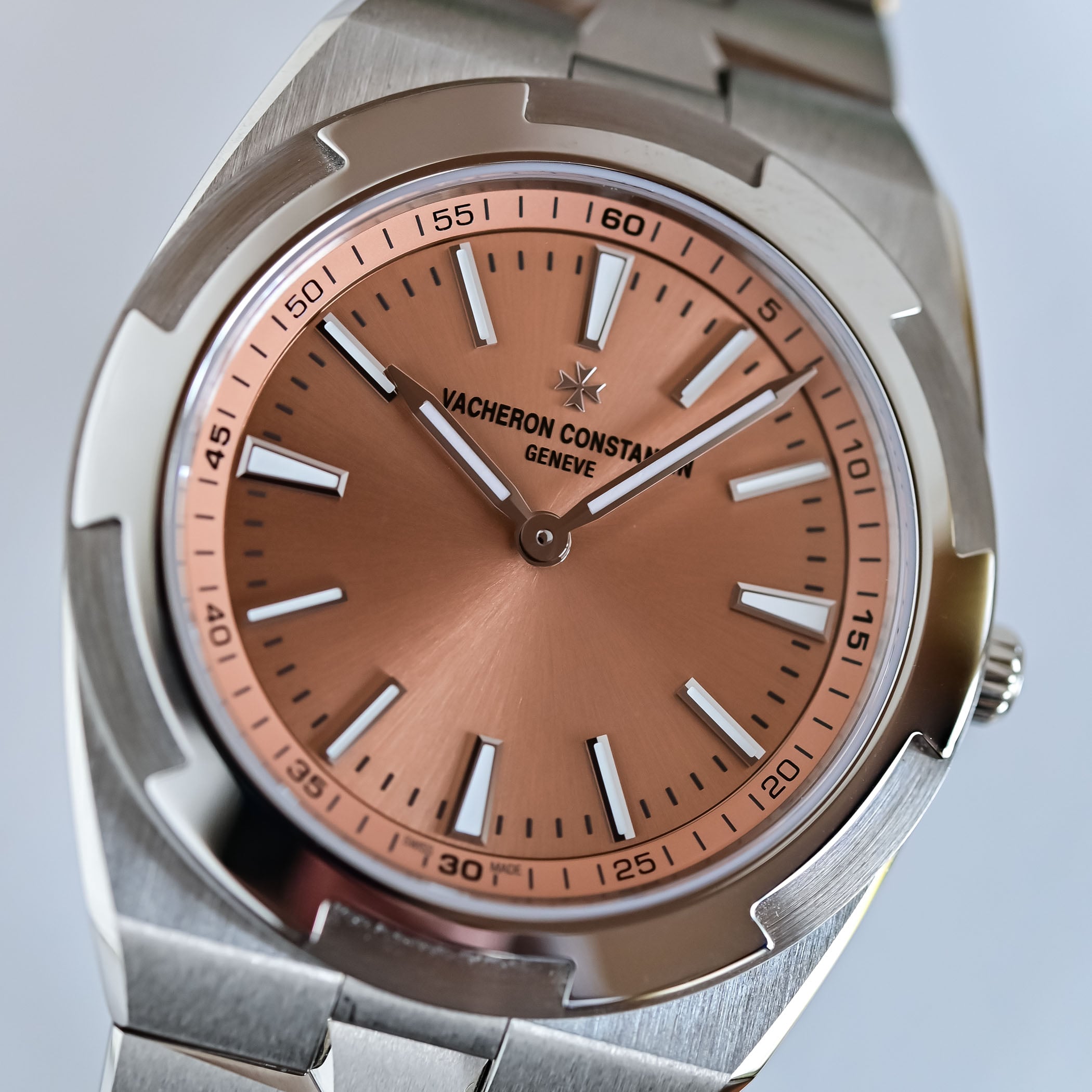
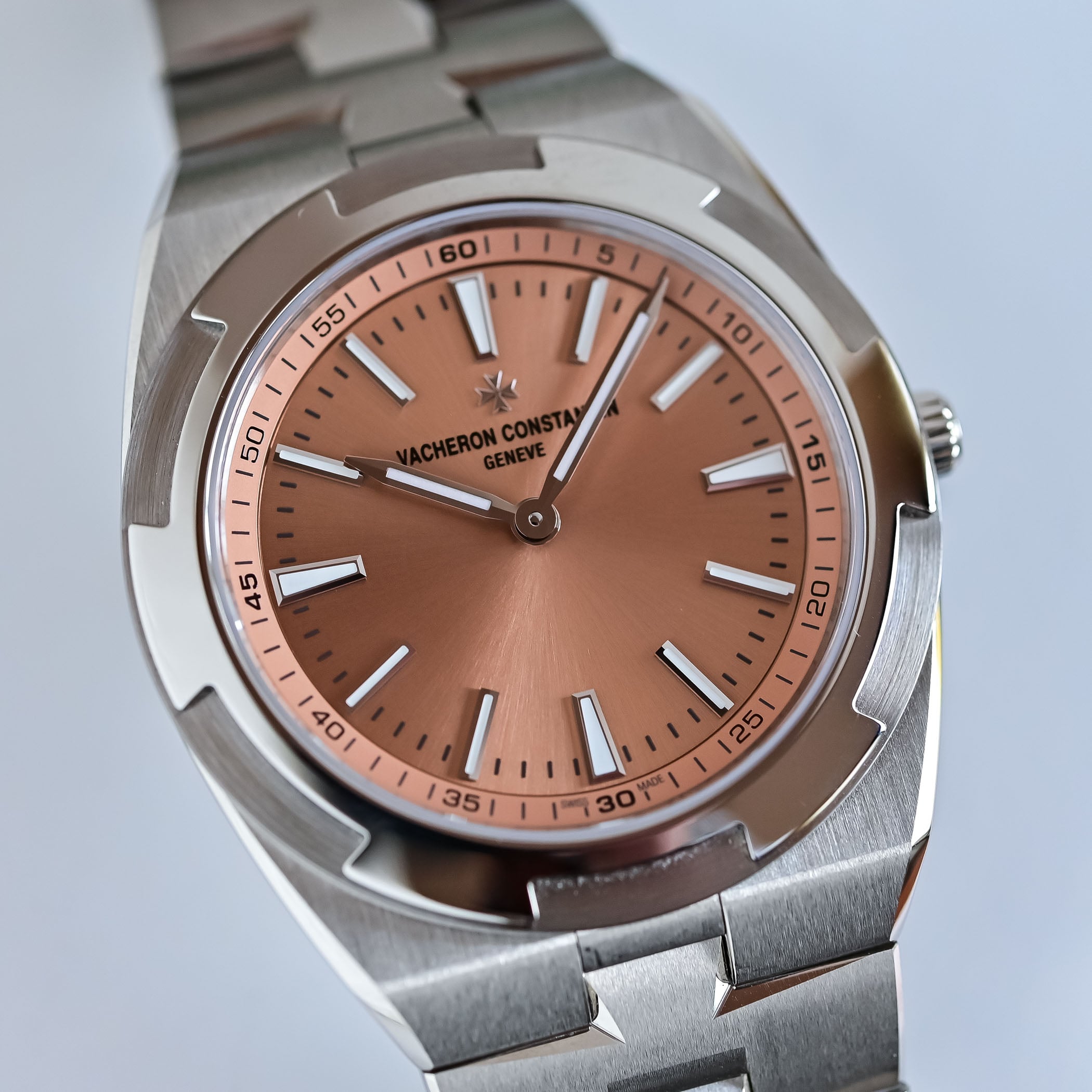
White gold applied markers and baton hands filled with blue Super-LumiNova maintain legibility while preserving the unmistakably luxurious, yet understated aesthetic expected of an ultra-thin time-only watch. And, just like an ultra-thin luxury sports watch with an integrated bracelet should be (at least considering the defining models of the mid-1970s), there’s no seconds hand. And following the 2000V, Vacheron chose a no-date display here.
The Overseas DNA
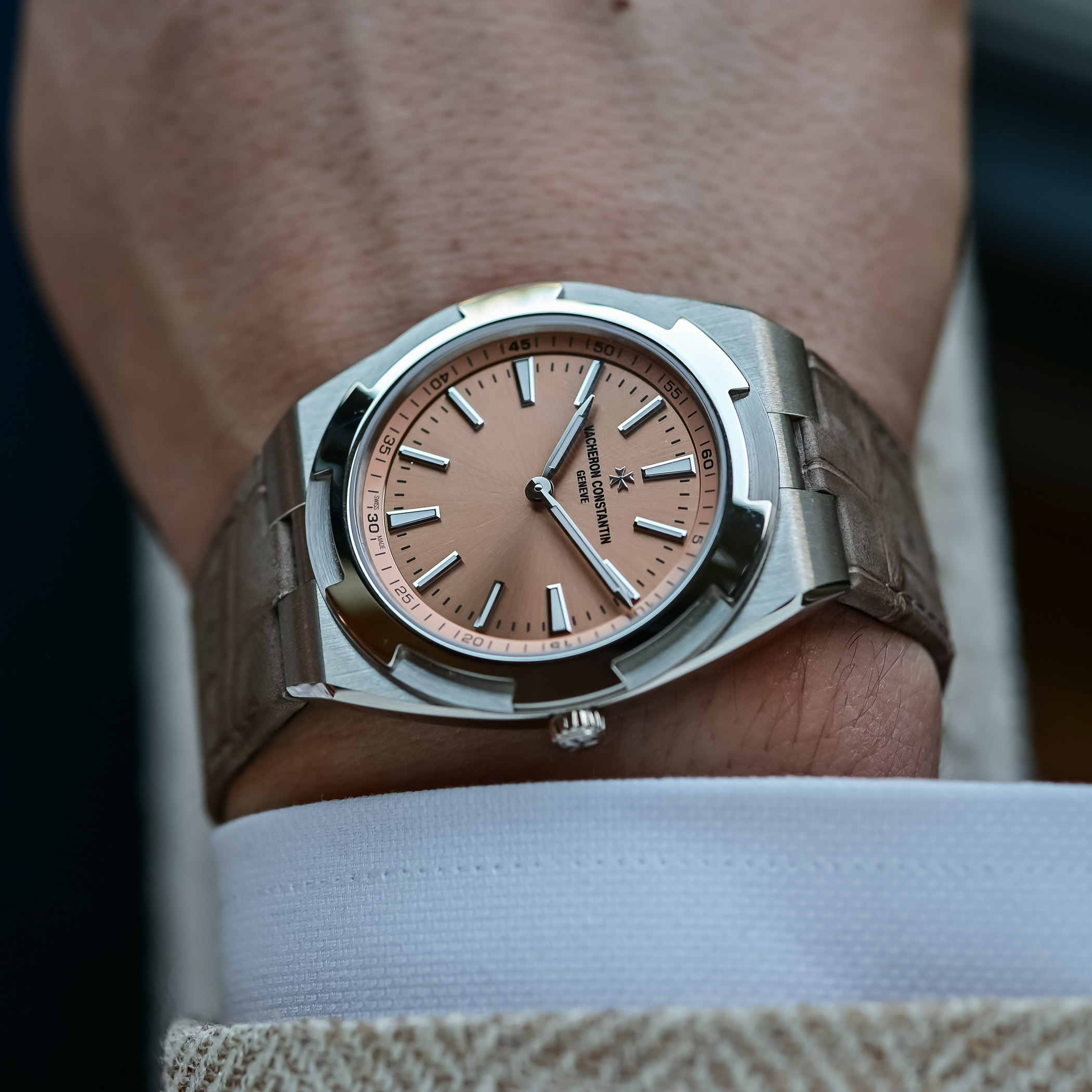
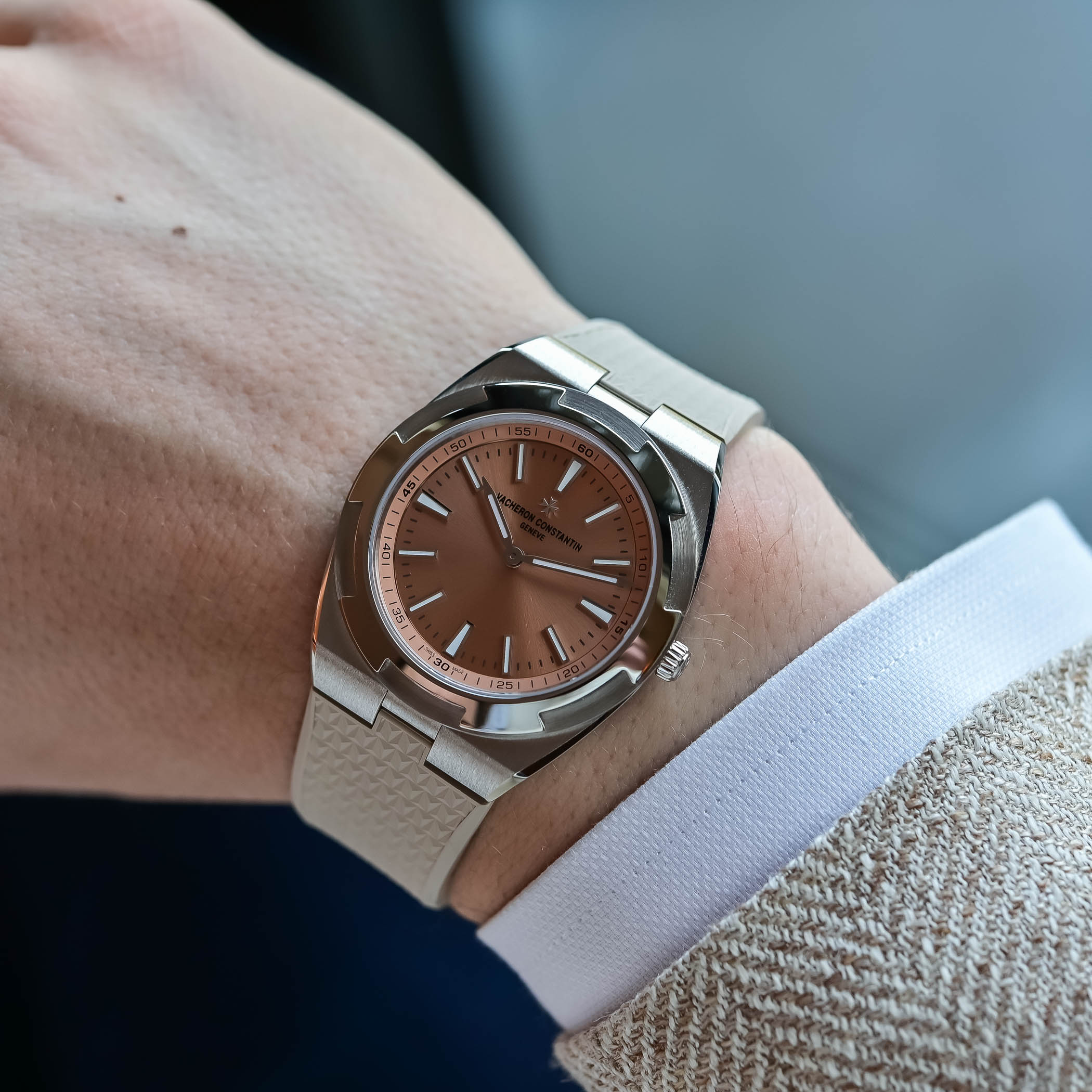
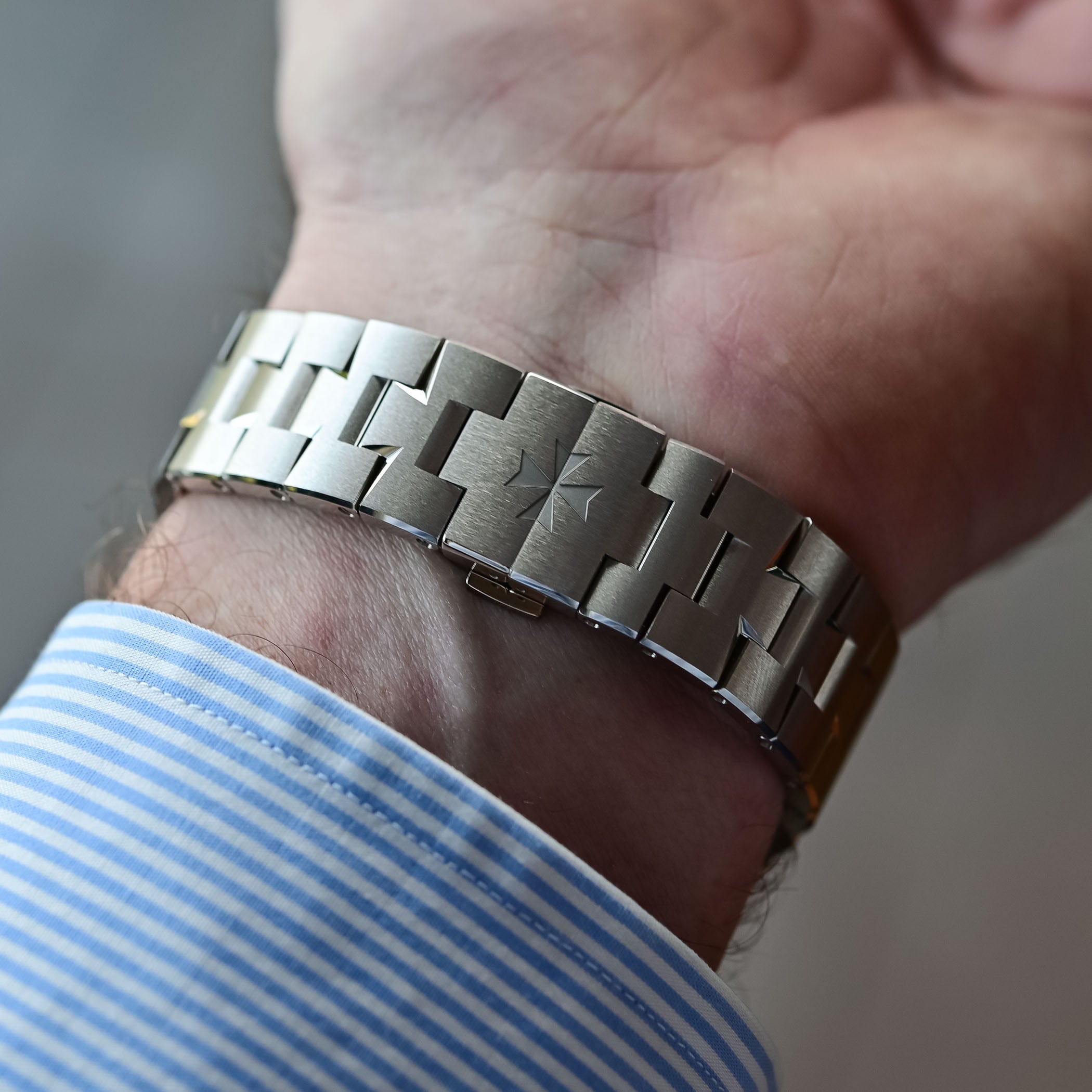
Despite its elegant execution, the watch retains the practical features that define the collection. Water-resistance is 50m, decent considering the ultra-thin construction and in line with the competition. The integrated platinum bracelet with the half-Maltese cross-shaped links can be removed without tools thanks to its quick-release system. It’s finishing, like all members of the Overseas family, is spectacular. For versatility, the watch is delivered with two additional interchangeable straps: a beige rubber strap and a dark beige alligator strap with nubuck finish.
A Limited Edition for Collectors
Clearly, the calibre 2550 represents the future of ultra-thin watchmaking at Vacheron Constantin. Much like the calibre 1120 before it, this new movement could serve as the base for future complications, including a new generation of Overseas ultra-thin perpetual calendars. Nothing has been confirmed by VC yet, but that’s an easy guess.
With this watch, Vacheron Constantin once again positions itself at the centre of the ultra-thin luxury sports watch segment. The Royal Oak, the Nautilus and the Overseas now all rely on modern in-house movements, ensuring that the curious rivalry between the three icons of the Holy Trinity remains as compelling as ever.
The Overseas Self-Winding Ultra-Thin 2500V is produced as a limited edition of 255 individually numbered pieces, a number that references the calibre powering the watch. The price is CHF 98,000. For more information, please visit vacheron-constantin.com.

3 responses
Nice watch but that price is crazy.
Just can’t wait to try it on. Micro Rotor movement in an ultra thin overseas is really icing on the cake, I wouldn’t mind
Water resistant to only 50m. Count me out. For this money, I’m looking for a high horology true sports watch. Not a “sport-style” watch.