


 Not all images were able to load for printing. Please close the print window and try again.
 The Patek Philippe Cubitus Perpetual Calendar Skeleton 5840P
What the Cubitus was meant to be… A complete integration of shapes between case and movement.
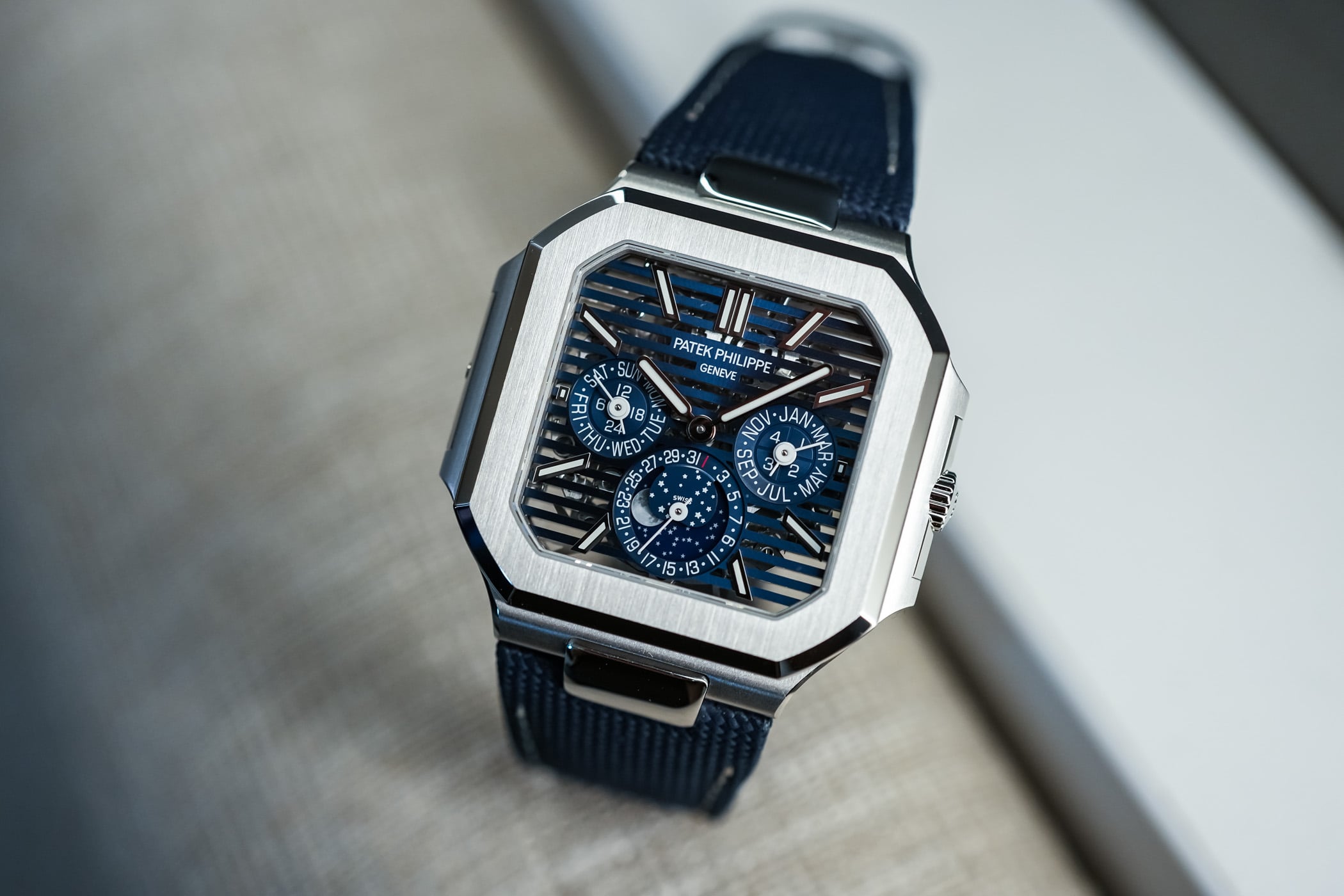
When Patek Philippe introduced the Cubitus collection in 2024, it drew fierce scrutiny. A square-shaped, angular evolution of the Nautilus concept, it challenged expectations. Yet, over successive releases, from the time-and-date references to the instantaneous grand date 5822P and the more compact 7128 models, the collection has settled into its role as Patek Philippe‘s modern sporty-chic platform alongside the existing Nautilus models. If, for once, we accept secondary-market prices as an indicator of desirability and series success, even discounting greed, it’s a collection that many find appealing.
Now comes the Cubitus Perpetual Calendar Skeleton 5840P, the first Grand Complication in the line. Rather than simply adding complexity, Patek Philippe has used this watch to fully align the identity of the Cubitus: geometry, mechanics, and design speak the same language. Dare we suggest that if this were the inaugural Cubitus to behold, the reactions would have been predominantly positive? Here’s our impression.
The Case
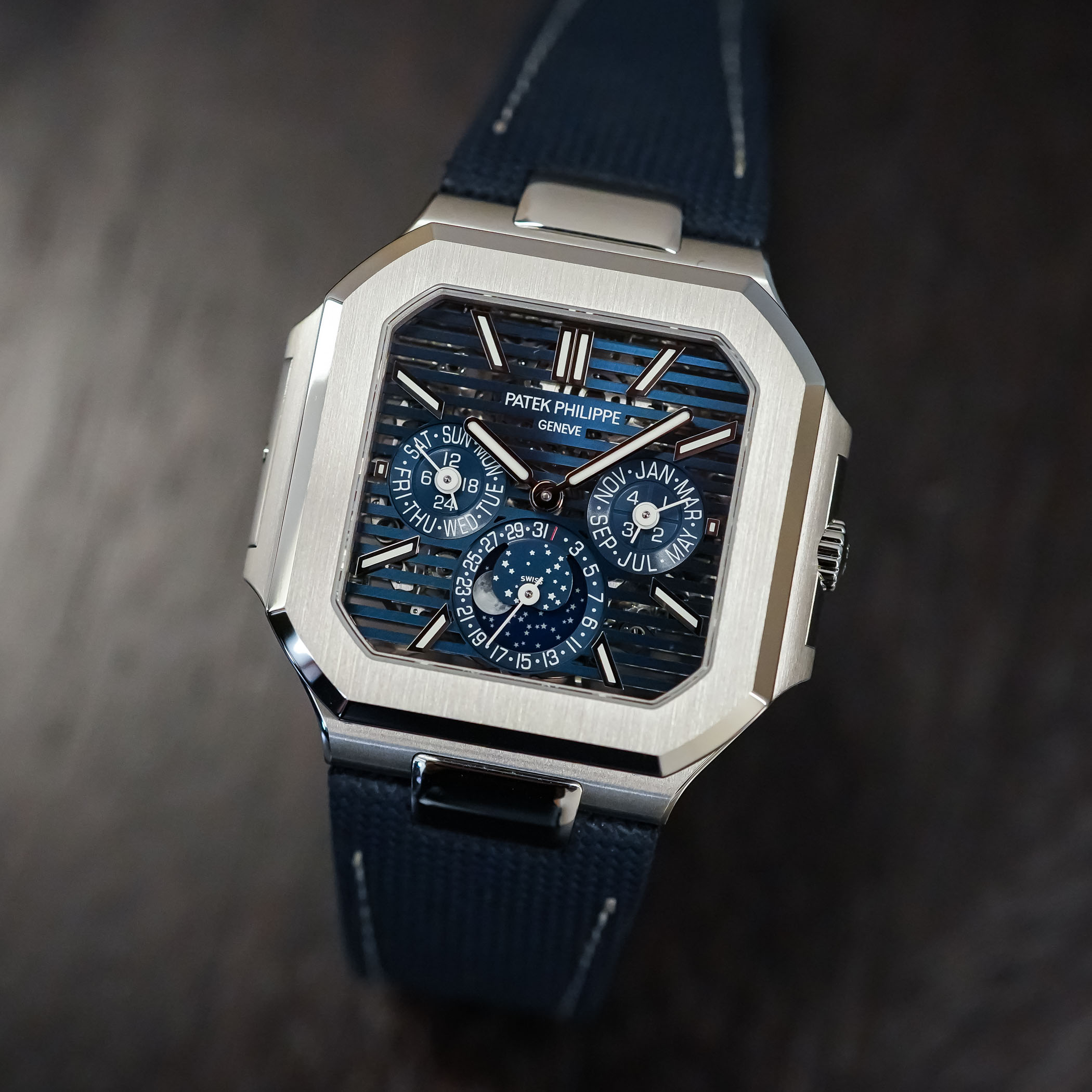
At 45mm across (10 to 4 o’clock), 44.85mm wide (from 3 to 9 o’clock with crown) and 10mm thick (crystal to crystal), the Cubitus 5840P is not a small watch, yet it wears just fine, even with the added heft of platinum. It actually has the same dimensions as the time-and-date 5821A and the Instantaneous Grand Date 5822P, with only a marginal increase in thickness. The watch has weight, noticeable but not excessive. It adds a reassuring density, in line with the perception of a high complication. The baguette-cut diamond set at 6 o’clock remains a signature detail. The screw-down crown offers two positions for setting and winding. The caseback is in sapphire crystal to see the movement.
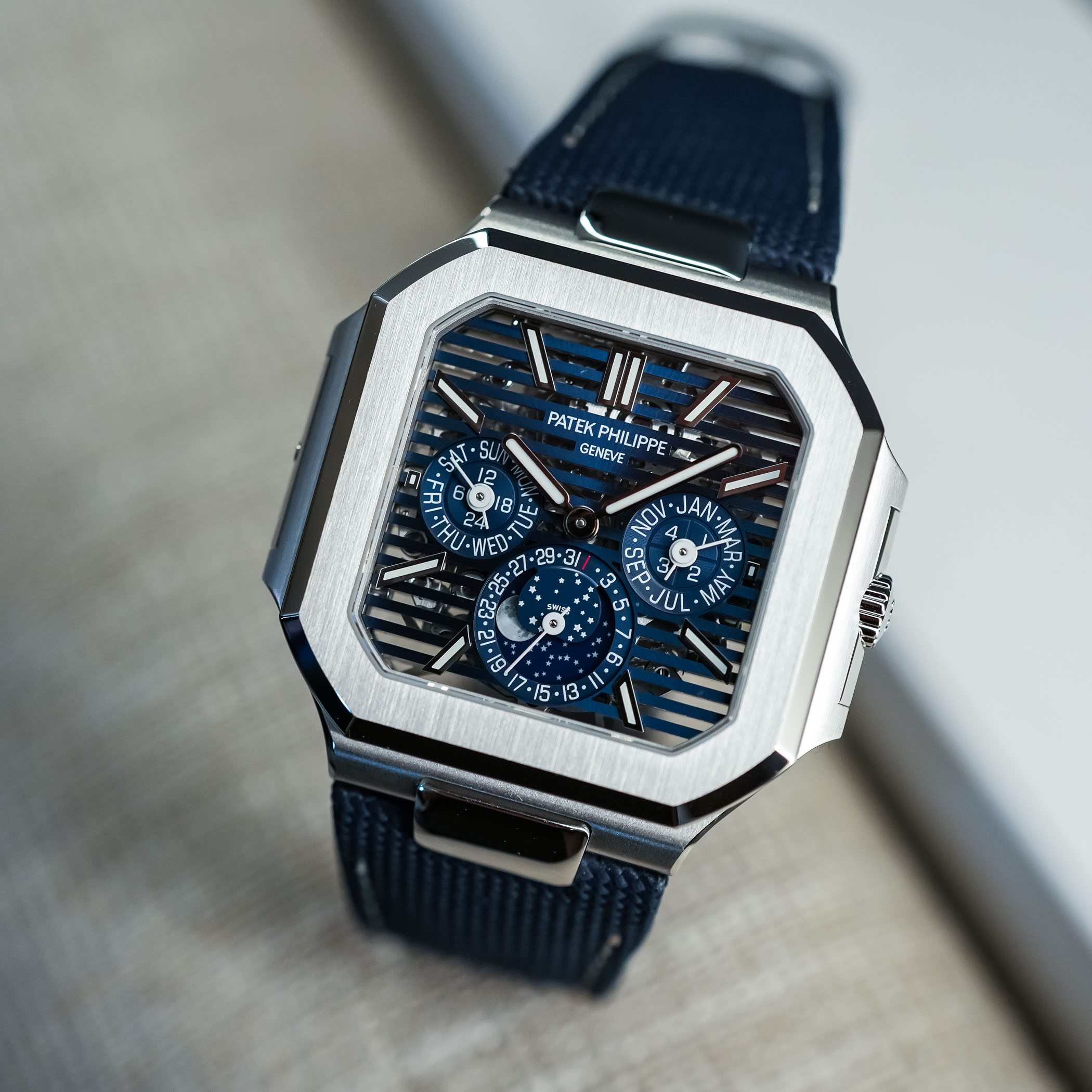
The collection’s two-part construction remains, with lateral “ears” framing the caseband, something borrowed from the Nautilus lineage, but rendered here with sharper, flatter planes. Finishing is classic: vertically satin-brushed surfaces contrast with polished bevels, allowing light to play on the edges of the bezel and case flanks.
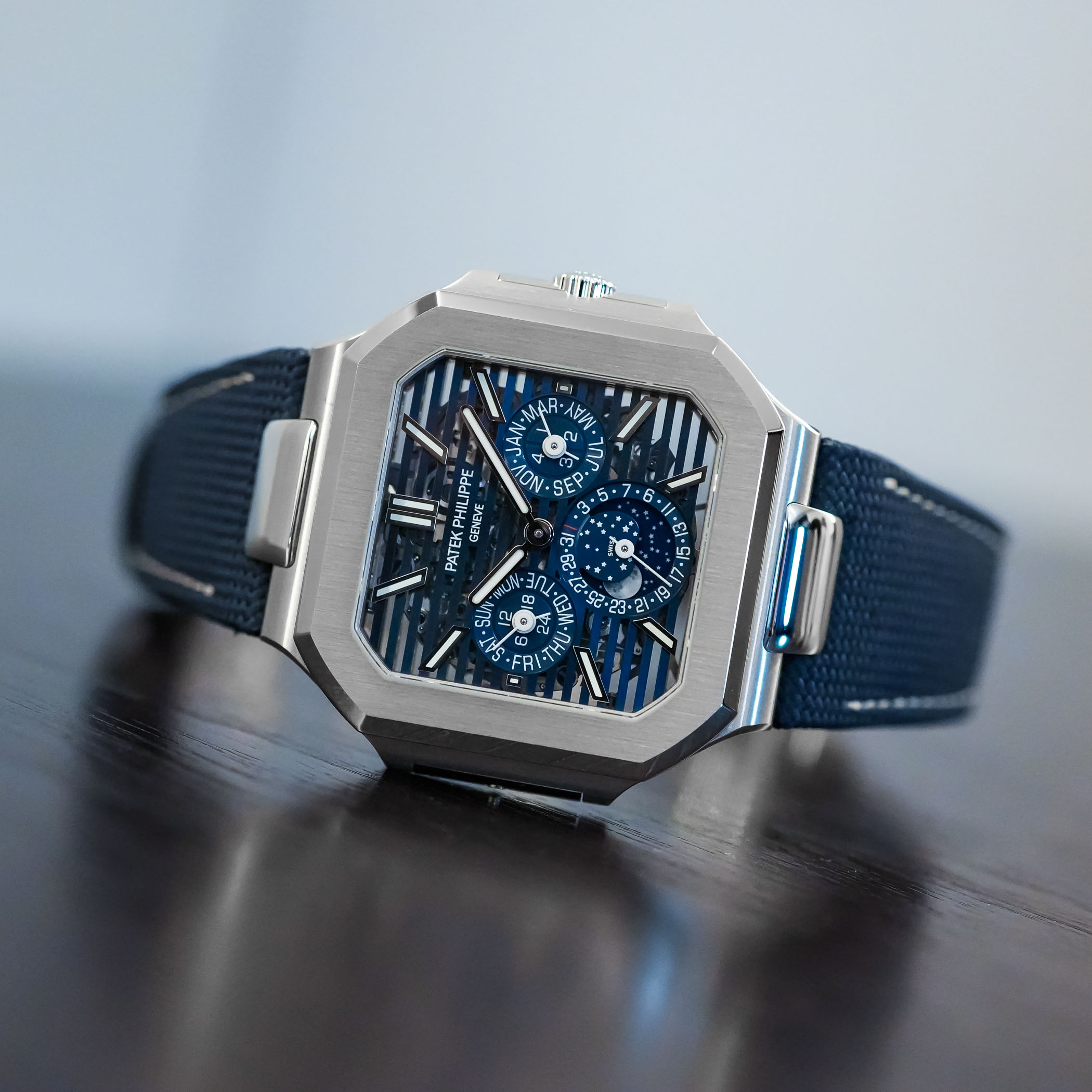
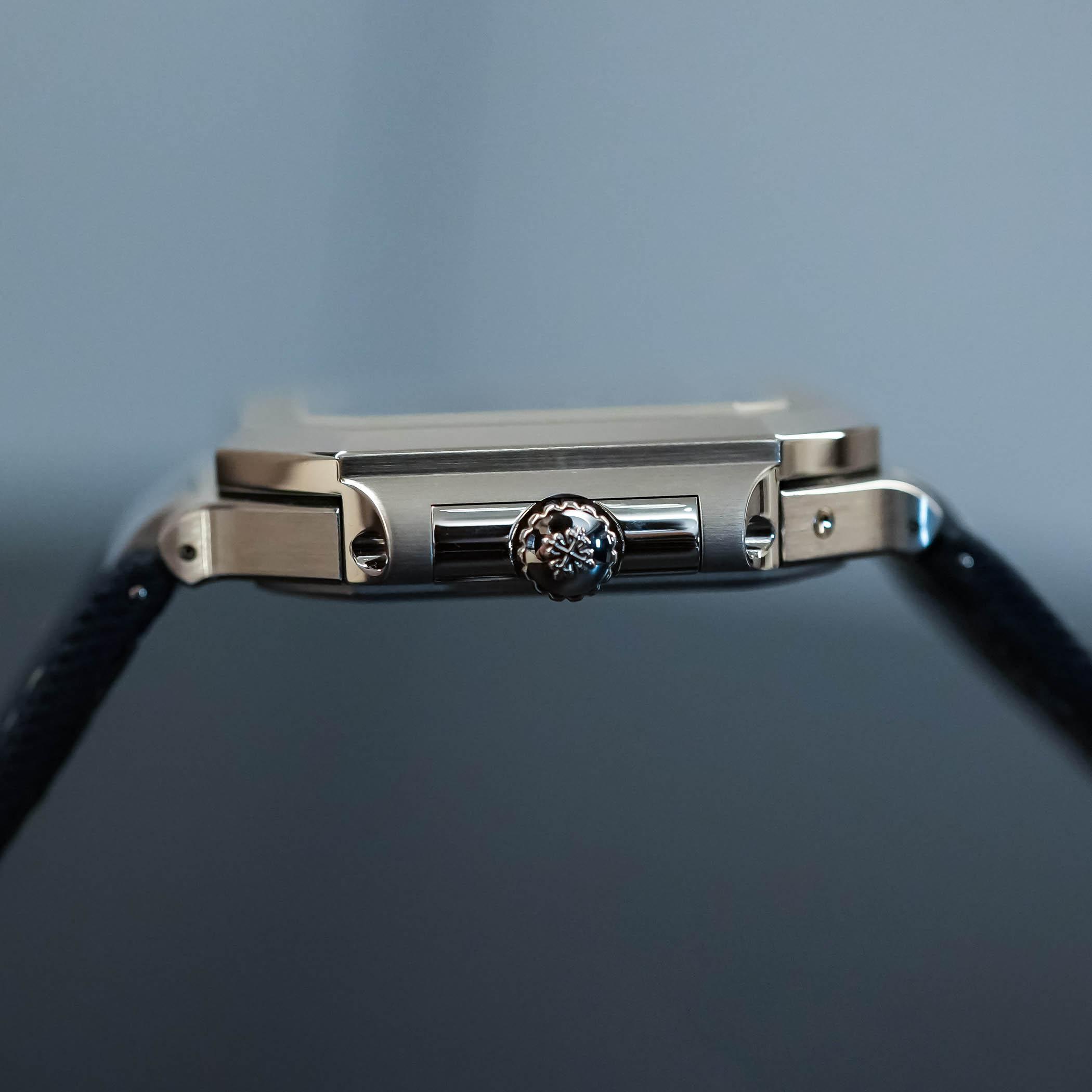
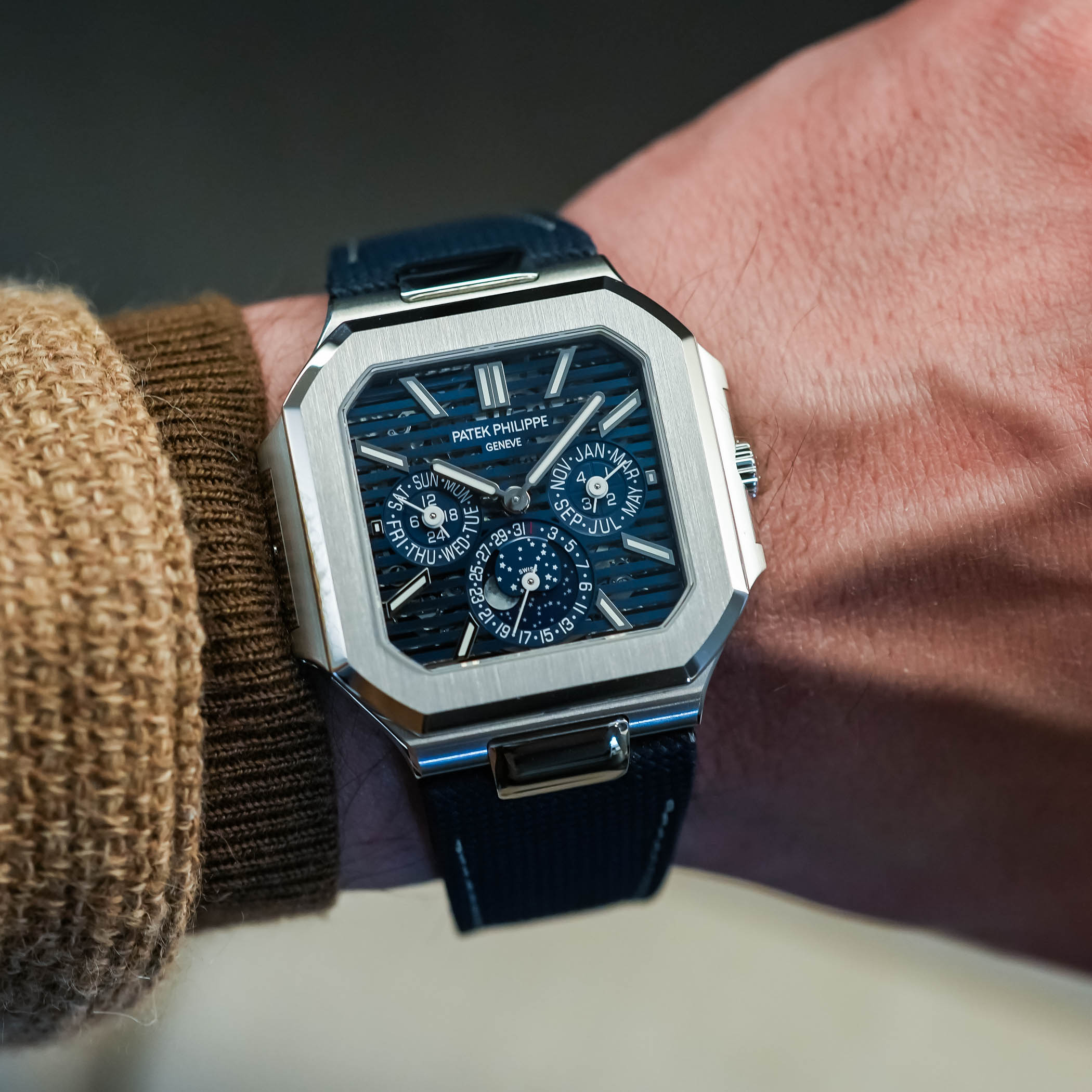
The square case with rounded corners spreads across the wrist, and its relatively slim profile and reasonable lug span keep it from feeling oversized. The watch wears flat and stable, and the wide stance is softened by the strap, which helps to avoid the rigidity often associated with square cases of this size. Water-resistance is 30m.
The Dial
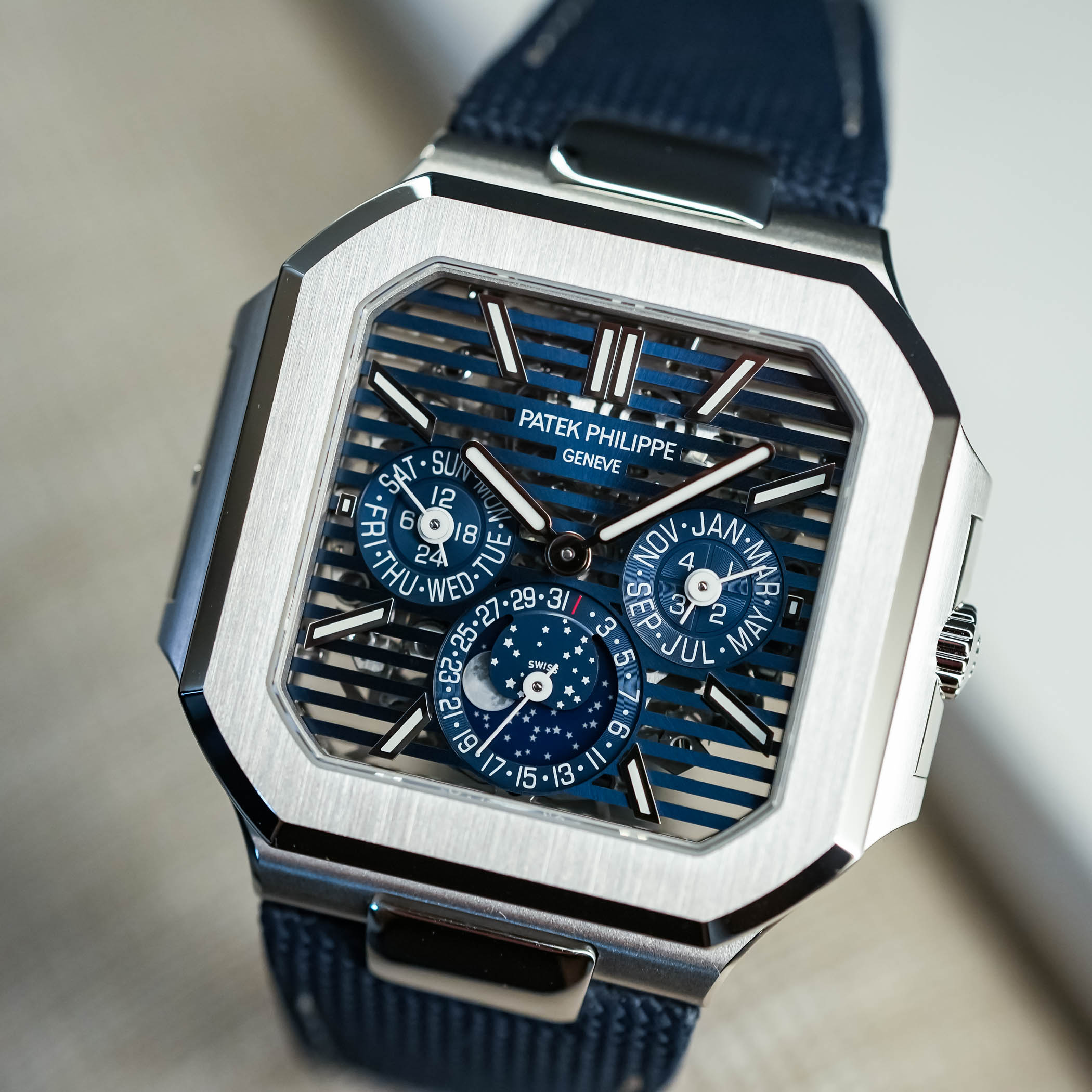
As suggested by its name, the dial of the Cubitus Perpetual Calendar Skeleton 5840P is openworked and layered, with the signature horizontal striped motif that extends from the dial to the movement’s top plate and the bridges visible on the back. The blue PVD coating applied to the dial elements adds contrast against the backdrop of the monochrome rhodium-plated movement. Depending on the light, it shifts from deep navy to metallic blue-grey, emphasising the depth created by the openworked design.
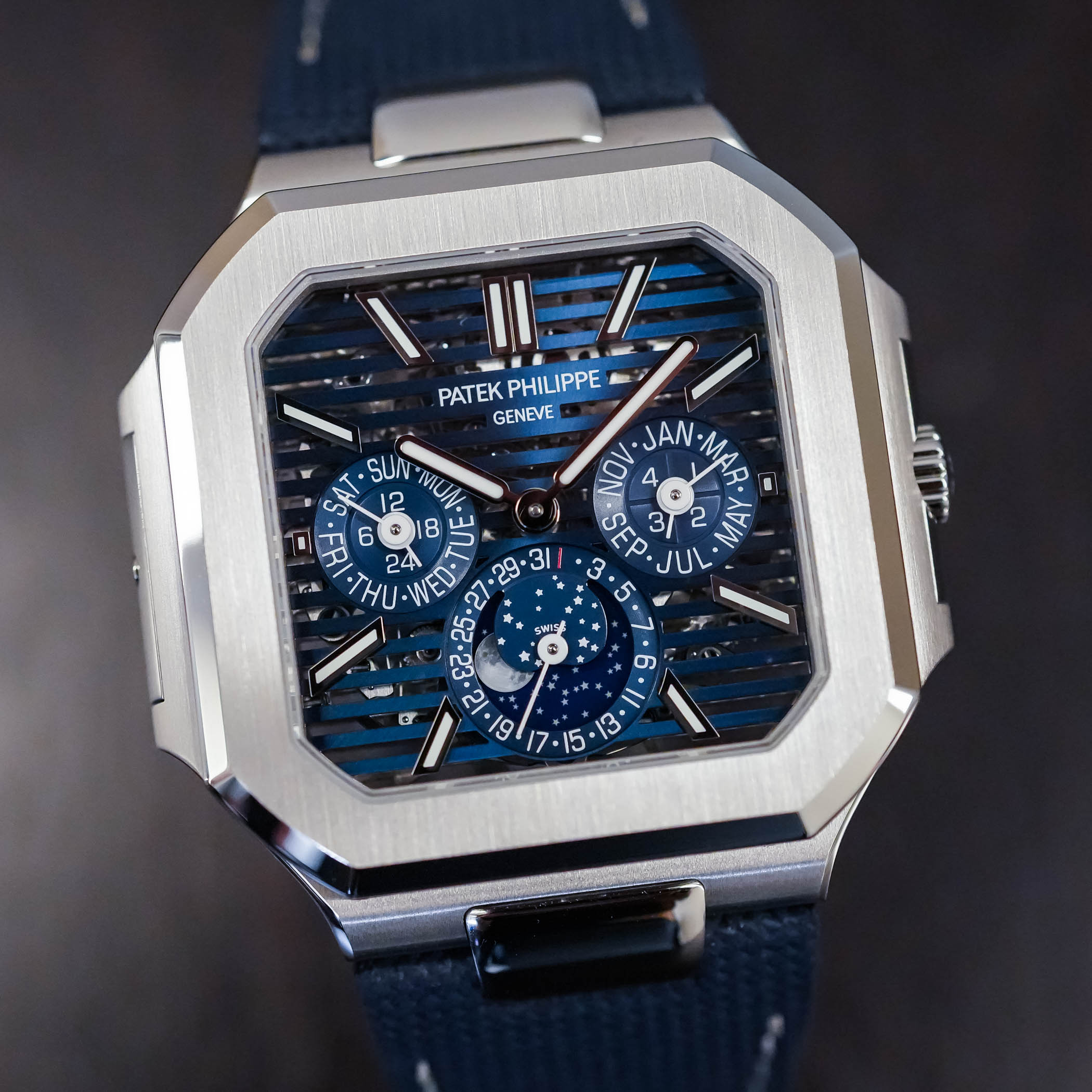
Legibility, despite the complexity, is quite good. The white gold applied hour markers, as if suspended above the dial, stand out, as do the baton hands, filled with luminous material, which remain clearly distinguishable. The calendar layout is classic, with the day and 24-hour indication at 9 o’clock, the month and leap year at 3 o’clock, and the date combined with moon phase at 6 o’clock, in the largest of the three subdials.
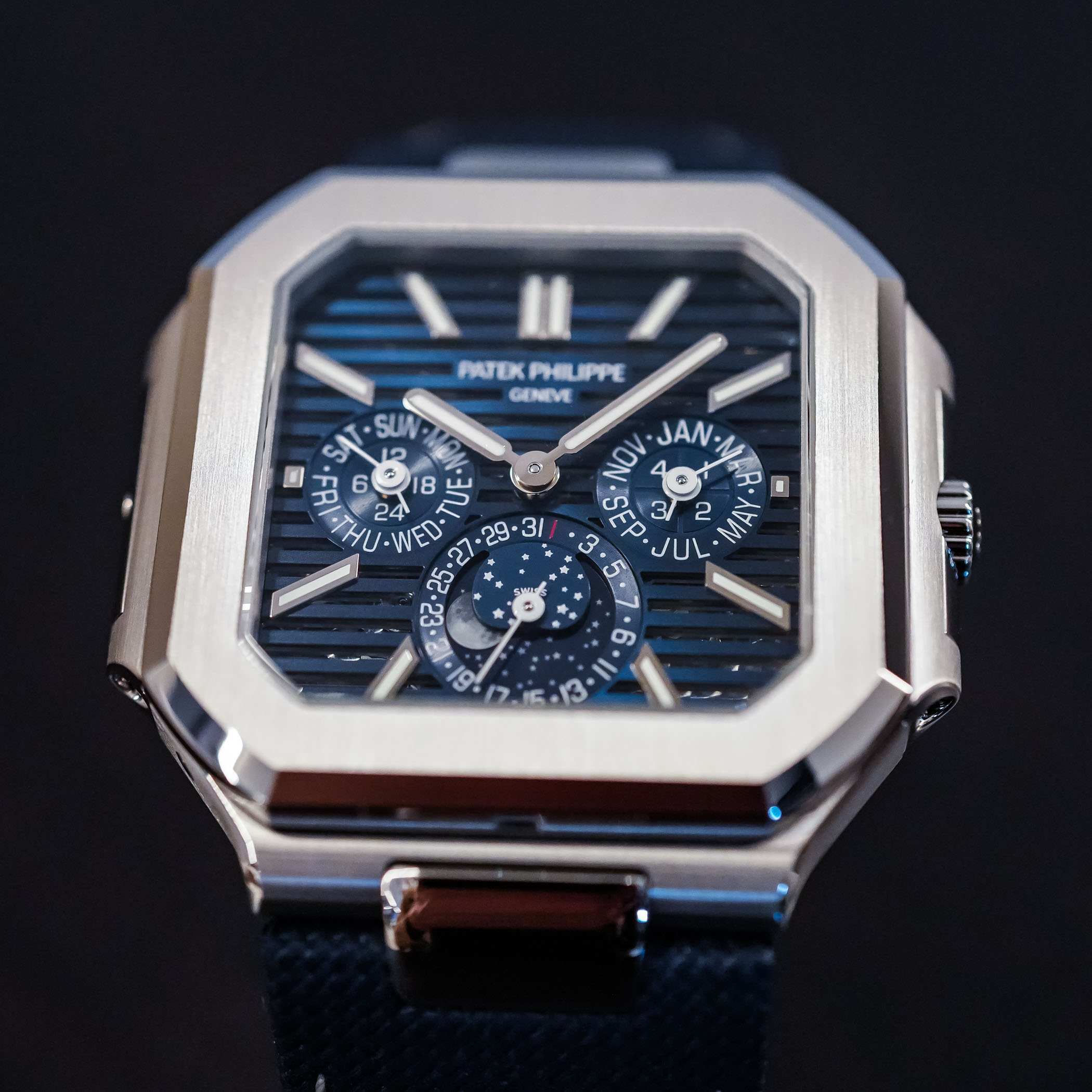
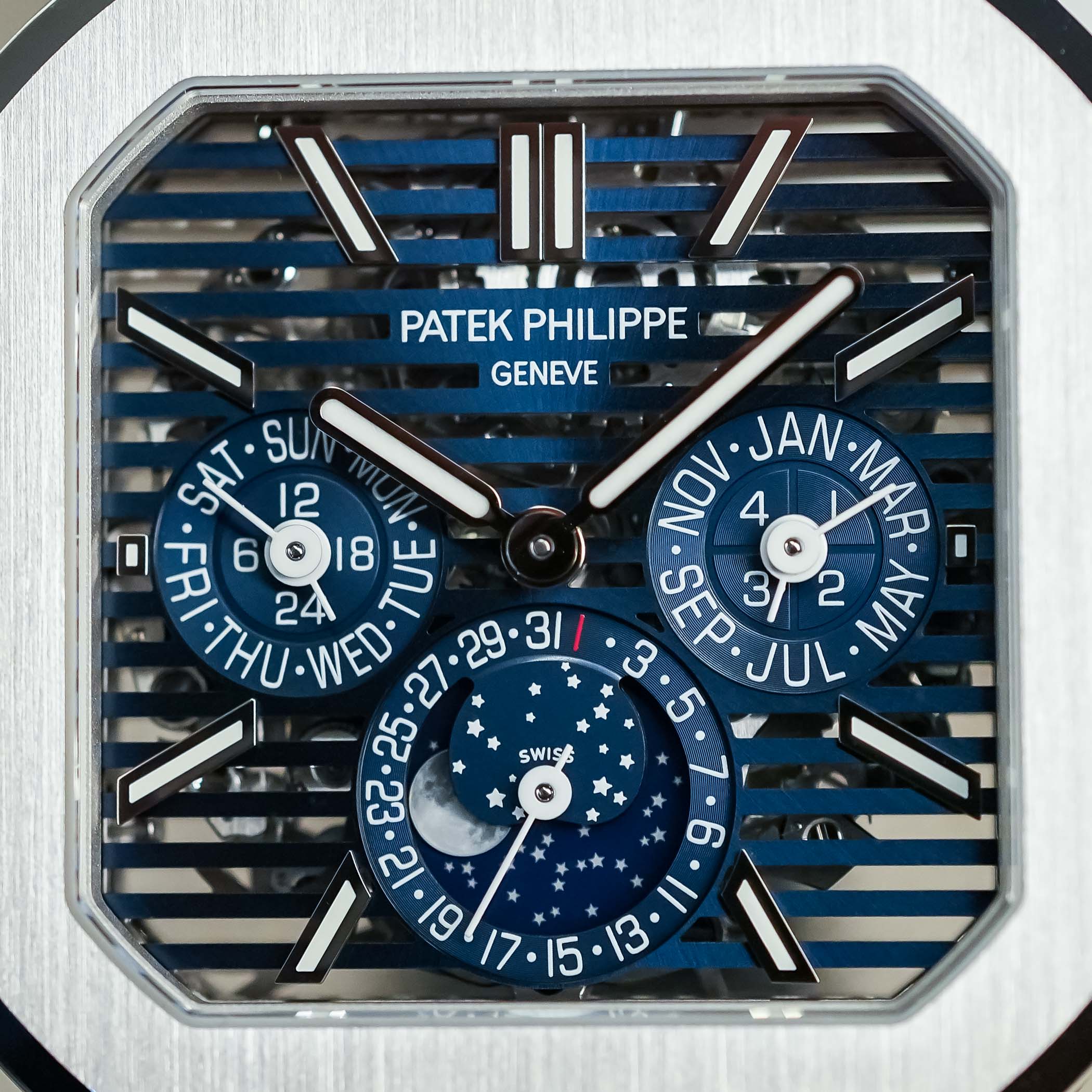
Now, the large moon display. Contrary to the traditional twin-disc systems, this one uses a single oversized moon rotating once every 29.53 days. The layered discs, laser-made lunar relief, and a deep blue sky create the composition that is better viewed with a magnifying glass, not to read the indications, but to admire the layered, three-dimensional drama.
The Shaped Movement
Perhaps the most important achievement becomes clear once you turn the watch over: the movement’s shape matches that of the case. The inaugural Cubitus references 5821/5822, and the mid-size 7128 used round calibres. The calibre 28-28 Q SQU is square, with rounded corners, designed specifically to match the case of the Cubitus. Most shaped watches still rely on round movements. Here, the mechanism fills the case, eliminating dead space and spotlighting the idea of a fully integrated timepiece. Based on the emblematic calibre 240, this new movement keeps the micro-rotor construction but adapts it to a new geometry.
The monochrome treatment is another feature. Bridges, plates, wheels and even the 22k gold micro-rotor are rhodium-plated. Only a few elements break this technical look: heat-blued screws and the engraved Calatrava cross on the rotor, as the movement uses transparent sapphire jewels in place of the usual red rubies. Small detail, but it adds significantly to the overall aesthetic. And the openworked motif matching the dial’s is quite a cool one, too.
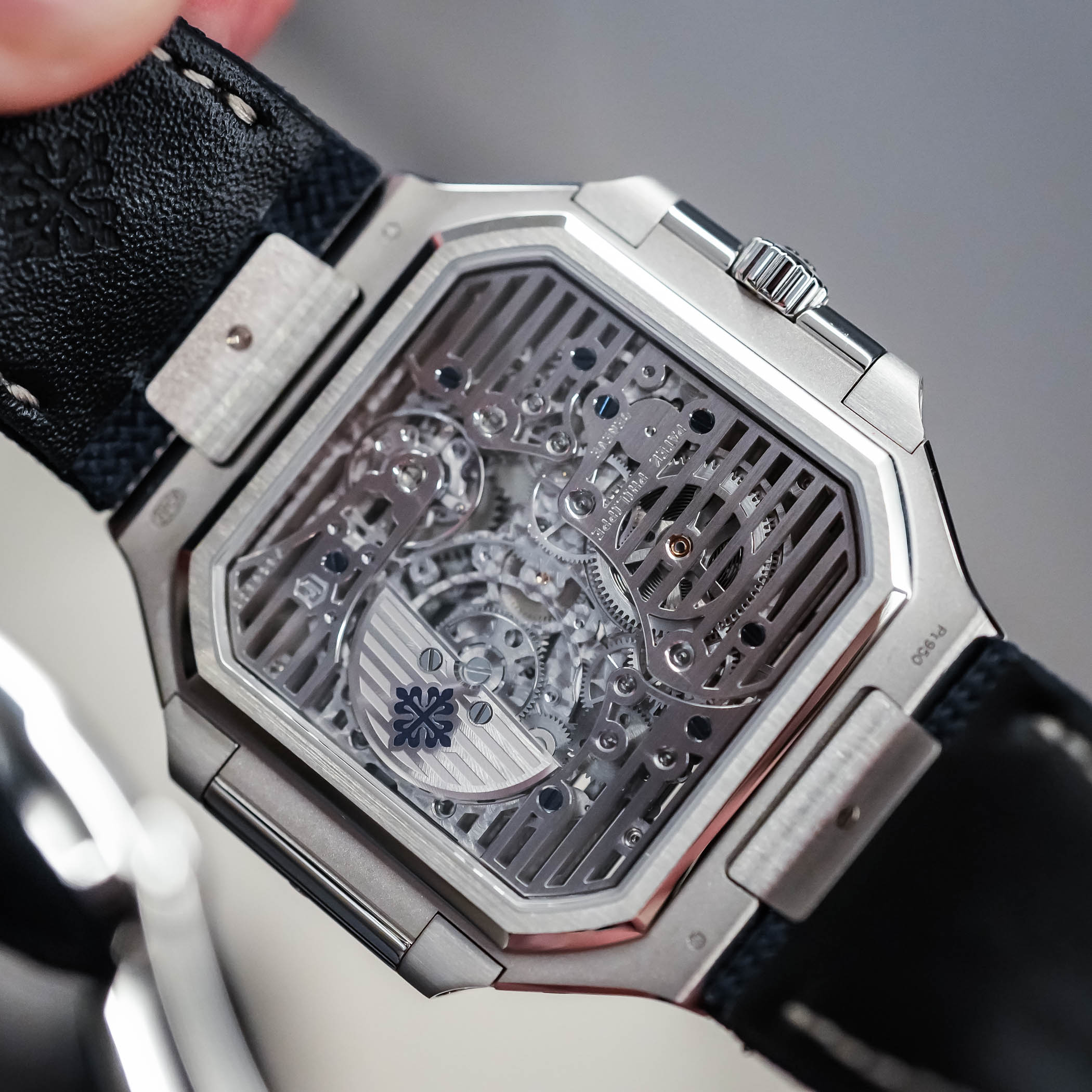
The perpetual calendar uses the classic 48-month cam system, completing a rotation every 4 years. It’s a known, reliable solution for a perpetual calendar, here integrated into a completely reworked layout. The mechanism remains hidden in operation, but its logic is present.
The Strap and Wearability
Unlike the simpler Cubitus models but consistent with the Instantaneous Grand Date, the Cubitus Perpetual Calendar Skeleton 5840P is worn on a strap rather than a bracelet. The navy blue composite strap with textile pattern feels appropriate: modern, technical and lightweight. The triple-blade platinum clasp feels secure, matches the case material, and maintains the sense of cohesion. On the wrist, the watch feels less formal than its complication commands. The overall design makes it wearable in a more relaxed setting than a traditional perpetual calendar.
Thoughts
Forgive the comparison, but the story of Cubitus seems to be shaping up pretty much like AP’s Code 11.59: released to mixed opinions, becoming an integral part of the brand’s modern image. The inaugural Code 11.59 time-and-date models felt incomplete regarding their dials, despite a superbly executed case, something the brand corrected rather quickly. With the added complications, the collection’s references turned out to be very attractive, not to mention the captivating execution. Could it be the same with the Cubitus? Much like the haunting father’s shadow in Shakespeare’s Hamlet, the Ghost of Nautilus looms, not seeking revenge but to invite comparisons. Disconnect from that image and see the new Cubitus Perpetual Calendar 5840P not as an evolution of the collection, but as a clarification.
The earlier models explored the new design language; the 5840P resolves it, but also indicates the next steps for the brand, more modern, less traditional. The integration between case, movement, and dial design is key. With the continuity of the striped motif and the restrained monochrome aesthetic, the watch feels thought through at every level.
It won’t convert those who do not like the Cubitus idea. But for collectors, the Patek Philippe Cubitus Perpetual Calendar Skeleton 5840P offers a high complication that is technically solid and conceptually coherent. And for many, it answers a question that has lingered since 2024: this is what the Cubitus was meant to become. The price is CHF 150,000 or EUR 175,300; for more information, please visit www.patek.com.

7 responses
The movement just has a body kit attatched to it to make it appear square. Patek is dying and we will all point to the cubitus and the Thierry interview as when the decline started.
Putting a square cage around a round movement does not, to me, constitute a square movement. Also, what’s with the “openworked” design that shows nothing of the internal workings? I can see less than with a traditional display back. This is a big miss for me.
Would this be a waiting list piece and can it be bought as a first purchase?
What an overpriced mess!
Under Thierry’s reign Patek has lost its marbles.
With more competition than ever before in their key segments, especially from new innovative independents, it’s difficult to see Patek regaining the status they once had.
Since Thierry took over the helm, Patek seems to be on the decline in terms of design and construction. Arrogance and disrespect to users’ opinion is the order of the day, unfortunately. Gone are the days when timepieces were released with full excitement and surprises.
I’m thinking that it is a good job these time pieces have “Patek Philippe” written on the dial.
Otherwise the manufacturer will have a hell of a job shifting these?
I cannot believe you guys are not pushing back or at least asking some pointed questions about how this movement can qualify as being “shaped”.
It’s a cal. 240 suspended within an octogonal grille on the front and back. Go the PP website, enter their movements sections, open the 28-28 Q SQU and 240 Q movements side by side. They have cheekily adjusted the perspective so you can’t see “through” the grille to visualise the round silhoeuette of the 240 movement suspended within an octogonal grille, but this is obvious in real life photos.
Trace the chaton/screw locations from the escapement wheel clockwise and you’ll see that *every single one* is in exactly the same location as the 240 Q. Coincidentally specs are identical too. Also, none of the interior angles on the grille appear hand finished?
Patek is fast moving from an aspirational old money brand to new money/flex/hype culture brand. Moving from Hermes to Versace. Sad to see.