


 Not all images were able to load for printing. Please close the print window and try again.
 The New TAG Heuer Monza Flyback Chronograph Carbon (Incl. Video)
Rooted in history, defined by racing.
Few brands are as intertwined with motorsports as TAG Heuer. Since the early days of the brand, then only known as Heuer, it has always had close ties with racing, predominantly thanks to its excellent mechanical stopwatches. The racing DNA resonates well within multiple collections, such as the iconic Carrera and Monaco. The Monza, however, is not to be overlooked and celebrates its 50th anniversary this year. Originally introduced to celebrate Ferrari’s 1976 Formula 1 World Championship with drivers Niki Lauda and Clay Regazzoni, it has been a fan-favourite ever since. Keeping the racing spirit alive and well, TAG Heuer returns to the track with the new Monza Flyback Chronograph Carbon.
Heuer’s chronograph watchmaking legacy is hugely important to the industry, as it patented its first chronograph back in 1882. In 1887, Heuer also patented the oscillating pinion, a solution still in use in the ubiquitous Valjoux 7750. In 1916, the company introduced the Mikrograph, which was the first stopwatch capable of measuring time to 1/100th of a second. In 1969, it wrote history yet again, with the Calibre 11 automatic chronograph movement, making its debut in the fabled Monaco. This was later also used in the Monza, which was introduced in 1976. Today, this innovative chronograph watchmaking legacy resonates throughout the brand, with solutions such as the compliant mechanisms found in the Monaco Evergraph.
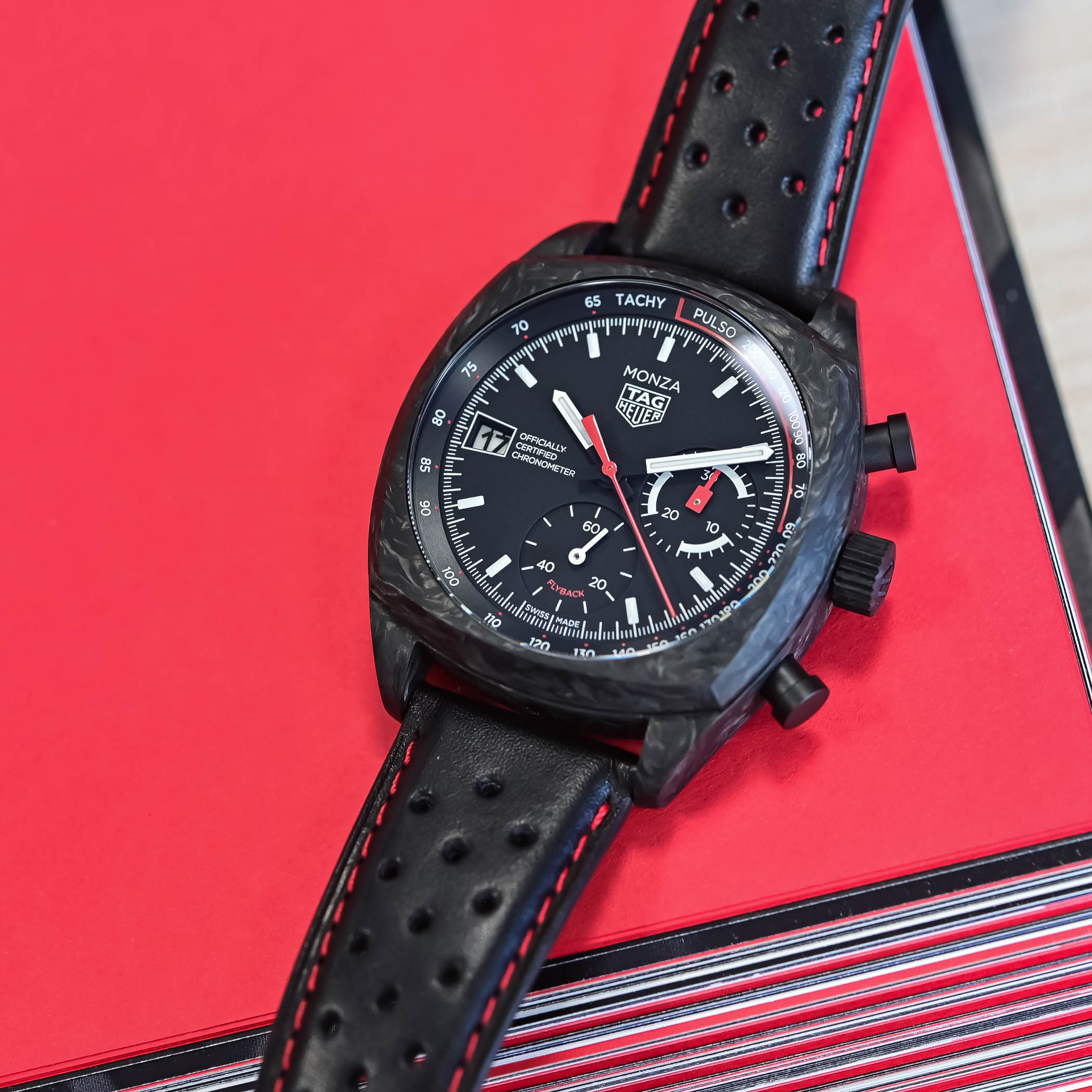
Originally, the Monza had a barrel- or egg-shaped case design, very reminiscent of the 1970s. The current cushion-shaped profile was introduced upon its return in the year 2000, and since then TAG Heuer has taken the creative liberty to swap the unconventional split crown-and-pusher orientation for a more conventional one on the right side of the case. In 2016, for the Monza’s 40th anniversary, TAG Heuer re-introduced the Monza in the more modern cushion-shaped style, yet with a fully blacked-out case and a colour palette very close to the 1976 original. The design of this new Monza Flyback Chronograph combines past design cues into a single, modern and very race-inspired chronograph. The black case, the cushion shape, the dial design- it’s all reminiscent of the original Monza while also seamlessly tying in with the 2016 limited edition and the 2023 Monza Flyback Chronometer.
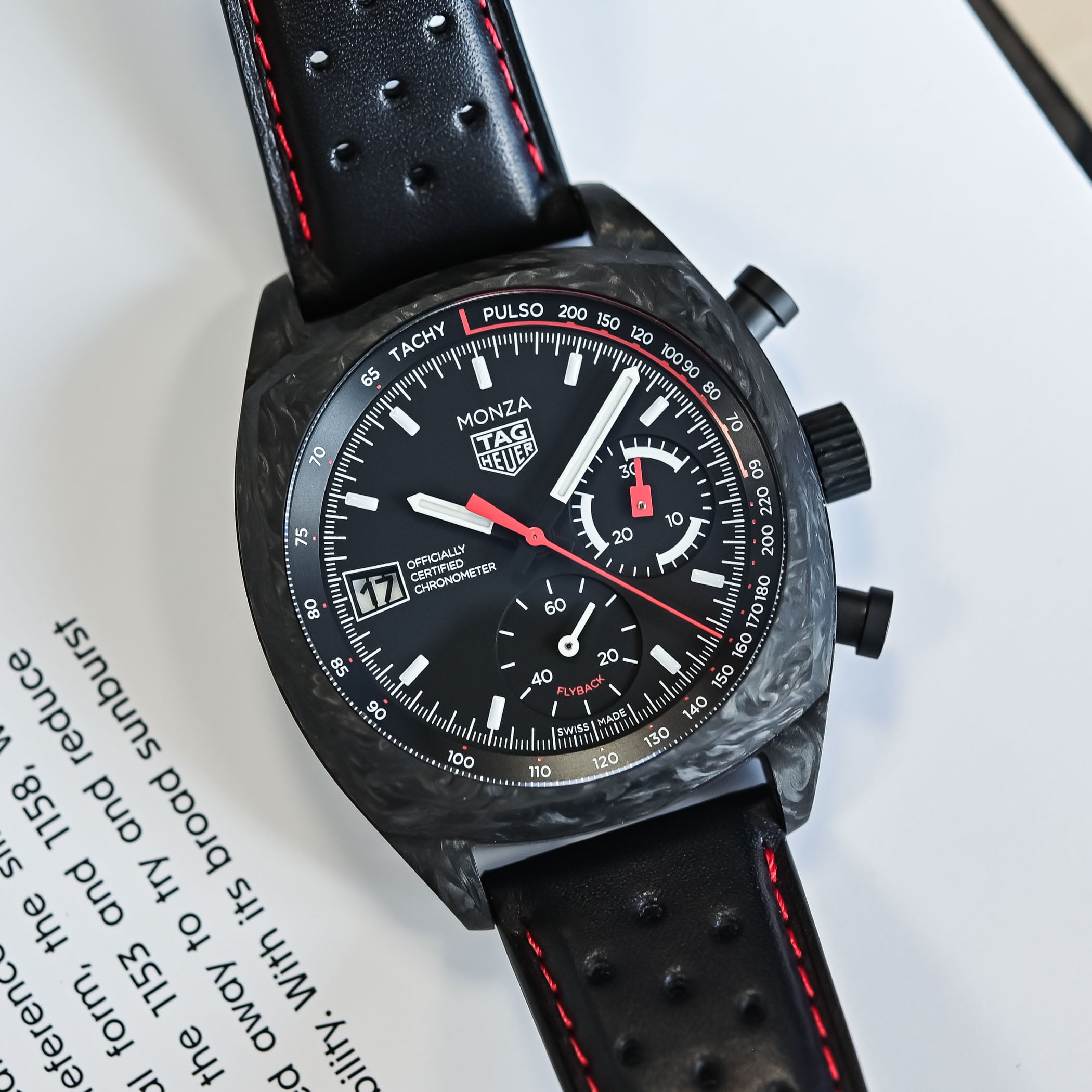
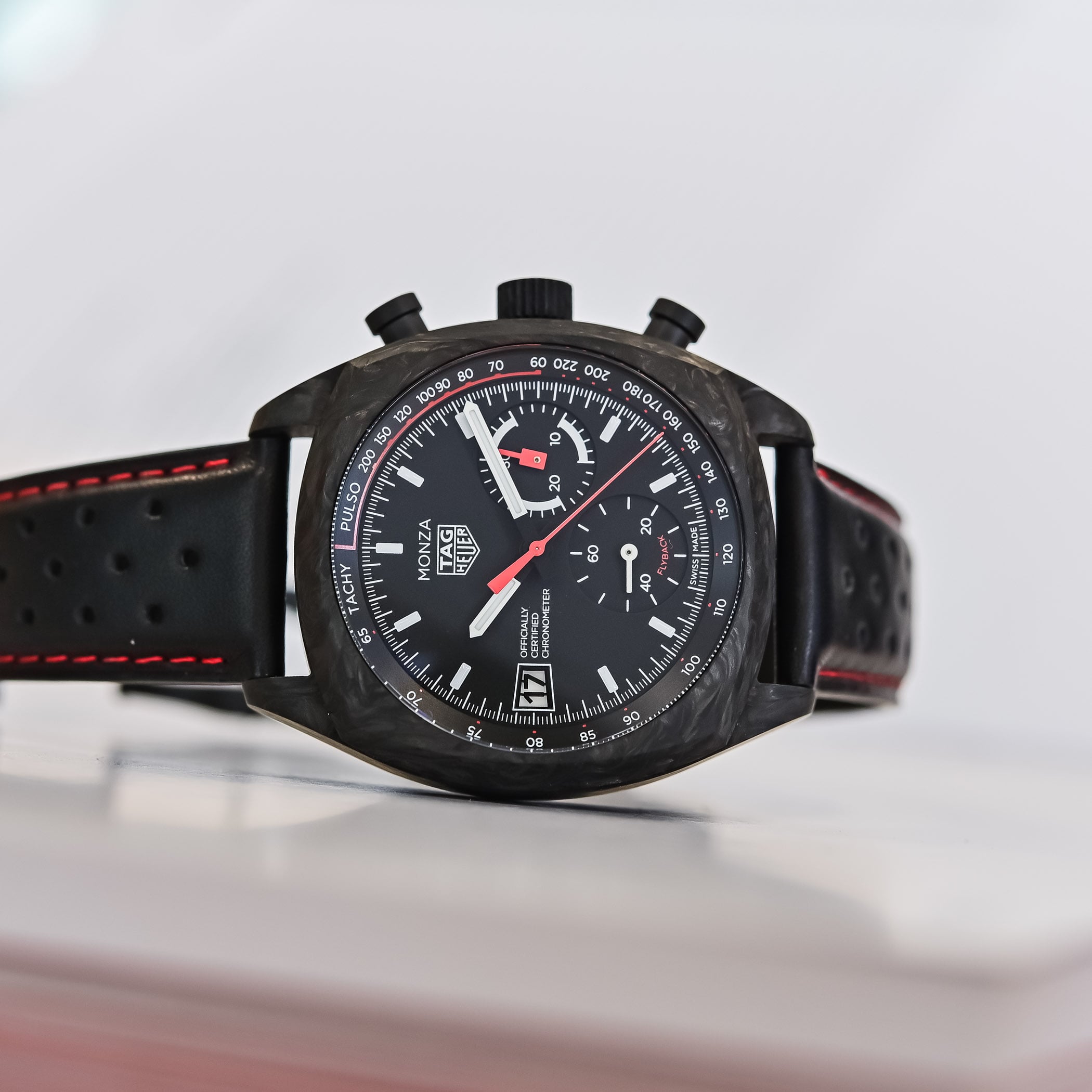
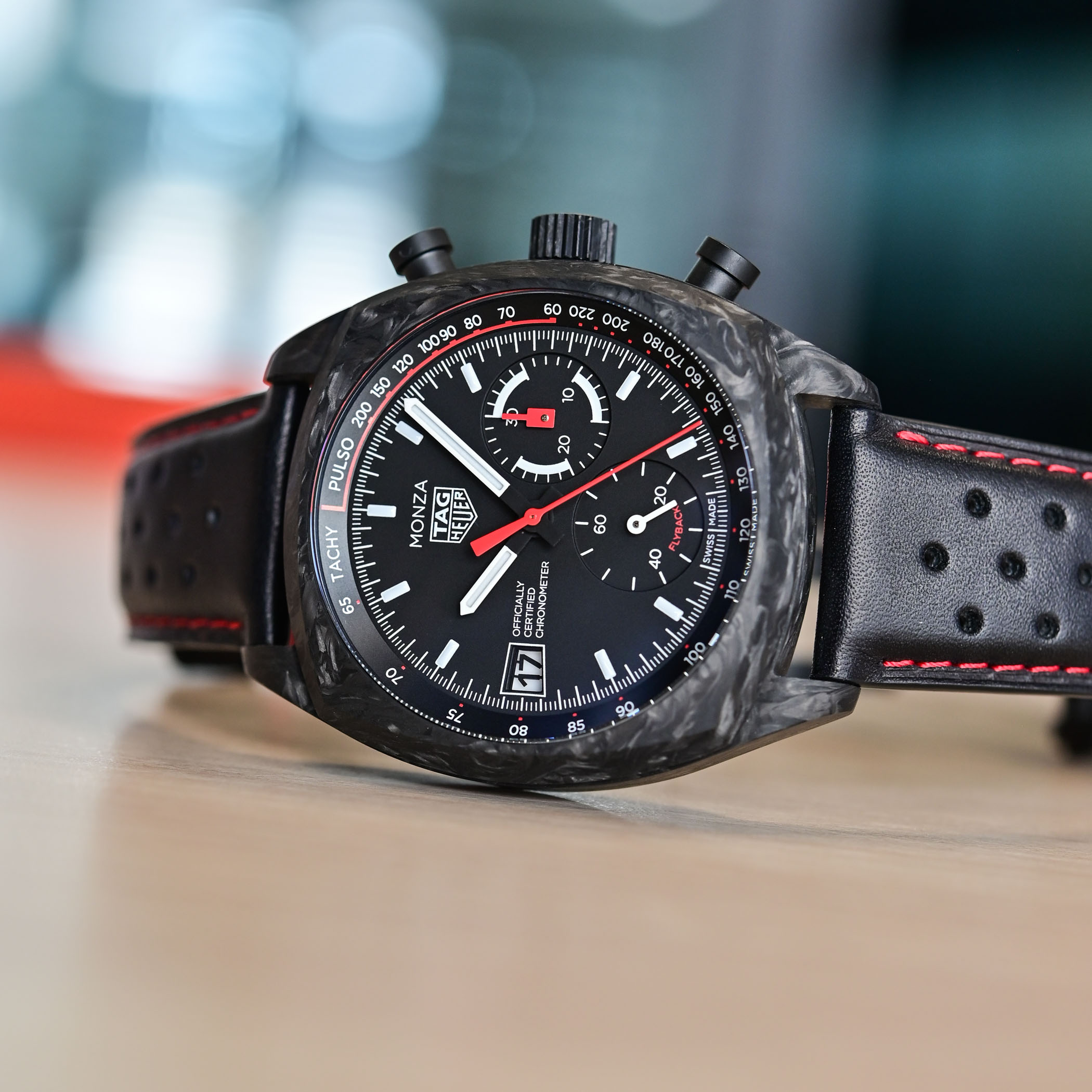
Crafted from lightweight forged carbon, the case is 42mm wide, with a height of 15.22mm top to bottom. The fixed bezel is also made in carbon, as is the crown, while the caseback is in black DLC-coated titanium and the pushers in black DLC-coated steel. There’s a sapphire crystal on either side, and the water-resistance is rated at a comfortable 100 meters.
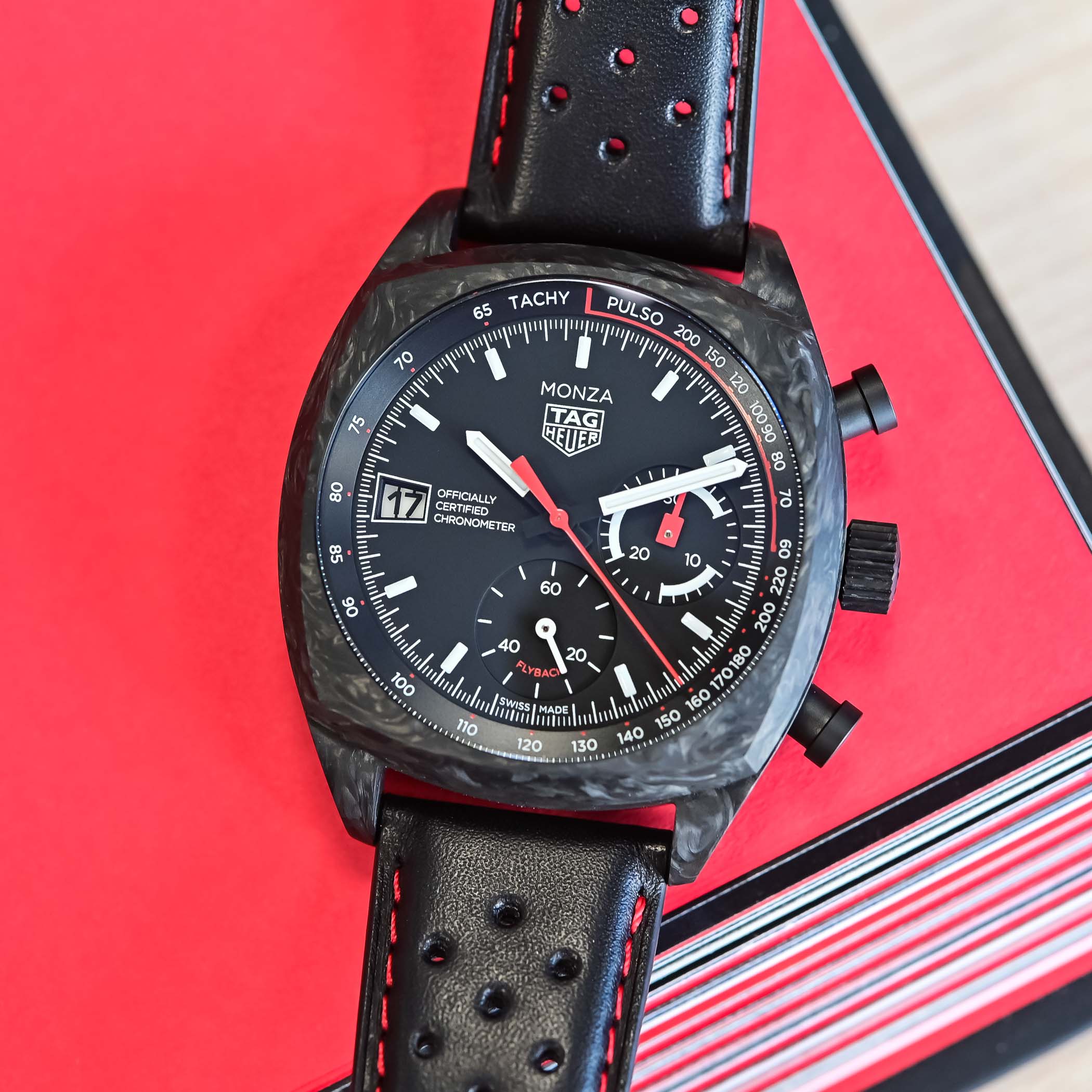
Where TAG Heuer changes things up a little is with the dial. Although the colour palette is very similar, the layout is a bit different. The original Monza had a chronograph minute counter at 3′, the date at 6′ and a running seconds subdial at 10′. Here, we still have the chronograph 30-minute counter at 3′, but the small seconds and date function have more or less switched places. Along the outer perimeter, there is a sloped flange for the tachymeter and pulsometer scales, and the hands and markings are a mix of white and red. It’s all very close to the original, yet in a crisper, more modern style. One thing I have to commend TAG Heuer for is the inversion of the colours on the chronograph 30-minute counter, as it now has a red hand, tying in with the red chronograph seconds hand.
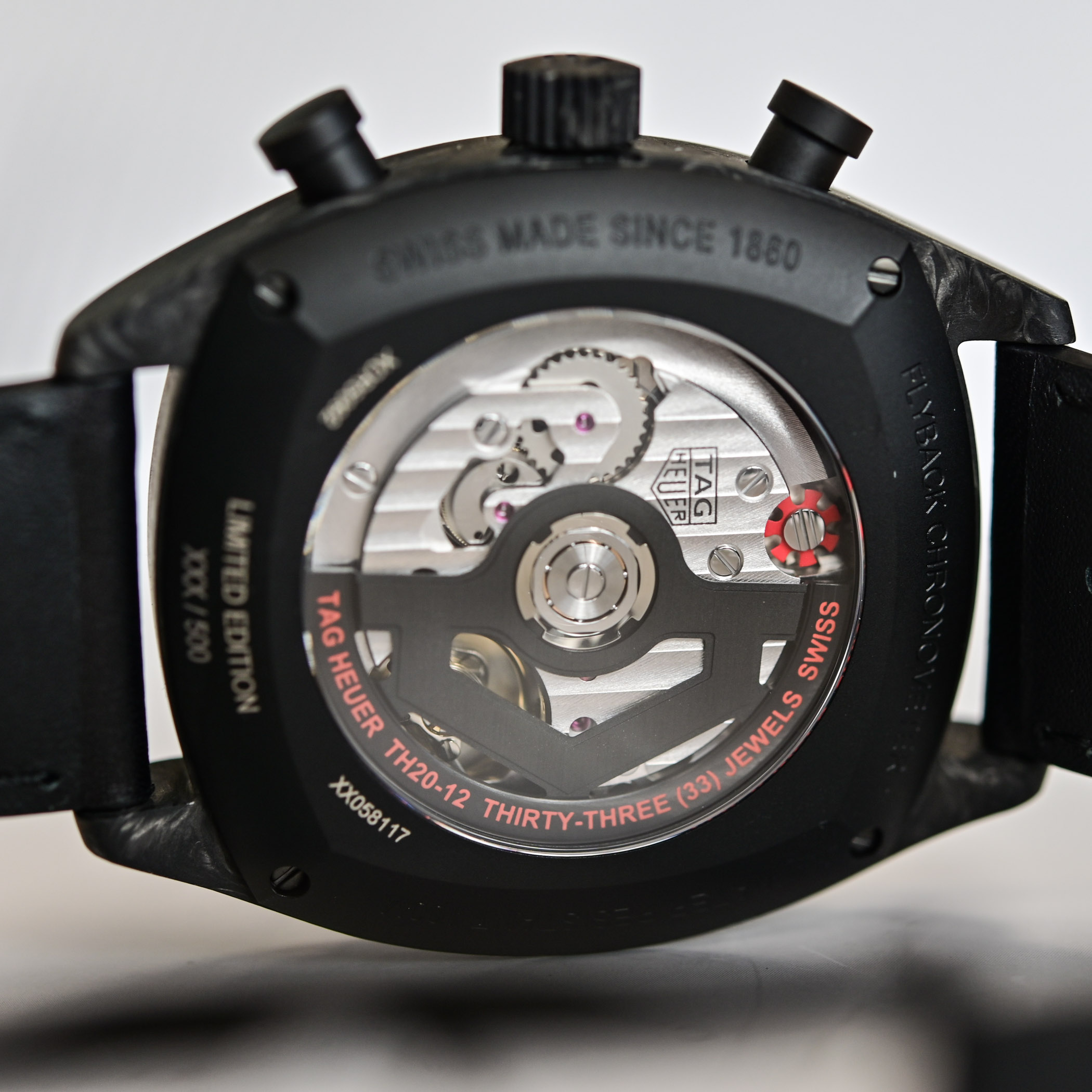
Moving to the engine, TAG Heuer uses its own TH20-12 automatic flyback chronograph for this one, as you might have suspected given its name. It’s essentially an on-skeleton version of the one used in the 2023 Monza Flyback Chronometer. Running at a frequency of 28,800vph, it can store a rather commendable 80 hours of energy when fully wound, something you don’t see too often in chronograph movements. The architecture is decidedly modern, with a column wheel and vertical clutch for smooth actuation of the chronograph function, and it’s a COSC-certified chronometer movement. To continue its black-white-and-red theme, the blackened openworked rotor is engraved with the movement’s details filled with red ink. The column-wheel is also given a red finish, completing the racing vibe.
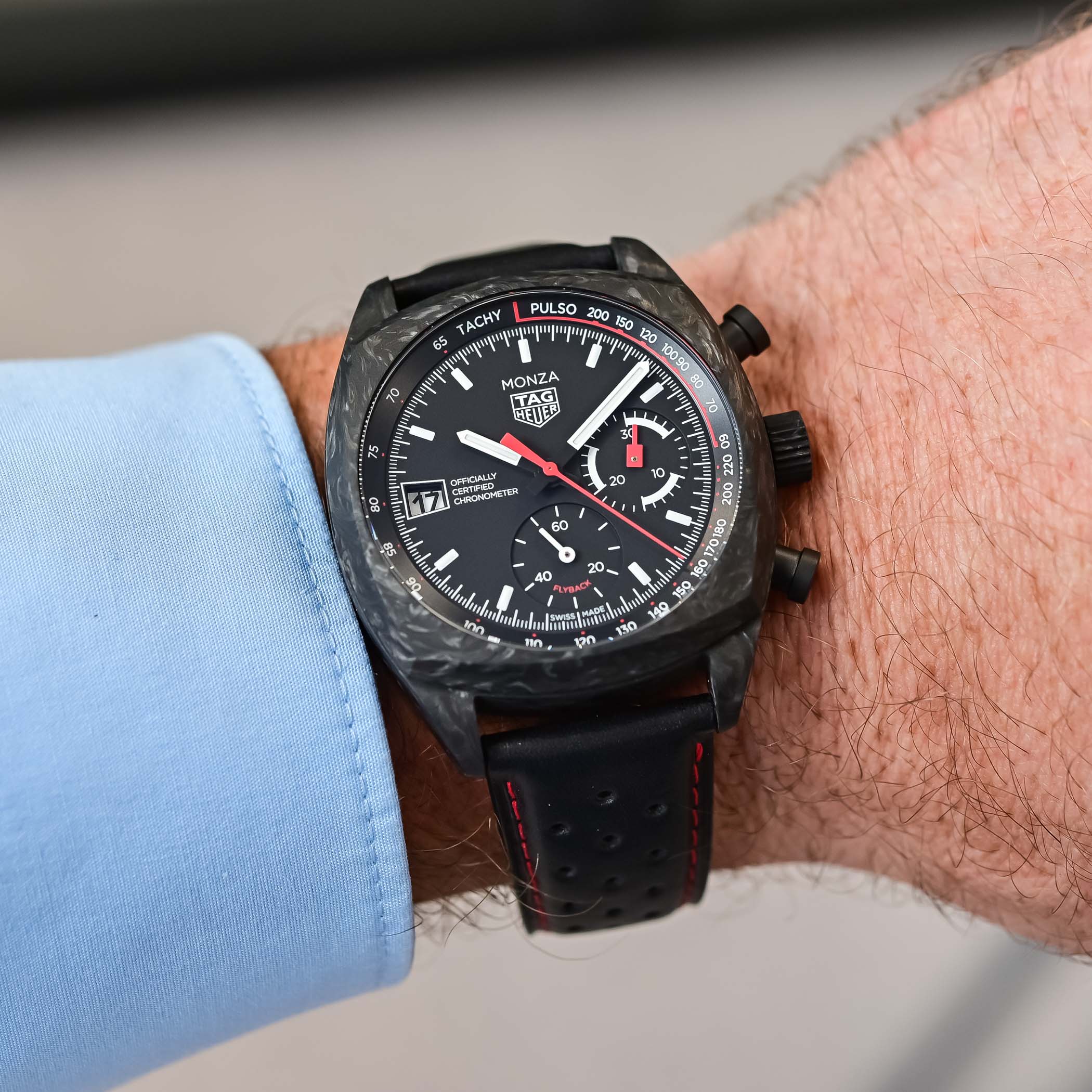
TAG Heuer presents the Monza Flyback Chronograph Carbon on a black perforated calfskin leather strap with red stitching and a black DLC-coated titanium folding clasp. It’s limited to 500 pieces and retails for EUR 13,350. To some, it might be odd to keep the Monza as a series of limited editions instead of a permanent collection, but I can understand the reasoning. TAG Heuer’s portfolio is already quite full of race-inspired chronograph watches, such as the Carrera, Monaco and, of course, the Formula 1. Keeping the Monza as a special edition-only series has collectors looking out for the next one instead of being too spoilt for choice. This way, each new Monza keeps the spirit of the original alive and well, without diluting its legacy too much, while benefiting from modern tech and materials in the process.
For more information, please visit TAGHeuer.com.

3 responses
Tag Heuer are too slow to the party. Slower in fact than Omega. Fat watch syndrome is always their Achilles heel with chronos. This like others before it from the maison have looked great in 2D images and failed on the wrist being bloated beyond usefulness. Take a look at your new toughest competition… Tudor.
I’m the first to criticise TAG Heuer and their endless and pointless Monaco and Carrera reissues, probably because I don’t remember a decent watch produced during the TAG ownership.
They’ve messed around with Monza reissued, infamously producing one version from a completely different era and just calling it a Monza, but this new version at least plays homage to the original 1976 watch and is all the better for it.
a 70’s style case, in a futuristic material, and the thickness of a burger? come on.
terrible… do better, or maybe do nothing and think for a second instead.