Not all images were able to load for printing. Please close the print window and try again.
Petermann Bedat Presents The Reference 2914 Monopusher, Their First Chronograph-Only Watch
Following the Reference 2941 Split-Second Chronograph, the independent duo refines the concept with a new, superb monopusher chronograph.
I vividly remember my first visit to Gaël Petermann and Florian Bédat in 2020, at their workshop in Renens, on the outskirts of Lausanne. It was for us the opportunity to discover their first creation, the Deadbeat Second Reference 1967. The promise we could already sense in that first watch was more than confirmed in the years that followed. In 2023, we saw the launch of the 2941, a superb split-seconds chronograph. Then, in 2025 and 2026, came the 1825 and 1826, the duo’s interpretation of a time-only watch. Today, independent watchmaking brand Petermann Bédat is still operating from the same workshop in Renens – although they are expected to move to more spacious premises in the near future. They are now presenting the reference 2914, a fantastic monopusher chronograph derived from their split-seconds model. A simpler proposition than the 2941, perhaps, but every bit as appealing, while retaining the distinctive aesthetic that has become the brand’s signature.
A Distinctive take on the Classic chronograph-only watch
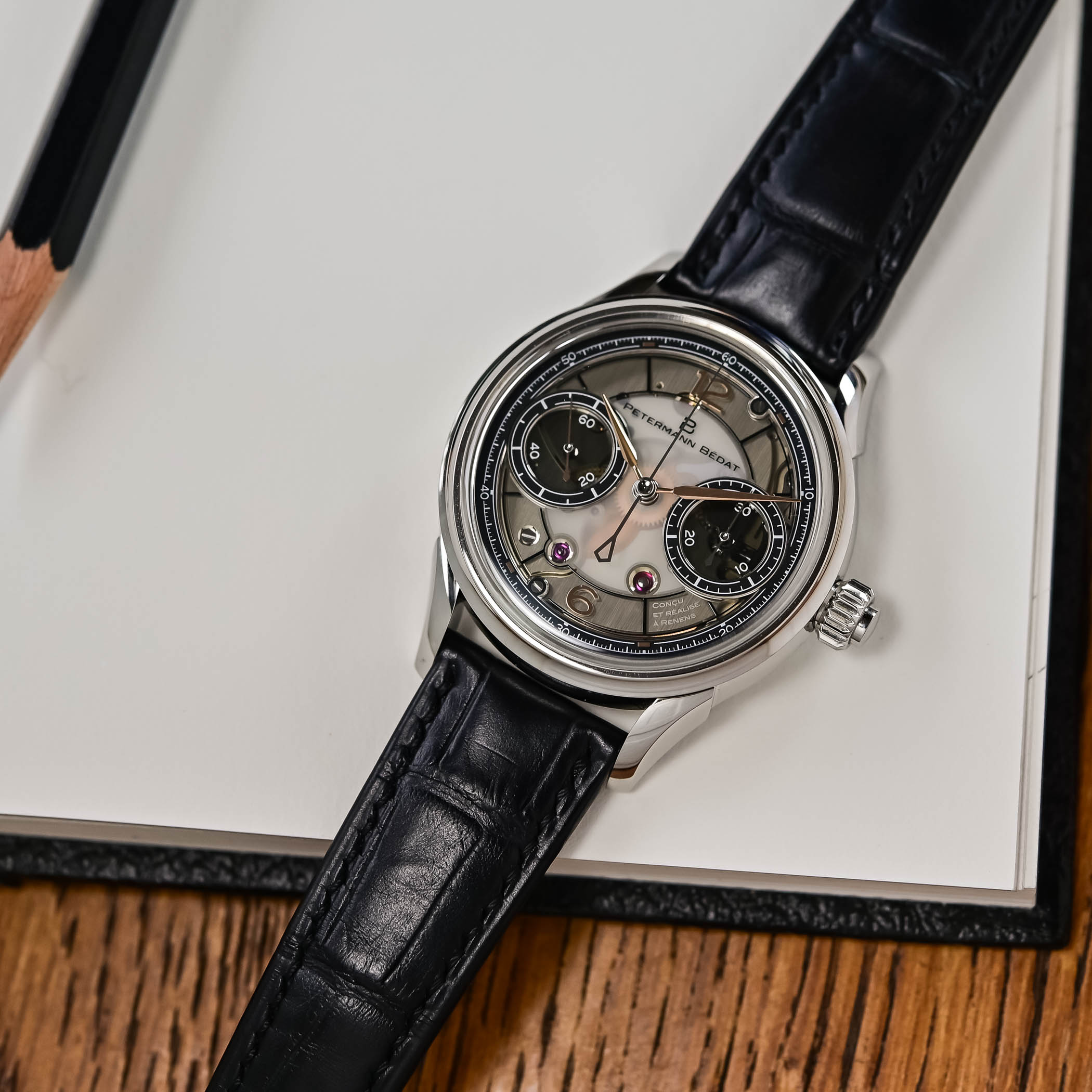
As one might have expected, the arrival of a classic chronograph from Petermann Bédat was perhaps a fairly natural next step. It should also allow the watchmaker duo to produce a somewhat larger number of pieces than they can with its considerably more complex split-seconds chronograph. The indie duo’s interpretation of a chronograph-only watch is, however, anything but conventional. It is elegant while remaining deeply rooted in the brand’s distinctive design language and aesthetic codes, and is built around a monopusher movement.
A compact and elegant case
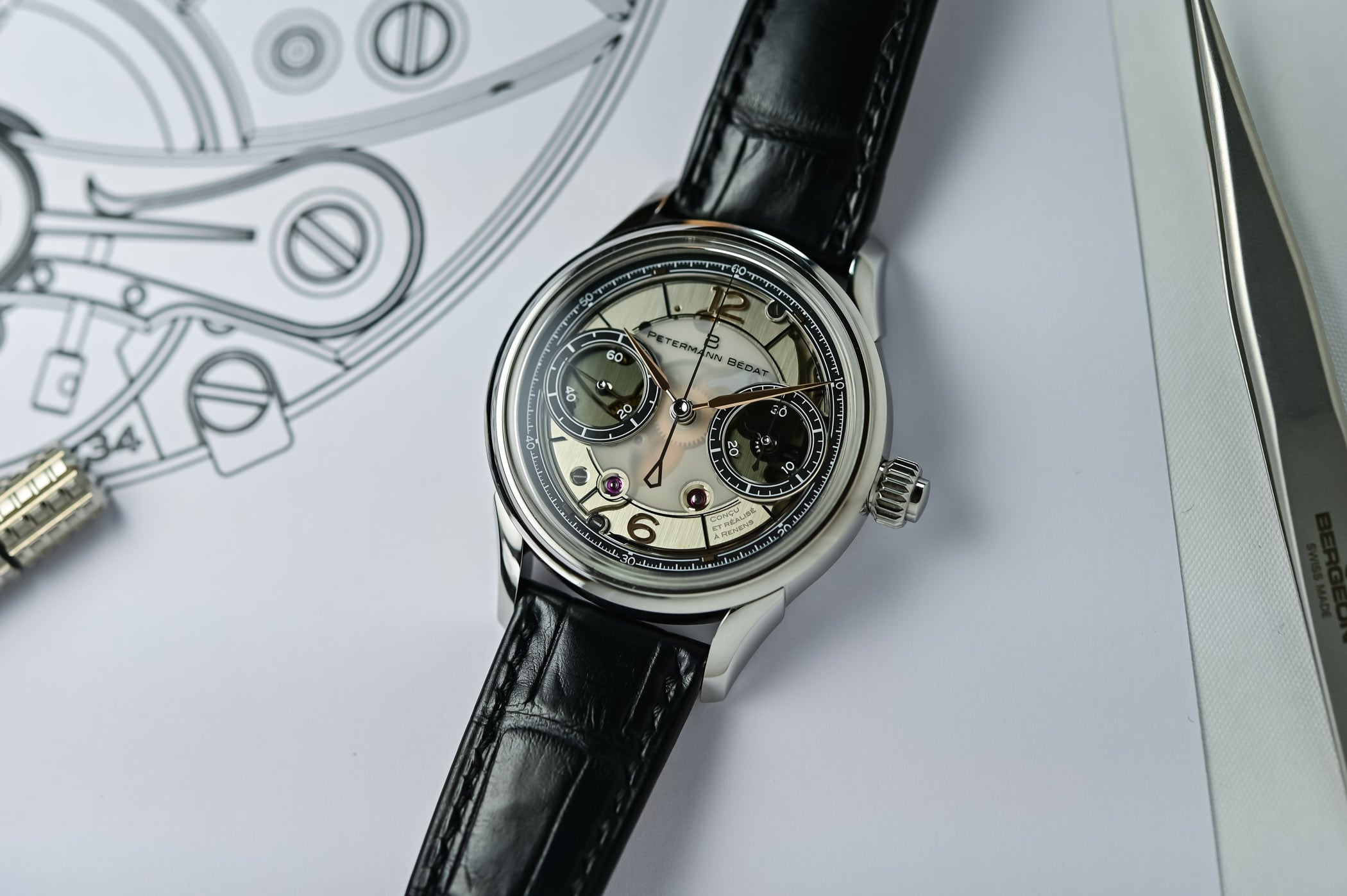
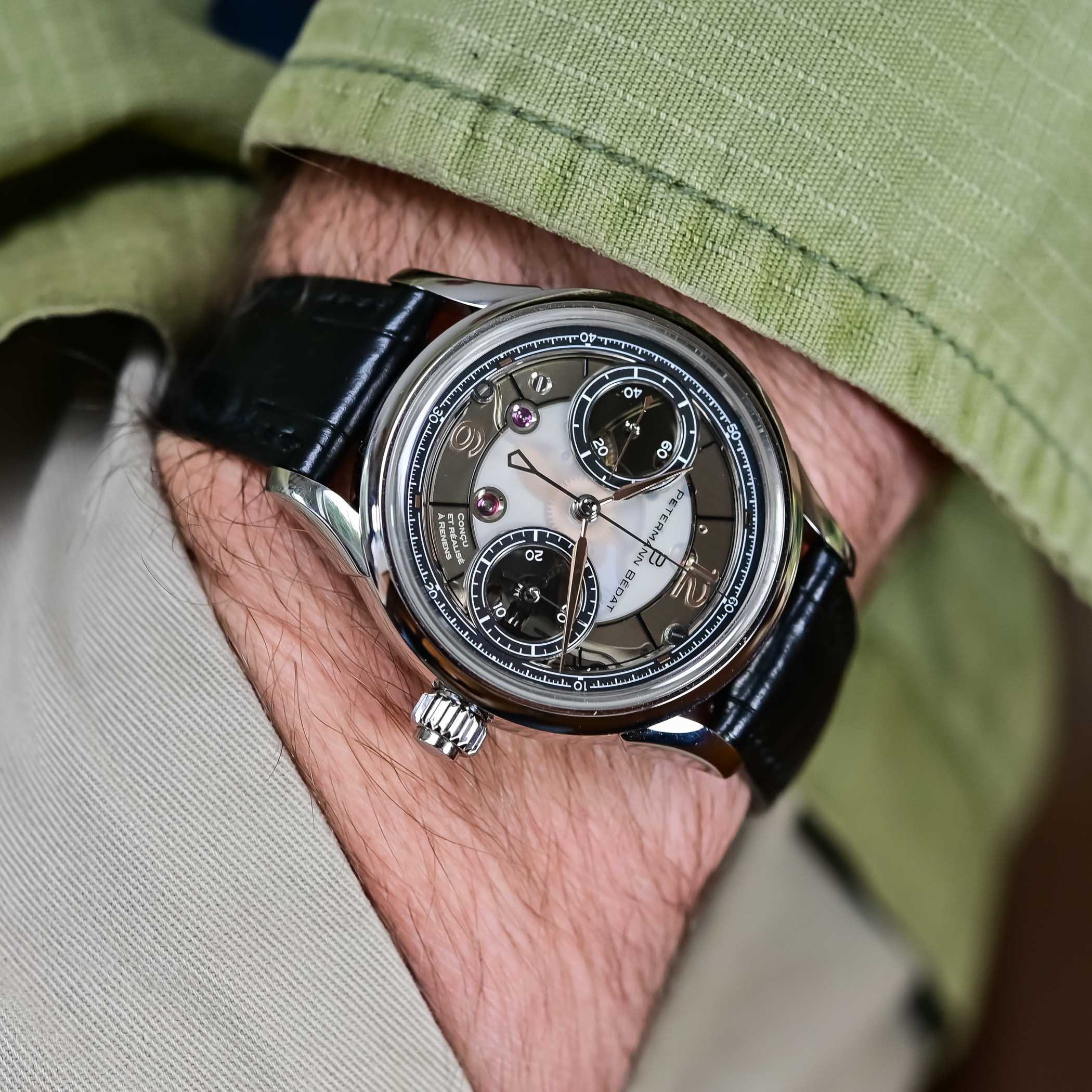
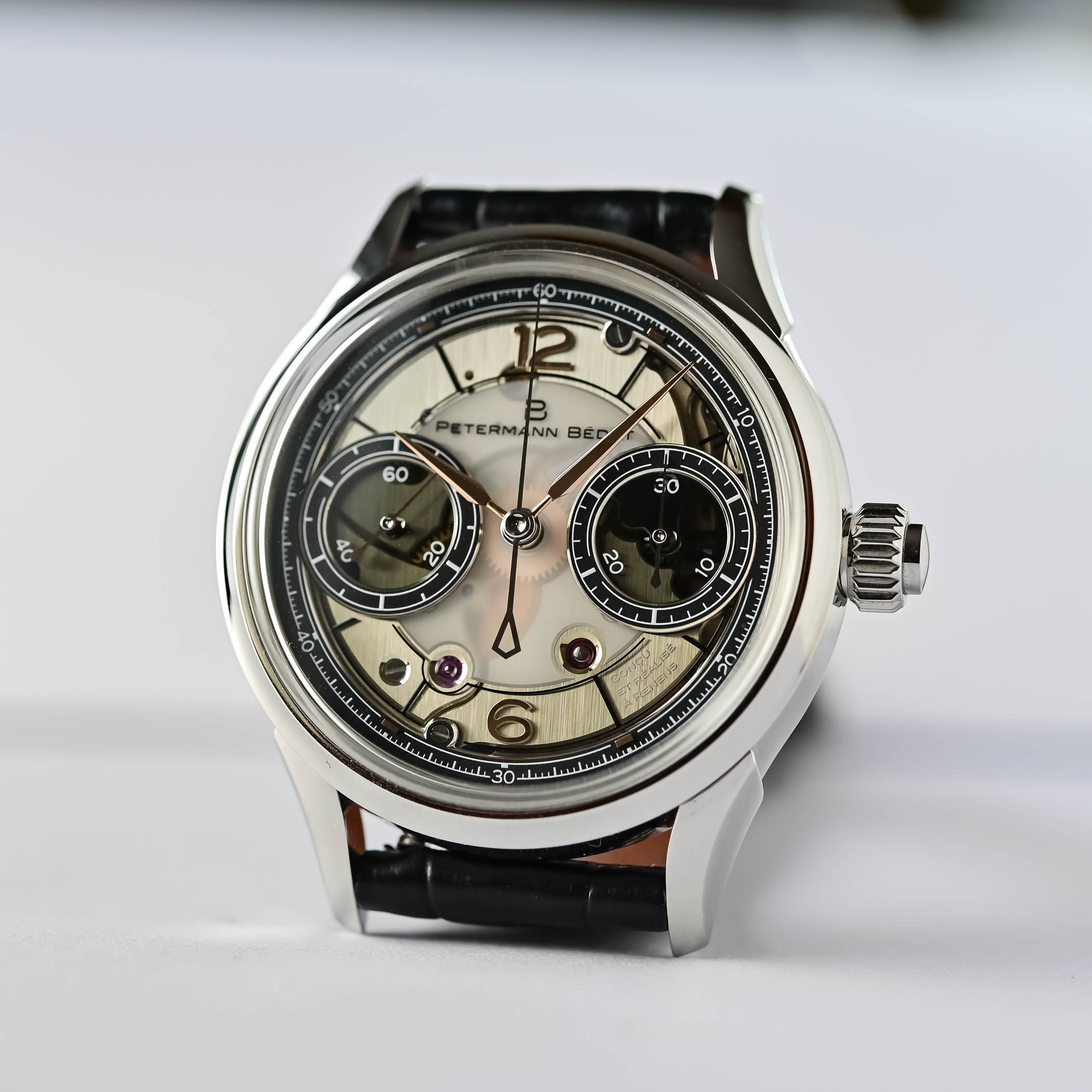
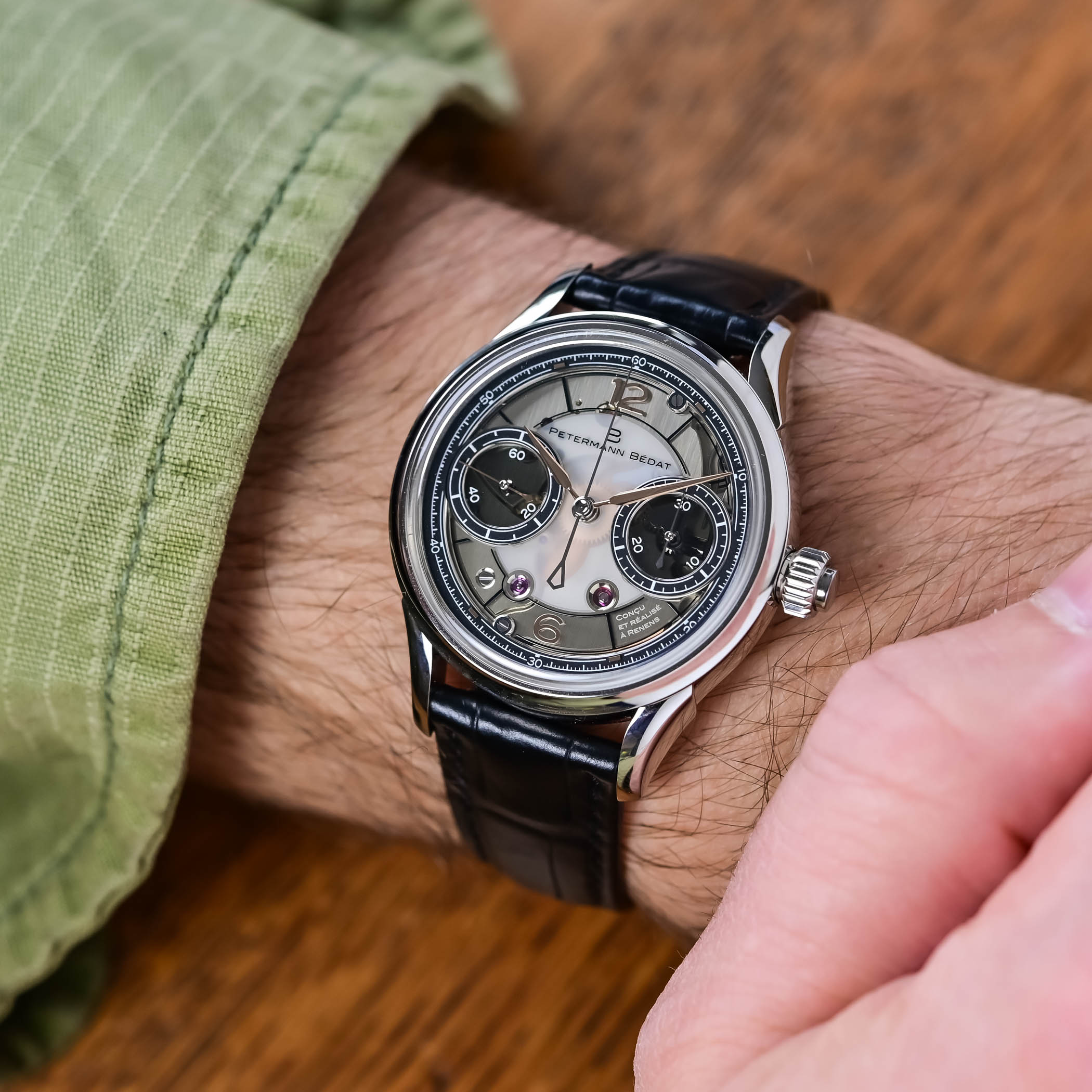
The platinum case of the Reference 2914 Monopusher Chronograph is more compact than the one used on their split-seconds chronograph, measuring here 36.5mm in diameter and 11.6mm in thickness (compared with 38.6mm and 13mm, respectively, for the 2941 Rattrapante). The beautifully proportioned case features soldered lugs and a polished concave bezel, while the box-shaped sapphire crystal gives the watch great character and presence. On the reverse side, there’s now a snap-on caseback construction, allowing for a cleaner overall appearance. This is not an entirely new solution for the brand, however, as the 1826 Time-Only for The Hour Glass also featured such a caseback.
A semi-transparent sapphire dial
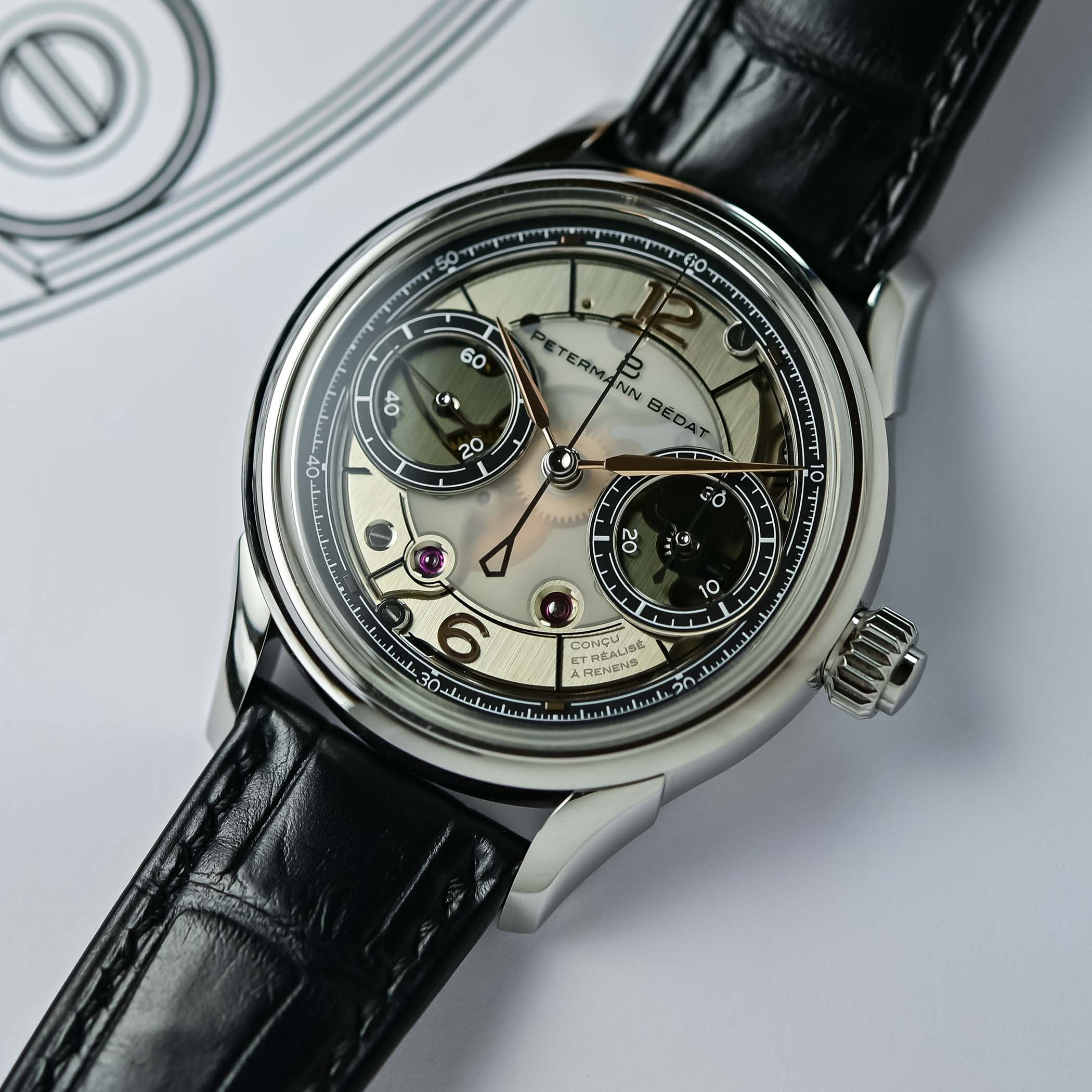
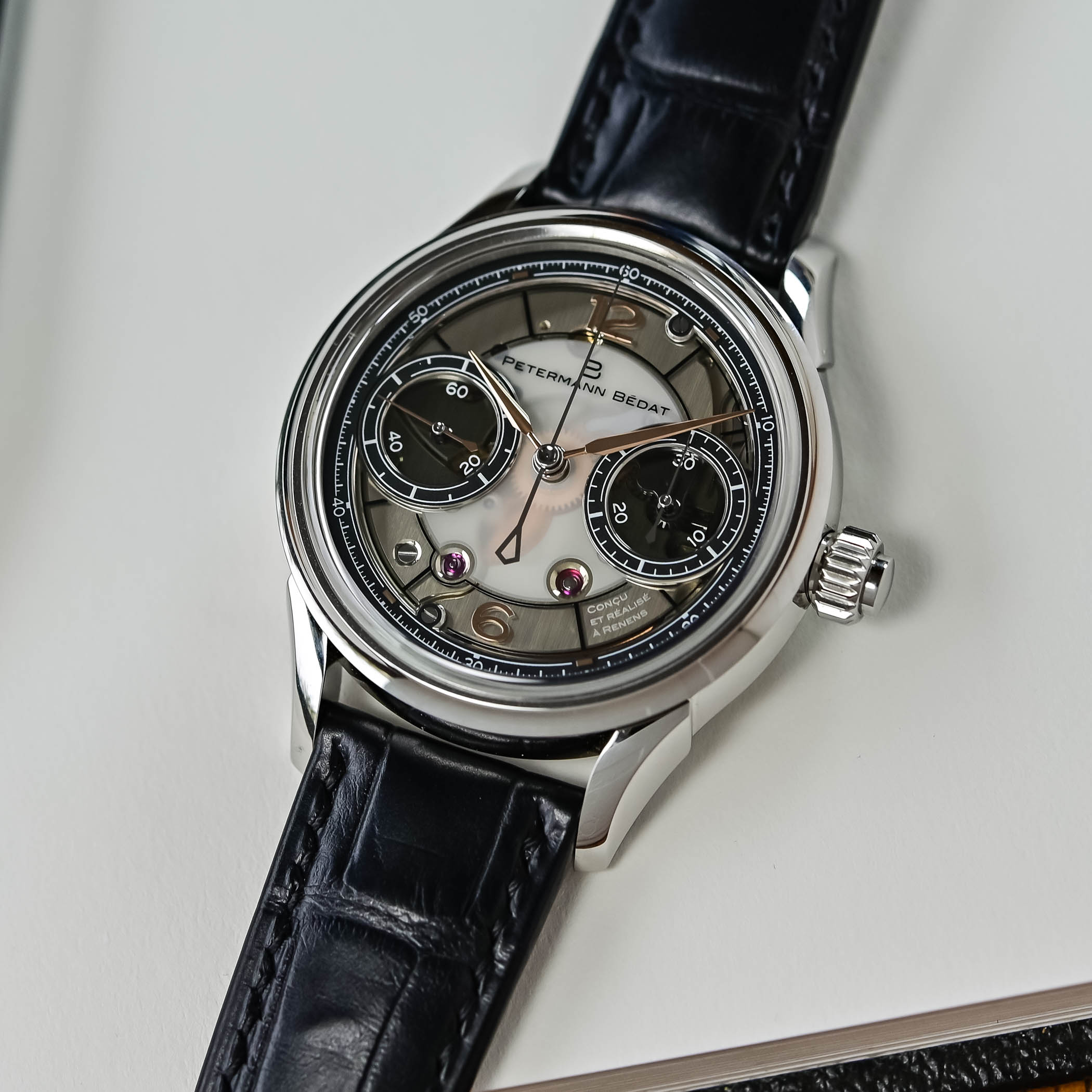
The dial of the Petermann Bédat Reference 2914 also incorporates several elements that have become familiar signatures of the independent watchmaking duo. Yet the execution feels more accomplished and elaborate than on previous models. Just like the reference 2941 Split-Second Chronograph, it is built around semi-transparency. It is still made of sapphire and produced by Kari Voutilainen’s Comblémine. This time, however, the construction is more elaborate, in particular with laser engraving for the central section of the dial, which creates an interesting semi-opaque effect over the warm German silver plates.
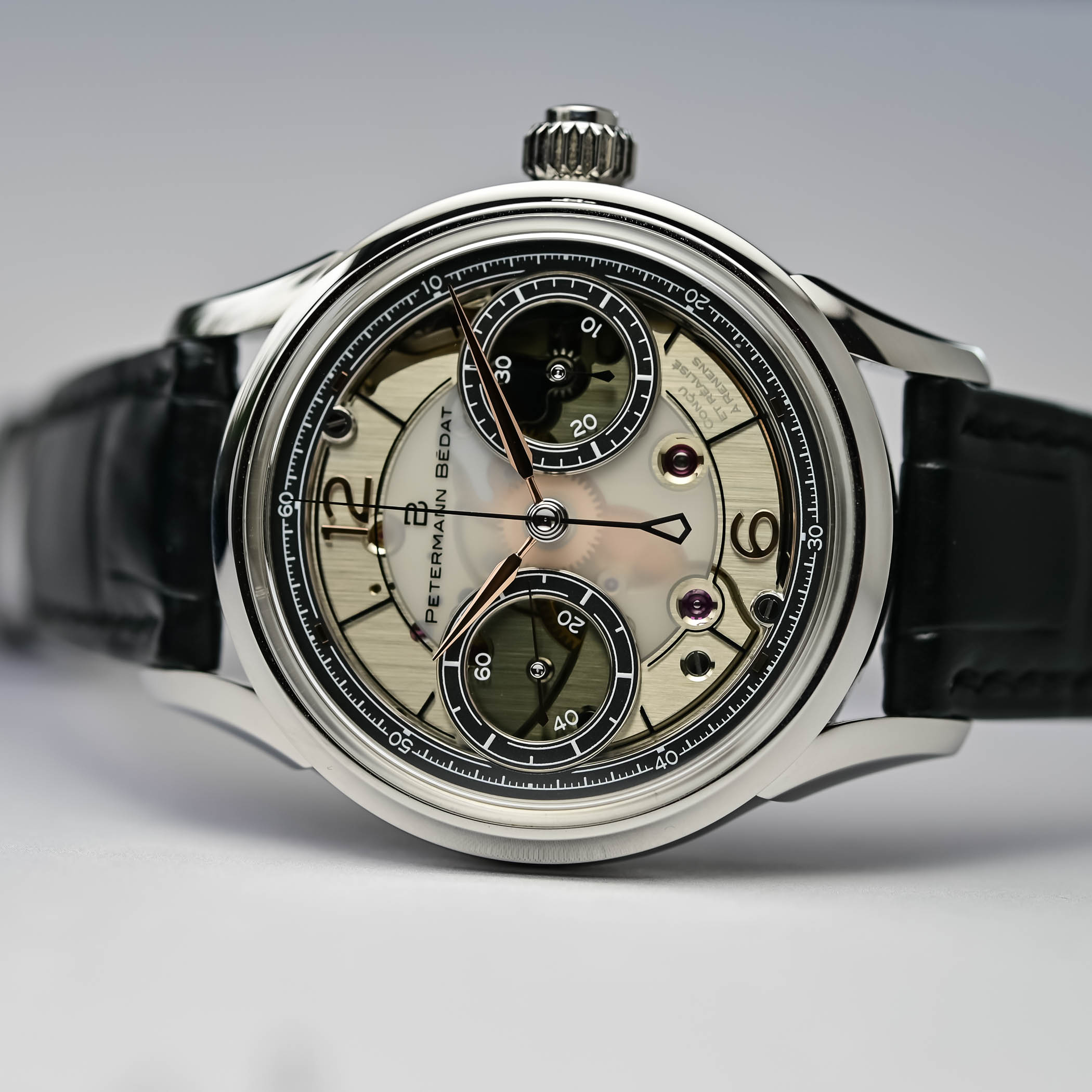
The dial also retains a sector-style display, with applied gold numerals at 12 and 6 o’clock, as well as smaller markers around the periphery of the dial. Further enhancing legibility, the dial and the sub-dials are framed by black rings, preserving readability through contrast while revealing the mechanics beneath. Finally, the hands are quite spectacular too, being hand-made from gold and stainless steel, with black polished surfaces and bevels enhancing the contrast.
The Superb Calibre 234
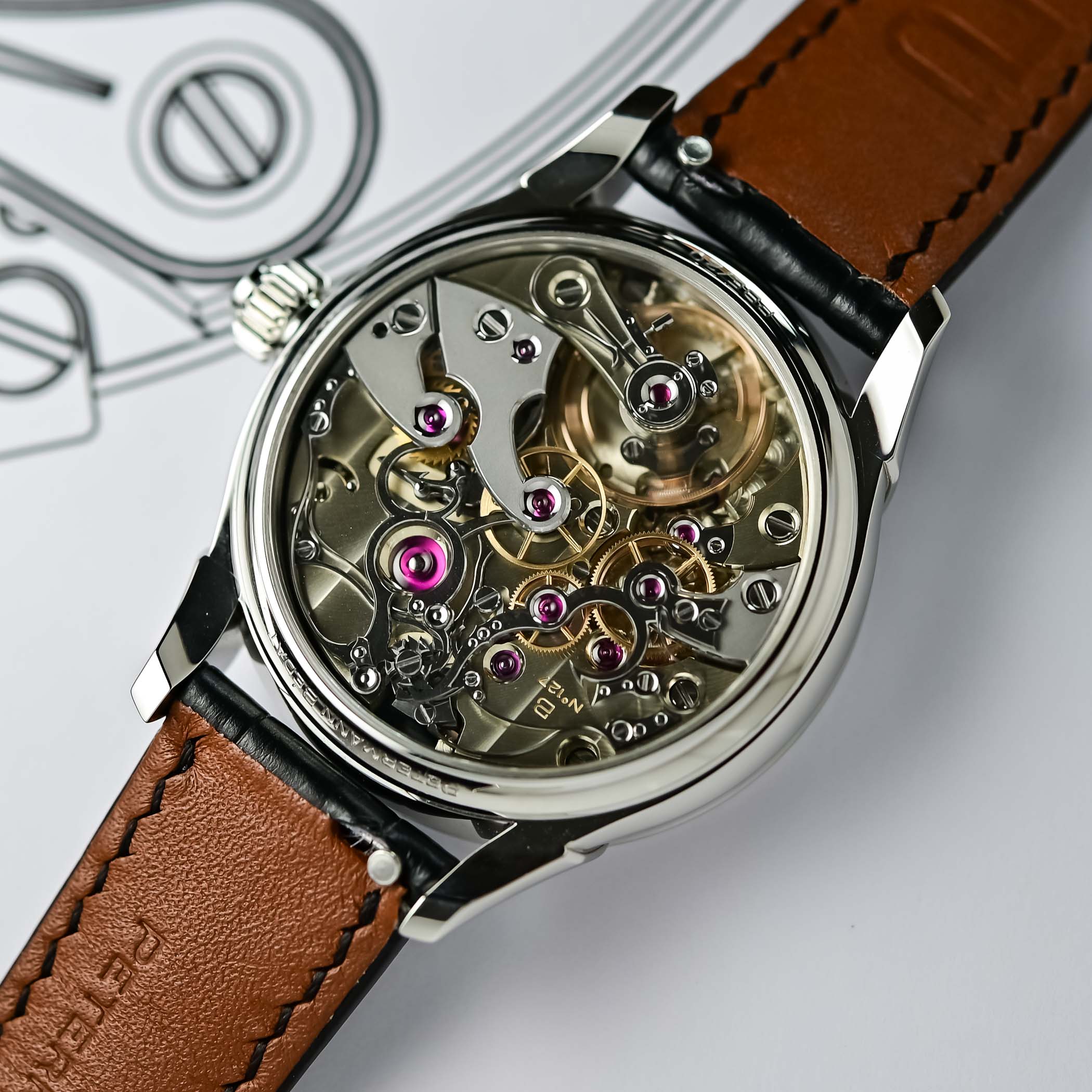
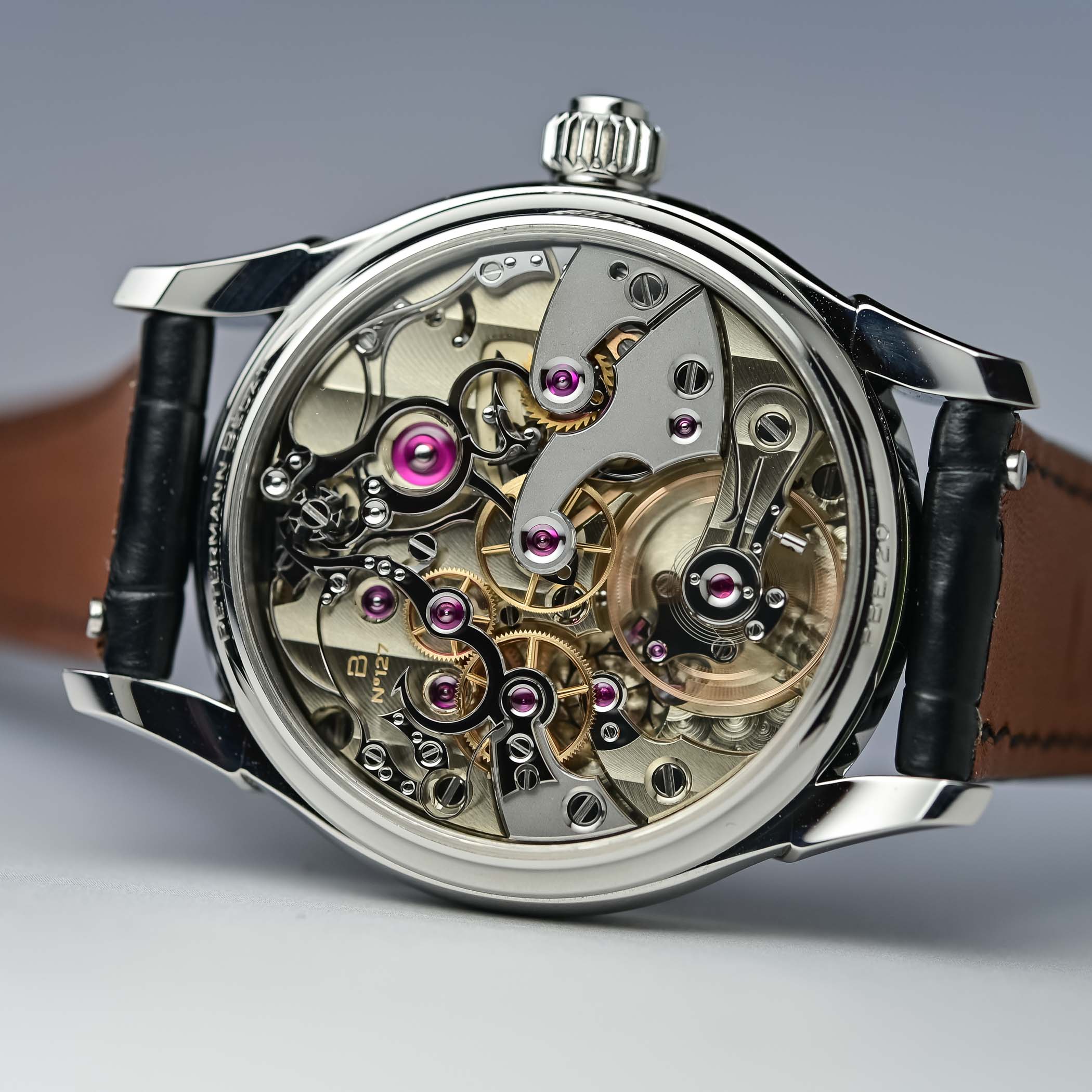
Under the hood of this Petermann Bedat Reference 2914 is the hand-wound calibre 234, which, in essence, is an evolution of the calibre 202 on which the split-second chronograph mechanism has been removed, as well as incorporating some upgrades. For instance, the reset mechanism and the hook of the column-wheel have been modified, and the going train has been redesigned and features hand-bevelled solid gold wheels. As such, you get a hand-wound column-wheel mono-pusher chronograph with a horizontal clutch, the most classic and visually appealing architecture for such a watch. The chronograph’s jumping-minute mechanism ensures precise and instantaneous reading of elapsed time. The large balance wheel is fitted with a Breguet hairspring, and it still beats at 18,000 vibrations/hour. The power reserve is now rated at 56 hours.
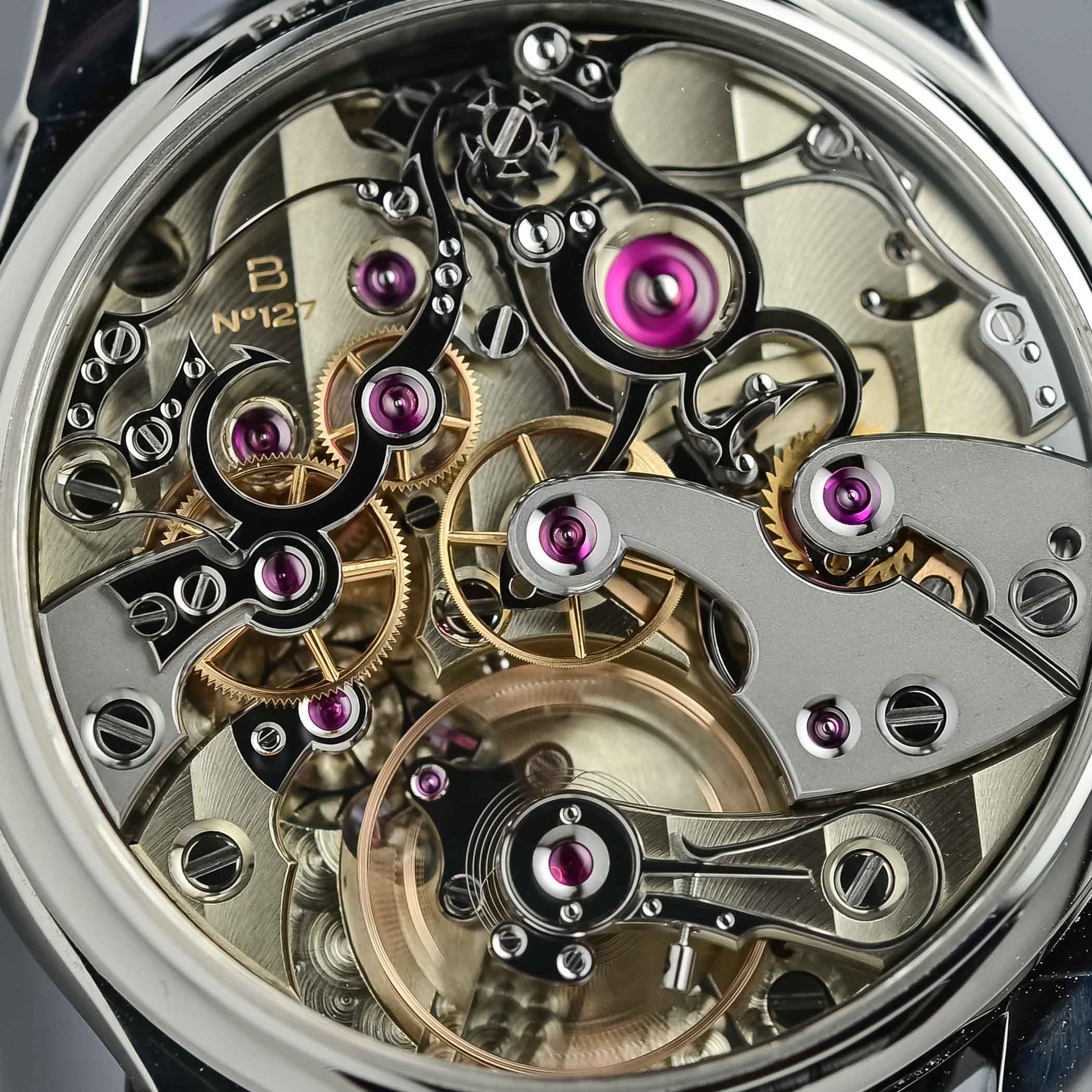
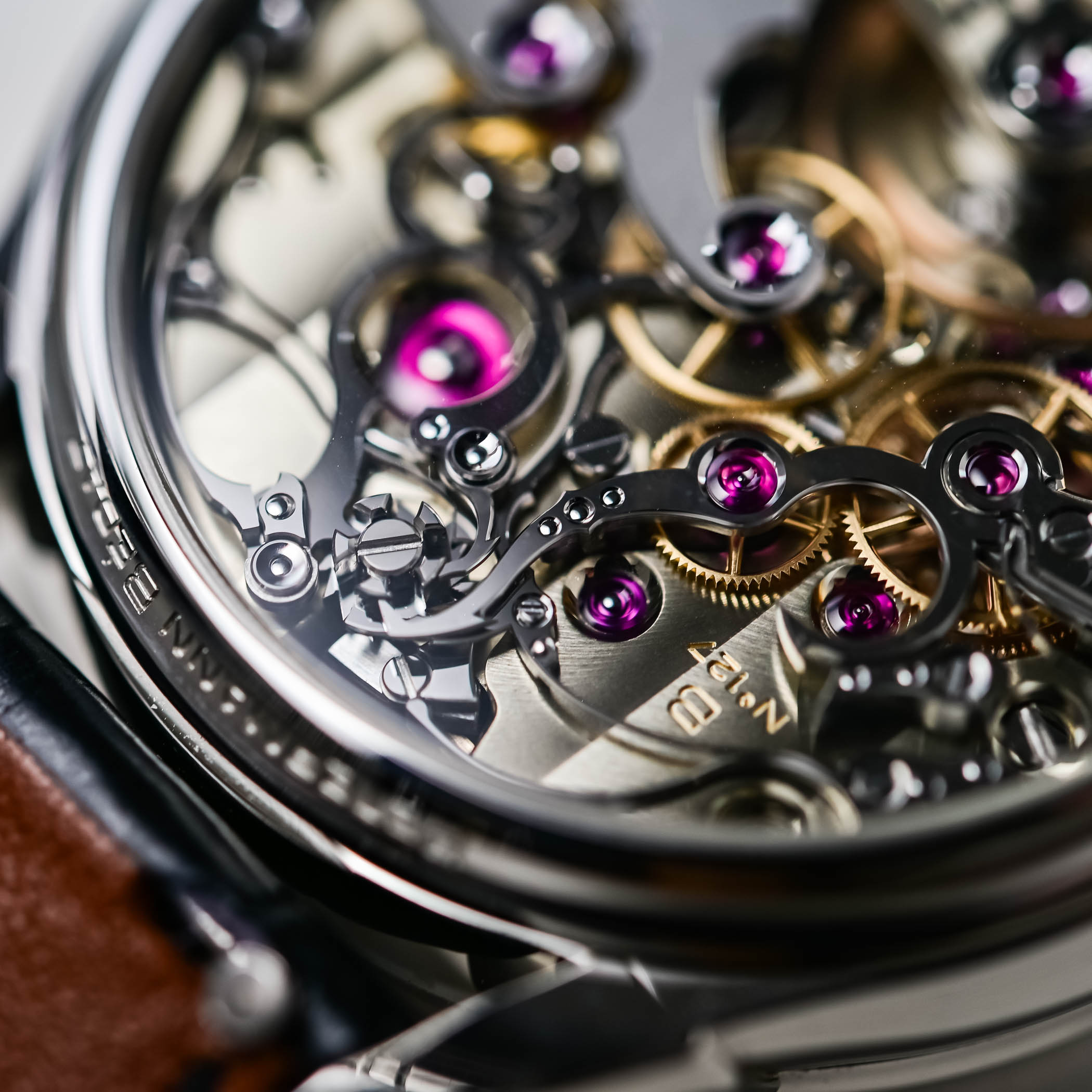
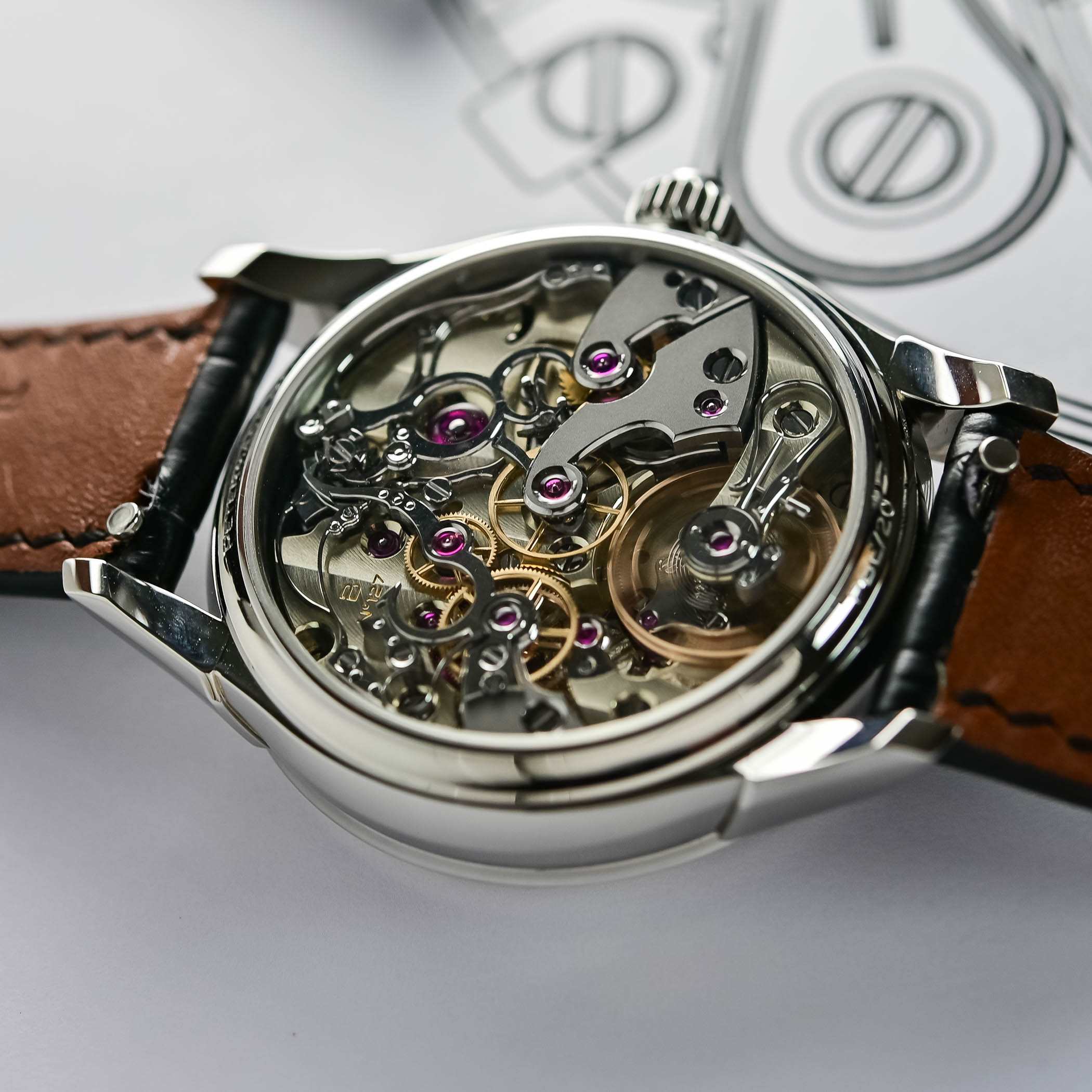
Turning the watch over, the exhibition caseback allows you to discover a superbly hand-decorated movement. Its lineage with the split-second chronograph calibre 202 is obvious. Showcasing the brand’s design language, its architecture includes an oversized balance wheel and beautifully shaped steel components with their characteristic arrow-shaped tails, a subtle nod to classic watchmaking. The finishing is, as always with Petermann-Bédat, top-notch. Beneath this intricate chronograph mechanism, broad and deeply engraved Geneva stripes create a beautiful visual harmony, complementing the complexity of the movement without making the overall aesthetic feel visually overwhelming. The large-size jewels are another detail I particularly appreciate.
Availability, Price and Competition
The Petermann Bédat Reference 2914 Monopusher Chronograph is released as a limited edition of 20 pieces in platinum, while other materials should be made available at a later stage. The watch comes on an alligator strap with a platinum pin buckle. A 10-row metal bracelet is currently under development.
With the 2941 Split-Second Chronograph priced at CHF 243,000 back in 2023, a hefty price tag was to be expected for the Reference 2914 Monopusher Chronograph. If you have sufficiently deep pockets to consider a watch at this level, this superb watch can be yours for CHF 180,000 excl. taxes. But if the financial aspect is not an obstacle, as with any Petermann-Bédat watch, securing an allocation is likely to prove quite a challenge in itself. True rarity rarely comes cheap or easily.
Looking at the competition, meaning hand-wound chronographs by independent watchmakers, the new Petermann Bédat Reference 2914 comes in direct opposition to the recent Rexhep Rexhepi RRCHF Chronograph Flyback (CHF 150,000 excl. taxes) or the Grönefeld 1941 Grönograaf (around EUR 160,000). At a different side side of the spectrum, there’s Greubel Forsey and the Nano Foudroyante (CHF 465,000 at the time of launch). We can also mention the Lang & Heyne Albert Chronograph (now discontinued, about EUR 85,000), or the Chronograph Masterpiece by Voutilainen (also discontinued). But there aren’t many classic chronographs by high-end, small-scale indie watchmakers to be found.
For more information, please visit www.petermann-bedat.ch.