


 Not all images were able to load for printing. Please close the print window and try again.
 The Patek Philippe Calatrava Alarm 5322G, Technically Impressive, Genuinely Usable
A cleaner, more elegant take on one of Patek's most intriguing modern complications.
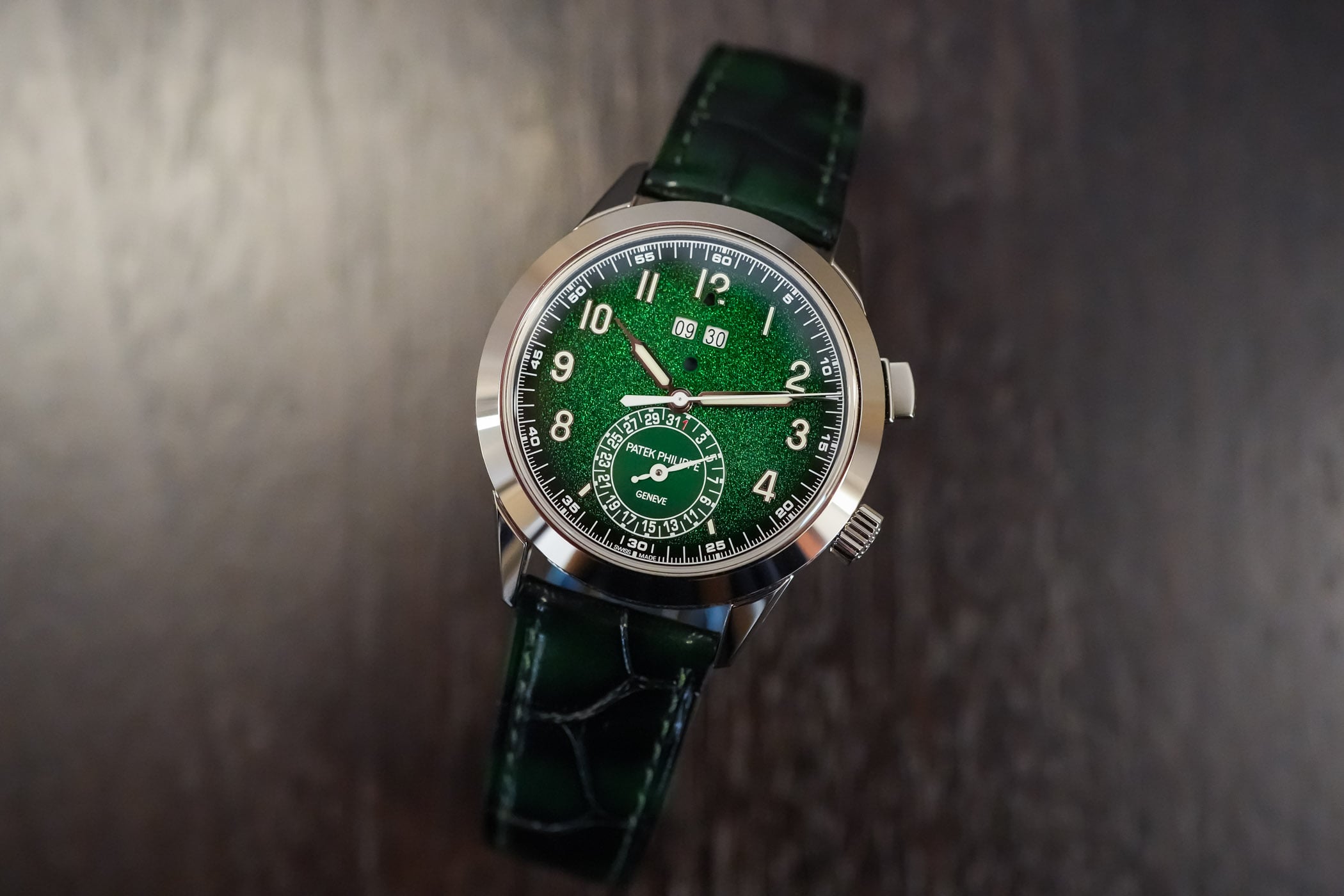
Over the past few years, Patek Philippe has been continuously reshaping the Calatrava. What was once the ultimate ultra-classical dress watch – well, it still is with the 6196P – has evolved into something more textured, more casual, and, importantly, more practical. References like the 5326 Annual Calendar Travel Time and the 5328 8-Day introduced a new design language: granular dials inspired by the texture of vintage cameras, bold Arabic numerals, and hobnail guilloché casebands.
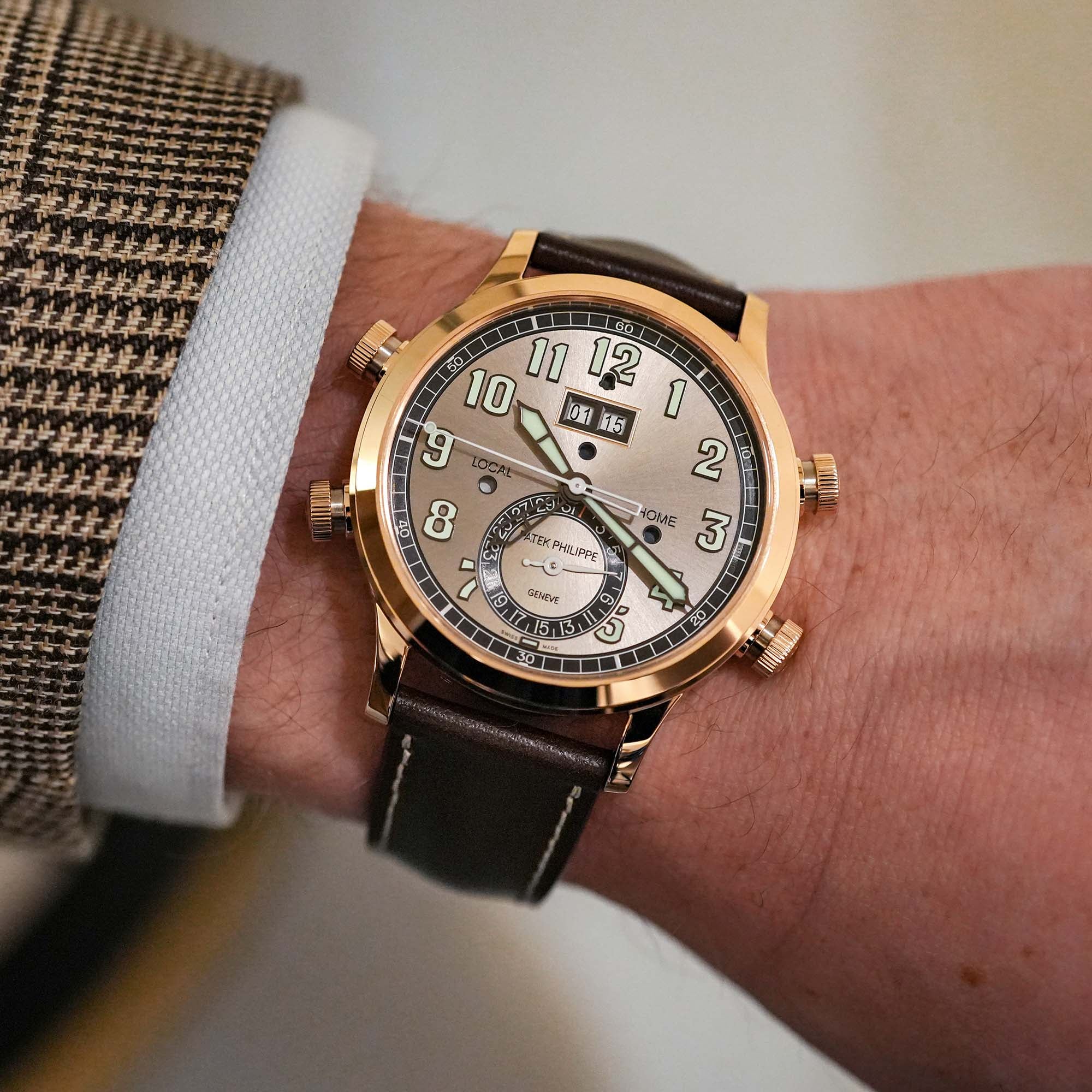
The new Calatrava Alarm 5322G follows in the footsteps of the highly complex alarm mechanism first seen in the Pilot-style 5520 and strips it of its travel function. No dual time, no aviation cues, and no controversial crown/pushers that gave the 5520 quite an unusual appeal. Just time, date, and a 24-hour alarm, presented in a far more restrained, contemporary Calatrava case. And in doing so, it becomes one of the most coherent modern grand complications in the Patek catalogue.
The Case
The 5322G feels very different from its predecessor. Gone is the bold, almost confrontational Pilot case of the 5520. In its place, a 41mm white gold Calatrava case with far more classical proportions, but certainly not conservative.
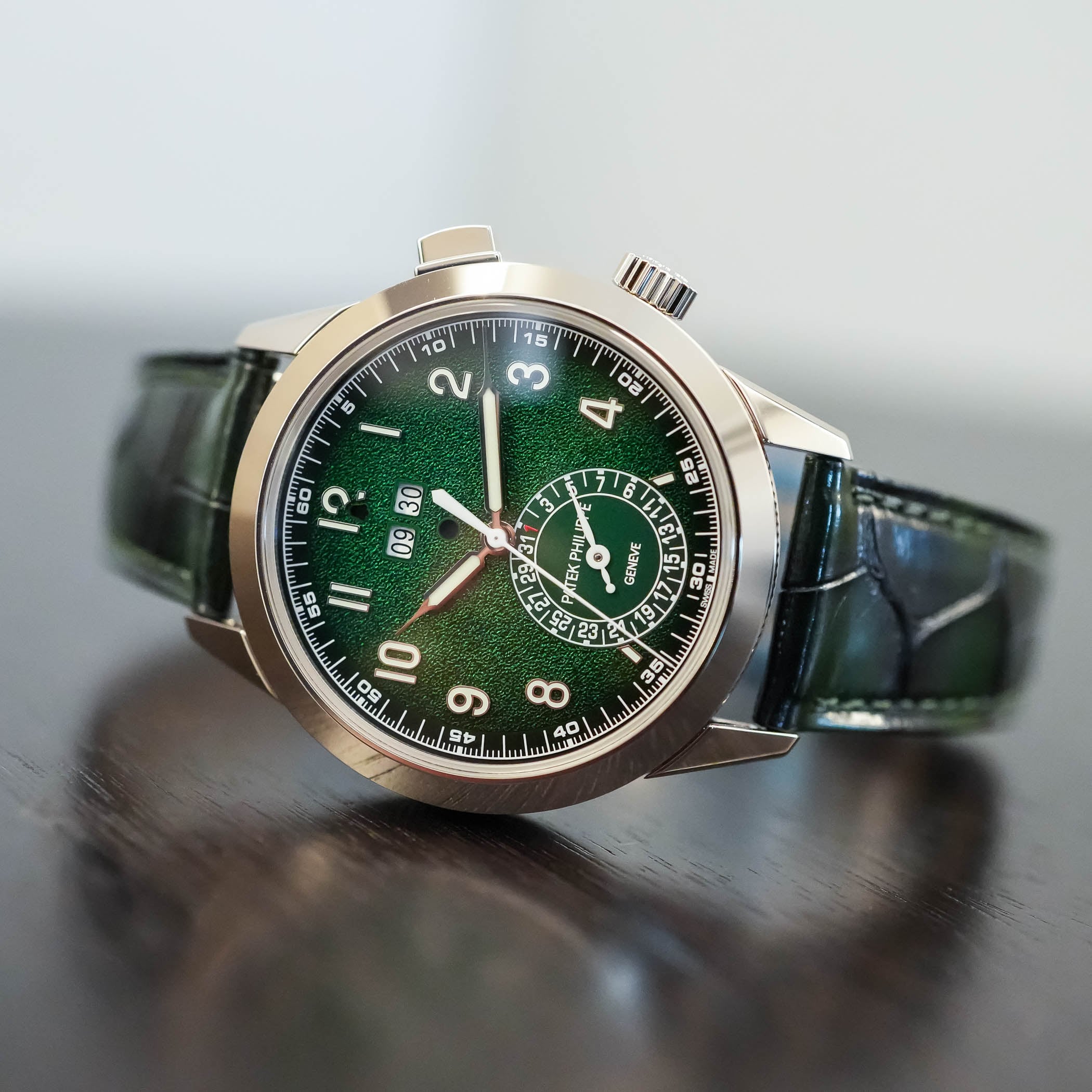
The Clous de Paris guilloché covers the entire caseband. Instead of being confined to the bezel, like on vintage references, it wraps the mid-case, adding texture and light play. The lugs are openworked and attached to the caseback and not the mid-case, allowing the pattern to run uninterrupted around the case. It’s a detail you may not immediately notice, but once you do, it makes you like the watch a little bit extra. The 5322G features sapphire crystals front and back, and here’s the surprising part: 30m water-resistance. That might sound modest, but in Patek terms, especially for a chiming watch, it’s not bad at all, also being the only chiming water-resistant watch in the current PP catalogue.
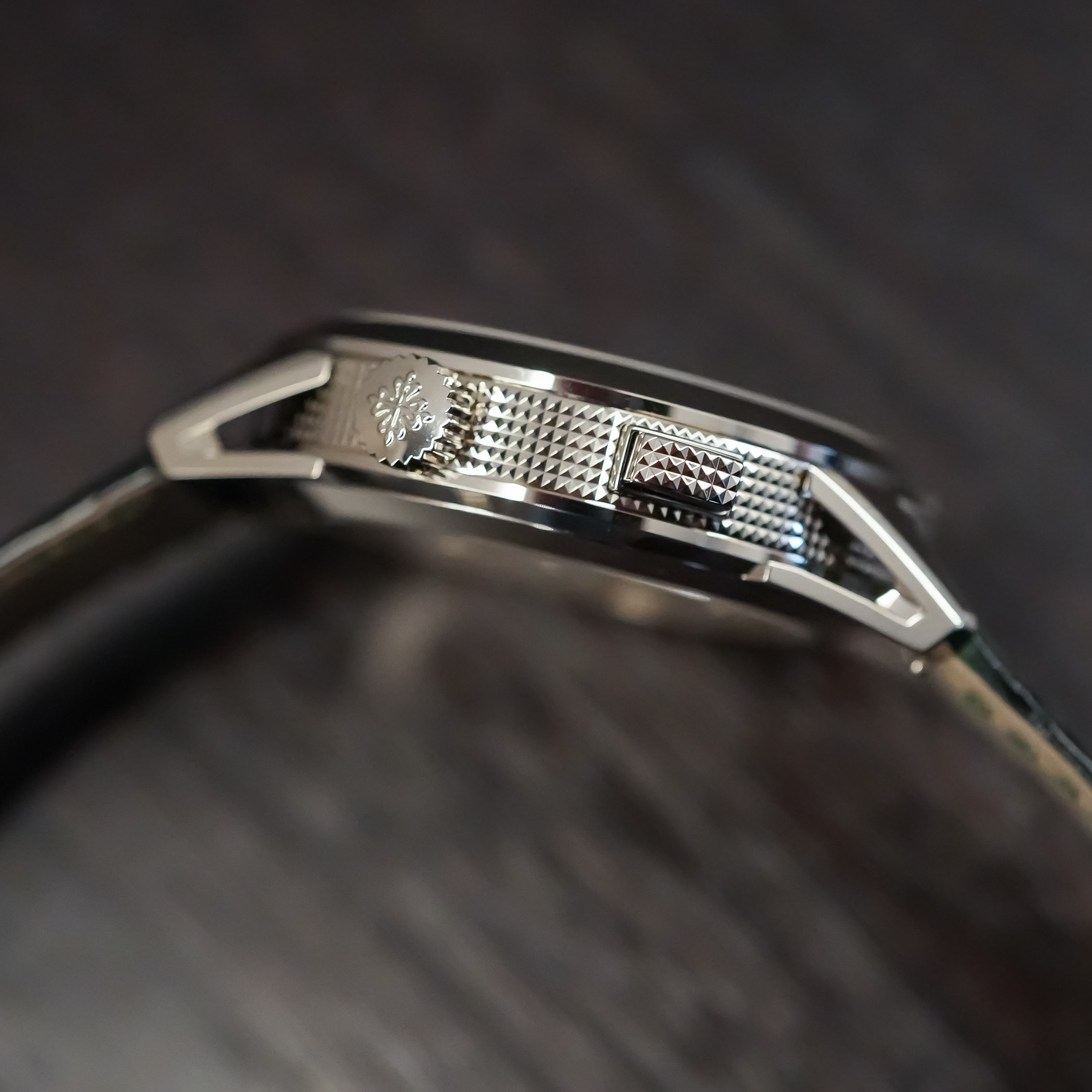
On the wrist, the watch sits flatter than expected for a chiming complication. At 12.22mm thick, it still feels rather compact – the Alarm Travel Time 5520 was 11.6mm thick but had a larger diameter, and the pushers made it far less comfortable. The crown at 4 o’clock avoids pressure points, and the single, rectangular-shaped alarm activation pusher at 2 o’clock keeps the profile clean, its top repeating the decoration of the caseband. Compared to the 5520, this is a dramatically more wearable watch.
The Dial
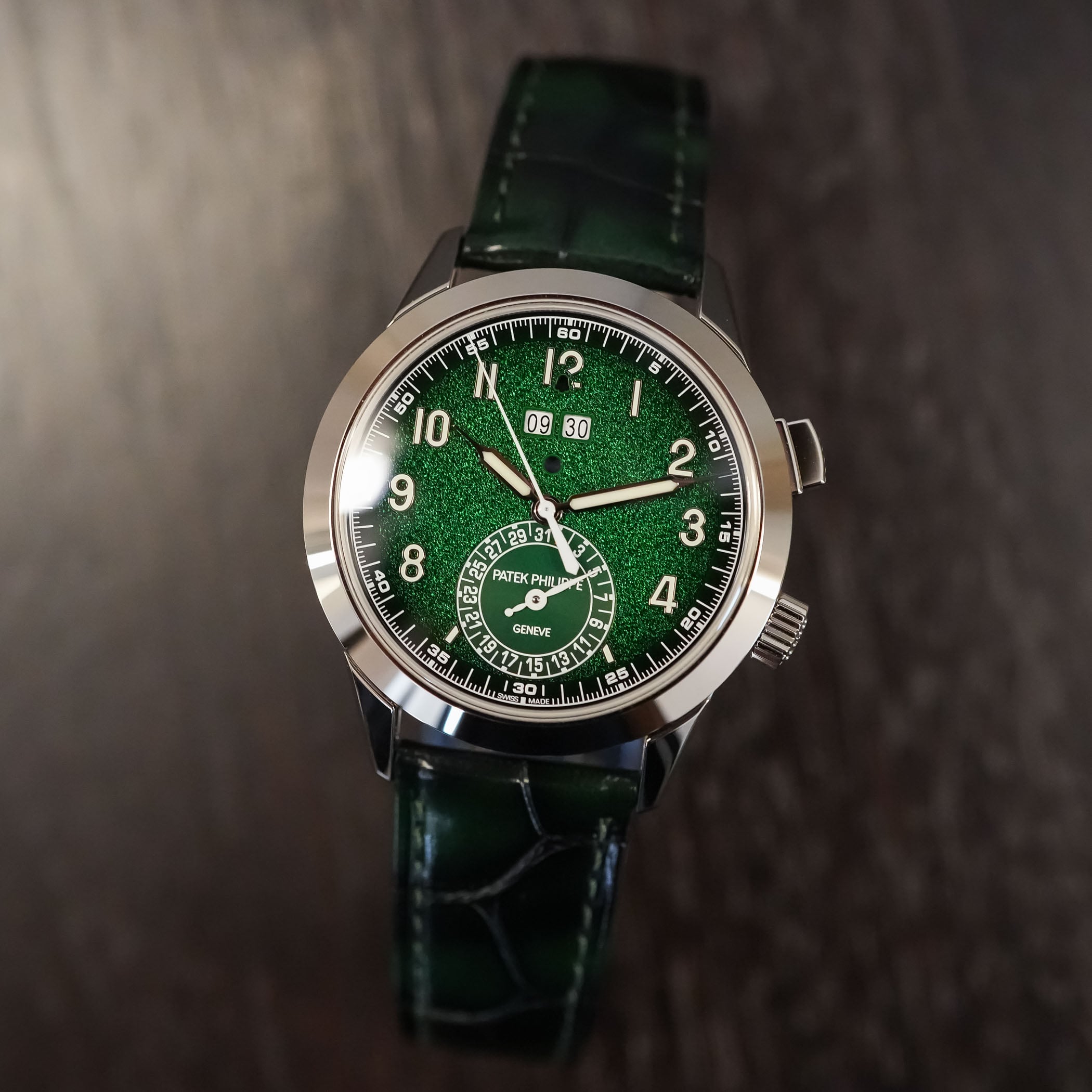
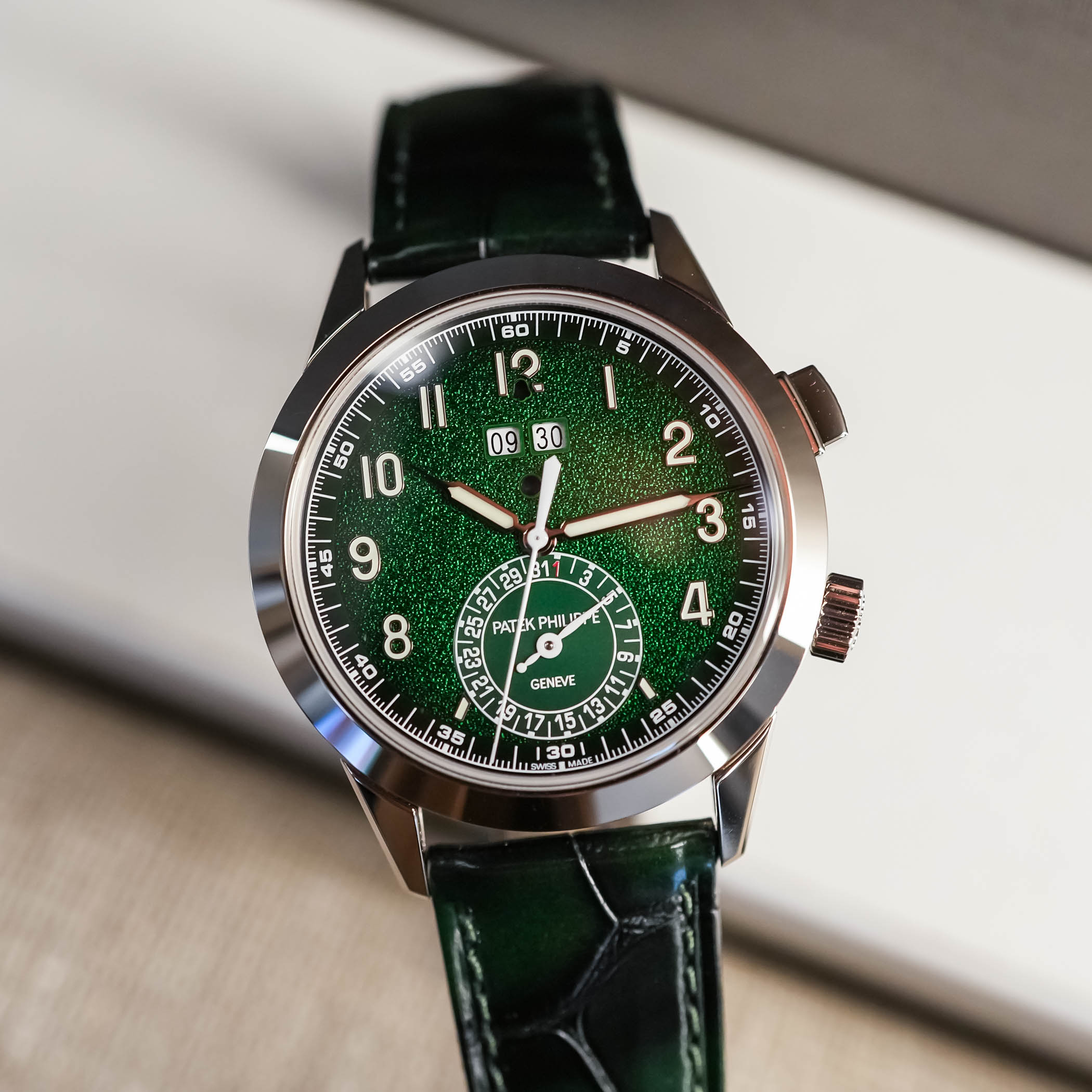
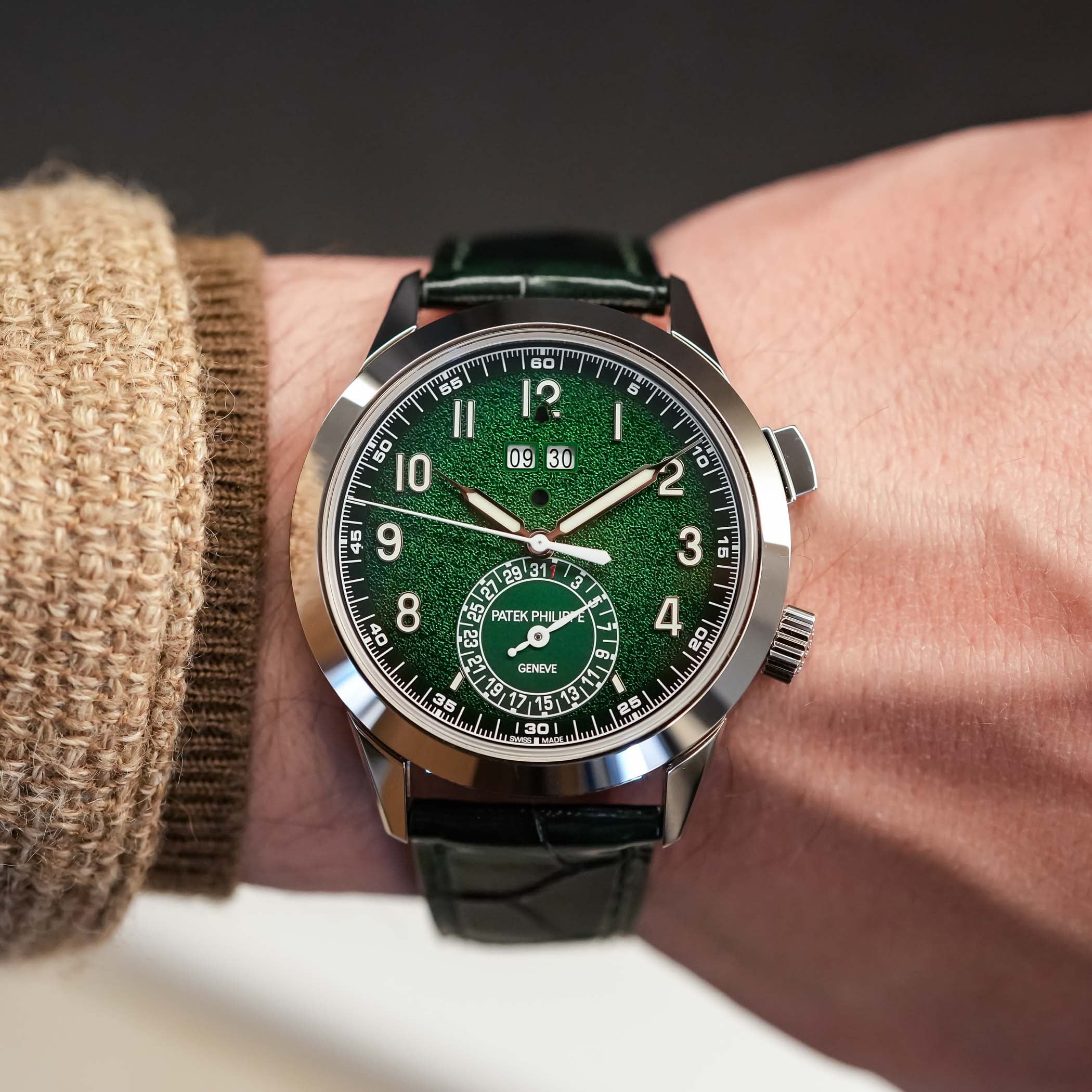
The dial continues the aesthetic introduced with the 5326 and 5226, but the Calatrava Alarm 5322G injects colour. Available in either deep blue or green, both versions feature a textured lacquer surface with a black gradient periphery. The effect is quite dynamic; under changing light, the dial shifts from matte to almost glossy, with the gradient adding depth rather than contrast.
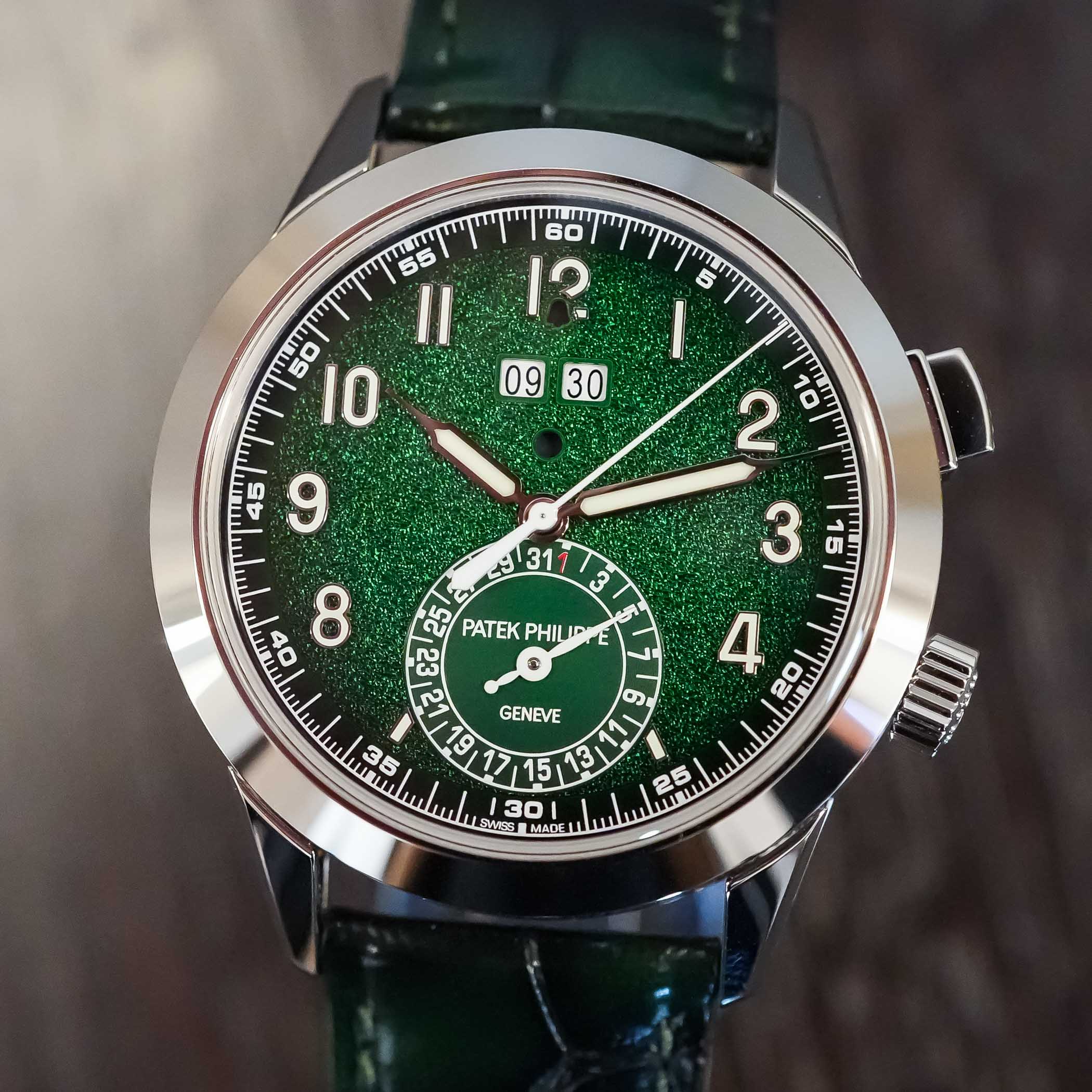
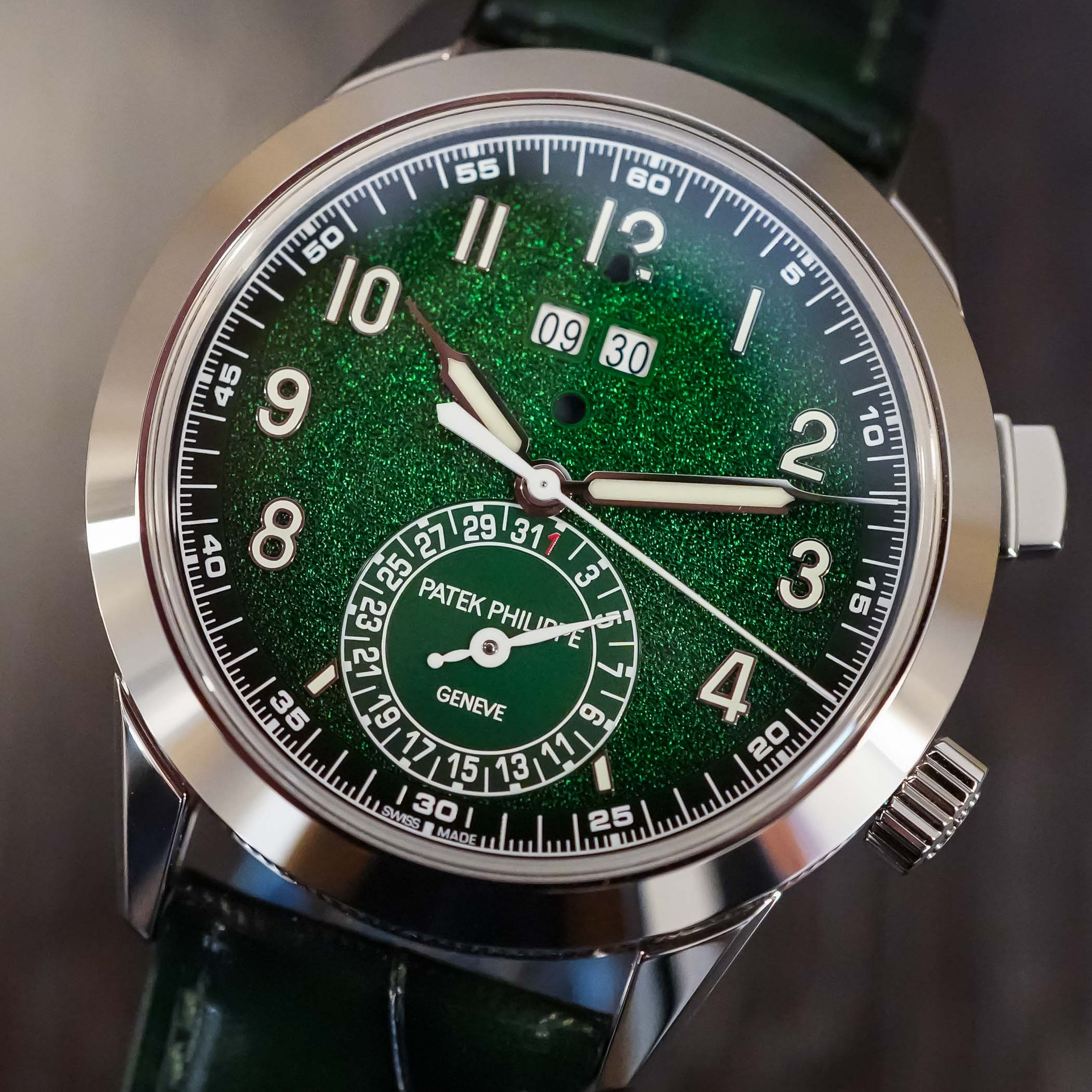
According to Patek, the dial-making process is quite complex, extremely time-consuming and requires over 60 different operations, from the electroplating of the brass plate, stamping of the grainy texture and snailed subdial pattern, coloured lacquer application, fixing the appliques with an initial white lacquered layer before being filled with lume, and multiple polishing techniques.
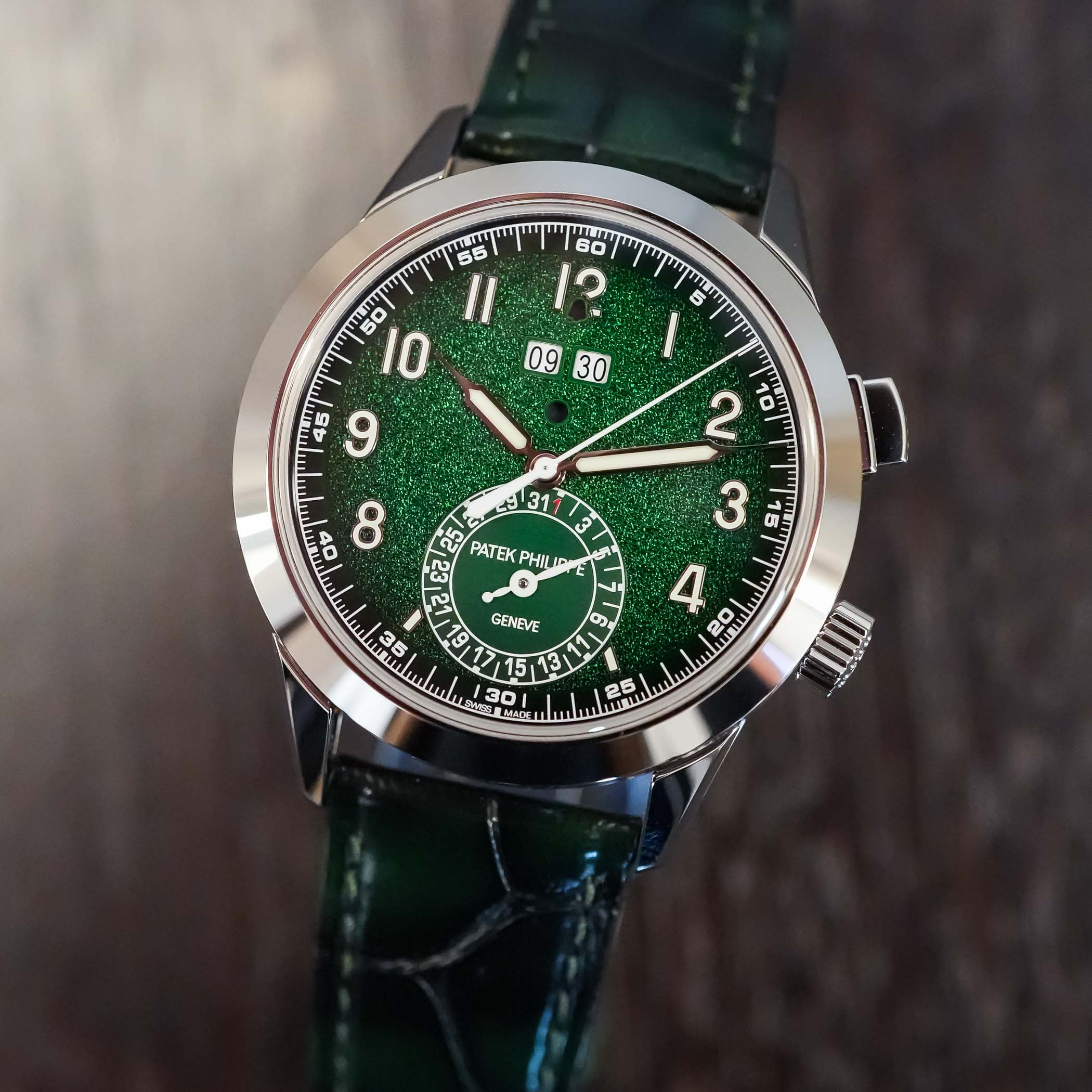
The layout balances complexity and cleanliness, but look closer, and the information density is revealed. It’s a technical dial that behaves like a simple one. At the top, the 24-hour alarm display dominates. A double aperture shows the programmed time in 15-minute increments, with a small circular opening below for the indicator to distinguish between day and night settings. Above it, a bell-shaped window indicates if the alarm is active, white for on, black for off. The lower half of the dial is occupied by the date by hand subdial at 6 o’clock, with indications in white, and only the numeral “1” printed in red (well, Patek says orange).
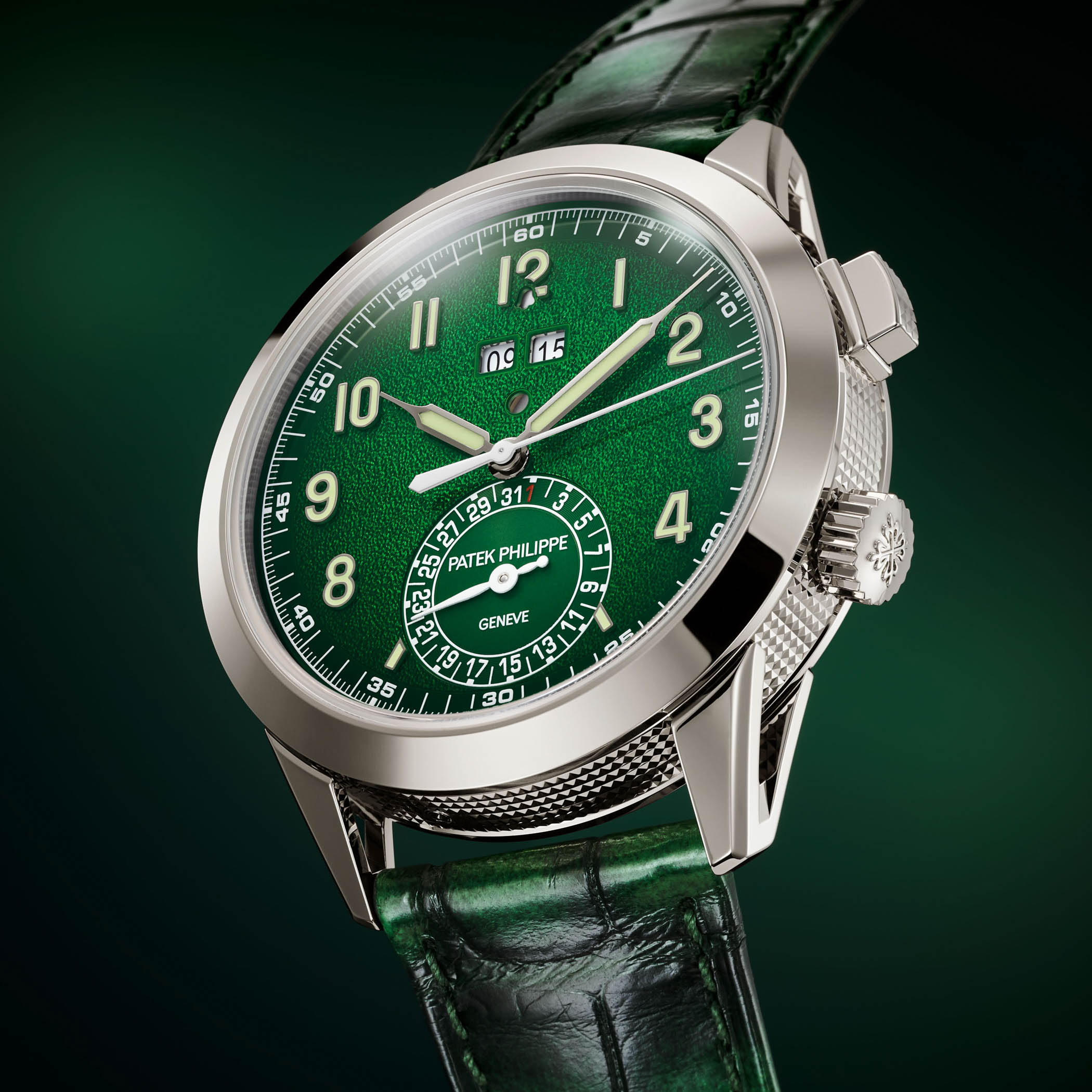
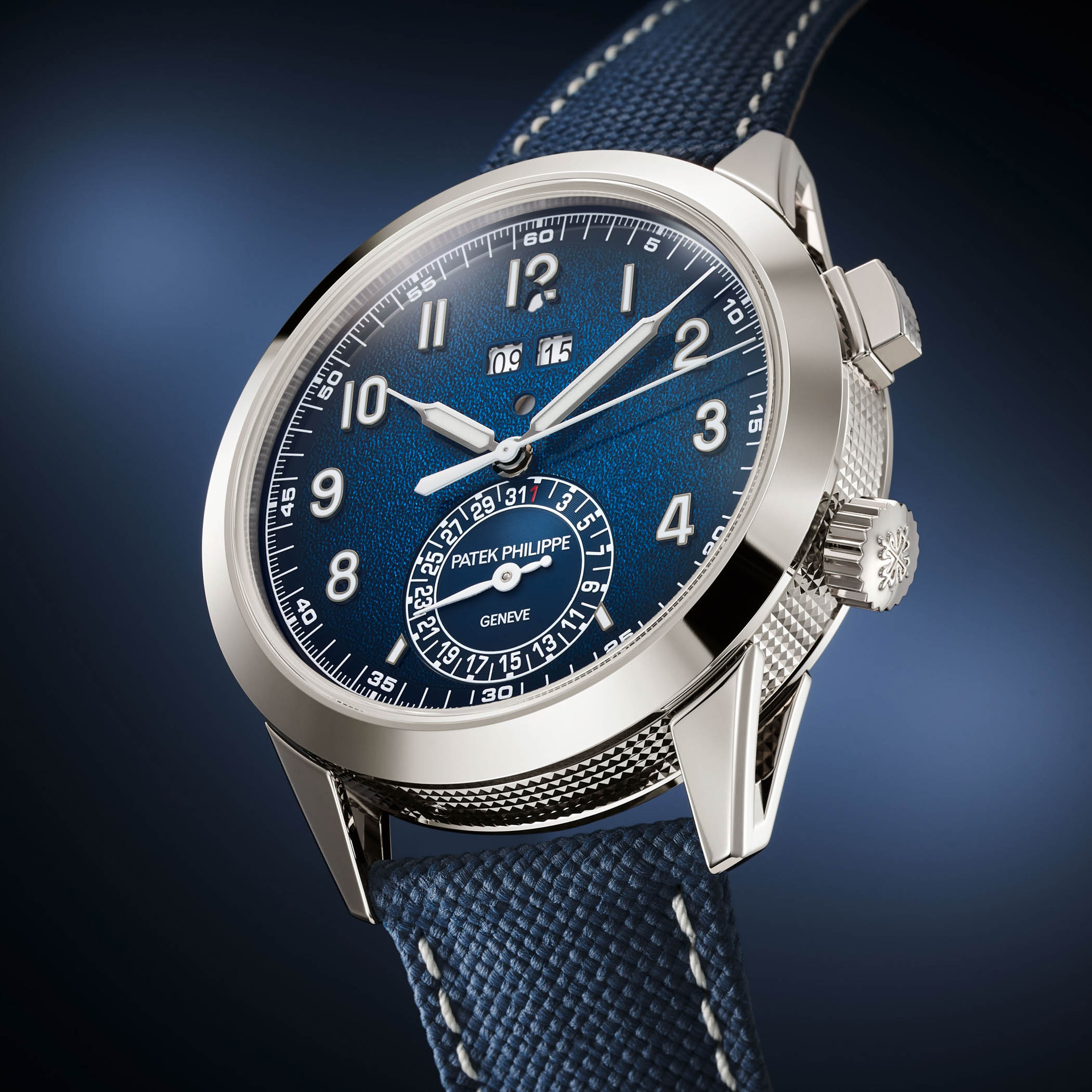
The crisp, white-printed minutes/seconds track runs the dial’s periphery, with the rest of the dial anchored by applied white gold Arabic numerals and syringe-style hands, filled with luminous material. The central seconds hand and the date hand are both in white.
The Movement and Operation
The Patek Philippe Calatrava Alarm 5322G is powered by the new calibre AL 30-660 S C, a streamlined evolution of the AL 30-660 S C FUS movement introduced in the 5520. The construction remains complex, comprising 524 components, of which nearly half are for the alarm mechanism, accurate to within 10 seconds of the programmed time, an improvement over the 30-second accuracy of the mechanism used in the 5220. But clearly, usability was the priority.
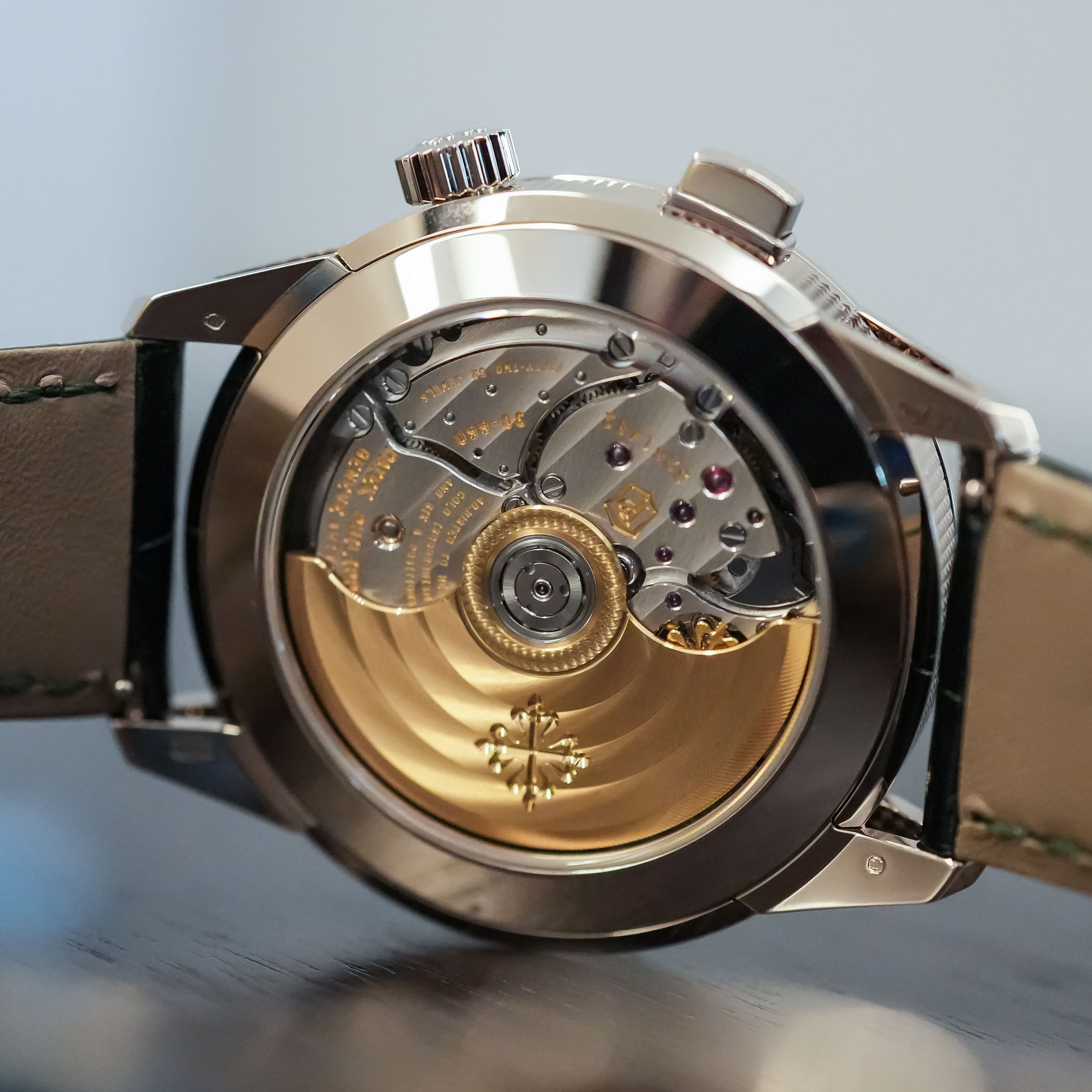
Unlike most mechanical alarms that produce a buzzing vibration, this one uses a hammer striking a coiled gong, much like a minute repeater, with a proper chime, clear, resonant, and far more refined than the usual mechanical alarm sound. The striking sequence lasts around 35 seconds (2.5 strikes per second over some 90 strikes), delivered at a steady rhythm controlled by an inertial governor at the end of the alarm gear train. To see how the alarm mechanism works on activation, the sequence and parts involved, kindly refer to the official Patek video here; the explanation starts at 2:50 min.
From the user’s perspective, it’s quite amazing how intuitive the system is. Everything is controlled via the crown and a single pusher. With the crown pushed in, you wind the movement (counter-clockwise) or the alarm (clockwise). Pulling the crown to position 1 allows setting the alarm time (remember using the pusher at 2 o’clock to activate), pulling the crown to the next position is used for time setting. Date setting is performed via a corrector placed on the caseband between the lower lugs. There’s clear logic to the operation, with mechanical safeguards in place, just in case. The alarm cannot be activated unless fully wound, and it automatically disengages once the energy is spent. The sound can be stopped at any time.
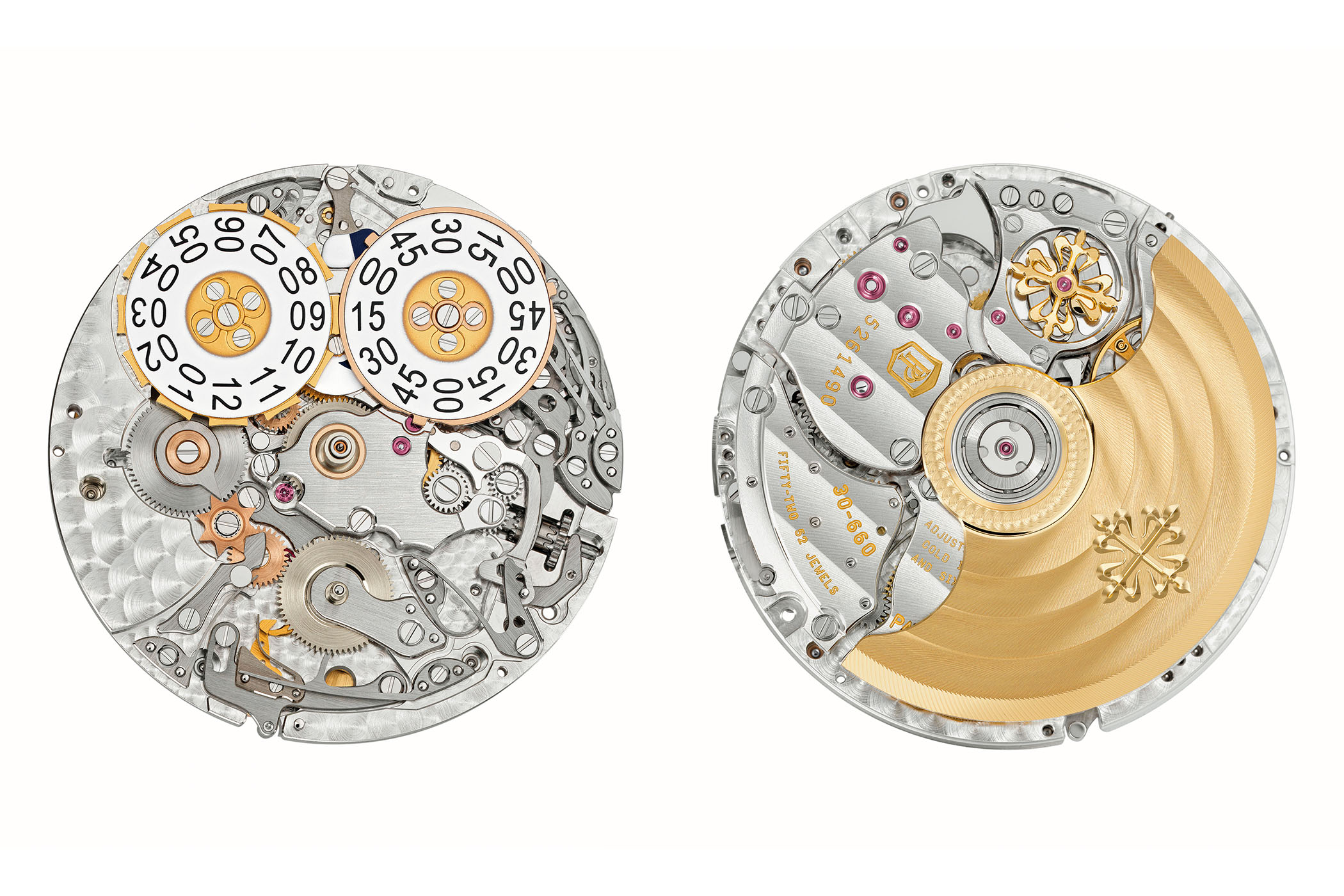
The timekeeping performance is equally strong. The 28,800 vibrations/hour frequency and use of a Spiromax silicon hairspring ensure stability, and the Patek Philippe Seal guarantees a rate of -1/+2 seconds per day. Power reserve is between 42 and 52 hours.
The Straps
The Patek Philippe Calatrava Alarm 5322G is offered with two straps. The primary is either a blue composite with fabric texture or a green patinated alligator, depending on the dial colour. For both, an additional beige nubuck calfskin strap is included. The blue dialled 5322G, paired with its straps, looks slightly more casual, while the green gets the sort of relaxed look when worn on the nubuck. The triple-blade folding clasp is secure and easy to manage, and the quick-change system allows swapping straps in seconds. It’s another small detail, but it speaks to the watch’s intended everyday usability.
Thoughts & Pricing
The 5520 was bold, complex, and visually divisive, while the new Calatrava Alarm 5322G brings the same technical achievement into something far more refined, yet still highly modern (like a lot of recent watches by Patek). It keeps the innovation, the alarm, the user-friendly mechanics, and the acoustic quality, but removes the polarising excess.
The watch is still undeniably a grand complication, but one that behaves like a daily wearer, a trend we see developing. It’s legible, comfortable, intuitive, and, in a way, discreet. For a brand often defined by tradition, this is a modern Patek Philippe in the best sense, technically advanced, thoughtfully designed, and very confident. The 5322G is a move towards complications that are not just impressive but genuinely usable. For the next edition, PP, please, make the alarm window display a 24-hour format, and move the bell-shaped aperture to where the day/night indicator now sits. It would be great to have the 12 o’clock numeral undisturbed.
The price is CHF 225,000 or EUR 263,000. For more information, please visit www.patek.com.


1 response
The hole through the 12 is nasty.