


 Not all images were able to load for printing. Please close the print window and try again.
 The Origins & Evolution Of The Breguet Tradition Collection (Incl. Video)
The story of A.L. Breguet is a remarkable one, with the master's watchmaking vision perfectly encapsulated by the Tradition collection.
Steeped in tradition, perfectly in place in the present, and not shy about welcoming the future, the Tradition collection by Breguet is perhaps the finest representation of Abraham-Louis Breguet’s true watchmaking vision. This cornerstone collection was introduced in 2005 and has reshaped the perception of modern watchmaking through something remarkable: the creation of a pocket-watch-style movement for a wristwatch at a time when no one was doing anything like it. The origins of the Tradition collection, and how it has evolved and takes us back to the time of Breguet’s famous Souscription watch, yet it also embraces modernity in more ways than one.
A resounding legacy
If ever you were to name the single most influential watchmaker in this centuries-old industry, you’ll likely name Abraham-Louis Breguet. Of course, that would bypass several other fundamental names who left an enormous mark on watchmaking throughout history, but Breguet certainly was one of the most influential watchmakers, and probably the most famous one. We know him mainly for the tourbillon, and that’s very understandable. After all, it was Breguet who was granted the patent for it back in 1801, and today it’s often regarded as one of the holy grails in watchmaking.
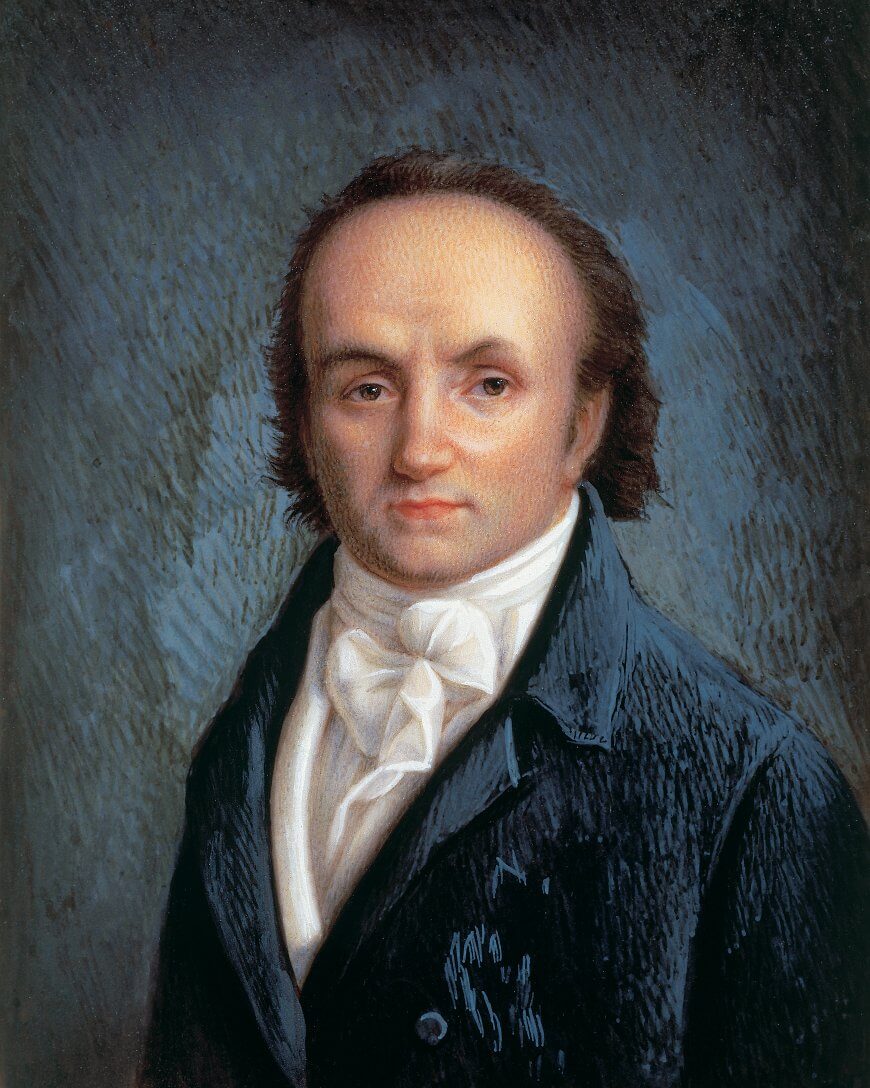
But there’s one chapter in Breguet’s story that might be even more important to the industry. You see, understanding how to make a watch is one thing, but being able to market it is another, especially back then, which is an entirely different undertaking. In the 17th and 18th centuries, it was customary for aristocracy and royalty to commission luxury items such as clocks and watches and then wait months, years, or even decades for them to be made. But Breguet thought of a different way to sell his watches.
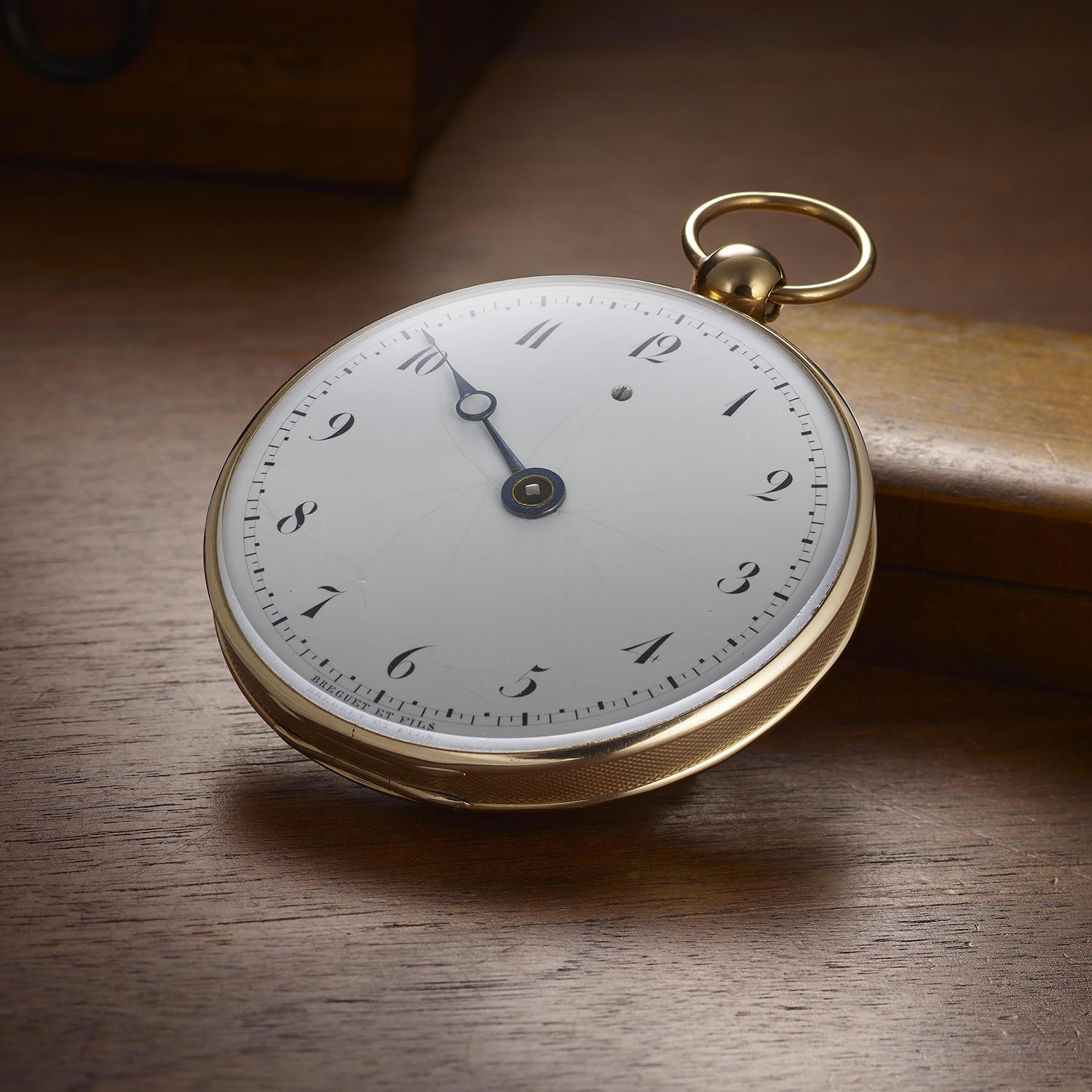
The clue is in the name, as his 1796 Souscription watch was offered on a subscription basis, with clients being offered the chance to register with a 25% down payment. Breguet, with a starting budget at hand, would then build the watch and deliver it to the client, upon which he was paid the remaining sum. However, Breguet’s Souscription concept goes much further than that. The Souscription watch was made intentionally simpler. It came in one style of case only, with a single hand over a white enamel dial. The movement construction was also standardised, so everything could be built in series. Pair that with the way it was marketed through a pamphlet, and Breguet basically created the very first watchmaking brand. This was utterly revolutionary back in the day, as it is essentially the very first implementation of standardised serial production as a business model.
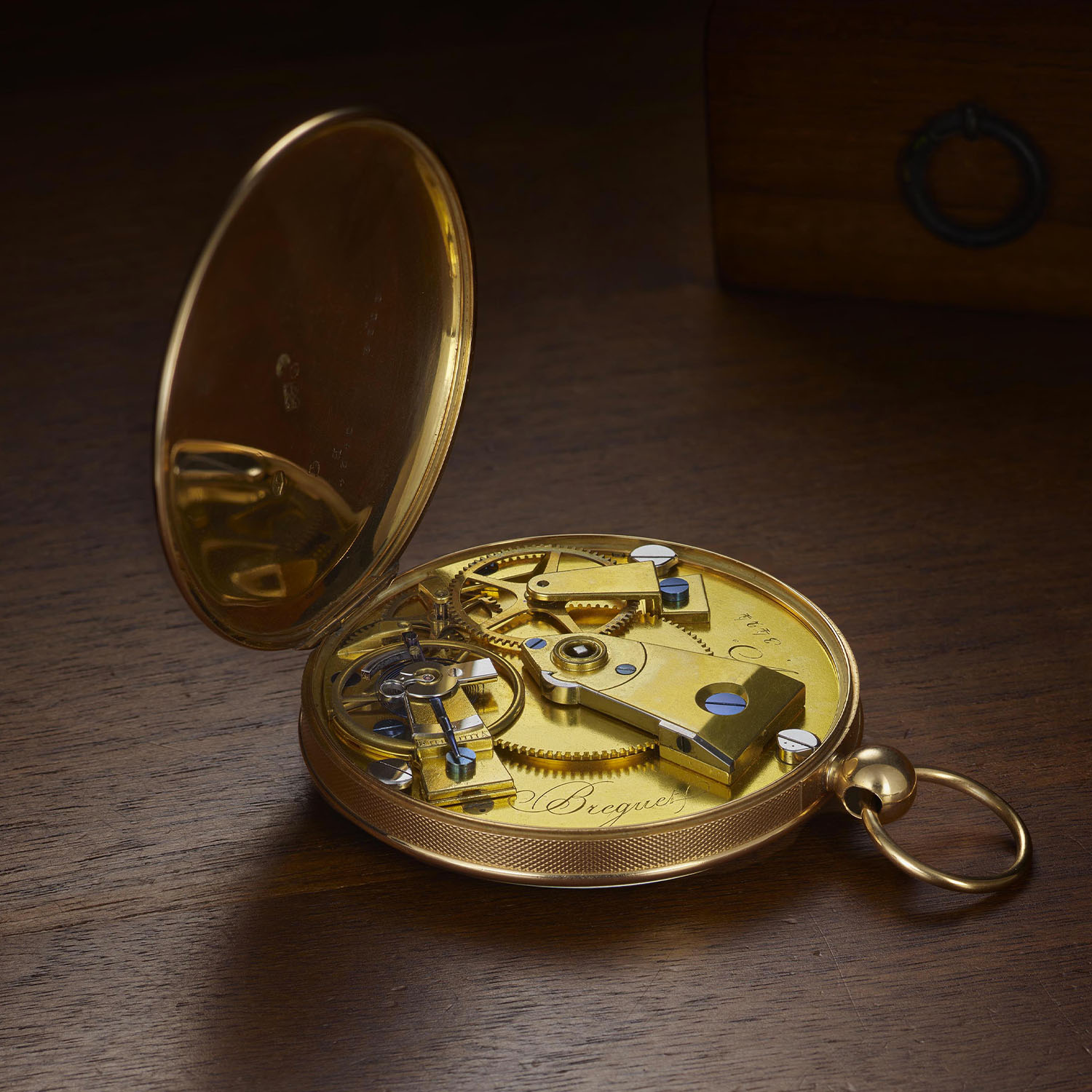
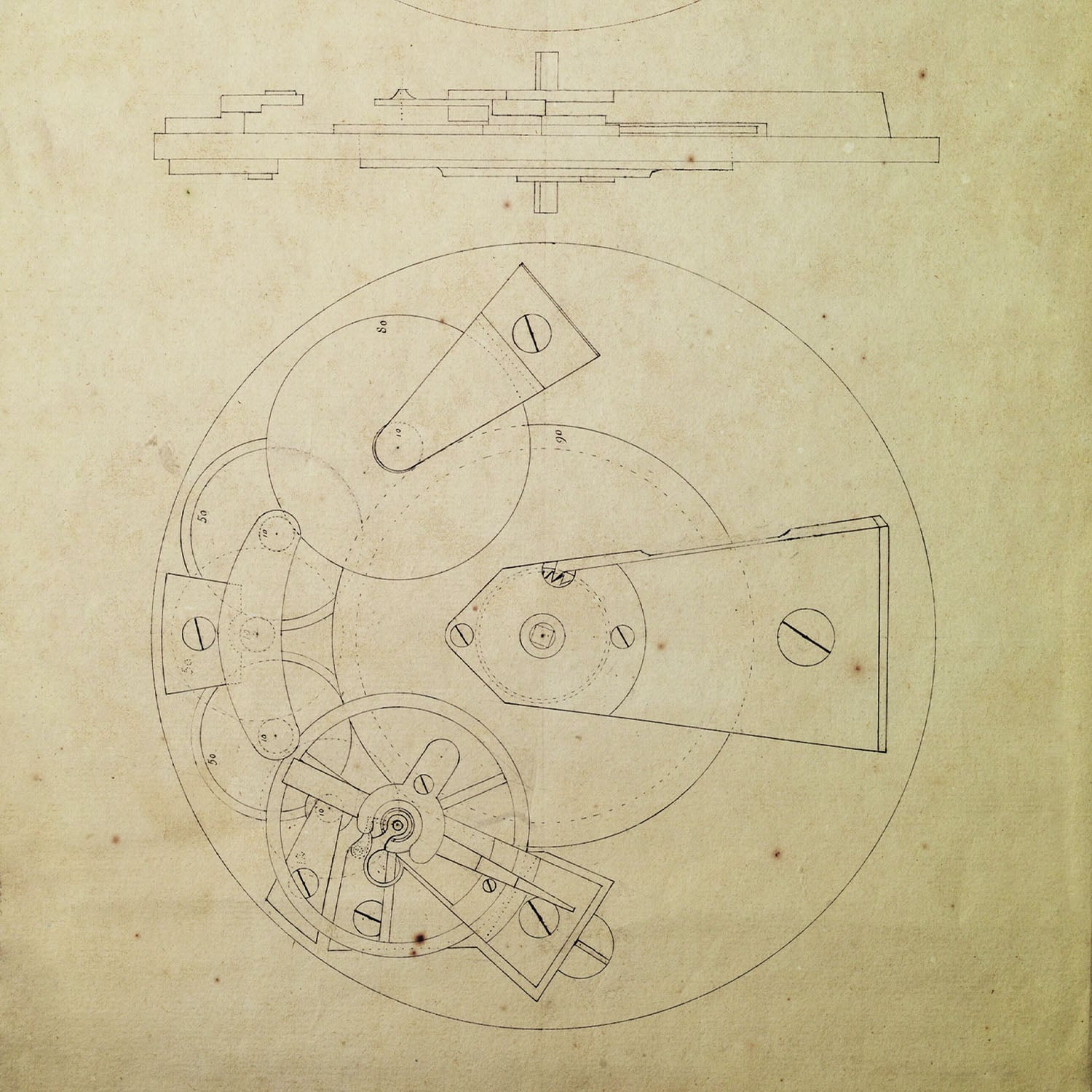
Apart from his technical mastery and business savvy, Breguet is also known for his love of décor. He paved the way for actual watchmaking design, with his intricate engine-turned guilloché dials. The typical font for the numerals and the shape of the hands are other key elements that define Breguet. Nowadays, this is referred to as Breguet’s “unmistakable signs”, which are upheld in the Maison’s current collection, including the Tradition. To get an even better understanding of how important the Souscription really is, we take a look at four models in the Tradition range that perfectly embody Abraham-Louis Breguet’s watchmaking vision.
Breguet’s unmistakable signs
If you look closely at the Tradition collection, it’s evident that it pays tribute to Breguet’s legacy in more ways than one. It differs from most other watch collections in Breguet’s arsenal as it takes direct inspiration from the mechanical heart of the Souscription from 1796. The collection itself made its debut in 2005, with the Reference 7027. The release coincided with a renewed pride in mechanical watchmaking, and the Tradition proudly presented its intricacy on the front of the watch for all to see.
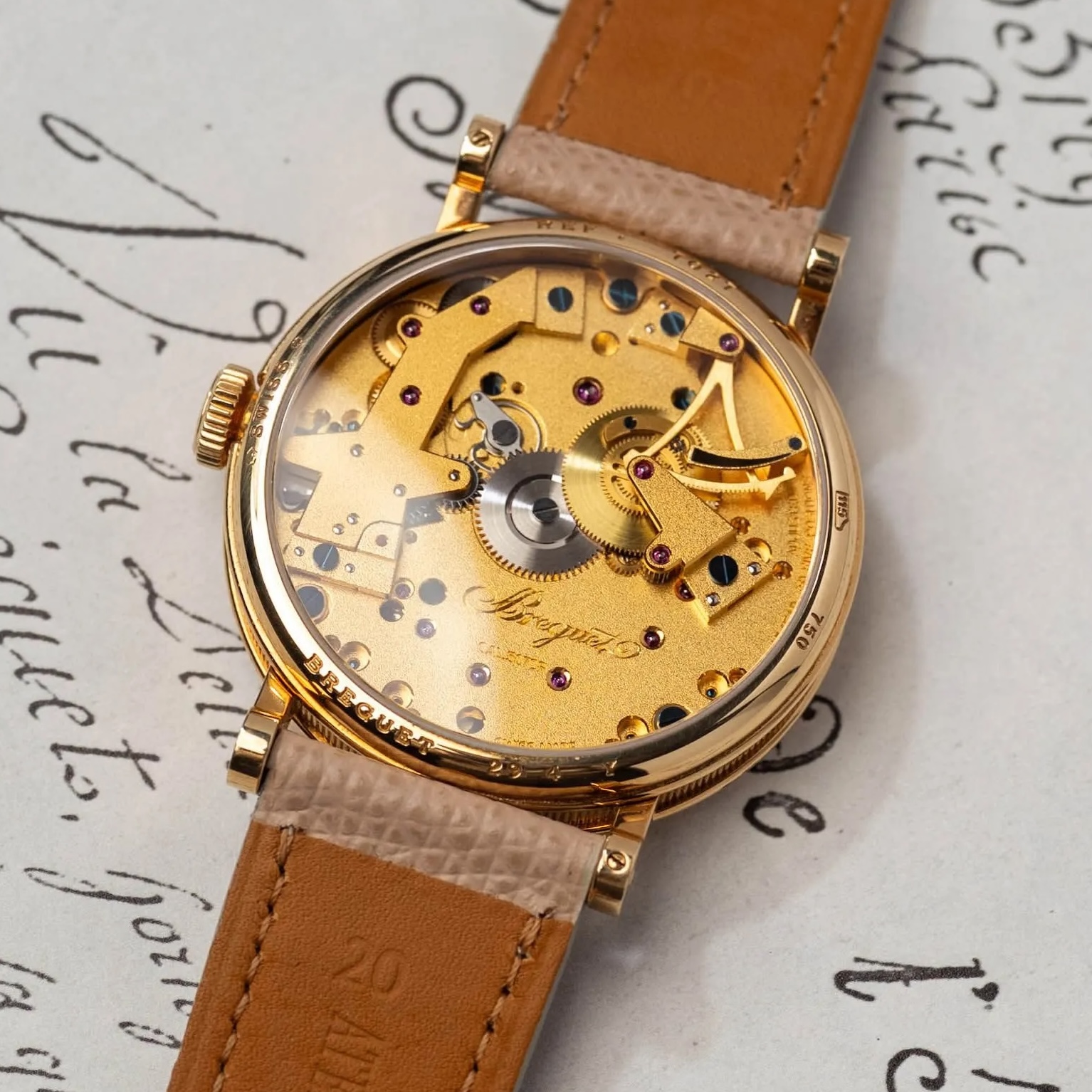
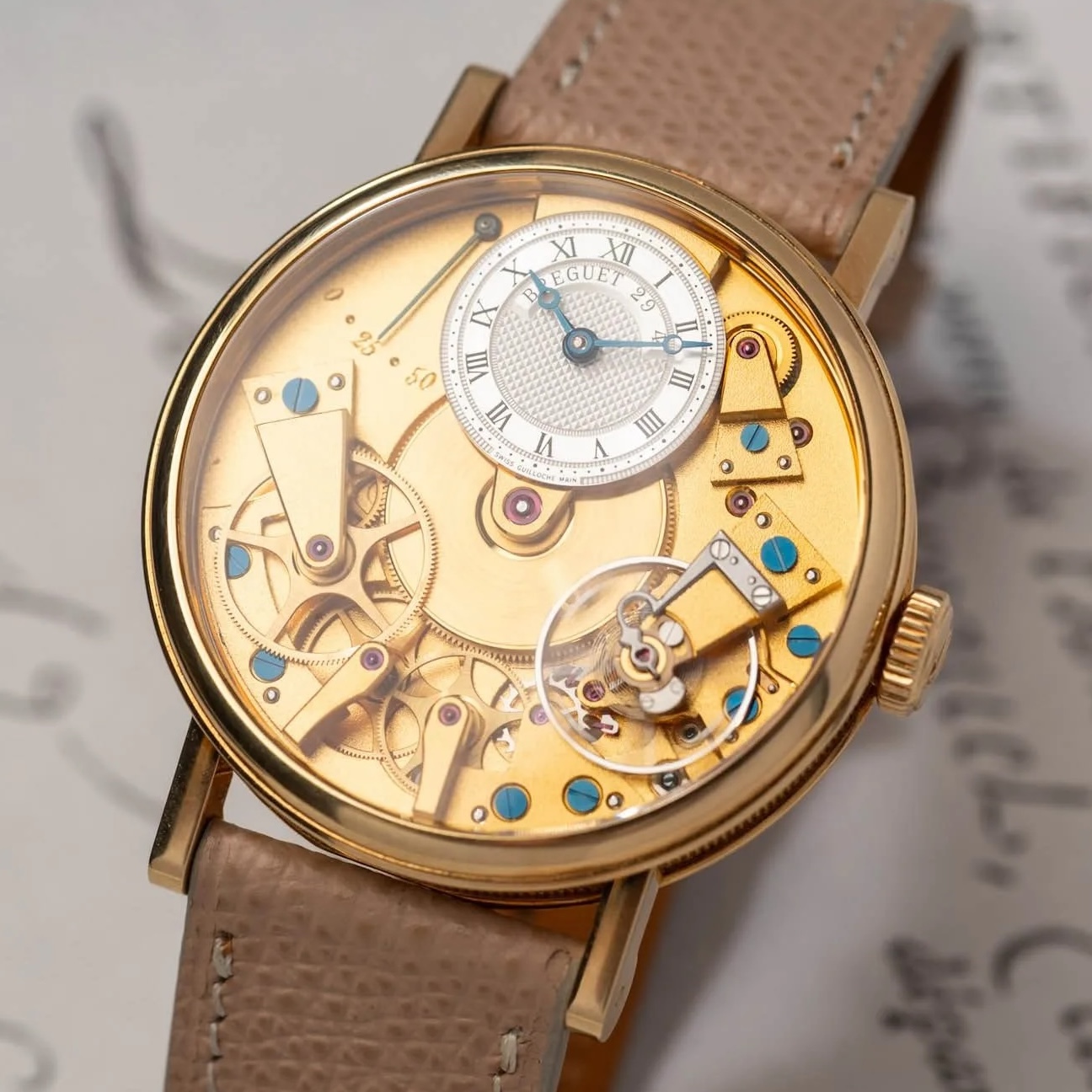
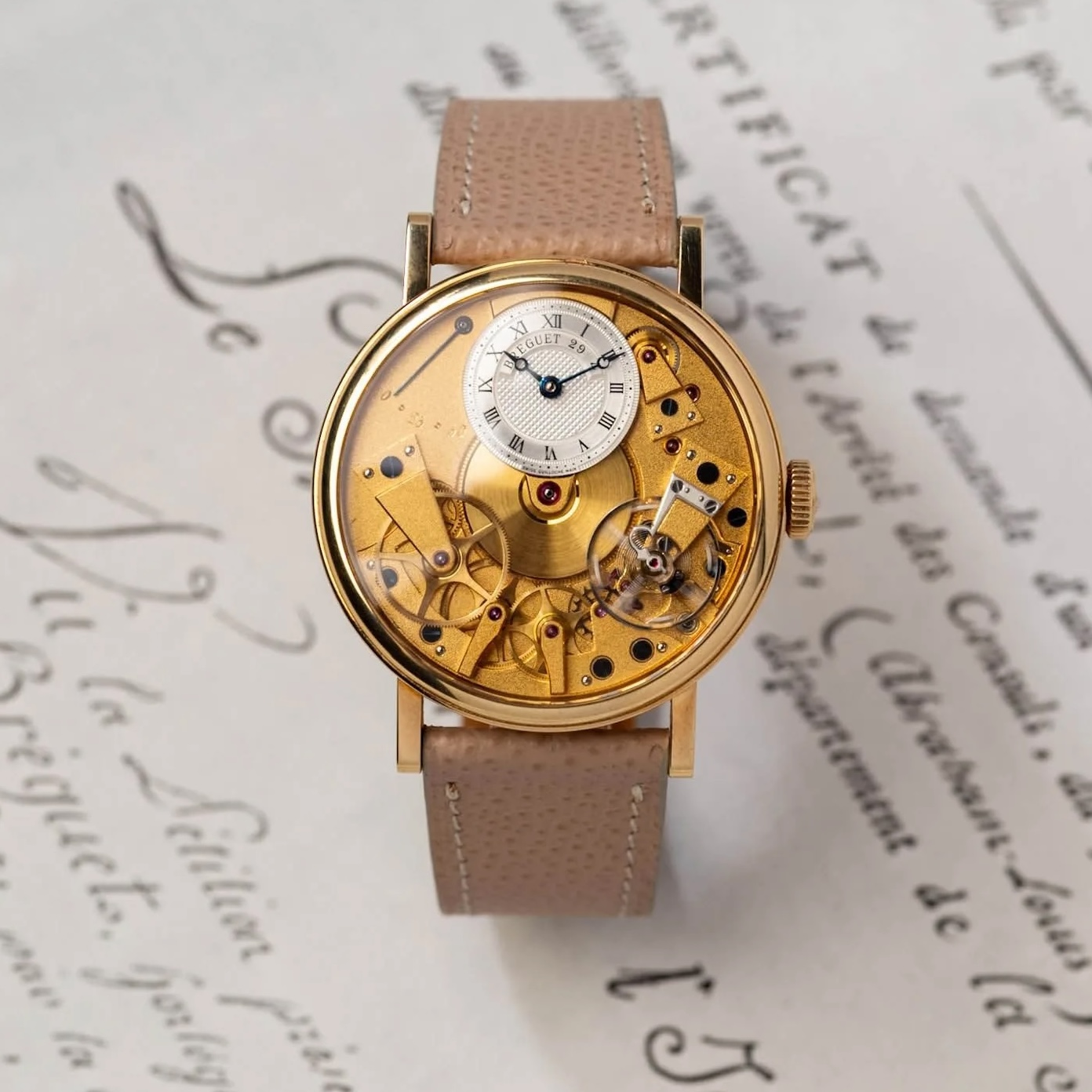
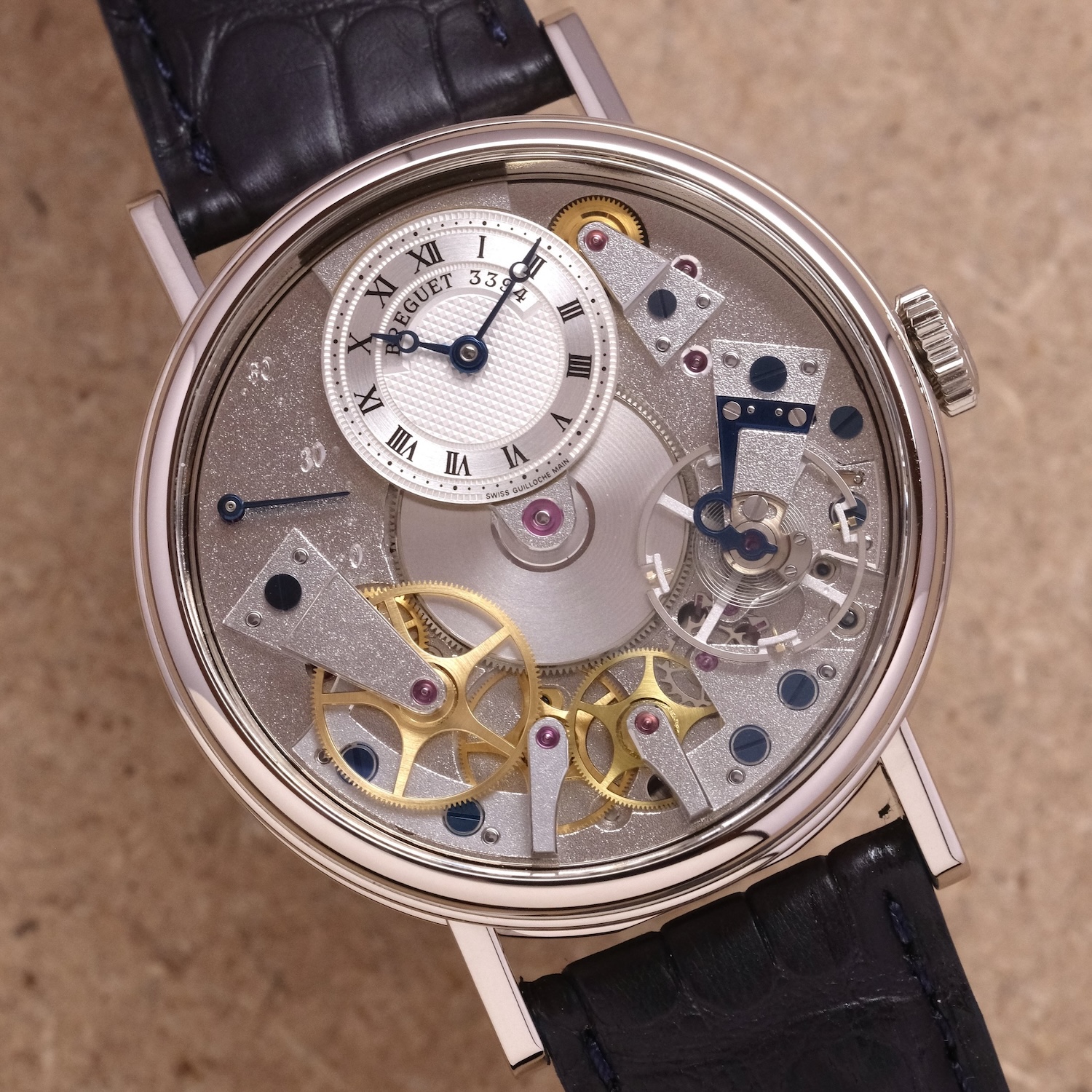
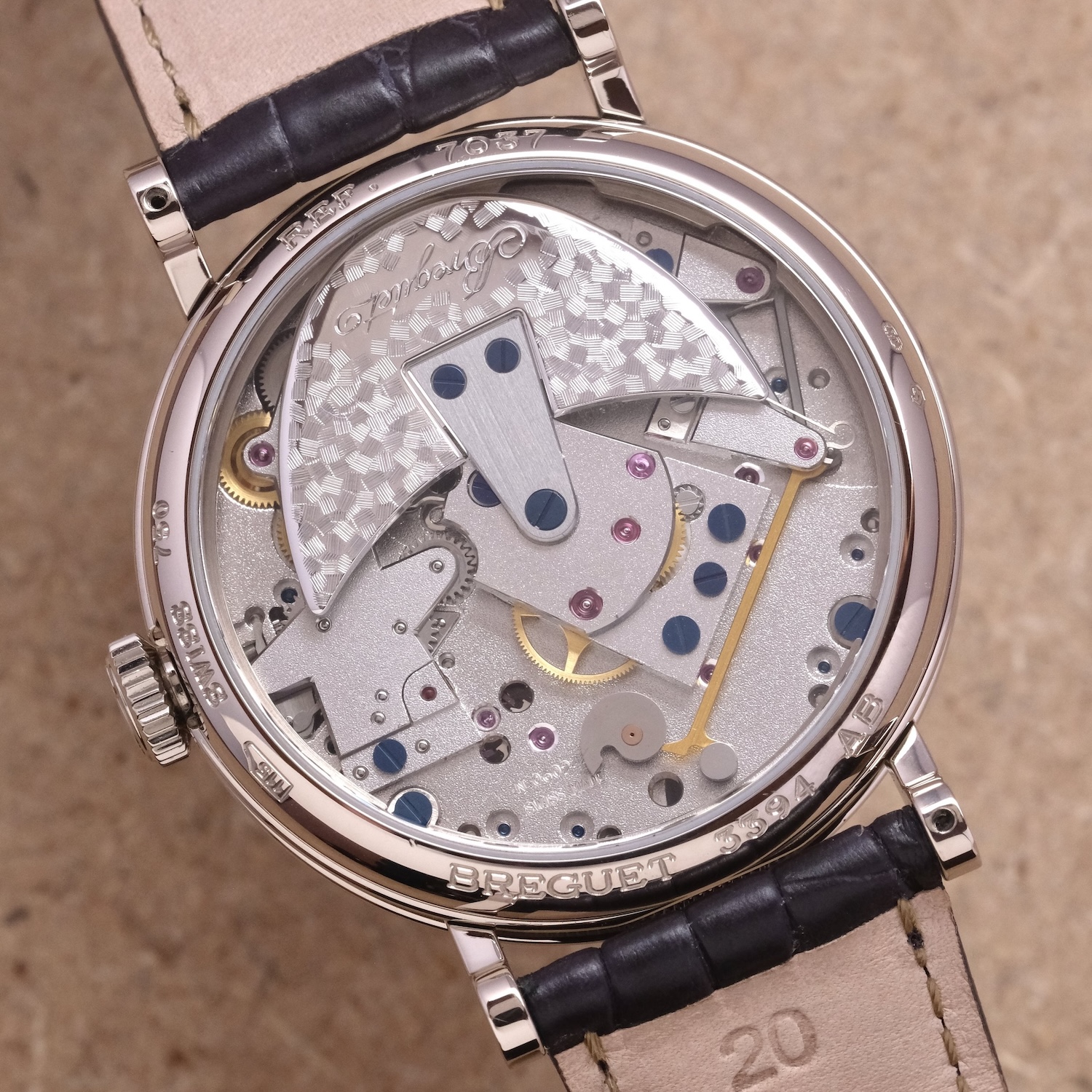
What Breguet did is actually very remarkable, as they essentially recreated an antique pocket watch movement and put it in a wristwatch. And back in 2005, that simply wasn’t done. The Tradition encompasses all of the Souscription’s core elements: the central barrel, the triangular stepped bridges, the shock-absorber over the balance staff shaped like an antique para-chute, and so on. Both the manually wound Ref. 7027 and the automatic Ref. 7037 that followed a year later paved the way for many more references, all respecting that unique movement construction. The barrel sits at the heart of all of them, as it did in the original Souscription, with everything else arranged around the centre.
A vessel for complexity
With the tourbillon being one of Breguet’s most acclaimed achievements, it’s only natural that this found its way into the Tradition. Designed to iron out the effect of gravity on the oscillator. A pocket watch in its natural habitat is mostly worn in a pocket, of course, in the same upright position. Gravity pulls on the balance spring and influences the stability of the watch’s precision. The tourbillon puts the balance wheel, spring, lever, and escape wheel inside a cage that rotates on its own axis and therefore, gravity pulls equally on all sides of the escapement.
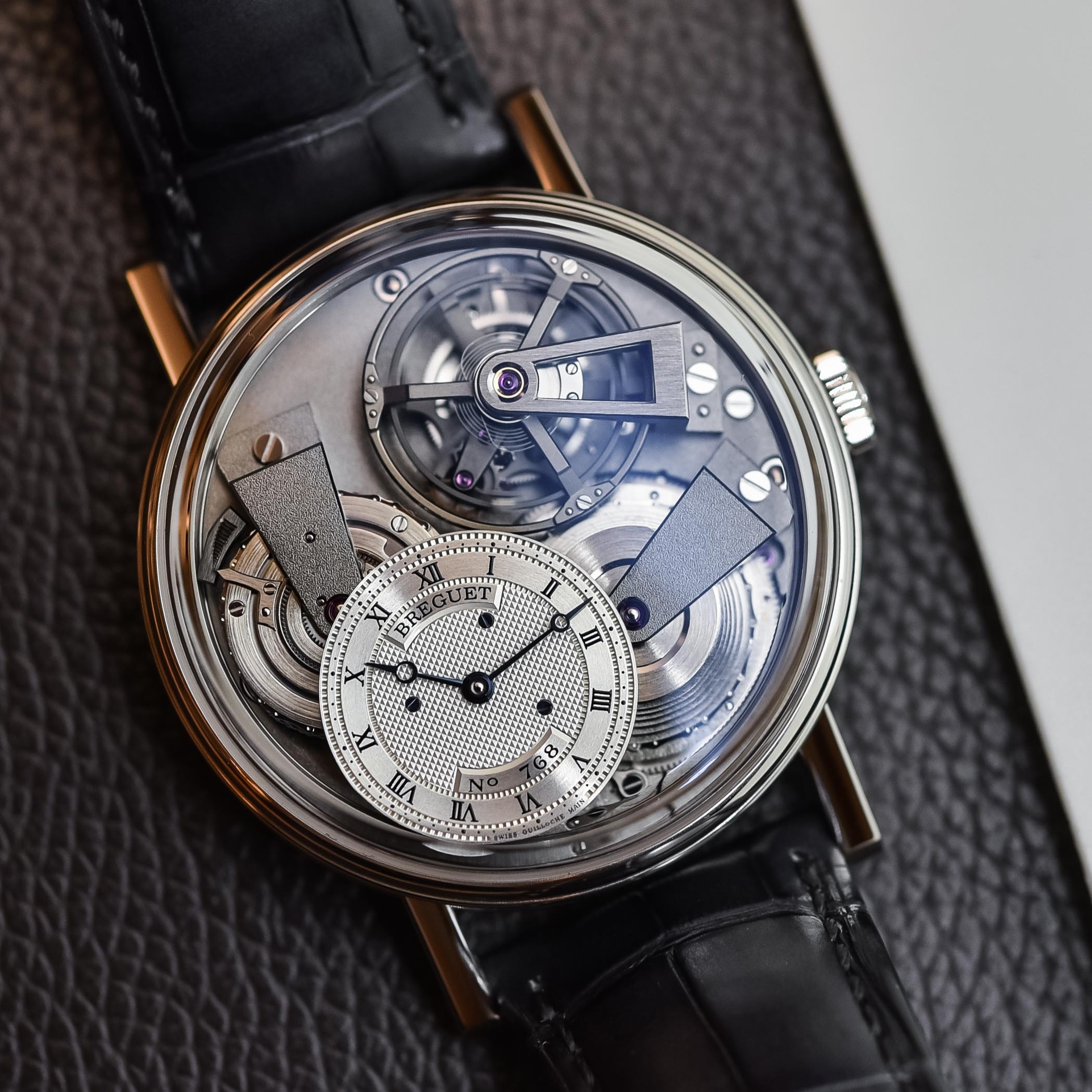
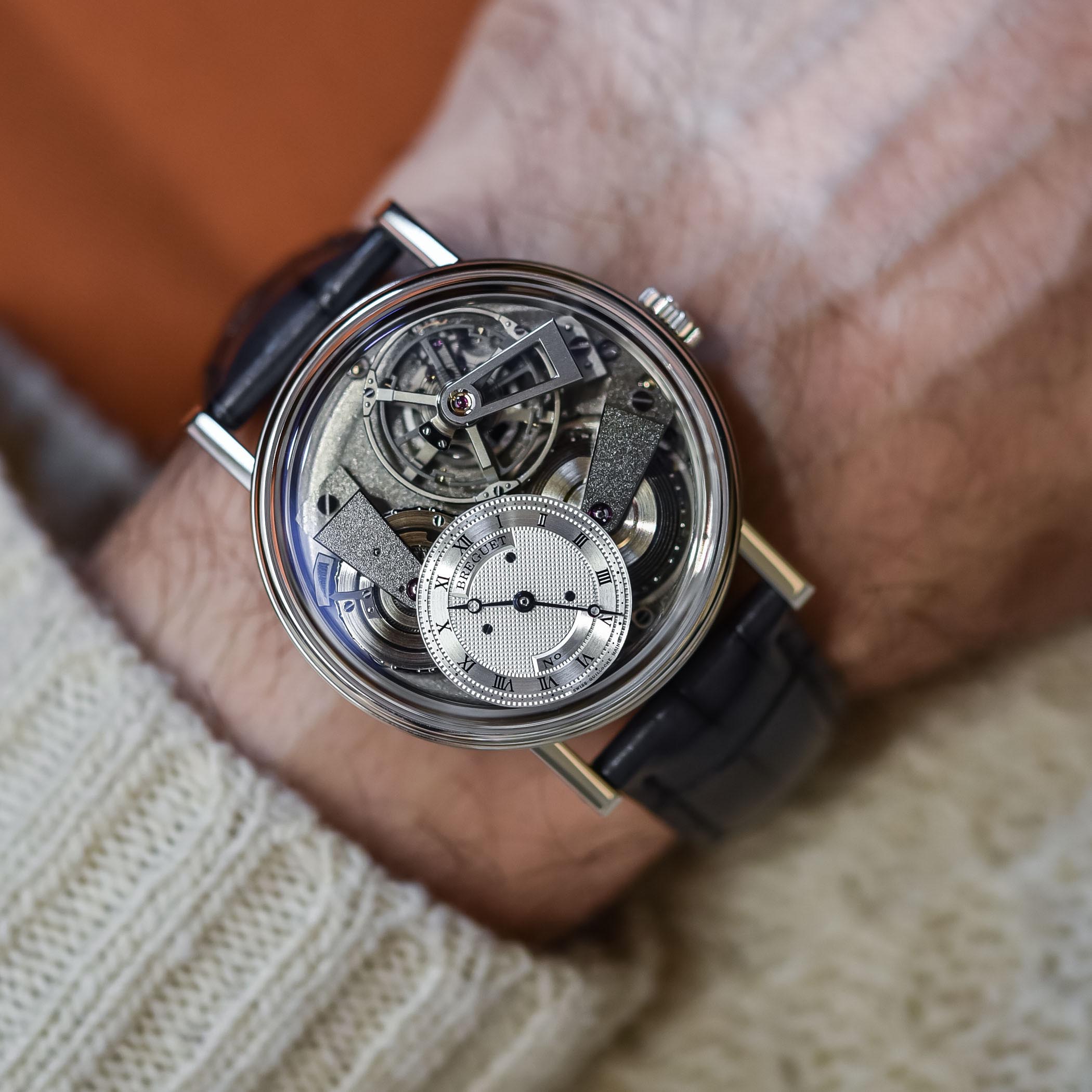
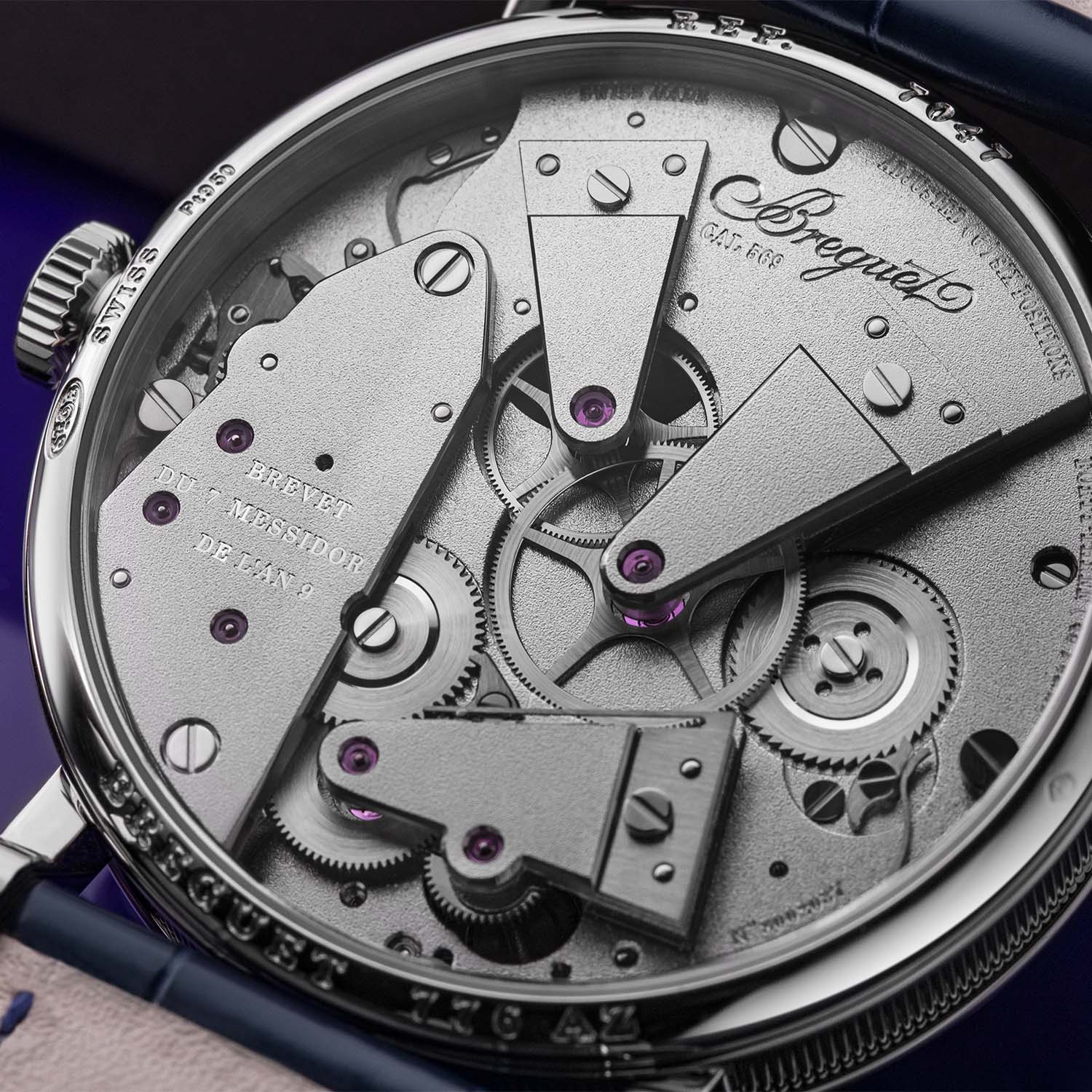
The Tradition Tourbillon 7047 puts a one-minute tourbillon escapement in the top right corner, suspended under a single stepped bridge. It’s connected to a fusée-and-chain mechanism below it, a complex mechanism of a chain coiling around two conical-shaped barrels designed to achieve a constant level of force throughout the watch’s running time. But don’t be fooled into thinking this watch is purely about tradition, as the tourbillon escapement features modern materials such as titanium and silicon to improve the mechanism’s specifics.
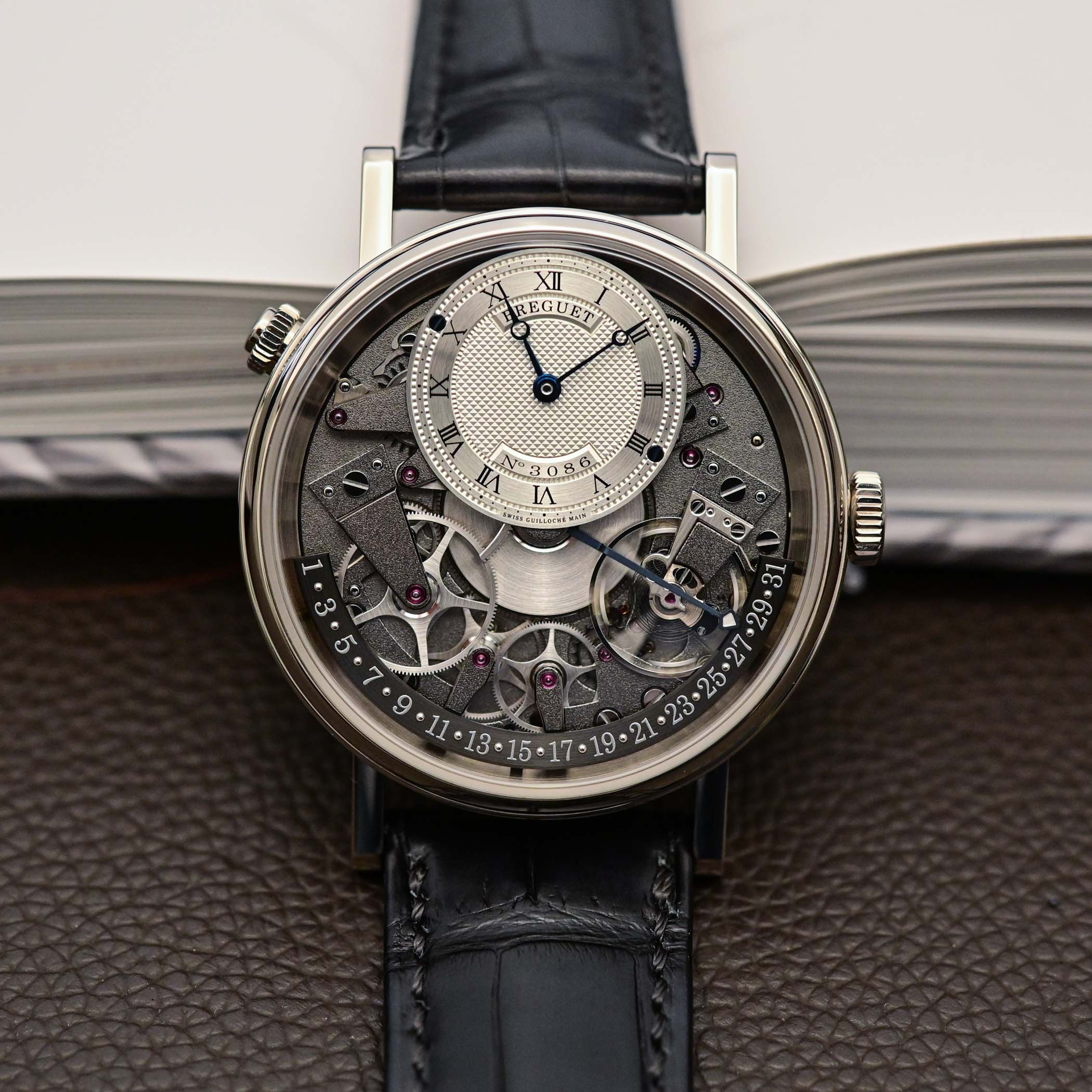
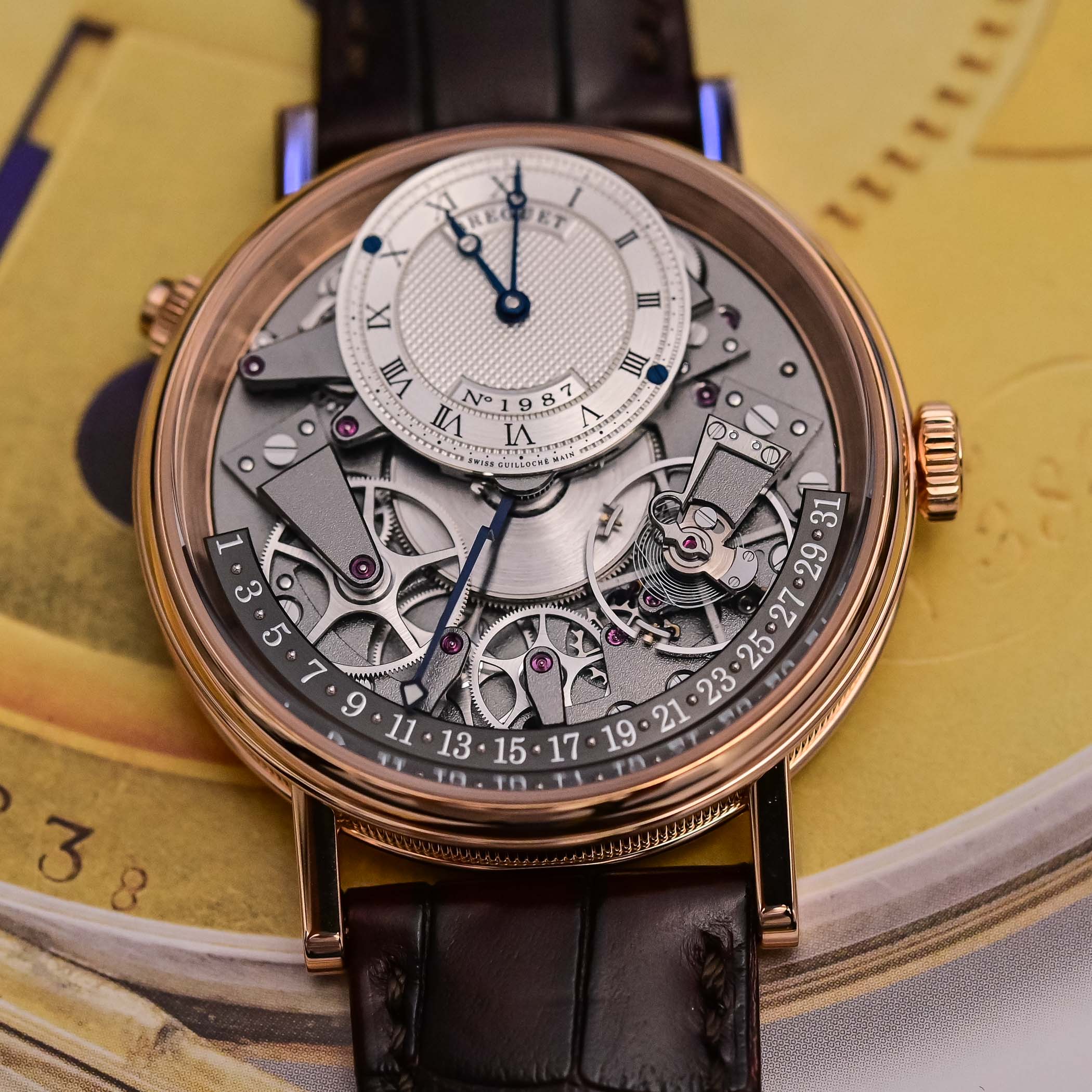
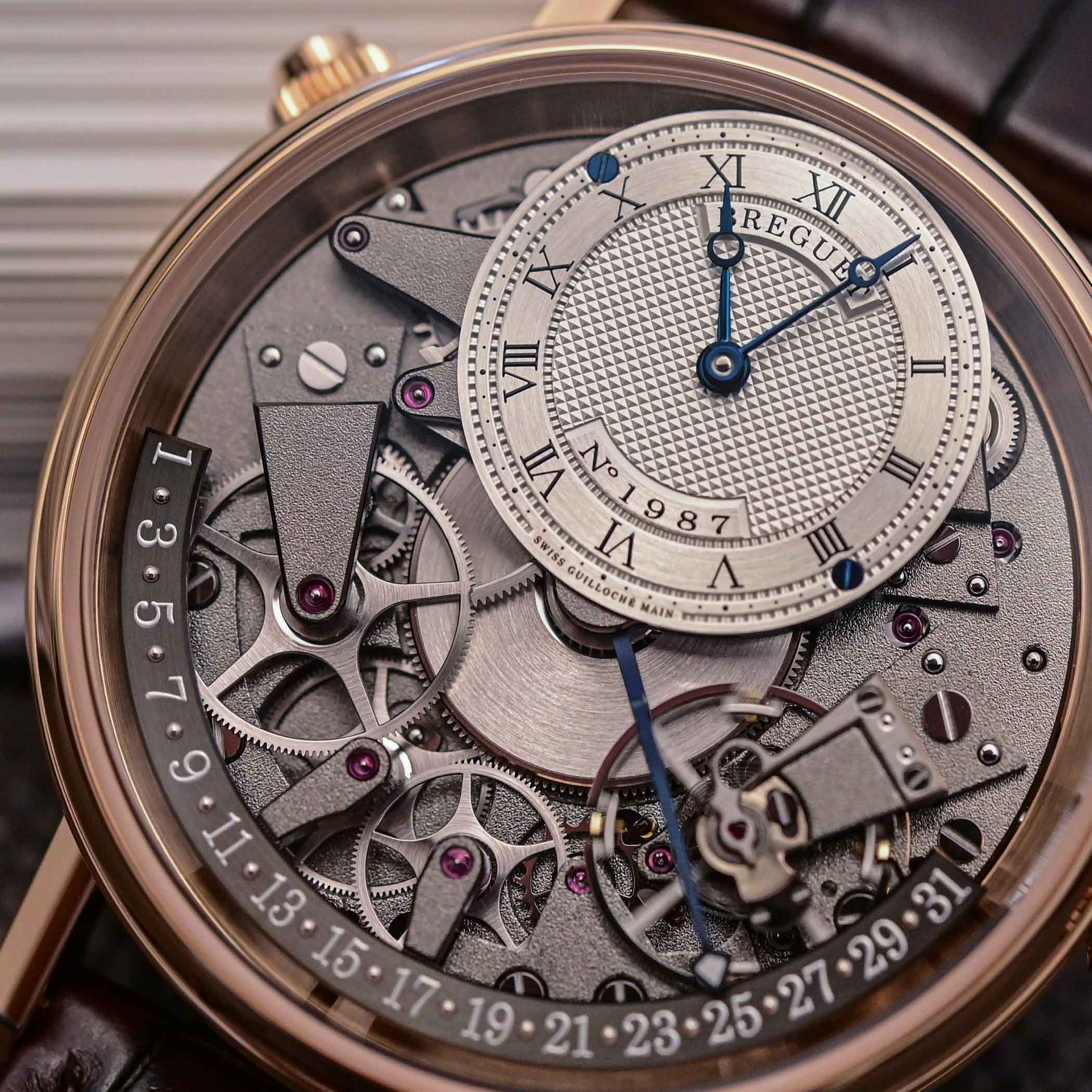
Another example that embodies the essence of Breguet is the Tradition Quantième Rétrograde 7597 and its clever date indication. The Clous de Paris guilloché-decorated dial for the hours and minutes is now pushed to noon, with the bottom half reserved for the retrograde display of the date, a mechanism seen in many of Breguet’s early watches. A central hand follows an arched path from the 1st of the month to the 31st, after which it jumps back to its original position to start all over again. Respecting the symmetry of the movement, it’s a perfect execution for what’s often seen as a simple complication. Here, however, given the centrally mounted barrel and the position of the escapement, the date hand needs to be shaped by hand to pass over the balance and centre wheel. It’s those little details that make the Tradition collection such a splendid representation of Breguet’s work.
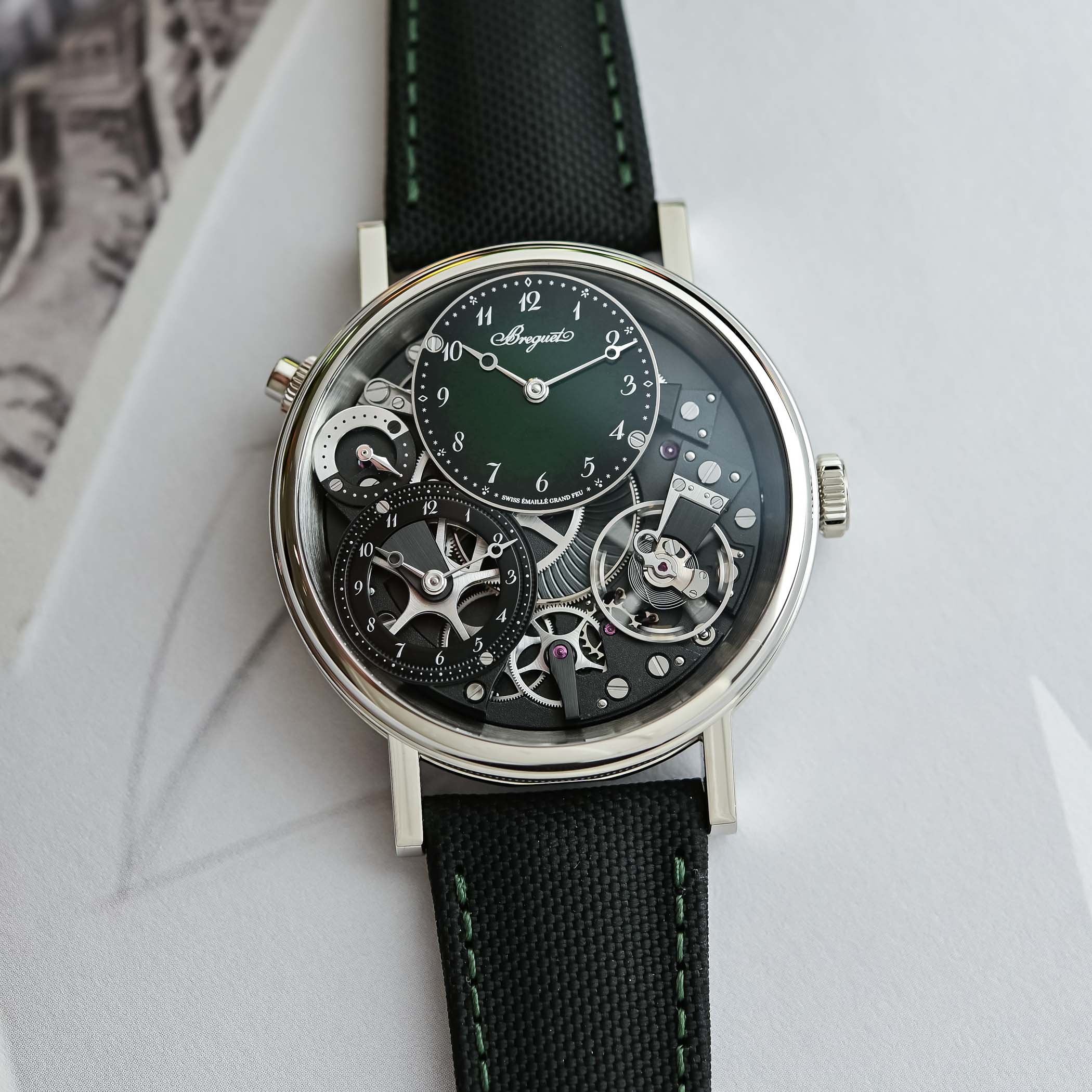
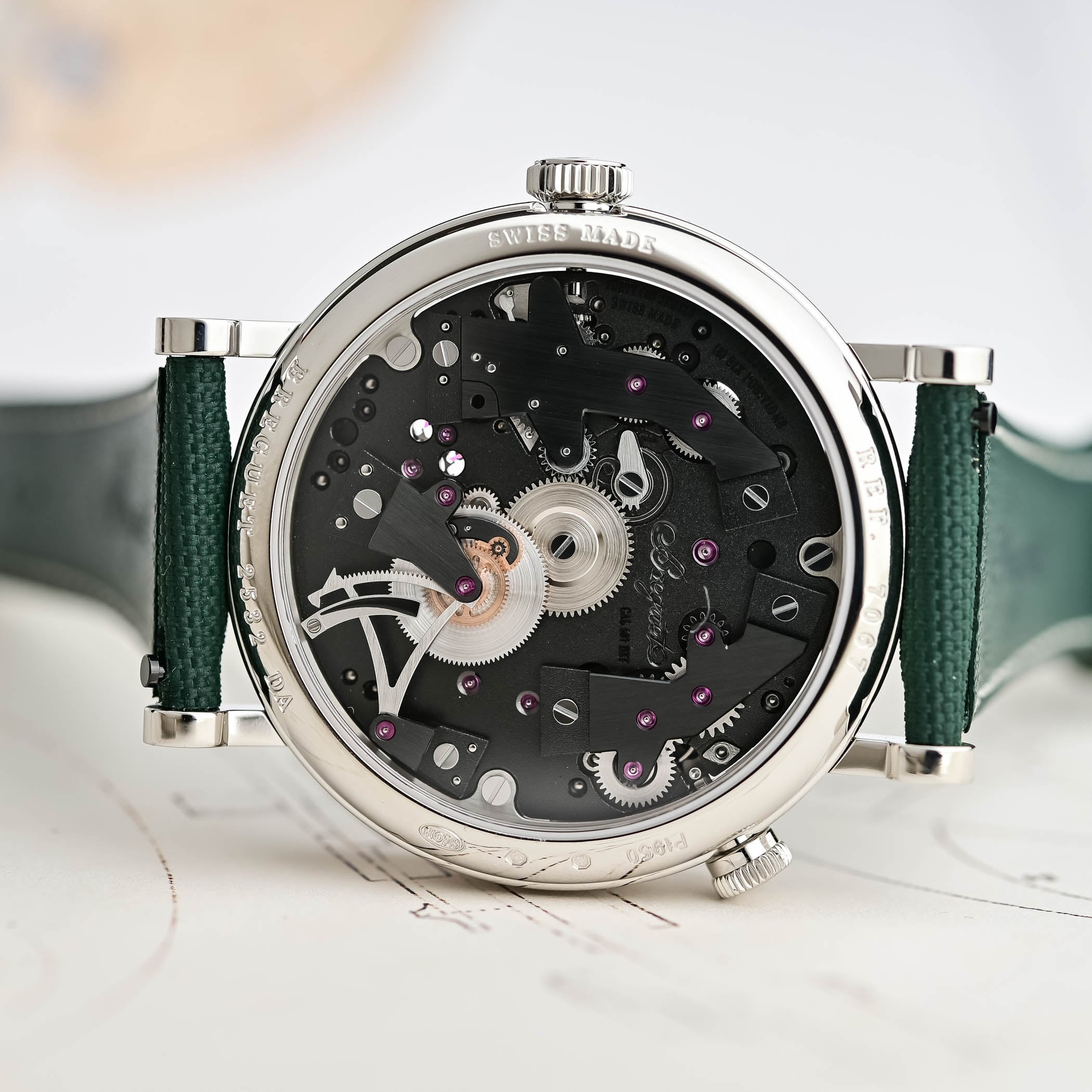
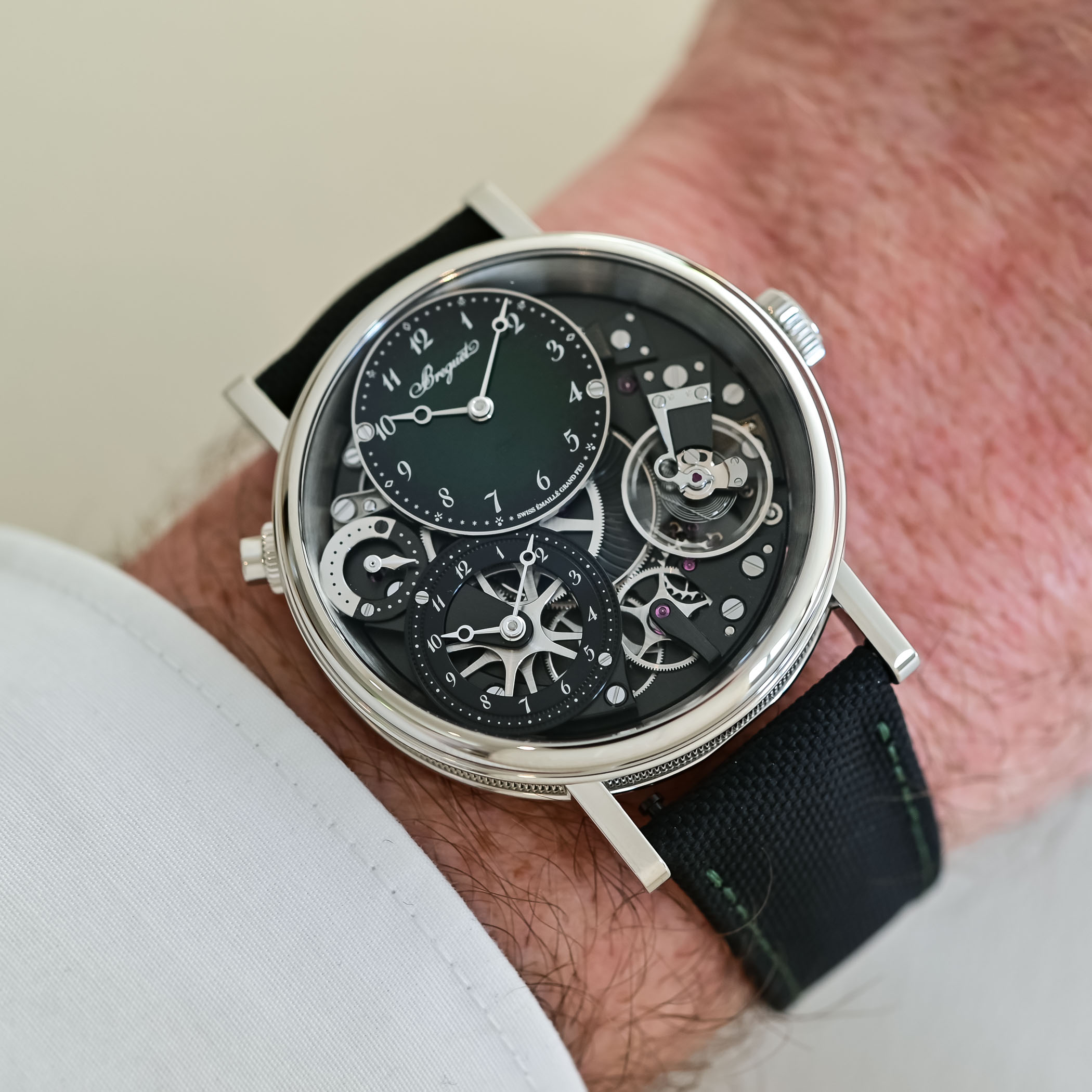
Fit for the modern traveller yet still rooted in history, the Tradition GMT 7067 is the perfect blend of old and new. It honours the design codes of the collection and the brand, yet pairs it with the practicality of a GMT function, something that would seem fit for today’s fast-paced world. We again see the signature stepped bridges, the off-centred dial with guilloché finishing and blued Breguet hands, yet now with a secondary display in the lower-left side of the case. This secondary display of time can be independently set through the crown at 10 o’clock and comes with an additional day/night indication as well. The finishing is also a merger of tradition and modernity, with a grained texture on top of the bridges and plates, polished bevelled edges, polished screw hands an so on. This continues around the back, where you will also find the power reserve indication, always very useful in a manually wound watch. The latest renditions of the Tradition GMT 7067 also show a bit of frivolity, through a gradient green-to-black dial, for instance.
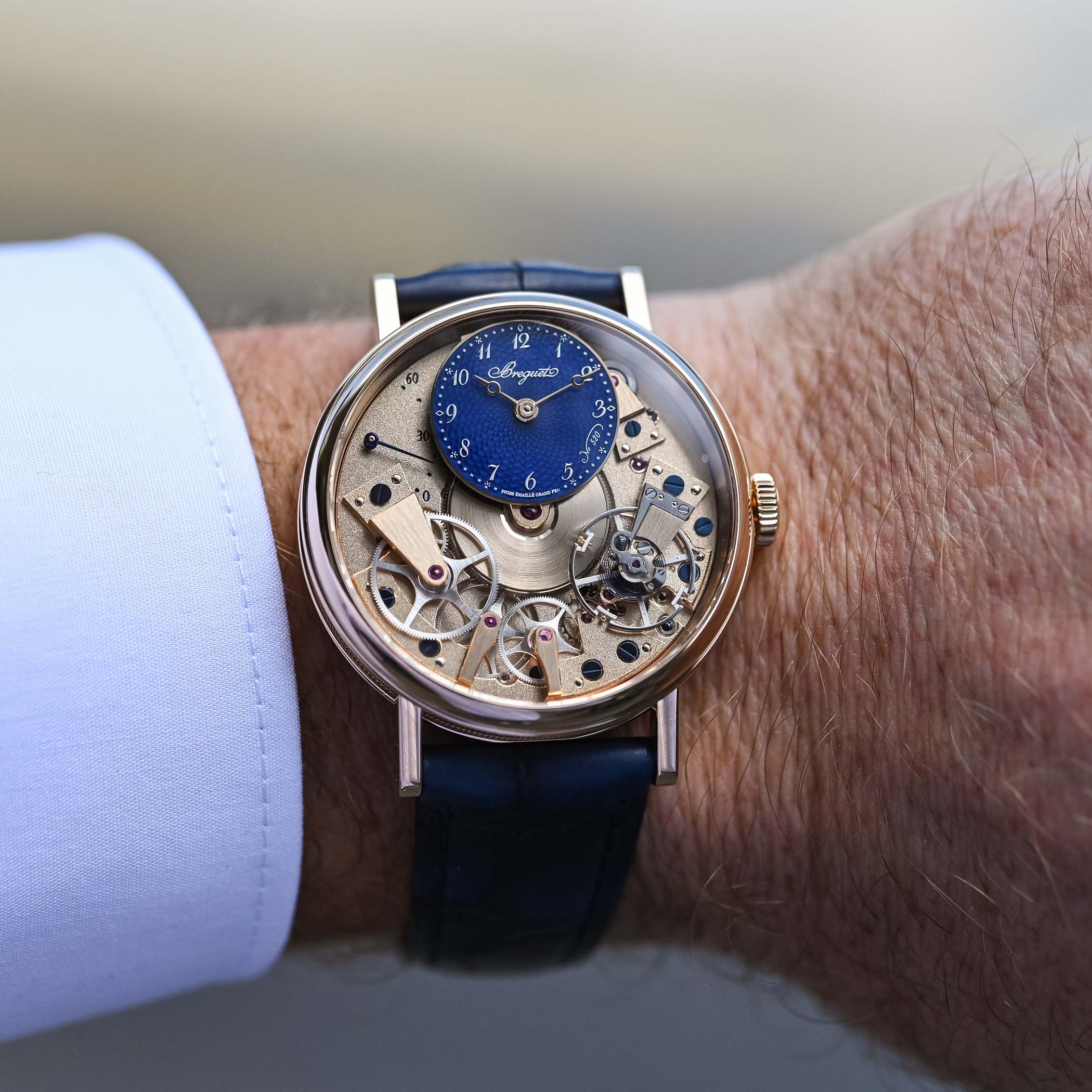
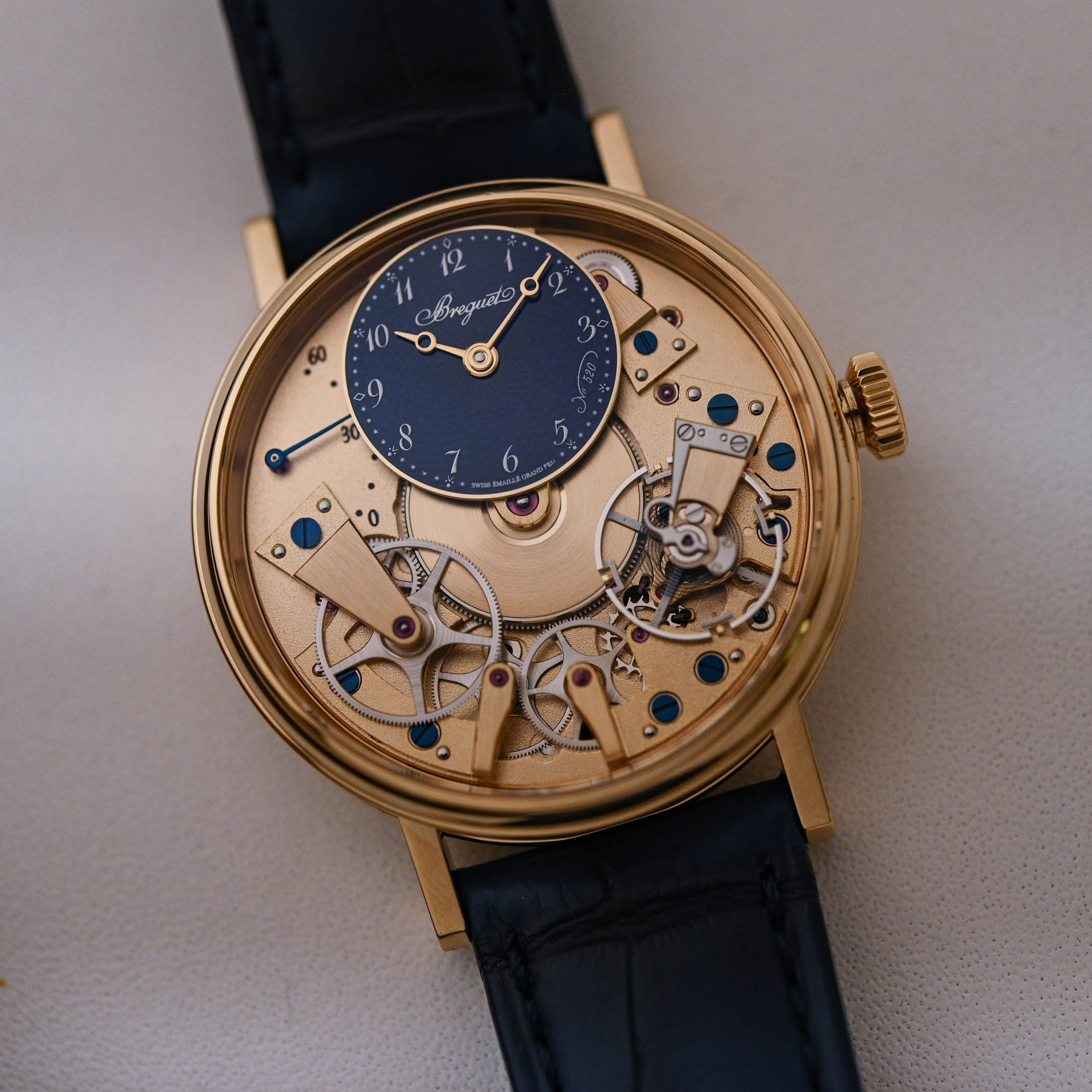
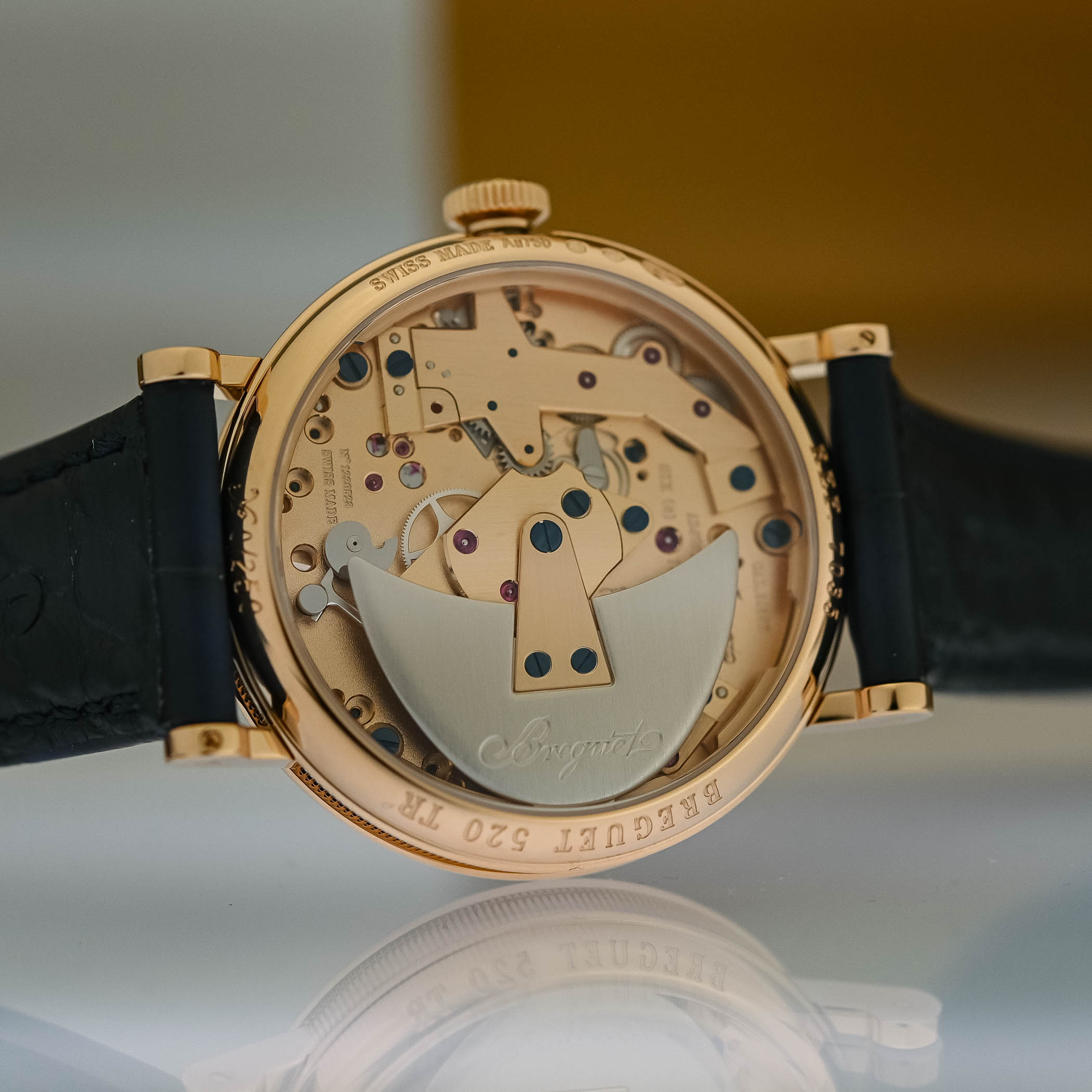
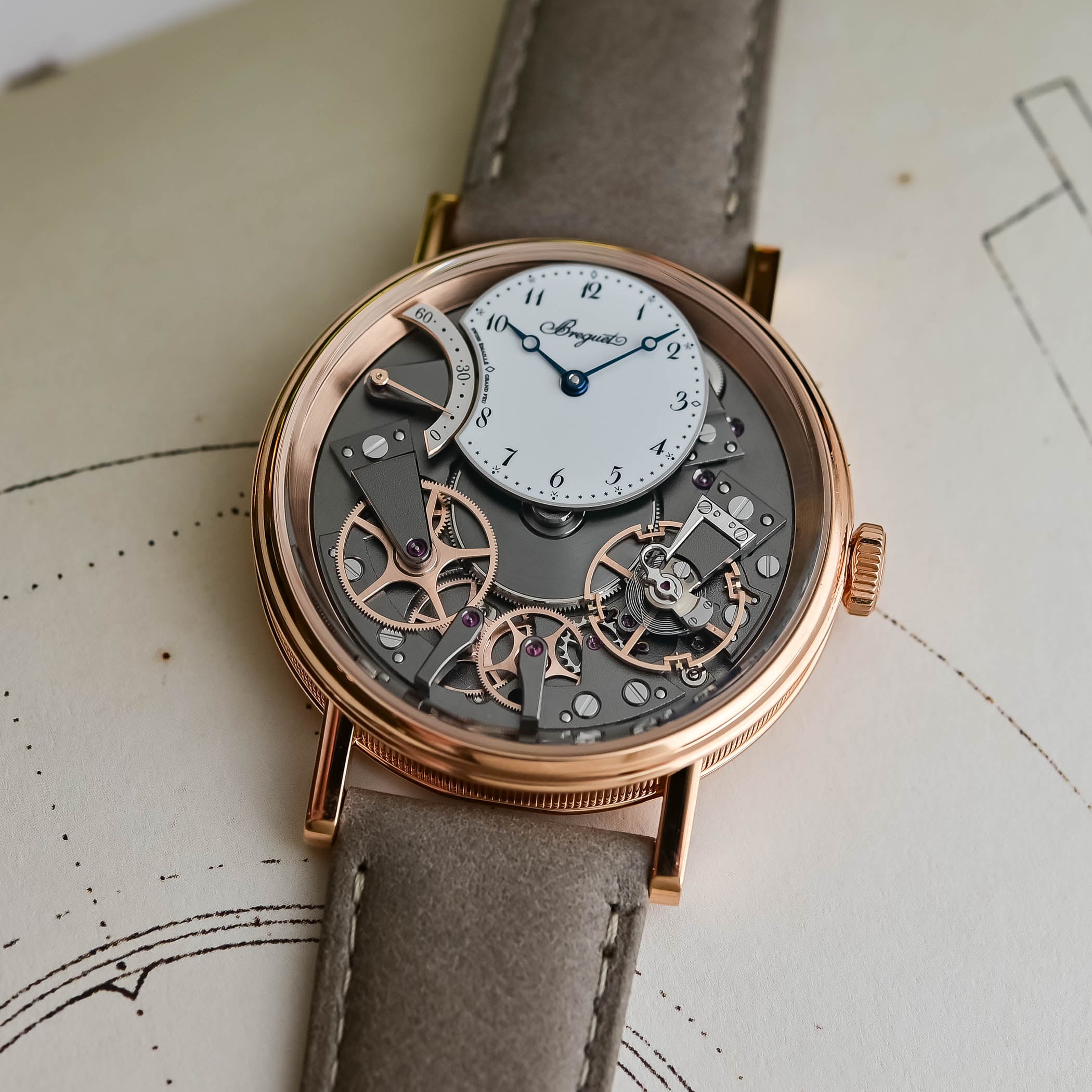
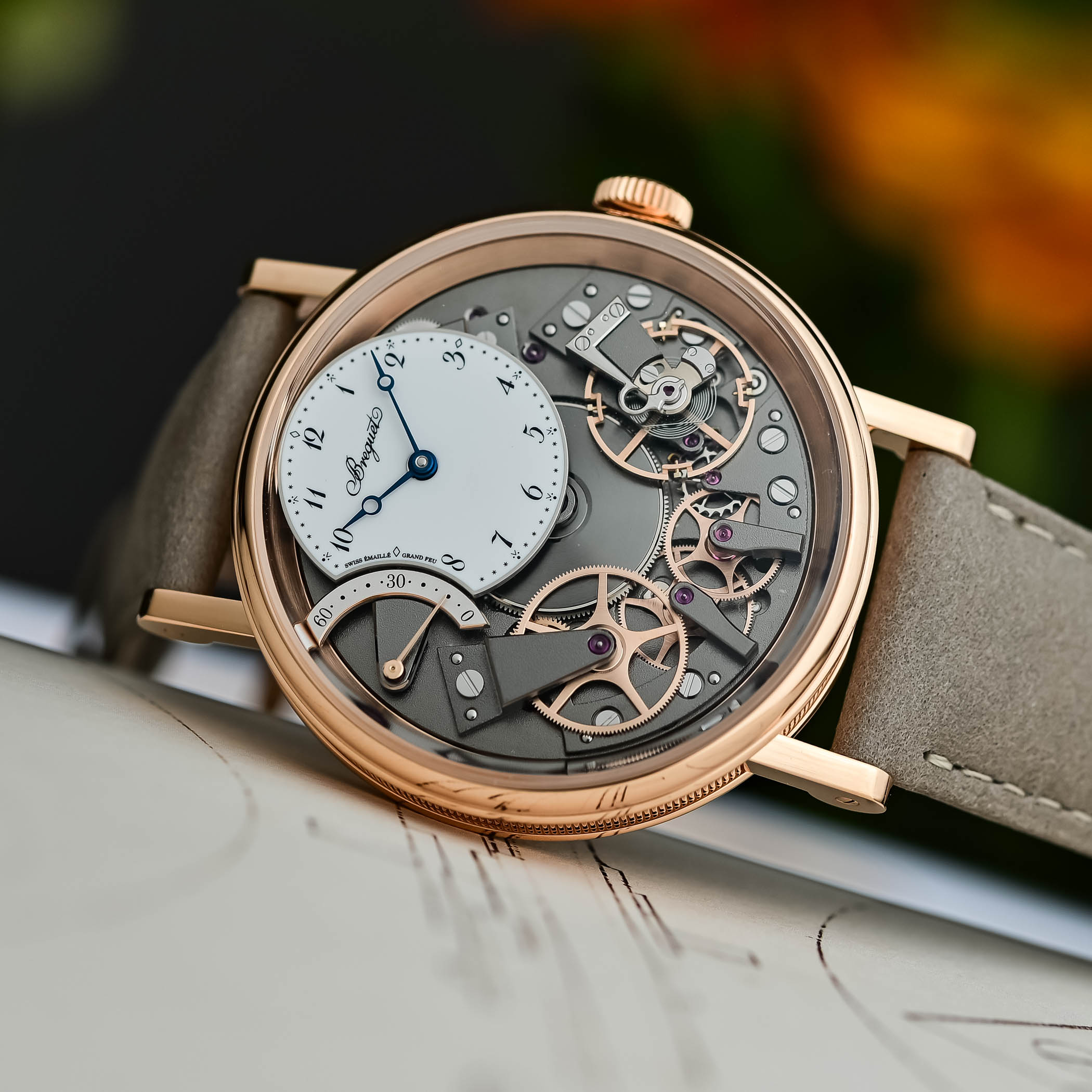
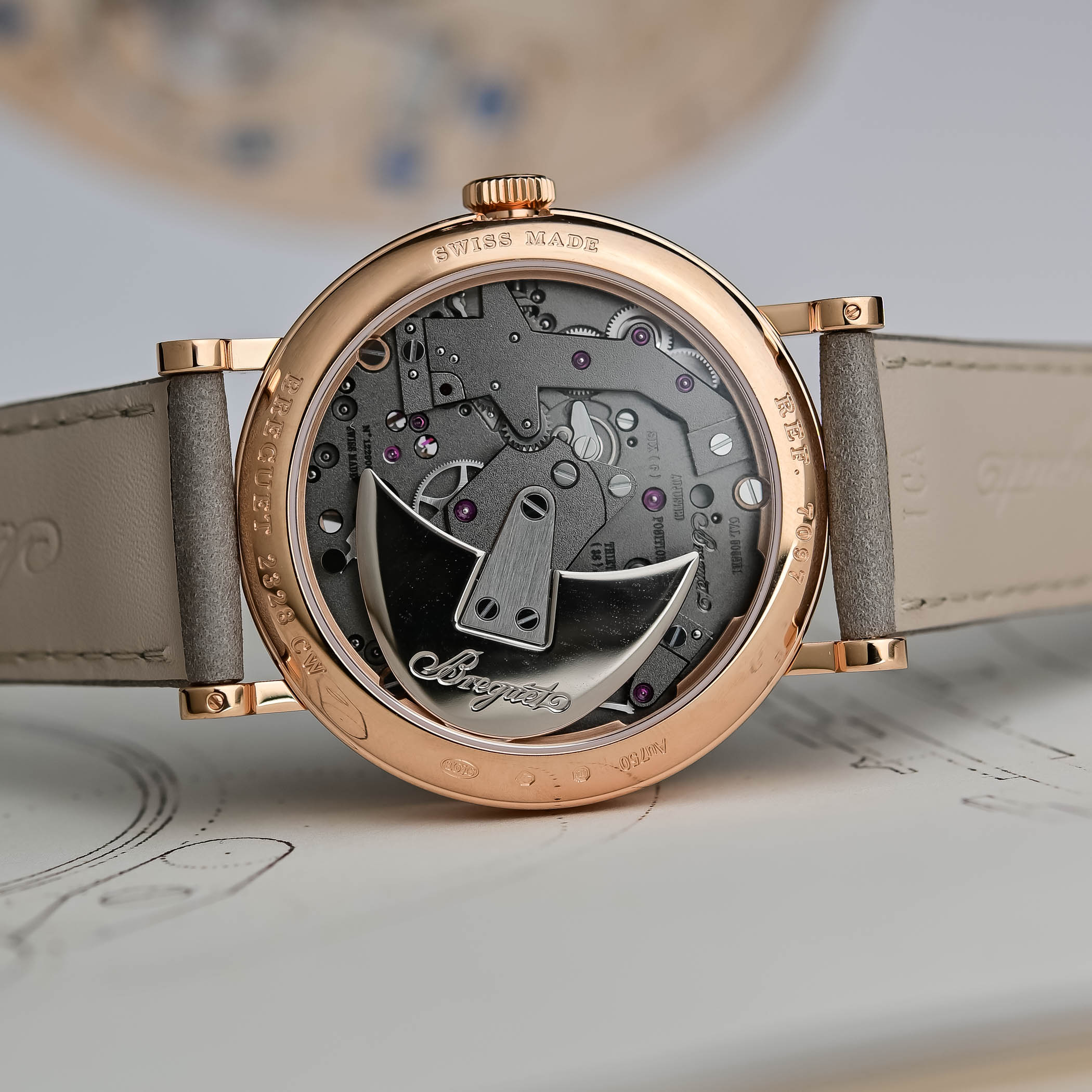
Last but certainly not least is the purest representation of the Tradition available today, the Tradition Seconde Rétrograde 7035. Presented as part of the 250th anniversary models as a leading example, we again find the typical Tradition traits. A fluted caseband, stepped bridges to hold the balance wheel and gear train in position, and a simple yet practical power reserve indication. However, if you turn this one over, it parts with the manually wound construction and offers an automatic winding system instead. Modelled after the blade-like winding mass in the Pérpetuelle from 1780, it’s another nod to Breguet’s unrelenting push for innovation that made him one of the greatest watchmakers in history. Yet modernity is found here as well, as the rotor is mounted on a ceramic ball bearing, reducing wear and increasing winding efficiency.
Breguet Then, now and into the future
The Tradition collection perfectly bridges past, present and future, as it relies on Breguet’s unmistakable signs while also pushing forward in terms of watchmaking innovation. Watches such as the Tradition Tourbillon 7047 keep Abraham-Louis Breguet’s most famous invention alive and kicking for years to come. The Tradition Quantième Rétrograde 7597 combines Breguet’s signature design codes and pairs them with complex calendar watchmaking, while the Tradition Retrograde 7035 is one of the purest expressions of the master’s philosophy.
To quote Gregory Kissling, CEO of Breguet under the Swatch Group umbrella: “The idea is to build on what has already been done, from the time of Abraham-Louis Breguet to the present day, always with an eye toward innovation. But not innovation for its own sake, but rather innovation that brings value to our watches, and thus our clients.”
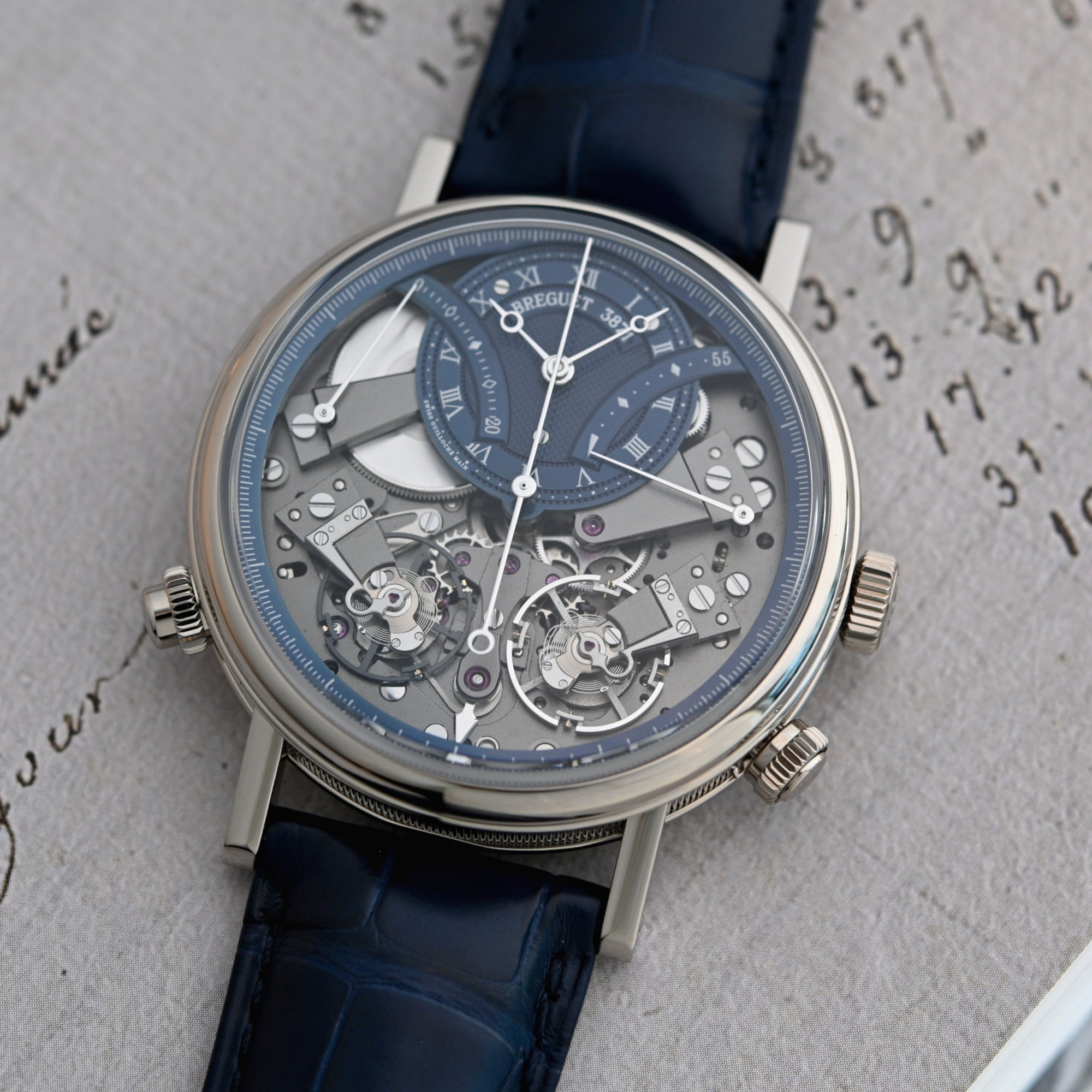
So with all that said, if you’re looking for a watch that truly embodies historical watchmaking by one of the greatest to ever work in the industry, while also incorporating modern materials and solutions, the Breguet Tradition collection is where you will find it. For more information, please visit breguet.com.

1 response
One phenomenal watch, at the price (2nd hand) of some ugly steel Rolex. It’s also very accurate.