


 Not all images were able to load for printing. Please close the print window and try again.
 All the new Dials for the Rolex Datejust in 2026, and There’s Much More than the Green Ombré
Rolex only talked about the gradient green version... Guess what? There are dozens of other new dials and configurations.
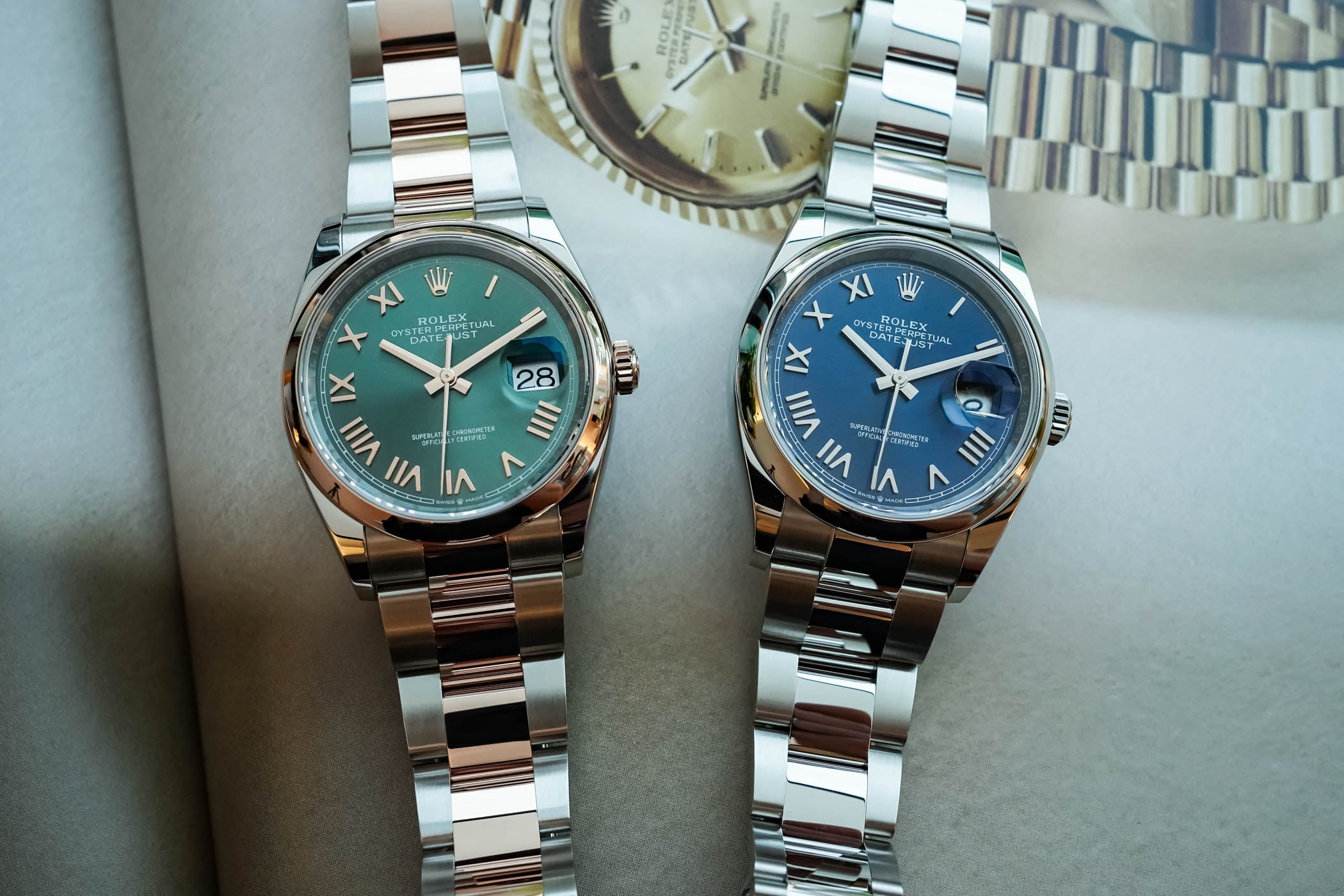
For 2026, Rolex had a pretty big year at Watches and Wonders Geneva. There was, of course, the much-debated high-end Rolesium and enamel Daytona, the revamped Yacht-Master II, or a new gold alloy named Jubilee gold for the Day-Date. Then, the Crown publicly showed the special edition steel and gold Oyster Perpetual 100th Anniversary. You thought this was only available in 41mm…? Wrong, as there are also 36mm and 31mm options. The same goes for the bold Oyster Perpetual with multi-coloured Jubilee dial. Only showed in 36mm, while 41mm and 31mm options exist. As for the Datejust, Rolex publicly released only one new reference, a 41mm model with a fluted bezel, Oyster bracelet and a new green ombré dial. Was it all…? Well, far, very far from it. In total, Rolex has released well over 100 new references in its Datejust collection, including a rather profound redesign of the models with Roman numerals. And we got the chance to go hands-on with a large number of these new versions.
Before we talk about the lesser-known additions to the Datejust collection, let’s have a quick look at what was the star of the show for the brand at Watches and Wonders Geneva 2026, the green ombré versions (yes, once again, there is more than just one…)
The Datejust with Green Ombre dial
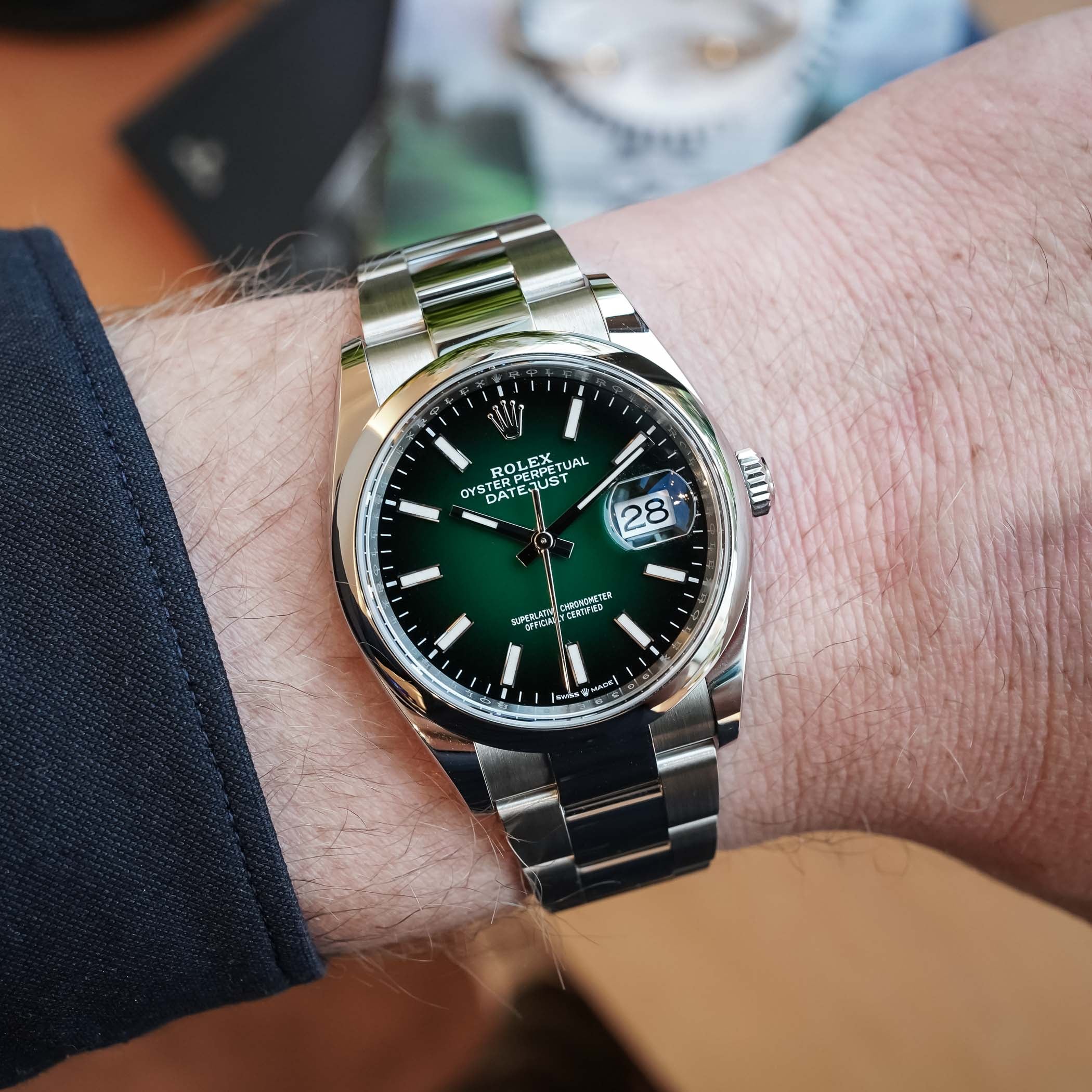
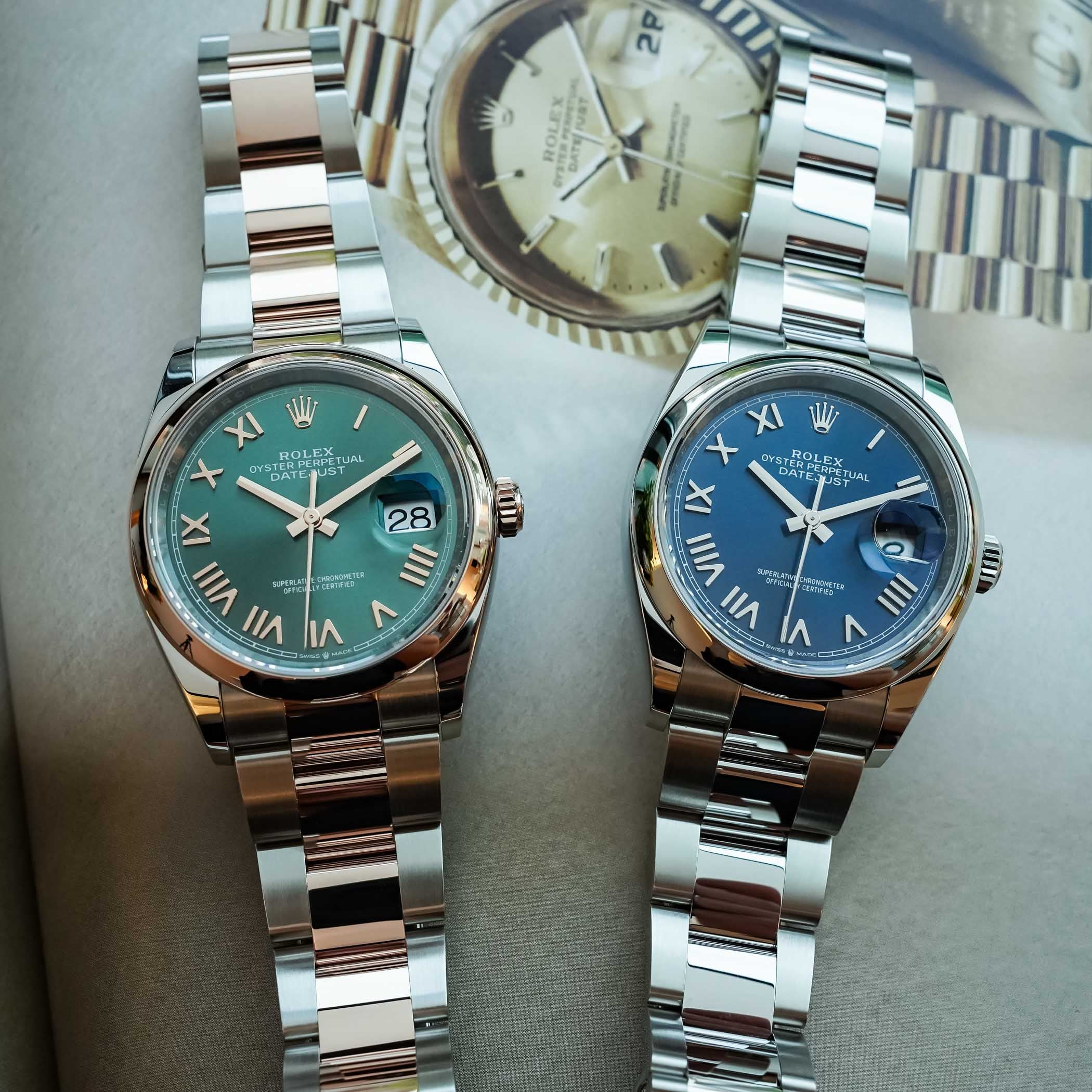
If Rolex mostly talked about this new dial variant, it is for a good reason. It objectively looks quite fantastic. A style that’s been applied for some years already to the Datejust’s bigger brother, the higher-end Day-Date, the ombré dial (Rolex’s name for a smoked, gradient effect) finds its way in the brand’s most classic watch now. As said, Rolex only publicly displayed a 41mm version in steel, with an Oyster bracelet and a white gold fluted bezel, while this green ombré dial is actually present on 8 different references: 36mm or 41mm, Oyster or Jubilee bracelet, smooth or fluted bezel.
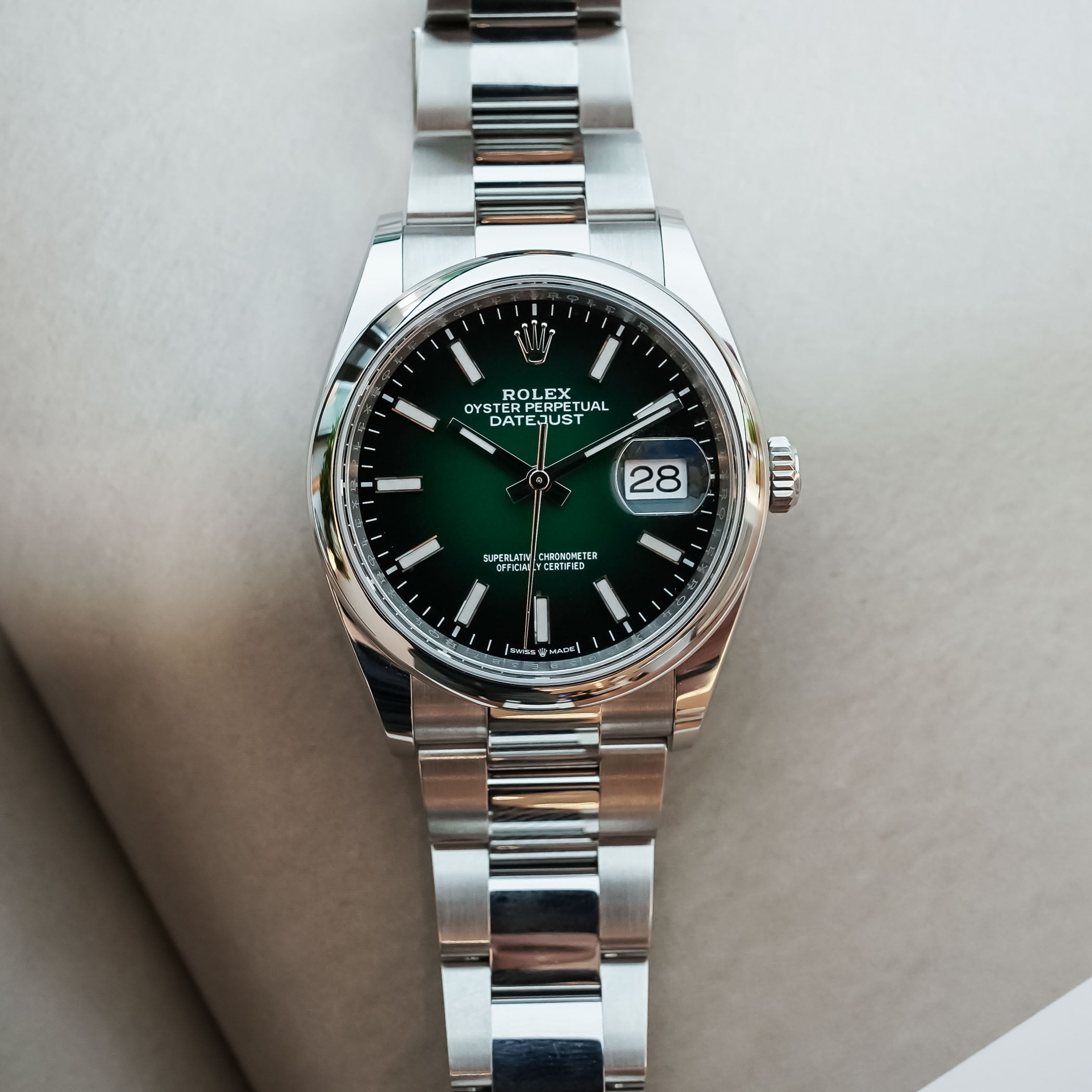
We had the chance to see two other variants of this watch for our hands-on session at Rolex’s HQ in Brussels, both with smooth steel bezels and Oyster bracelets, on the 36mm and 41mm versions. The whole story turns around the new dial, of course, which retains the classic baton markers in white gold, with white luminous material, and baton-style handset. Nothing new here, as the watch remains other than dial identical to the models presented in 2016 and 2017, when the Datejust received the new 3235 movement.
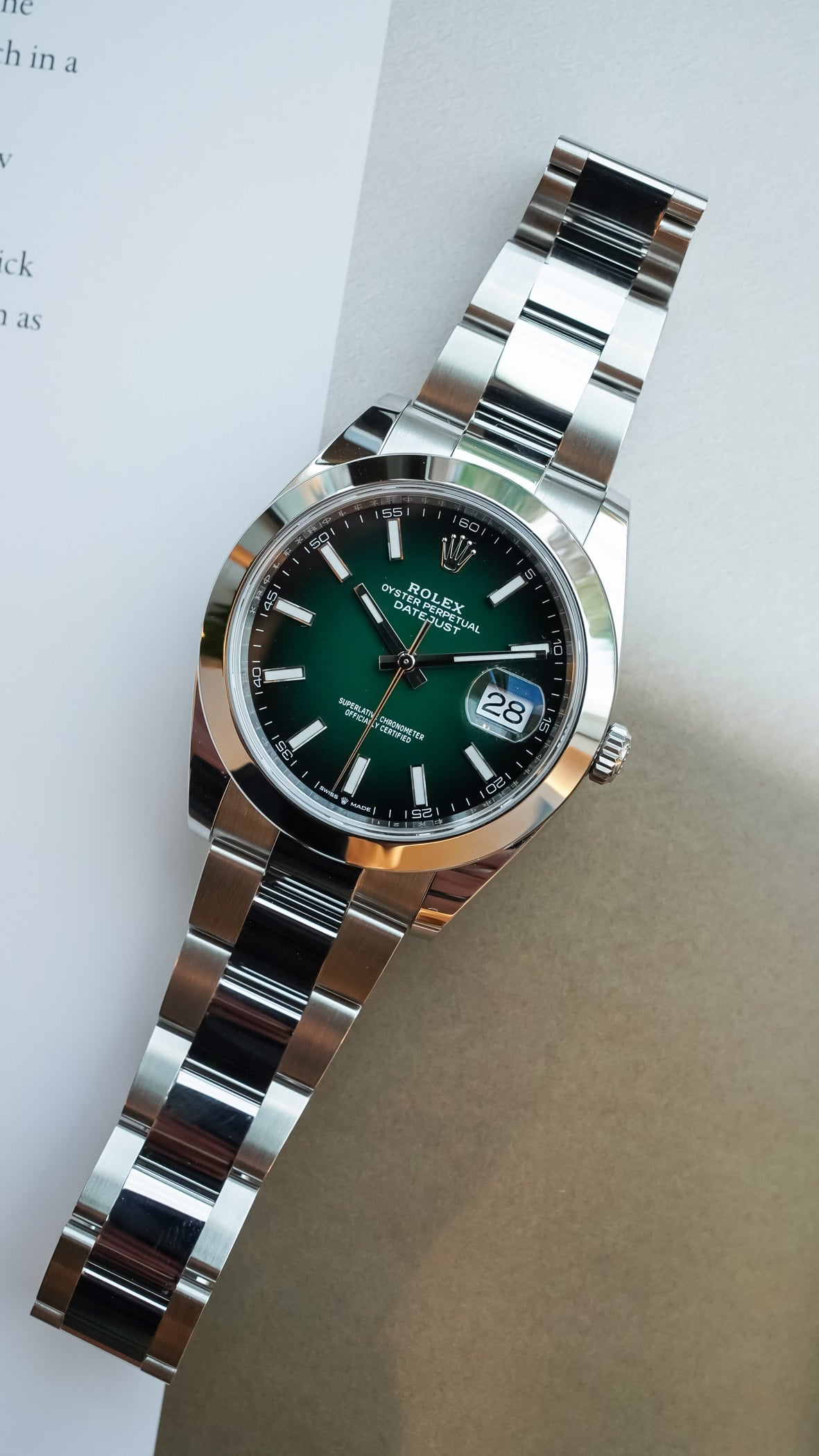
This new dial is coloured entirely by lacquering – a first for an ombré dial since the pattern was reintroduced to the brand’s catalogue in 2019. Green lacquer is applied to the base plate, then, as with all ombré dials, the colour gradient is created by spraying black lacquer in concentric motions. The result is a dial that’s discreetly coloured, more animated and quite elegant. Modern, fresh and certainly very appealing.
36mm or 41mm… Two very different options
Having the chance to photograph multiple versions of the Datejust also reminded me how different the 41mm and 36mm editions are. Many think that the smaller version is just a downsized model, equipped with the same movement. But the story goes much further than just scaling down all elements. Having both sizes of the Datejust next to each other is an eye-opening moment, when you realise that these two couldn’t be so different.
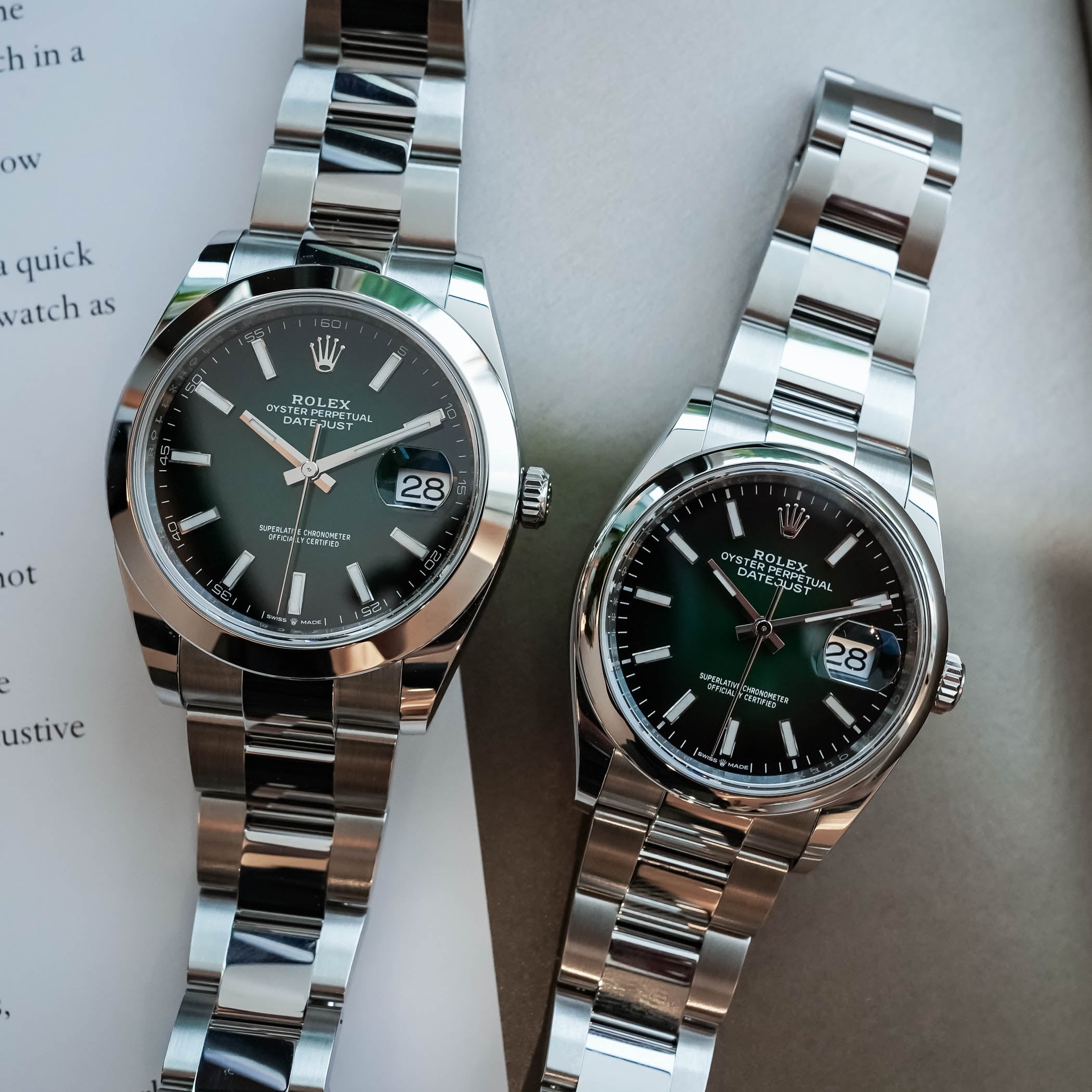
First, lets quicky compare the dimensions. The 36mm version is 11.8mm in thickness (not including the cyclops), 43.1mm in lug-to-lug, has a 20mm lug width and has a dial opening of 30mm (an important measurement for the rest of the story). The 41mm version is 11.6mm in thickness (not including the cyclops), 47.4mm in lug-to-lug, has a 21mm lug width and has a dial opening of 32mm. Both are equipped with the same Calibre 3235 and have a 100m water-resistance. Those are the hard numbers.
But the visual comparison tells a much different story. When you look at both together, you can see that the 41mm has far more bulk and sharpness, with a flat, edgy bezel that is much wider. This is easily explained by the difference between the dial opening and total diameter, measured at 9mm on the 41mm and 6mm on the 36mm. In addition, the smooth steel bezel of the 36mm has a domed profile, not a flat surface (something that visually reduces its size). Also, since the ratio between the case size and lug width is much smaller on the 41mm edition, the “watch head” feels larger still, while the 36mm has more continuity between case and bracelet. Finally, the lugs are much narrower on the 36mm edition, making the watch lighter and more elegant – a feeling that’s reinforced by the more domed flanks of the case.
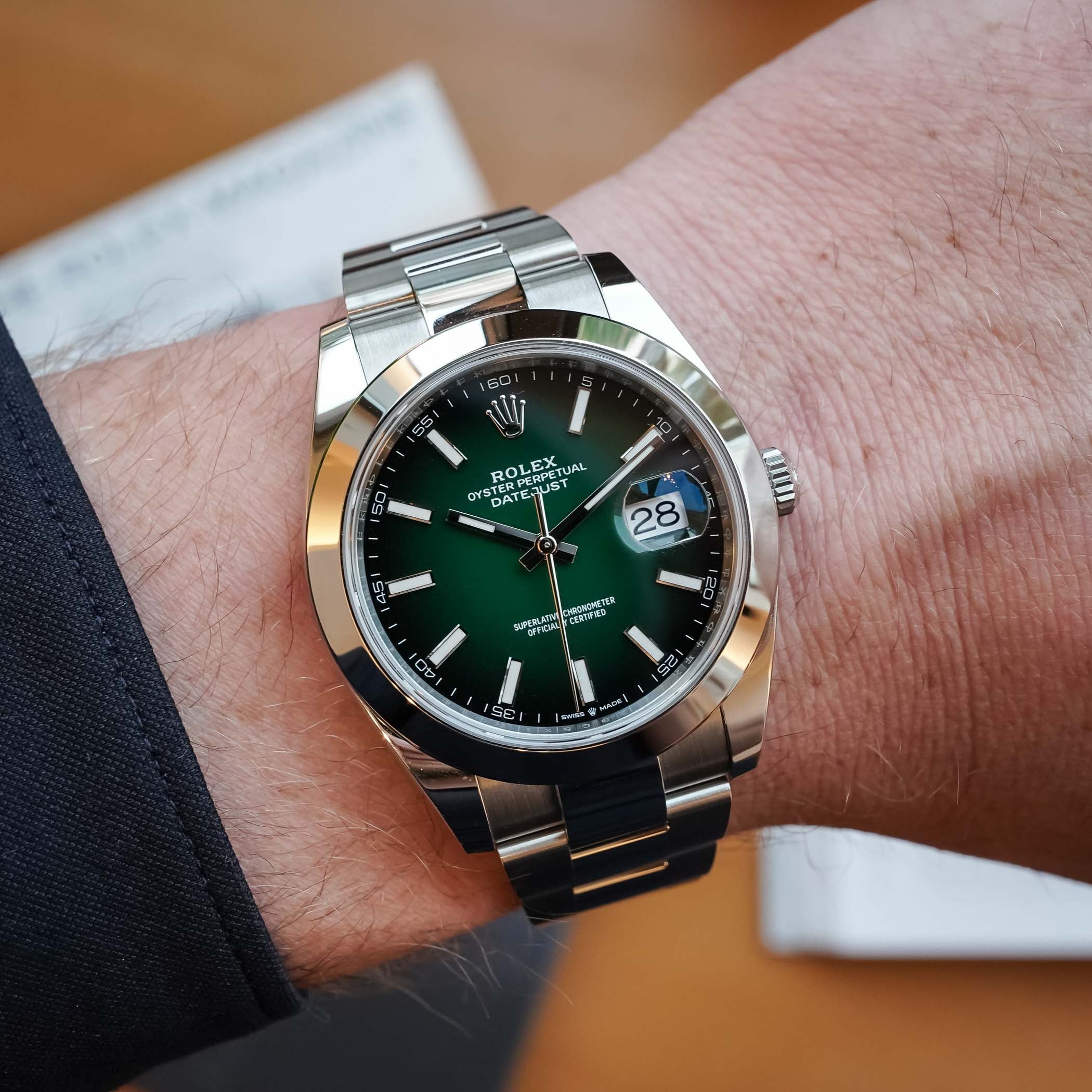
As for the dials, there are some notable differences too. The most obvious one is the presence of a minute scale with numerals on the larger watch, giving it a sportier edge, when the 36mm model only carries a scale with small markers. Of course, it remains a matter of choice, preferences, taste and wrist size, but seeing both models next to each other makes it clear where my money would go… 36mm all the way!
The new dial with Roman numerals
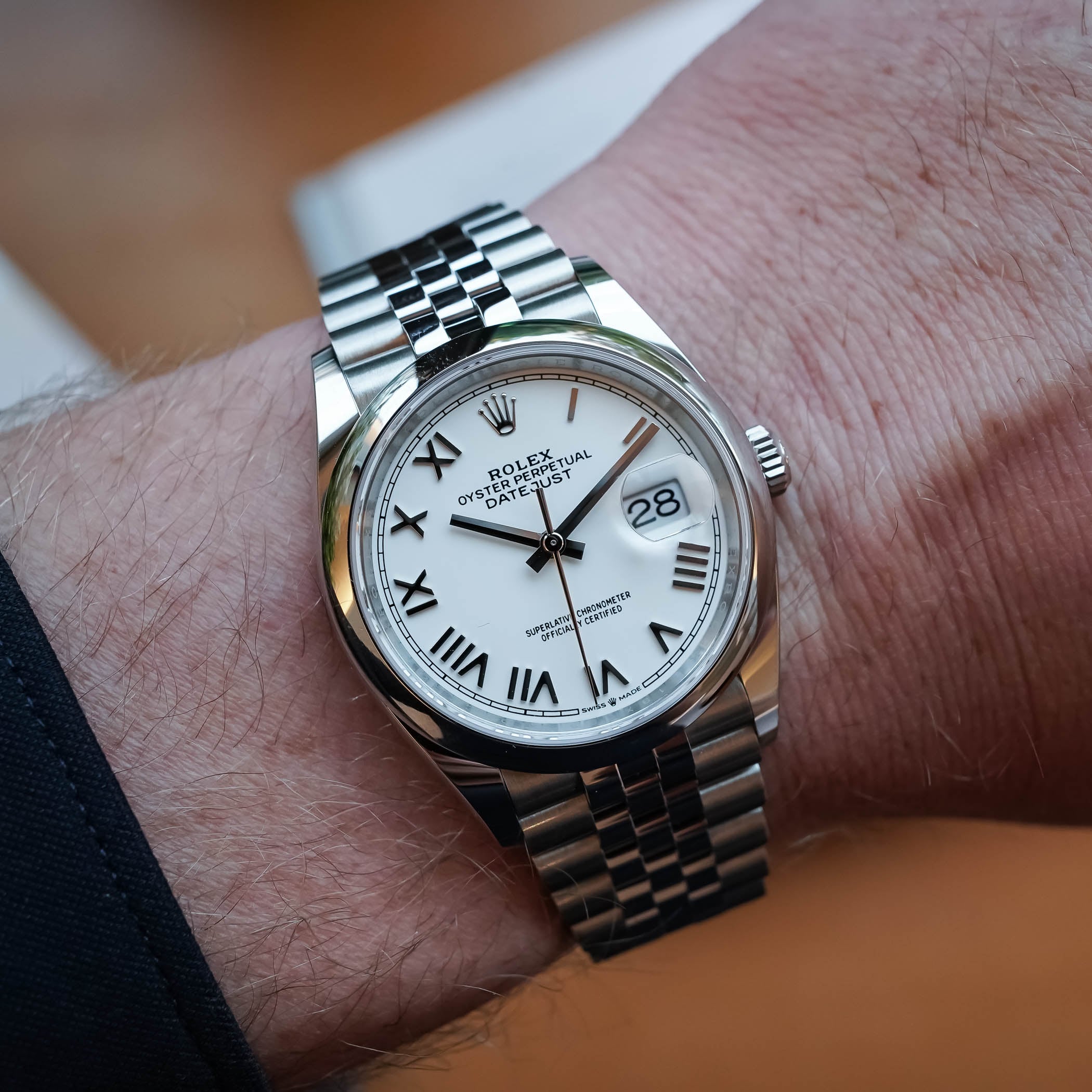
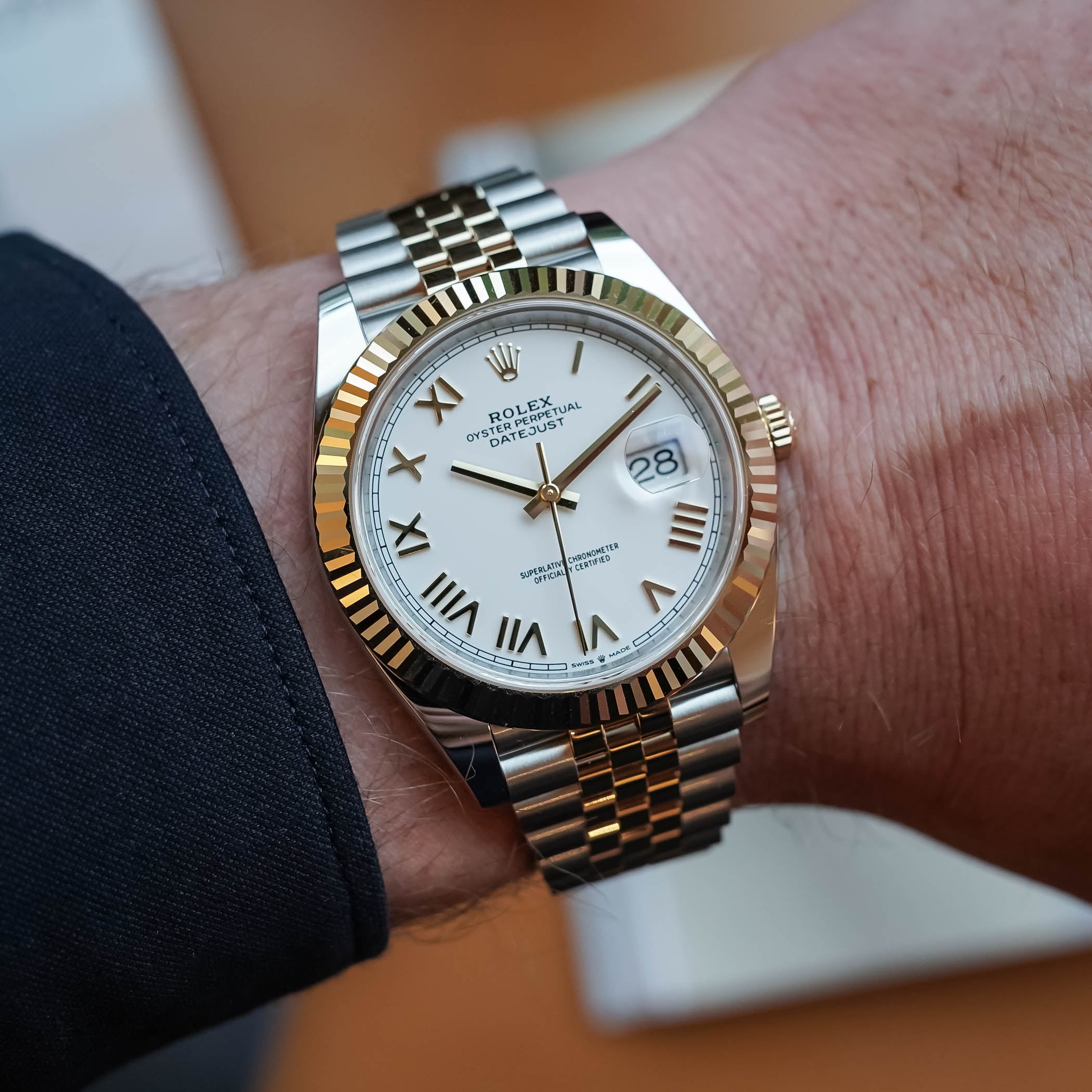
Let’s now talk about what was not openly communicated by Rolex during Watches and Wonders 2026: an array of new dials for the Datejust 36mm and 41mm (the 31mm range isn’t concerned), as all models with Roman numerals, except for the emblematic Wimbledon model, have been updated. This means new dials applied to steel, white Rolesor (steel and fluted bezel), yellow Rolesor, and Everose Rolesor models, with an Oyster or a Jubilee bracelet. In total, it is well over 100 new references that have been added to the catalogue, while most of the older generation dials with Roman numerals, as found on the Azzuro and Wimbledon models until last year, are gone.
So what is the update all about? Mostly, the applied Roman numerals have been deeply redesigned, giving the collection a more modern edge and more consistency with the applied markers found on its bigger sister, the Day-Date. These are sharper, sans-serif applied Roman numerals that somehow recall what’s used on the Day-Date. The numerals are now composed of separate elements (for example, 4 batons for the IIII or 4 distinct elements for VIII), while before each numeral was a single element. Also, these numerals are now flat and angular, and have a thicker profile than what was previously used on the model, and the baton marker at 9 o’clock has been replaced by a numeral. So not only is the typface different, but the execution is drastically updated, too. The result is both more complex and yet sleeker, more modern than before.
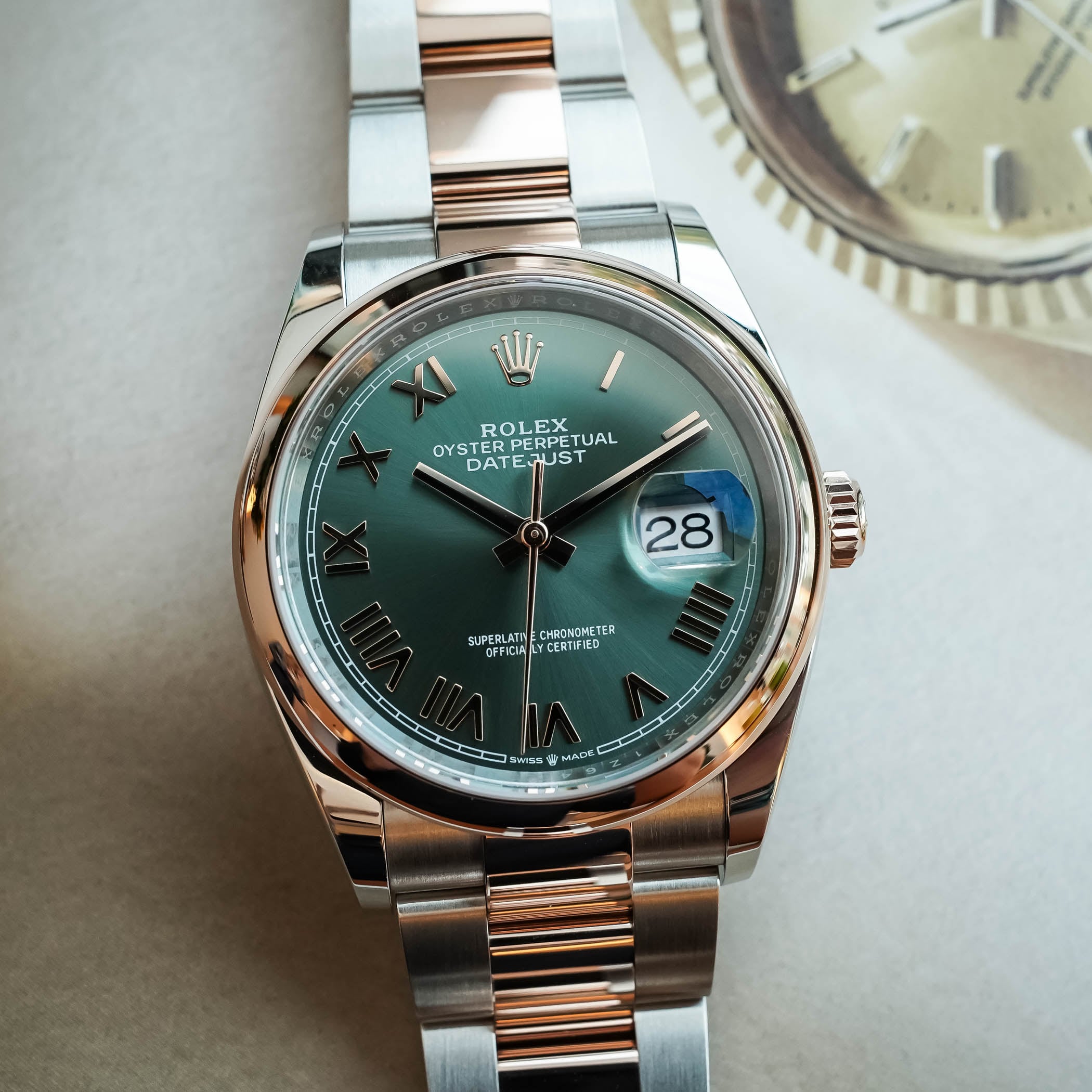
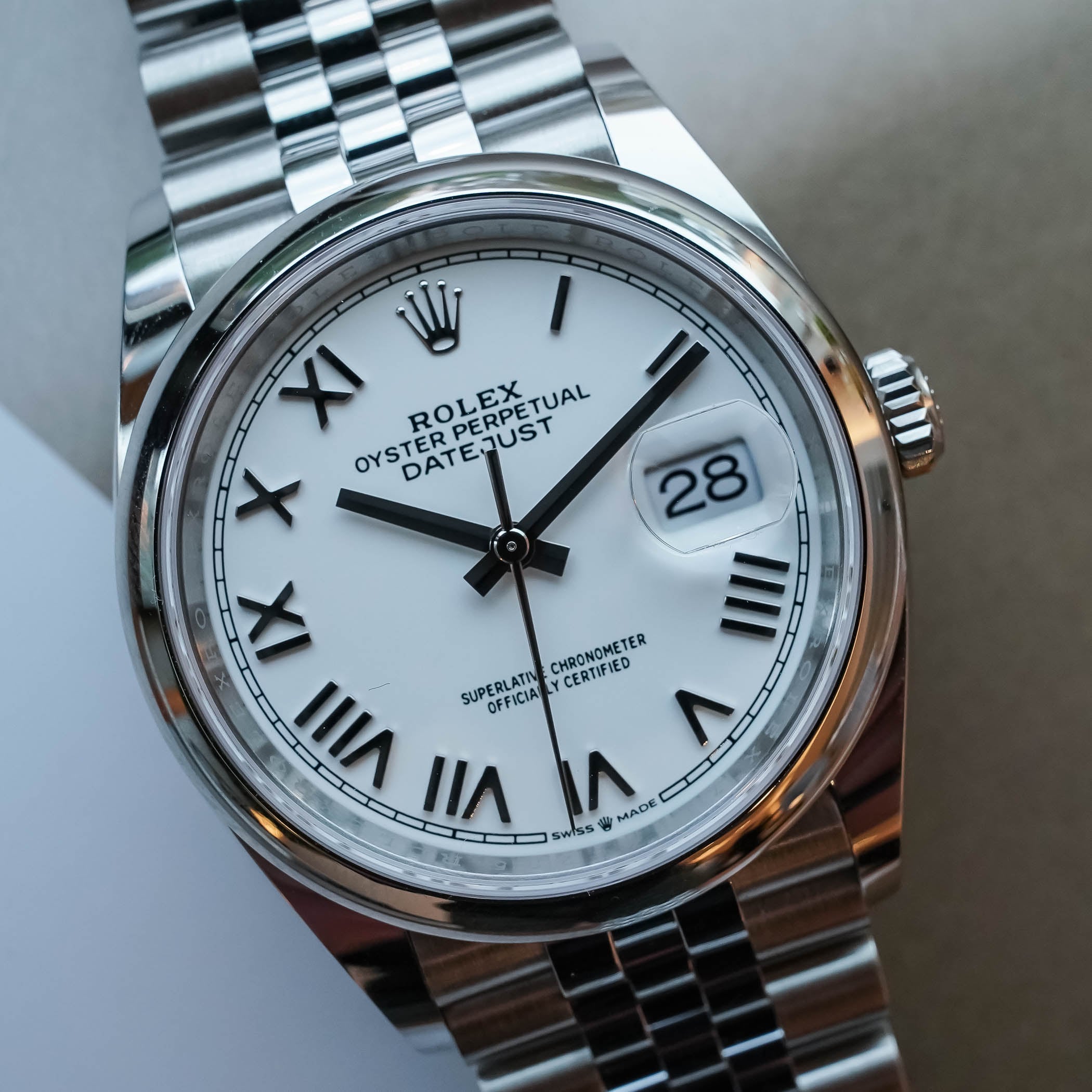
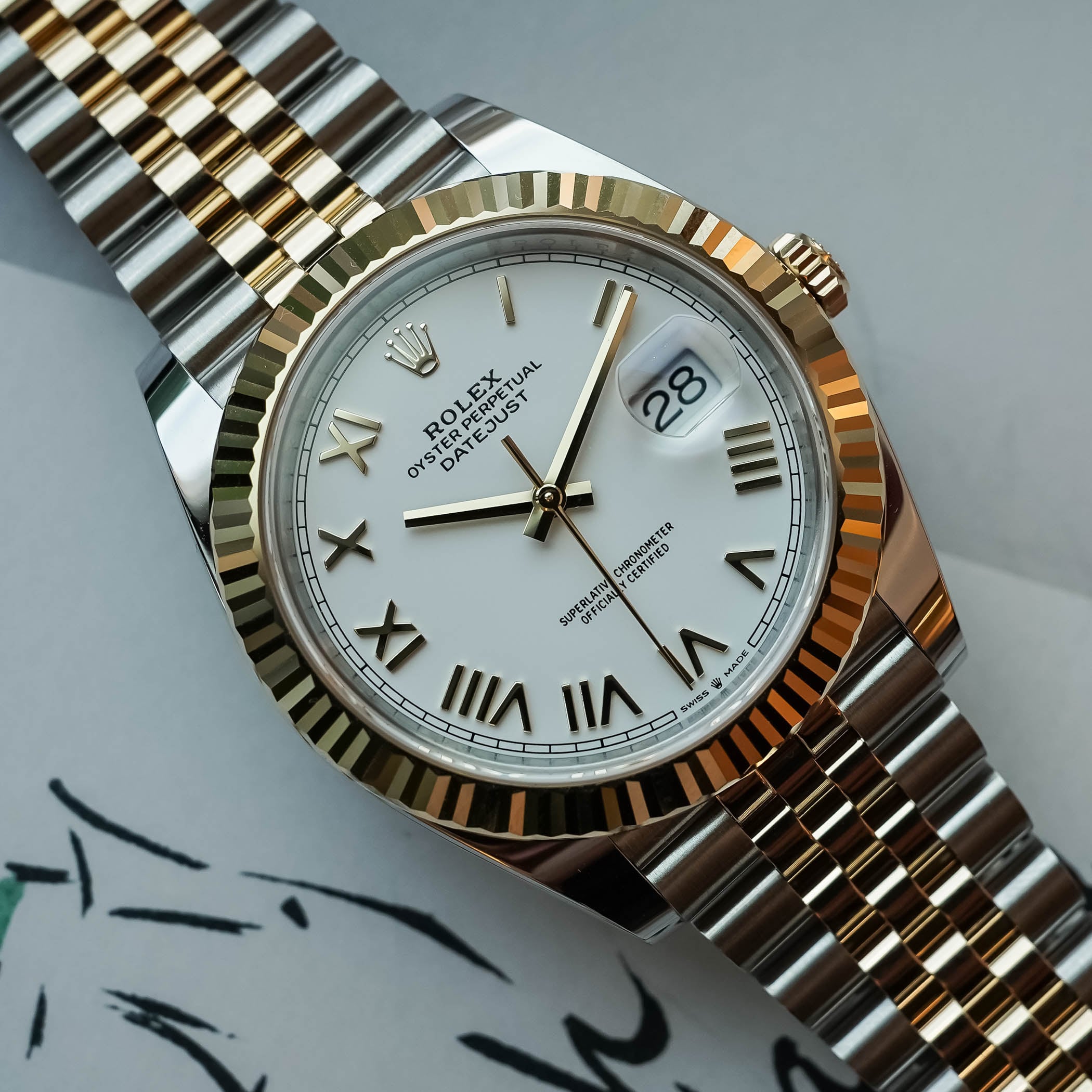
Also, all versions of the Datejust with Roman numerals have been unified regarding the minute track, which is now a continuous railroad-style element across the entire range, in white or black depending on the dial colour. Talking about options, and depending on the size and material of the case, Rolex has deployed a vast range of tones, ranging from classic glossy white to new mint or olive green – used respectively on Everose Rolesor and yellow Rolesor models, as well as black and blue for the 41mm – all paired with hands and markers that match the bezel. And before you ask, the Azzuro model with its sunray-brushed blue dial is still available.
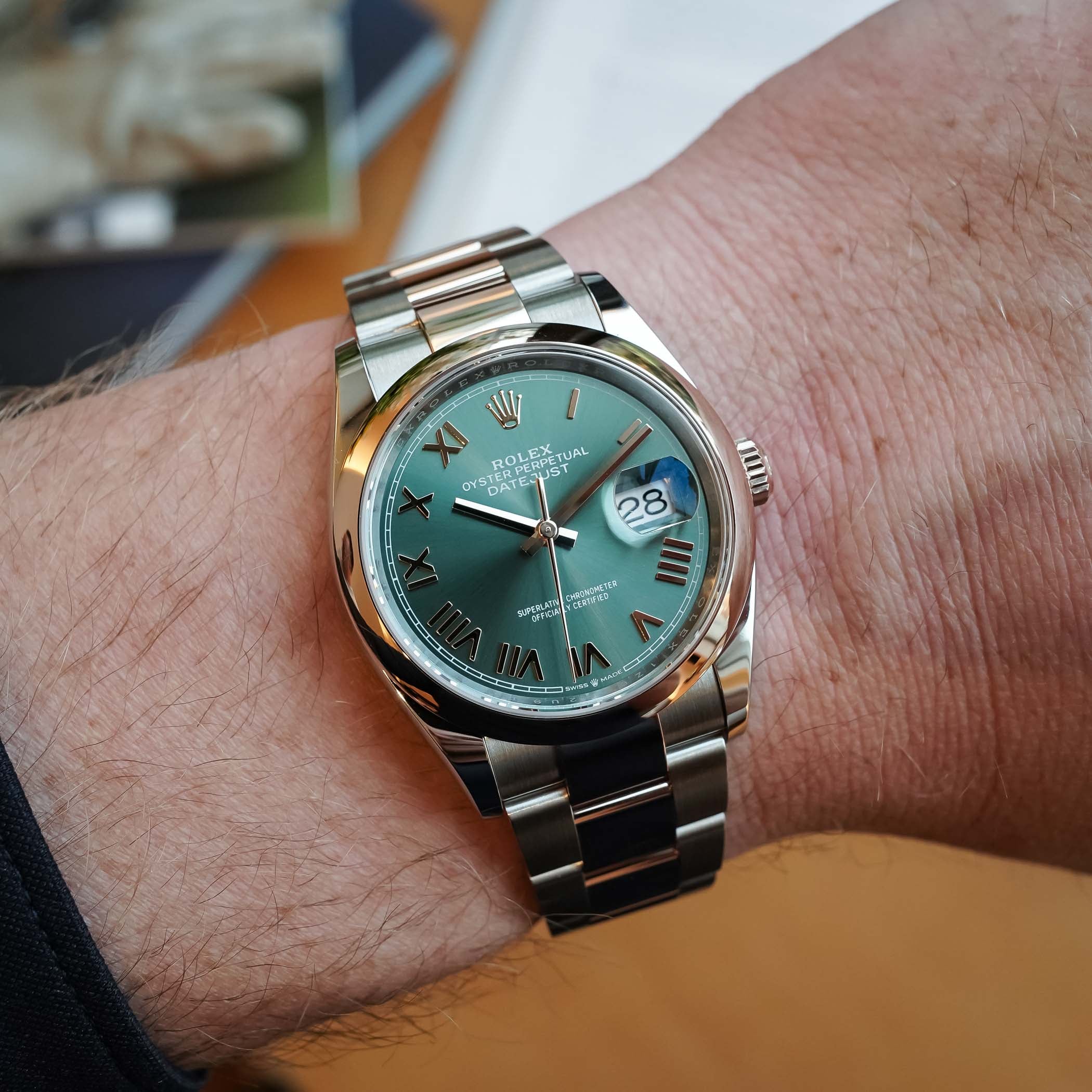
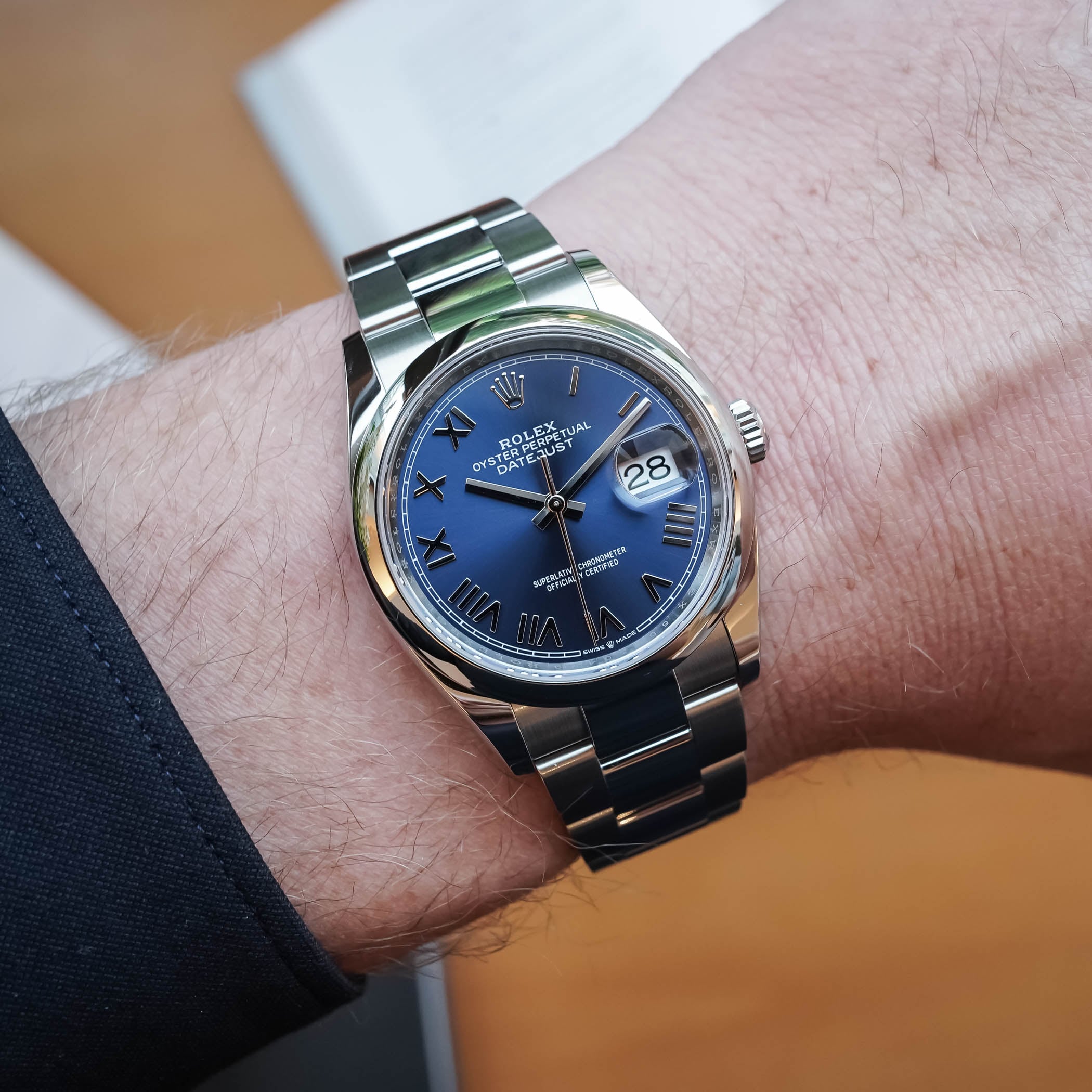
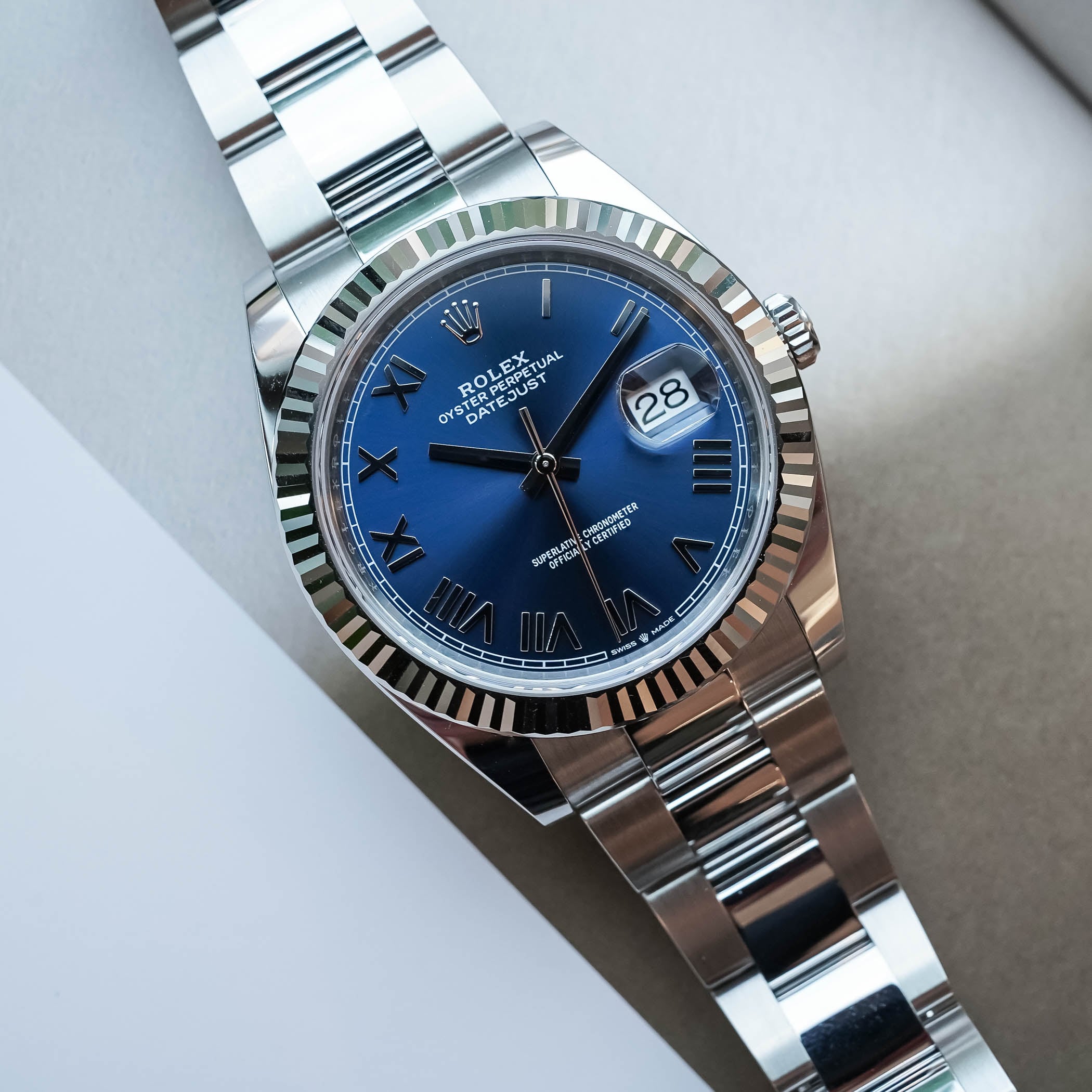
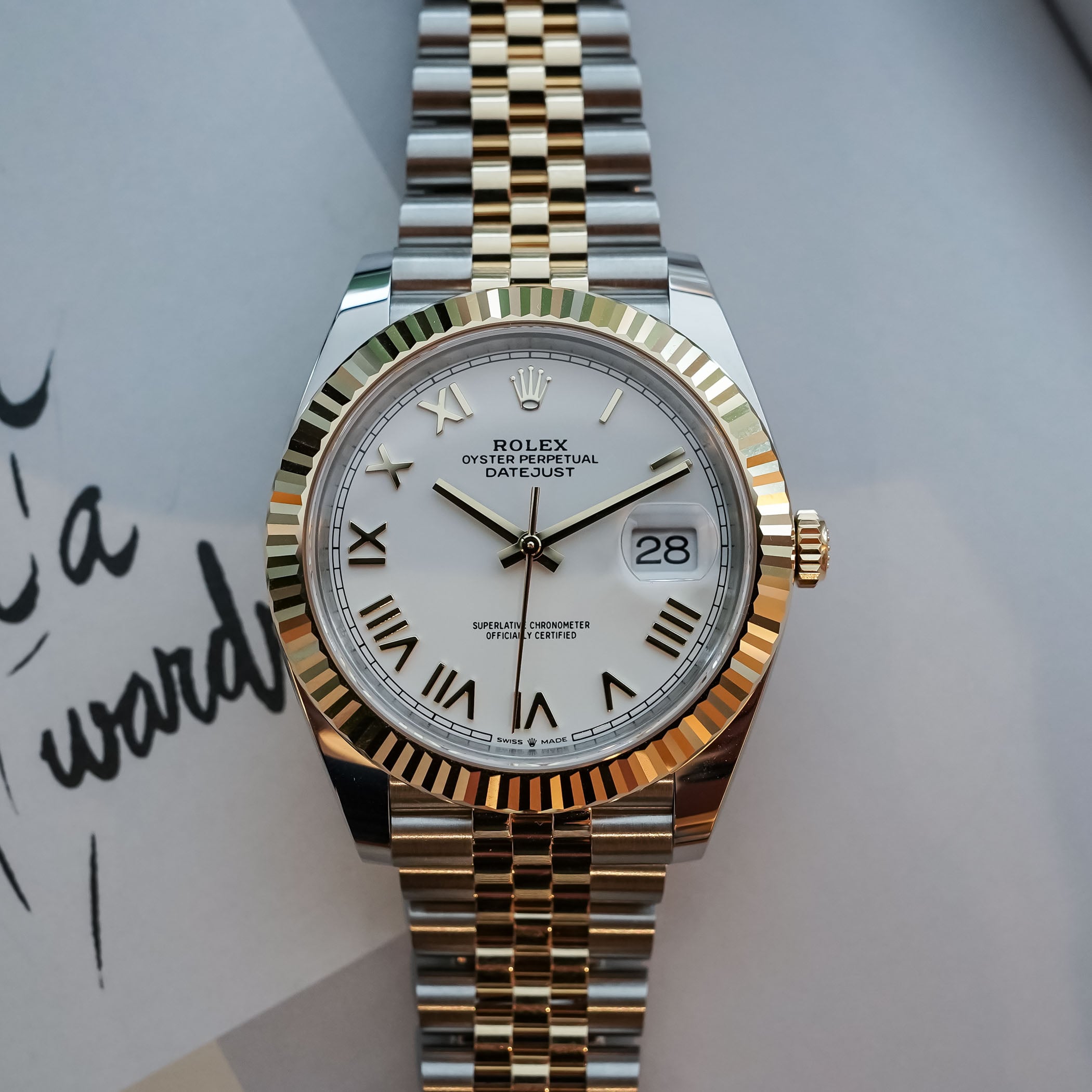
For the 36mm, the collection is even larger in terms of colours, as it includes the tones mentioned above and additional colours, which are available only on certain combinations of materials – dark grey, aubergine, pink, silver, chocolate, slate and salmon – with some of them featuring diamonds on the applied numerals at 6 and 9 o’clock.
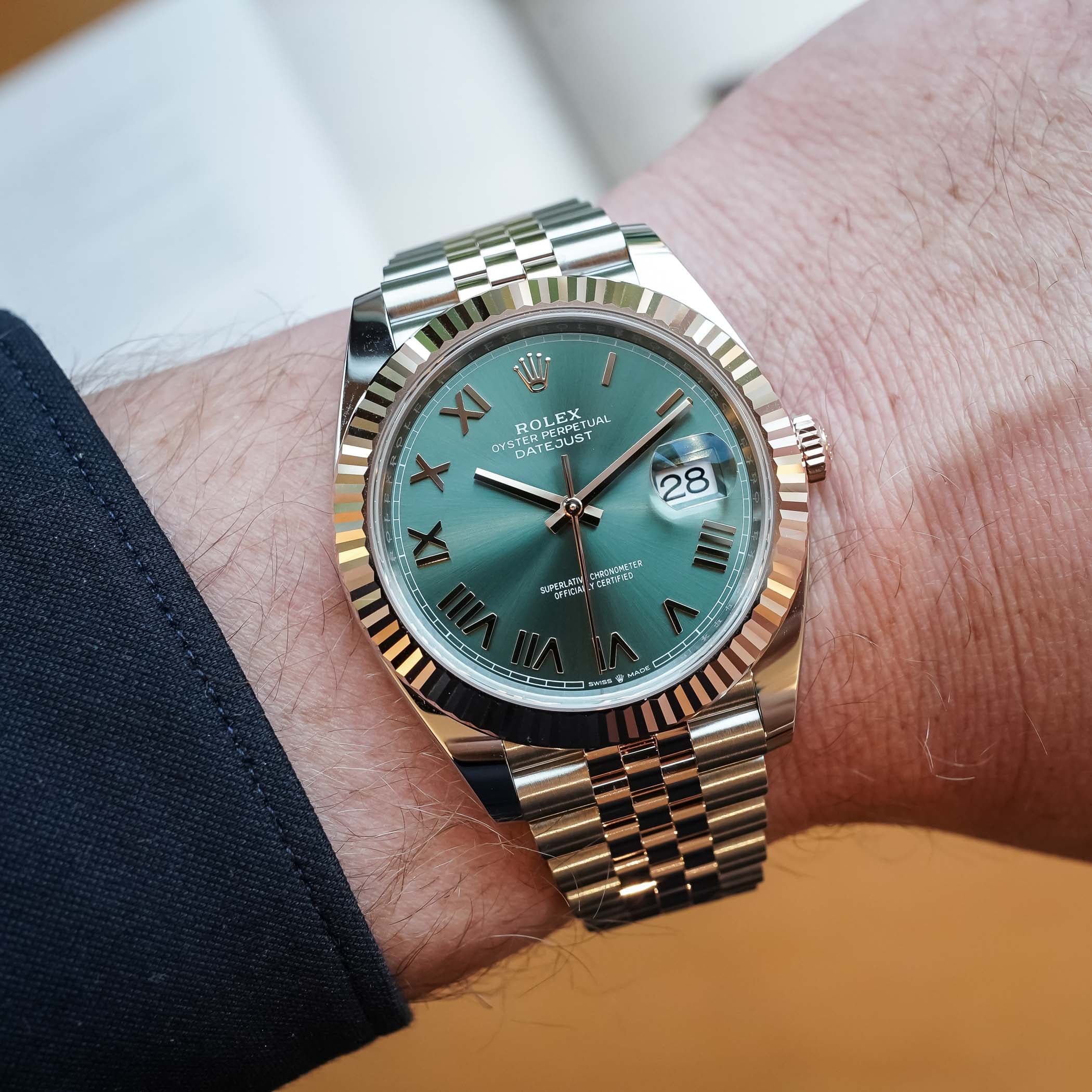
All in all, we’re certainly not talking about a revolution for the Datejust but a stronger update than expected. Not only did Rolex introduce a new gradient green dial to the collection, which looks rather fantastic, but it also updated about half of the dials available in the entire range. The result, with the new Roman numerals, is a fresher, more modern and sharper take on one of the brand’s classics, making it feel up to date and cleaner than before. For more details and to consult the entire range of new dials, please visit www.rolex.com.

9 responses
Nice article! I have always had a soft spot for the Datejust, but I also admire the way Rolex manages its catalogue. New variations often appear quietly, allowing enthusiasts to discover them gradually, while the collection remains organised around clear product families such as the Oyster Perpetual, Datejust and Land-Dweller.
Omega often does the opposite, launching each new reference as if it were an entirely new watch, despite a catalogue generally estimated at well over 800 references. Perhaps the Aqua Terra would be the ideal place to start building a more coherent, family-based approach.
What new dials? There’s no new dials, no old dials; no new watches, no watches available unless you go to the secondhand market to pay above retail or you have a secret in with an AD. It’s smoke and mirrors, as usual. Why keep what amounts to nothing more than advertising for them for something that most of us have been blocked from? I’d rather read about watches that exist, rather than make believe.
@Ugly_ In both 41mm, Omega has 30 Aqua Terra versions, Rolex has 85+ versions of the DJ….not sure to understand what’s the problem with Omega’s line-up
@Amar I agree with you on the numbers. My point was about how the catalogue is presented: Rolex feels like one coherent family, while Omega feels more fragmented.
Great article but correction – the azurro is no more the Roman numerals version is the same bright blue used in the baton version. It says so in the configurator itself and having seen one in person I can confirm it is NOT azurro blue anymore. And I think it looks better for it.
So if there are a zillion different new steel datejusts of all varieties for 2026 alone, why is nobody ever seemingly allocated the one they want on a timely basis?
@Fahim Hussain – thank you for the imput – always helpful
@J. Quincy Magoo – we publish between 3 and 4 articles a day… pretty sure you can skip Rolex articles and still have plenty of things to read on MONOCHROME. There’s surely something that will please you there.
Mr. Goulard – I’ve also written comments endorsing and praising the educational and informative articles that Monochrome publishes where I can learn more about various aspects of watches, including the various workings of mechanical movements to finishing techniques. I understand the concept of watch brand reviews and the integral part it plays in your business model, but when it comes to a brand taking advantage of the propaganda aspects of a review the results can be malicious. By the number of hits my previous comment received, my guess is I’m not the only one who has these sentiments.