


 Not all images were able to load for printing. Please close the print window and try again.
 The Dominique Renaud Pulse 60 and the Fascination of a One-Hertz Regulating Organ
When others pursue high frequencies, Dominique Renaud slows things down, proving that one beat per second can be just as fascinating as ten.
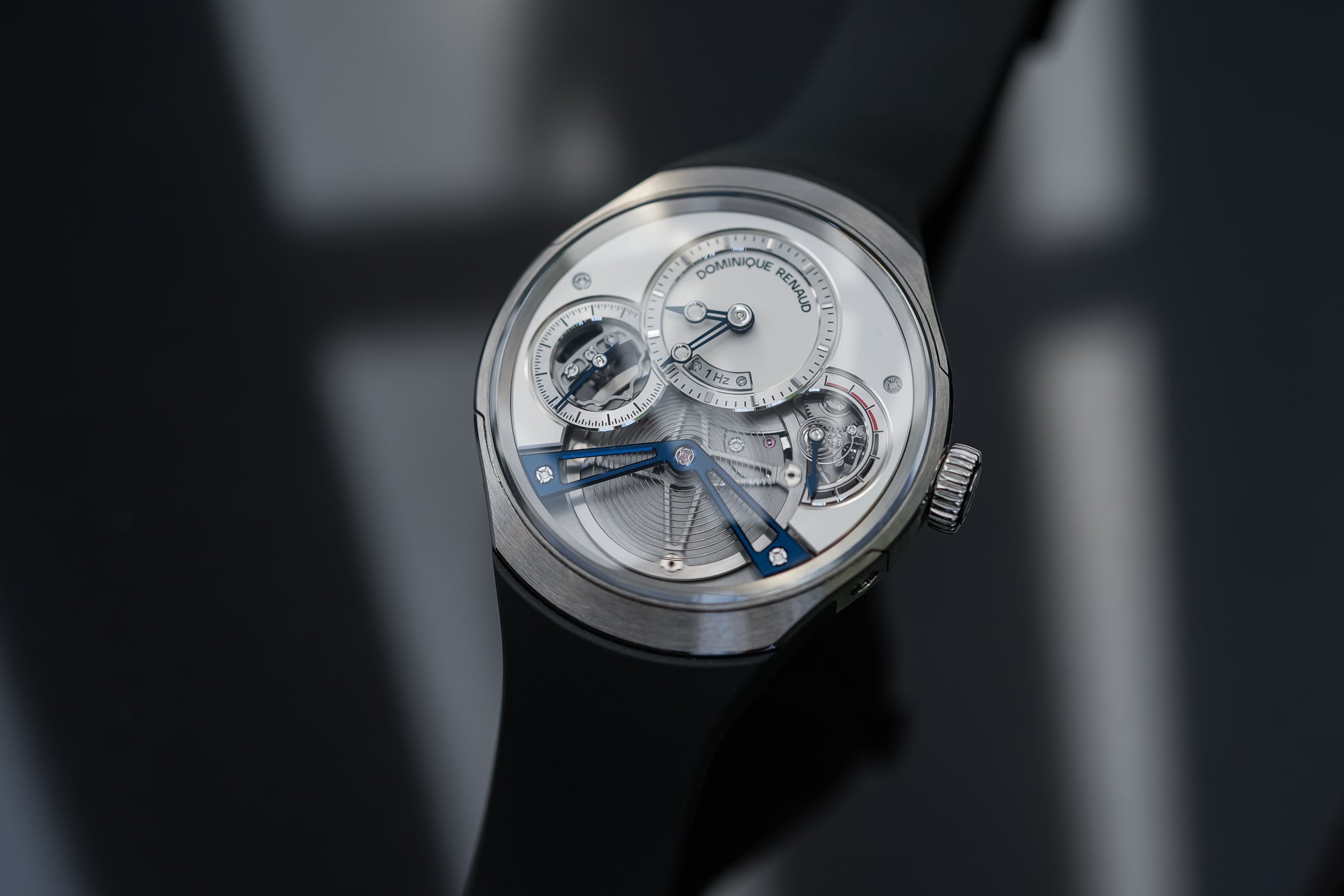
Dominique Renaud hardly needs an introduction. Co-founder of Renaud & Papi, later to become Audemars Piguet Renaud & Papi (APRP), he helped shape modern haute horlogerie by developing complications for Audemars Piguet, Richard Mille, A. Lange & Söhne and many others. His workshop also became a breeding ground for independent watchmaking, with Robert Greubel, Stephen Forsey, Andreas Strehler, Peter Speake, and Christophe Claret all passing through its doors. Following the launch of Renaud Tixier in 2023, the Pulse 60 marks the debut of his eponymous brand. We briefly described this timepiece when it was introduced in this article here; let’s take another look at the watch, unlike almost anything else presented this year.
The Context and the Frequency Question
Watch frequency is often discussed as if it were the near-ultimate measure of performance. A movement beating at 4Hz (28,800 vibrations/hour) has been regarded as the industry standard for over half a century, balancing chronometric stability, power consumption and durability. Brands seeking greater precision have moved even higher still. The Girard-Perregaux Gyromatic, the Longines Ultra-Chron, the Zenith El Primero and the Grand Seiko Hi-Beat calibres 61GS and 45GS have famously operated at 5Hz since the 1960s. More recently, in 2011 and 2012, TAG Heuer’s Mikrograph, Mikrotimer, and Mikrogirder explored frequencies that reached extraordinary levels. We should also mention the latest 10Hz Breguet Experimentale 1. Dominique Renaud himself once experimented with a 12Hz low-amplitude oscillator; see our article here.
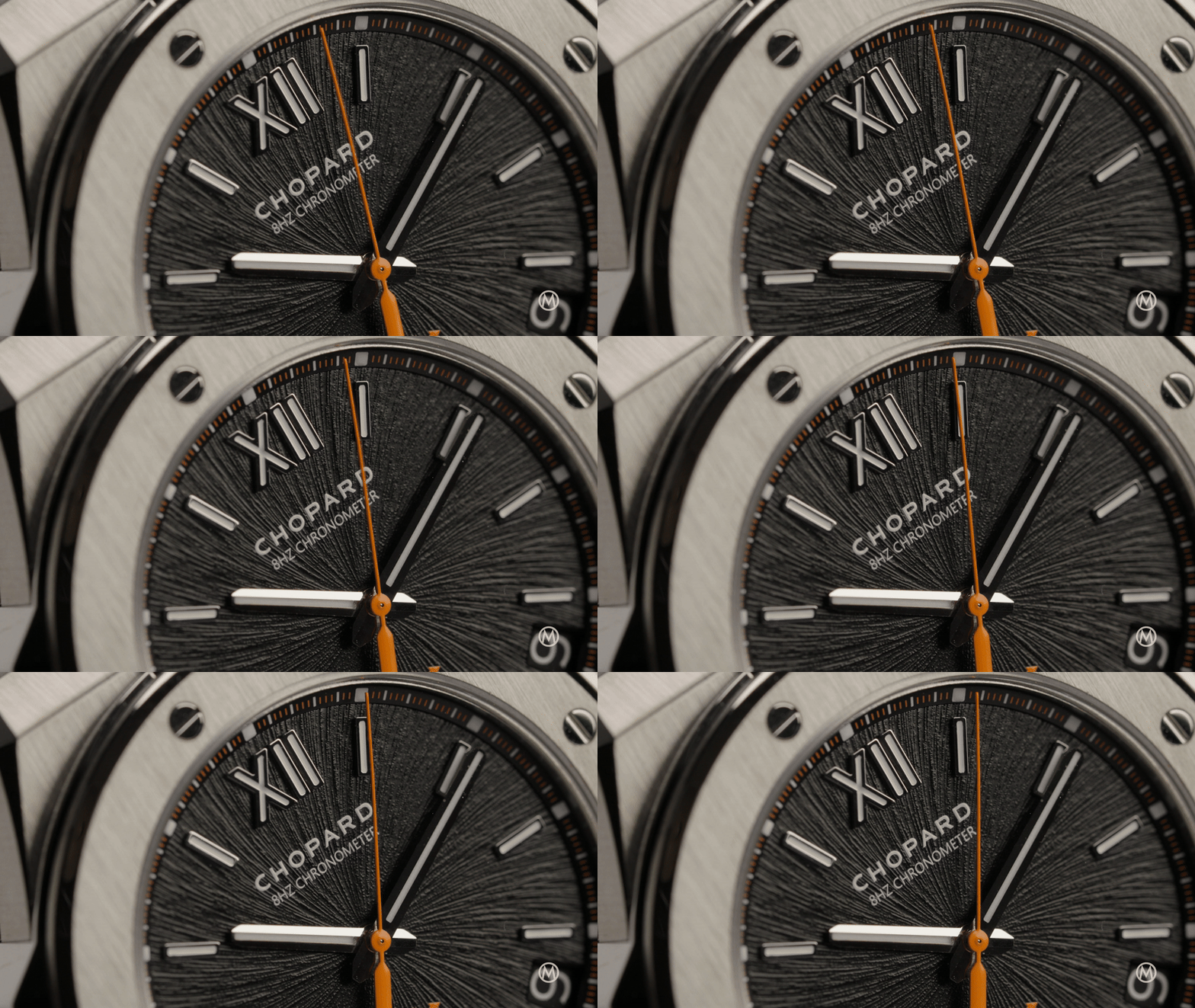
Why speed things up? This is a topic we explored in this video, and in principle, a faster balance receives more impulses per second, averaging out small disturbances more quickly and generally improving rate stability. The trade-off is equally well understood and addressed (higher friction, greater energy consumption and increased wear of the regulating organ). Despite decades of experimentation, 4Hz remains king as it offers the most sensible compromise.
Yet some of history’s most precise mechanical timekeepers were never particularly fast. The great marine chronometers built by masters such as John Arnold, Thomas Earnshaw, and later Ulysse Nardin relied on large, slow-moving balances with enormous inertia. They sought stability by resisting external disturbances, not trying to average errors by a higher frequency. It was a different philosophy, but one that proved successful, and this historical approach is the foundation of the Dominique Renaud Pulse 60. Renaud slowed the regulating organ to just one hertz, or 7,200 vibrations per hour; sixty oscillations every minute, almost identical to the resting heartbeat of a healthy adult, hence the name.
The Case and Display
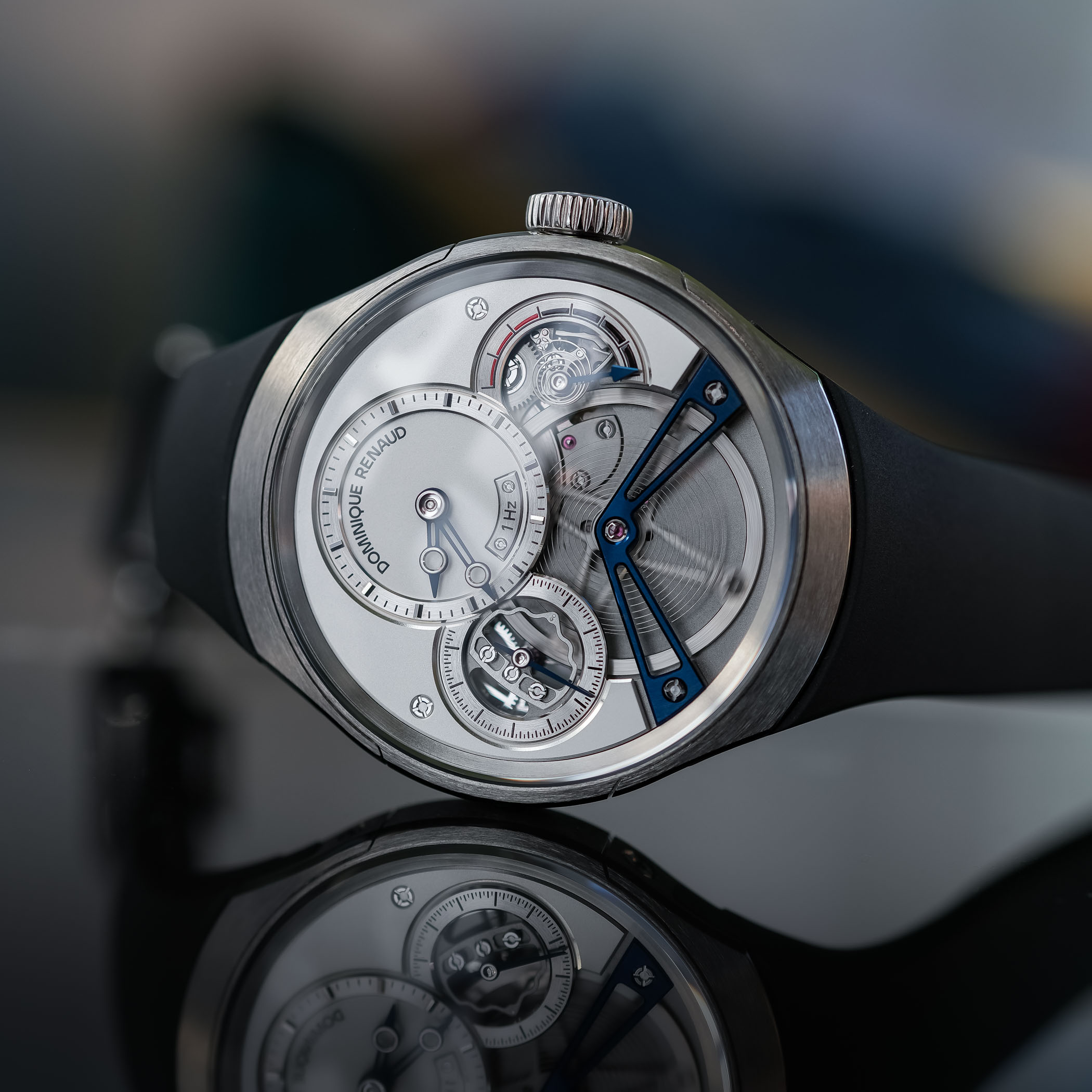
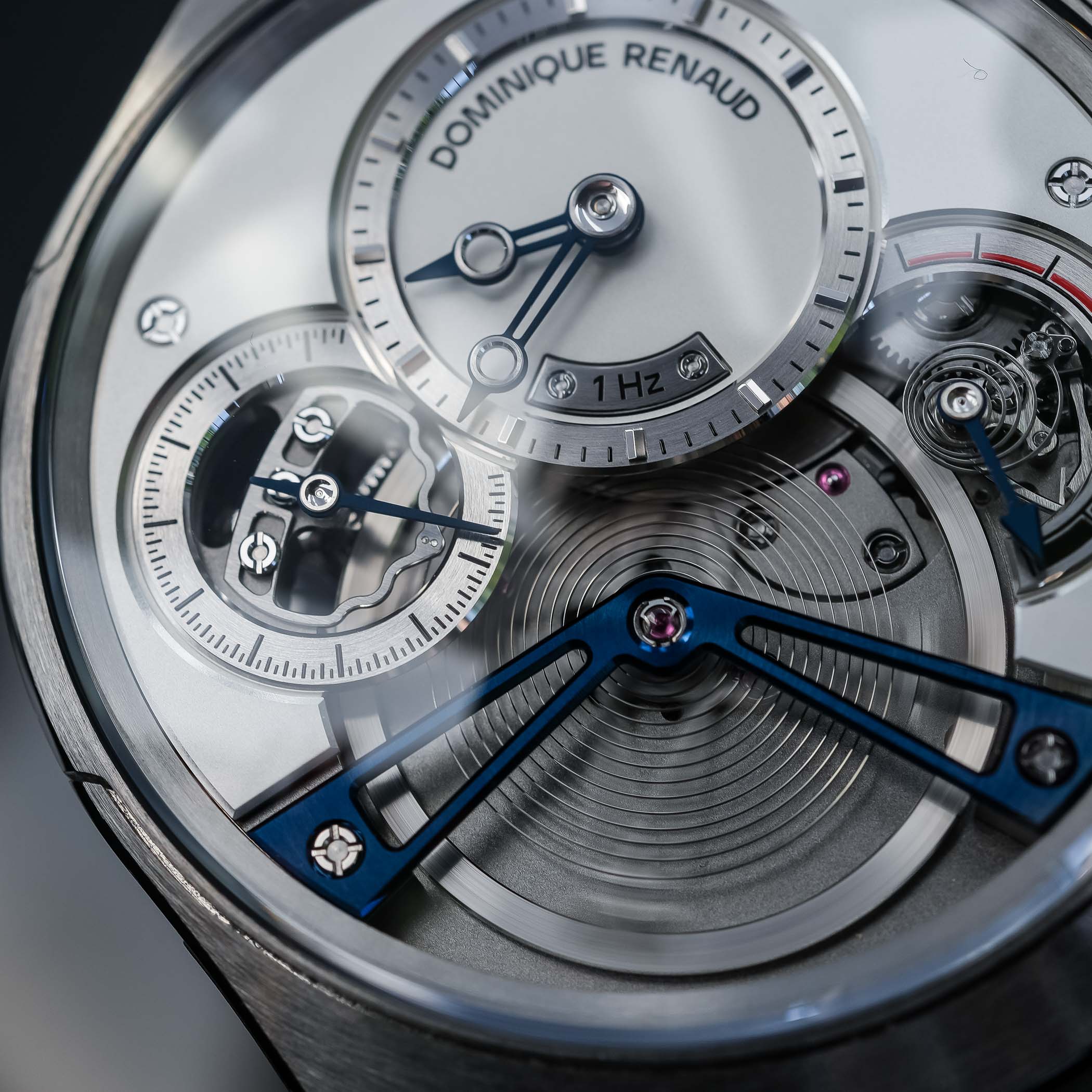
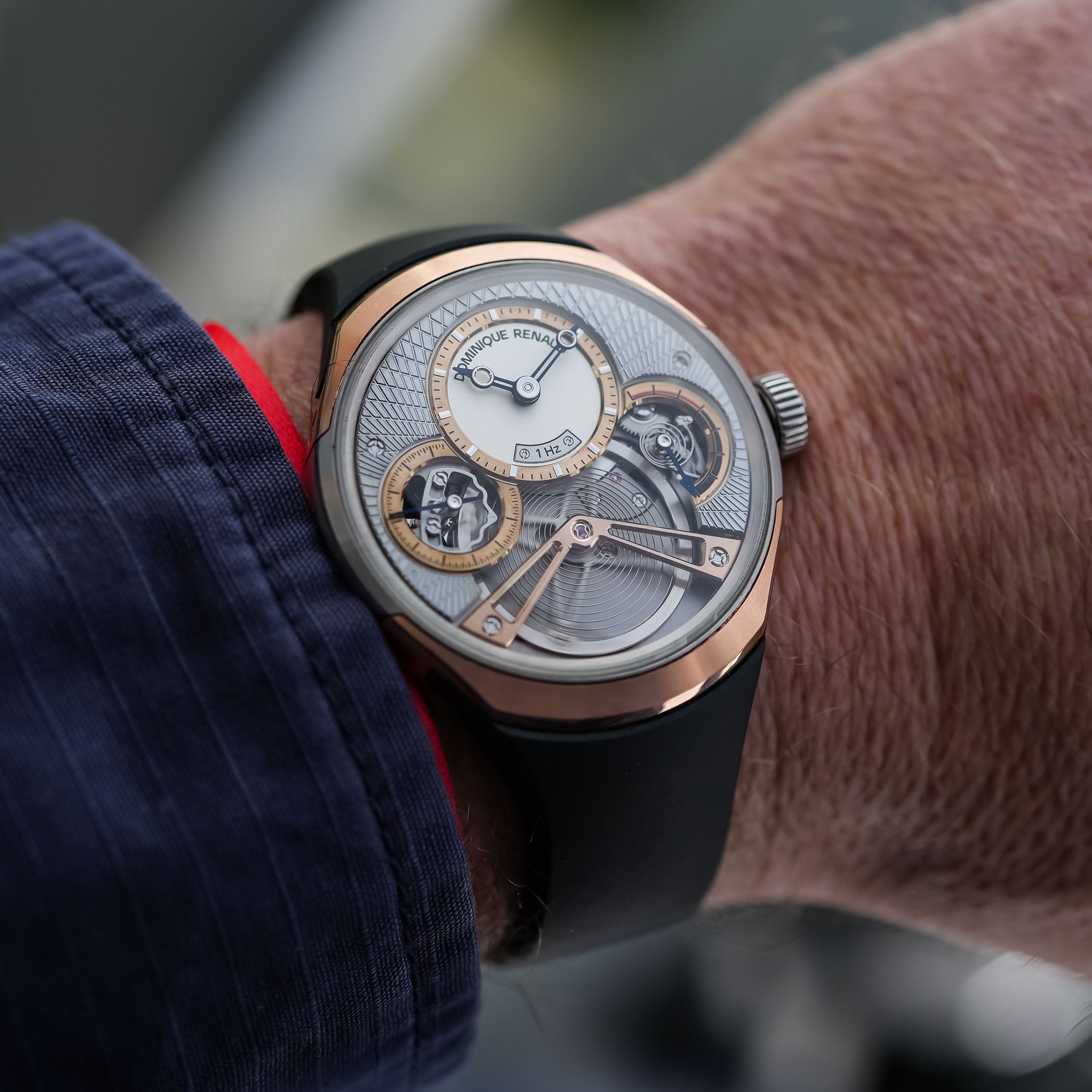
The Pulse 60 makes it clear from the outset that this is no conventional mechanical watch. Its aesthetic exhibits the same functional clarity as the movement, with a fine-industrial approach to finishes and presentation. The 40mm diameter, 12mm thick case, available in either titanium or a combination of pink gold and titanium, dispenses with a traditional silhouette and features integrated, laterally screwed lugs that flow directly into the rubber strap. The circular satin-brushed upper surface contrasts with polished flanks, while the domed sapphire crystal blends into the case, eliminating the visual separation normally created by a bezel.
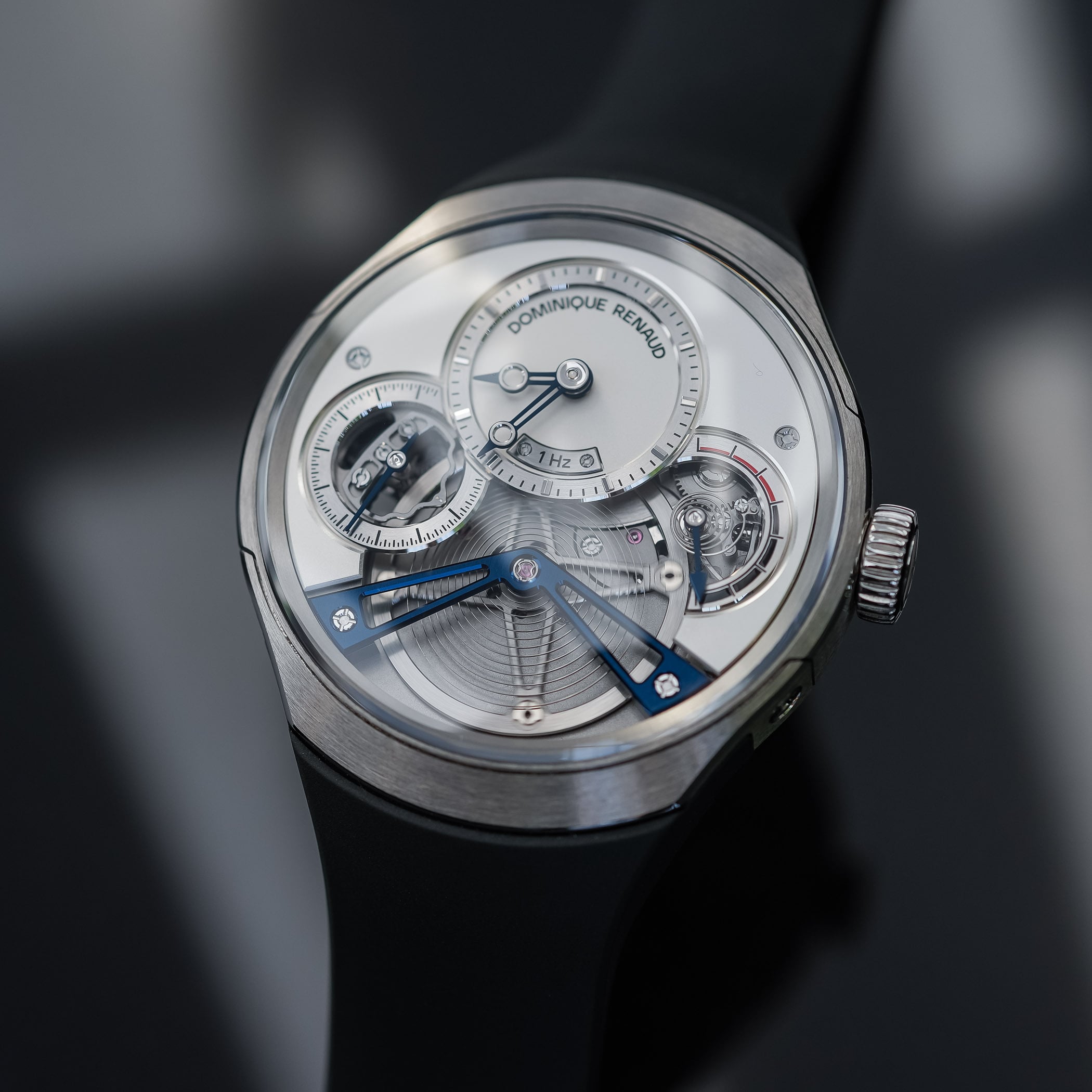
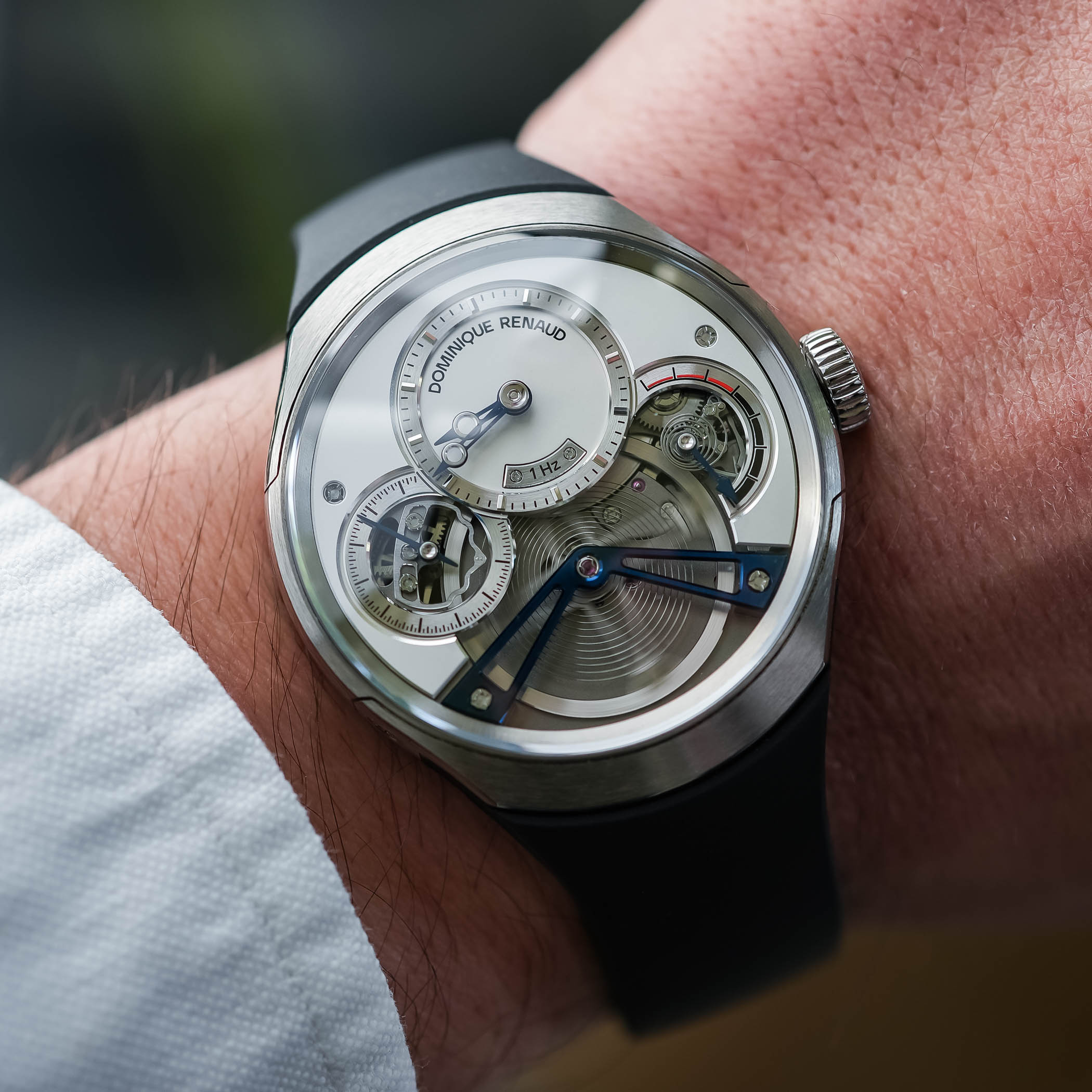
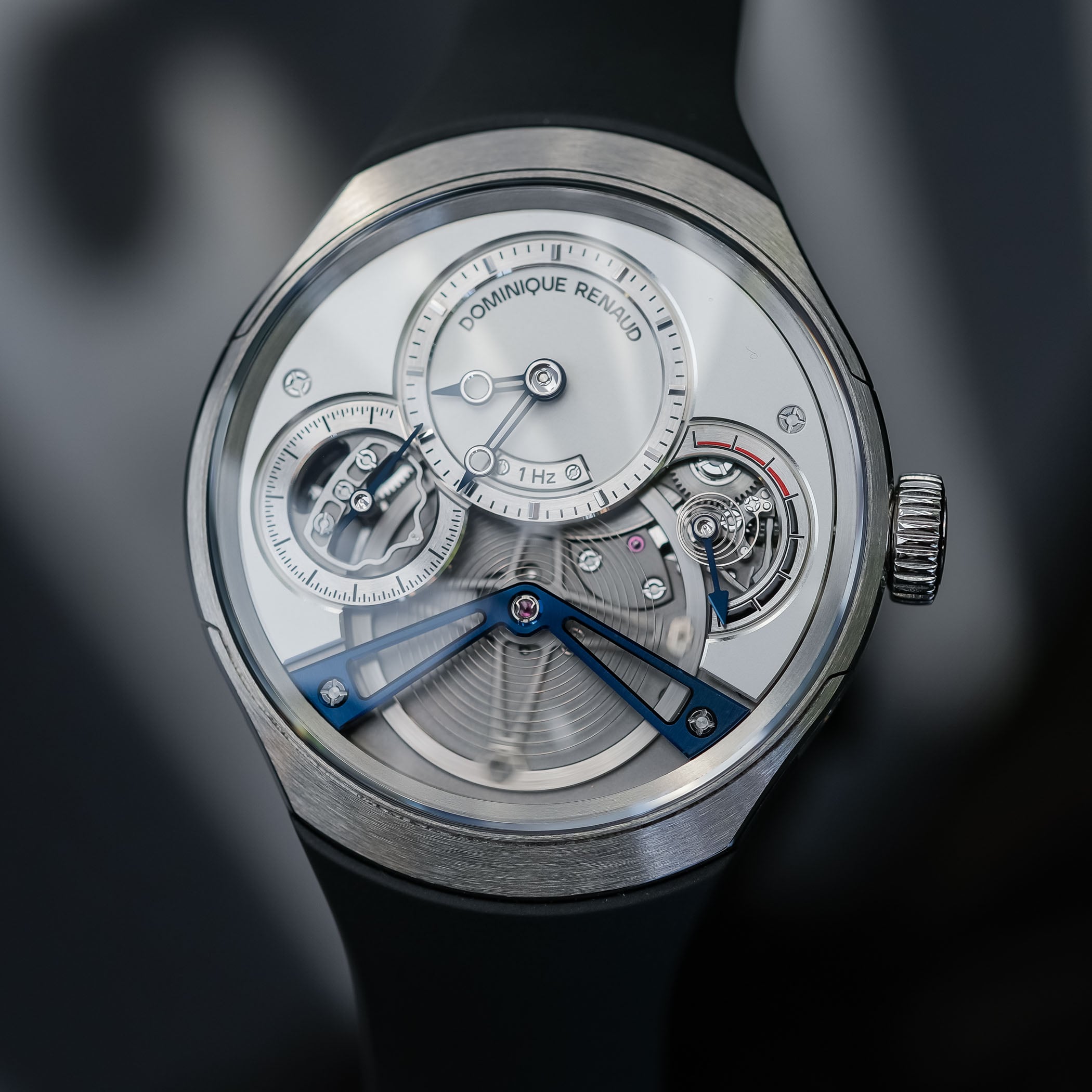
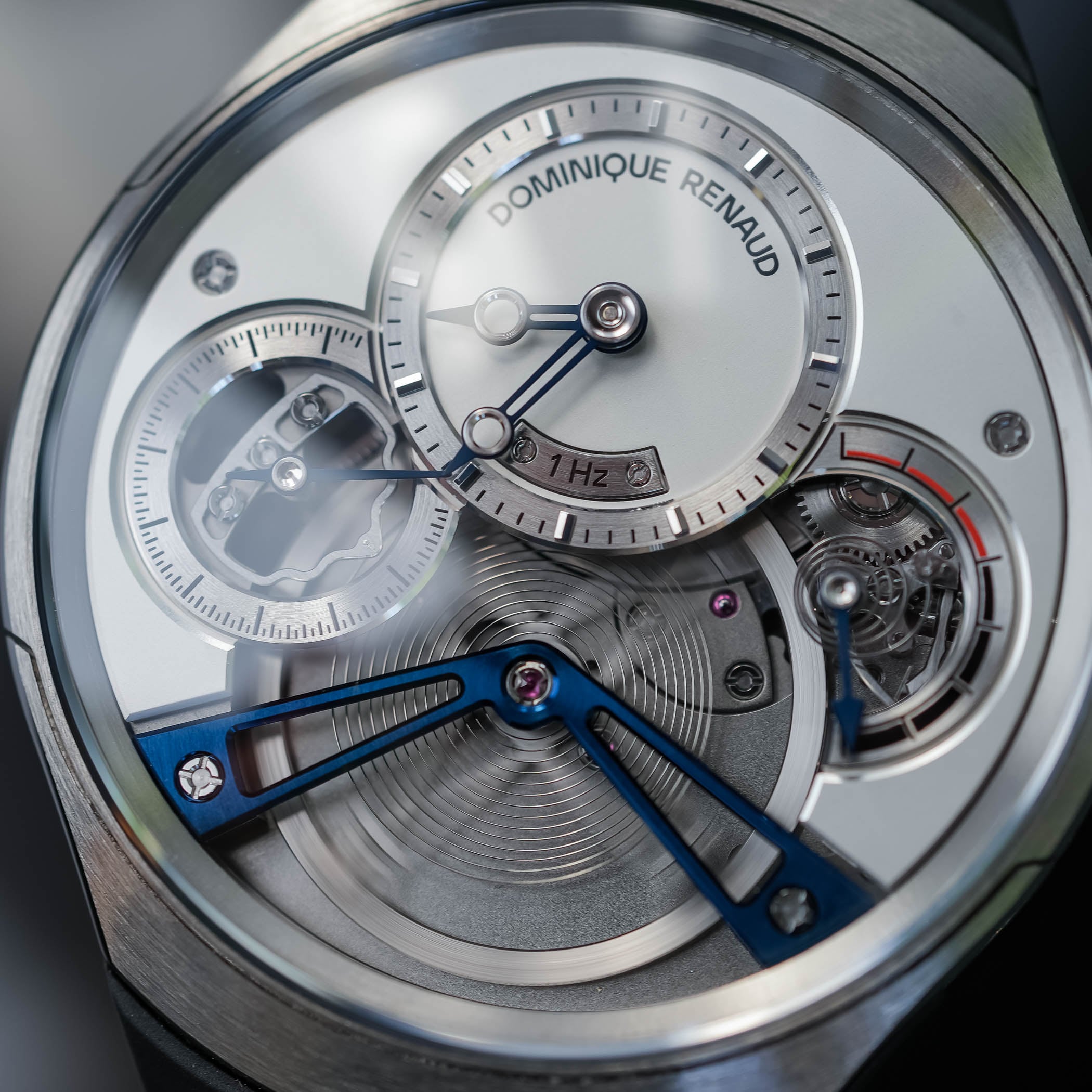
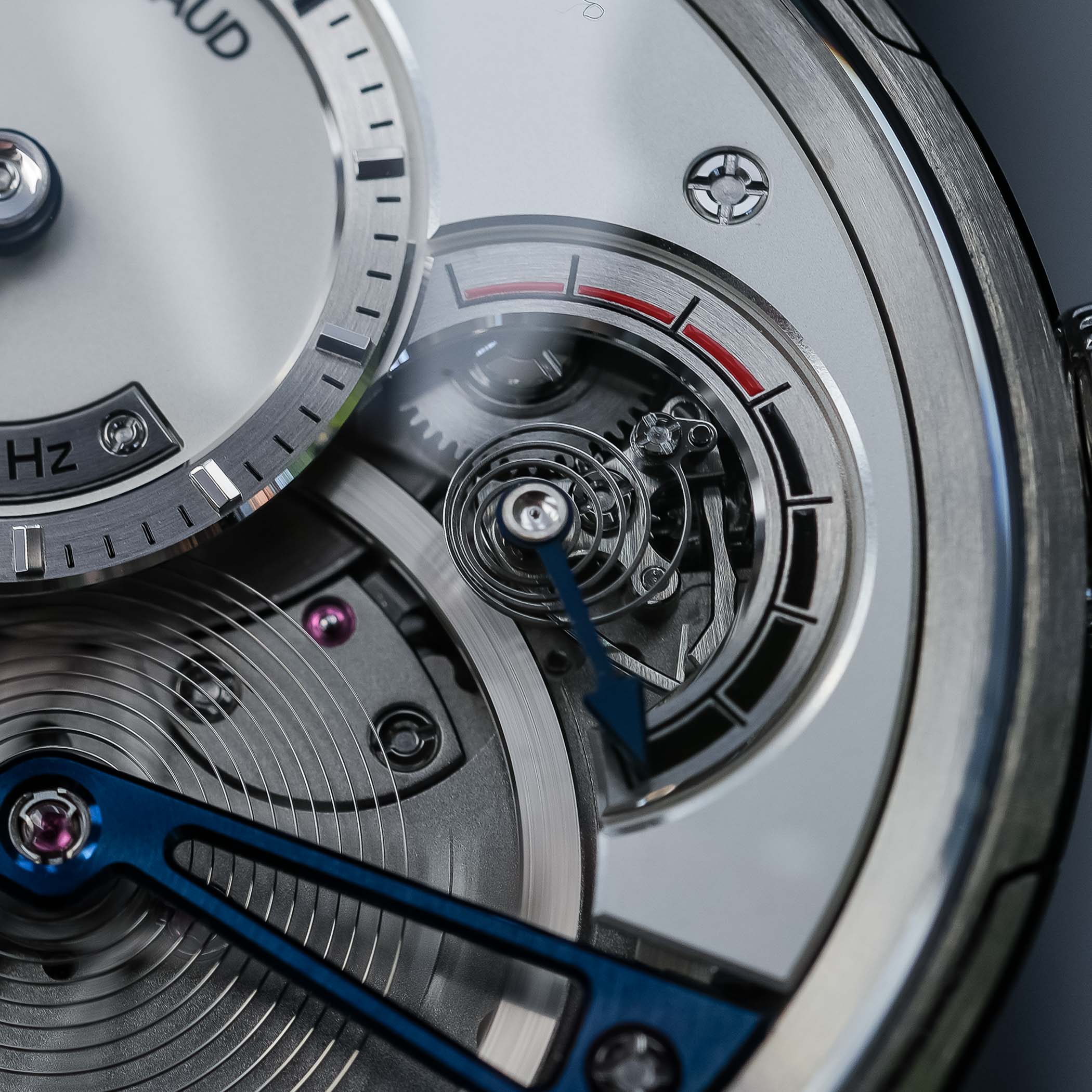
The dial is dominated by what matters here: the regulating organ. Occupying much of the available space is the oversized 20mm balance wheel, displayed beneath an openworked bridge. Watching it in motion is unlike observing almost any contemporary mechanical watch. Instead of the familiar blur produced by a 4Hz movement, each oscillation becomes a slow, deliberate event. You can follow the balance breathing back and forth, giving the regulating organ a presence usually reserved for tourbillons.
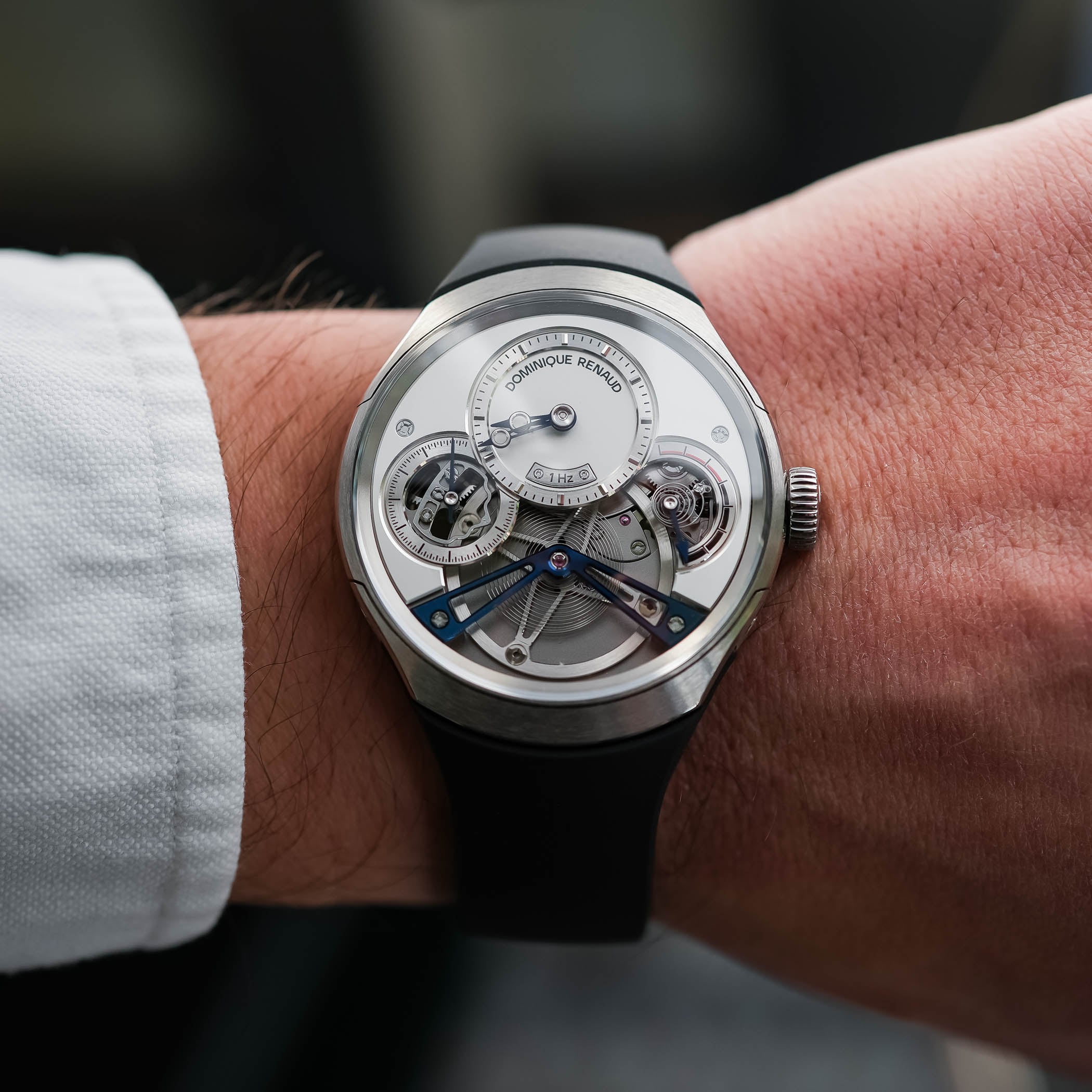
Hours and minutes are displayed on a compact subdial at 12 o’clock with distinctive openworked hands. A torque indicator at 3 o’clock draws its information directly from the barrel, a concept Renaud had already explored during his years at Renaud & Papi, while the small seconds at 9 o’clock advances in natural half-second increments, another reminder that this movement follows a completely different rhythm. Depending on the version, the dial is finished in silver grey or black opaline for the titanium models, or with a refined grey guilloché pattern for the striking pink gold edition.
The One-Hertz Movement
The Pulse 60 is not entirely alone. The closest comparison is the Antoine Martin Slow Runner, introduced in 2013 and designed by Martin Braun around an enormous 24mm balance wheel beating at 1Hz. Some might also think of the Grönefeld One Hertz, but despite the name, it pursues a completely different objective. Tim and Bart Grönefeld’s masterpiece uses a conventional 2.5Hz balance, while its beautifully jumping seconds hand is driven by an ingenious independent deadbeat-seconds mechanism powered by a separate gear train and mainspring barrel.
The Pulse 60, by contrast, truly lives at one hertz. Its manually wound BUA2024 (Balancier Ultra Amplitude) calibre features the oversized balance, visible on the dial side. However, simply enlarging the balance would not have achieved much. Conventional Swiss lever escapements are limited by amplitude. Push them too far, and the impulse pin begins to strike the pallet fork incorrectly, producing the phenomenon known as knocking. Renaud therefore re-engineered the regulating organ, allowing amplitudes beyond 360 degrees, with a theoretical maximum of 700 degrees.
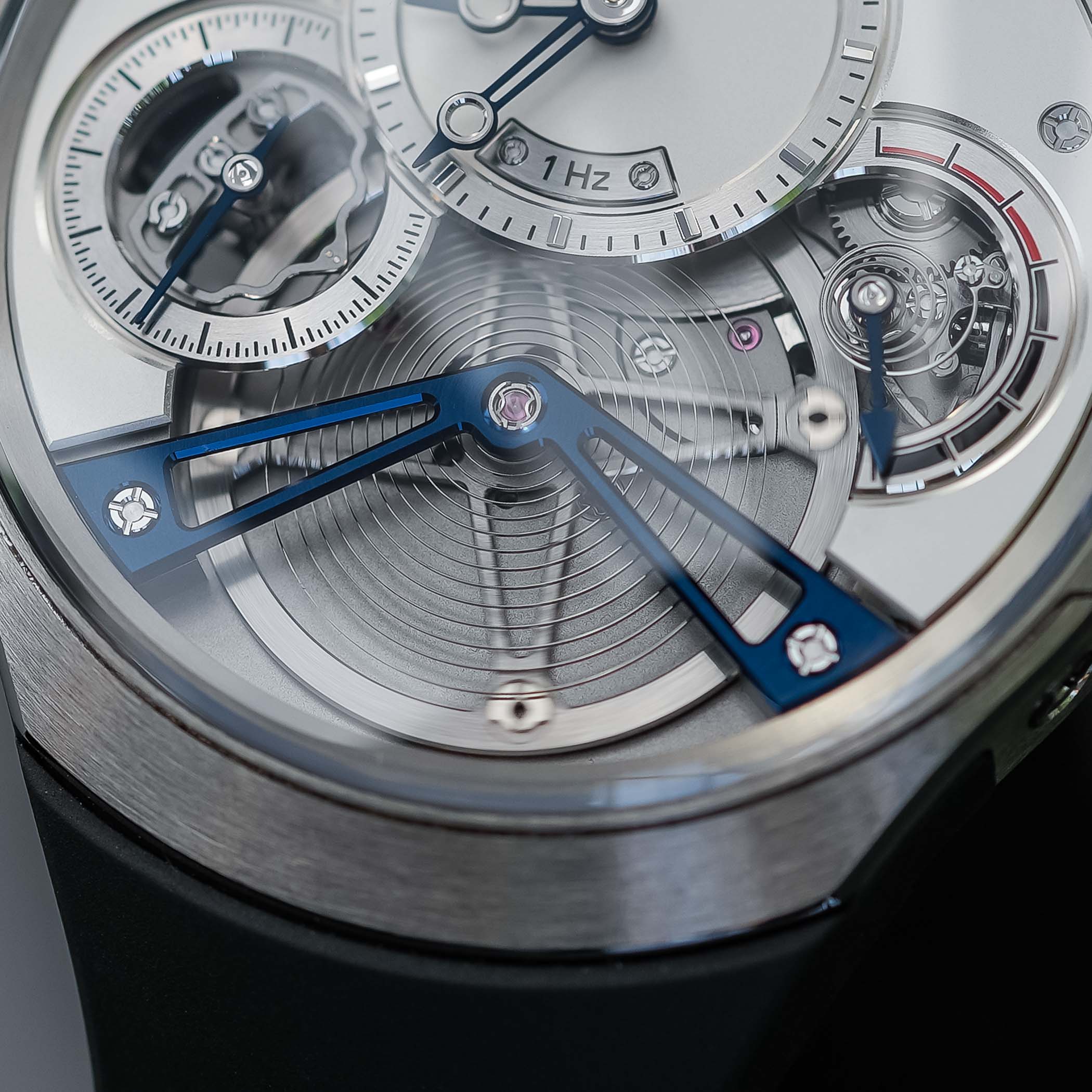
Next, a large balance stores much more kinetic energy than a smaller one, so it is naturally resistant to minor disturbances. The escapement also delivers fewer impulses than a 4Hz movement, reducing friction and limiting wear. Still, compromises remain: the larger balance also carries more mass and can be more vulnerable to heavy shocks than a high-frequency regulator. Unfortunately, the brand doesn’t specify how accurate the Pulse 60 is, and we didn’t have the time or tools to measure it.
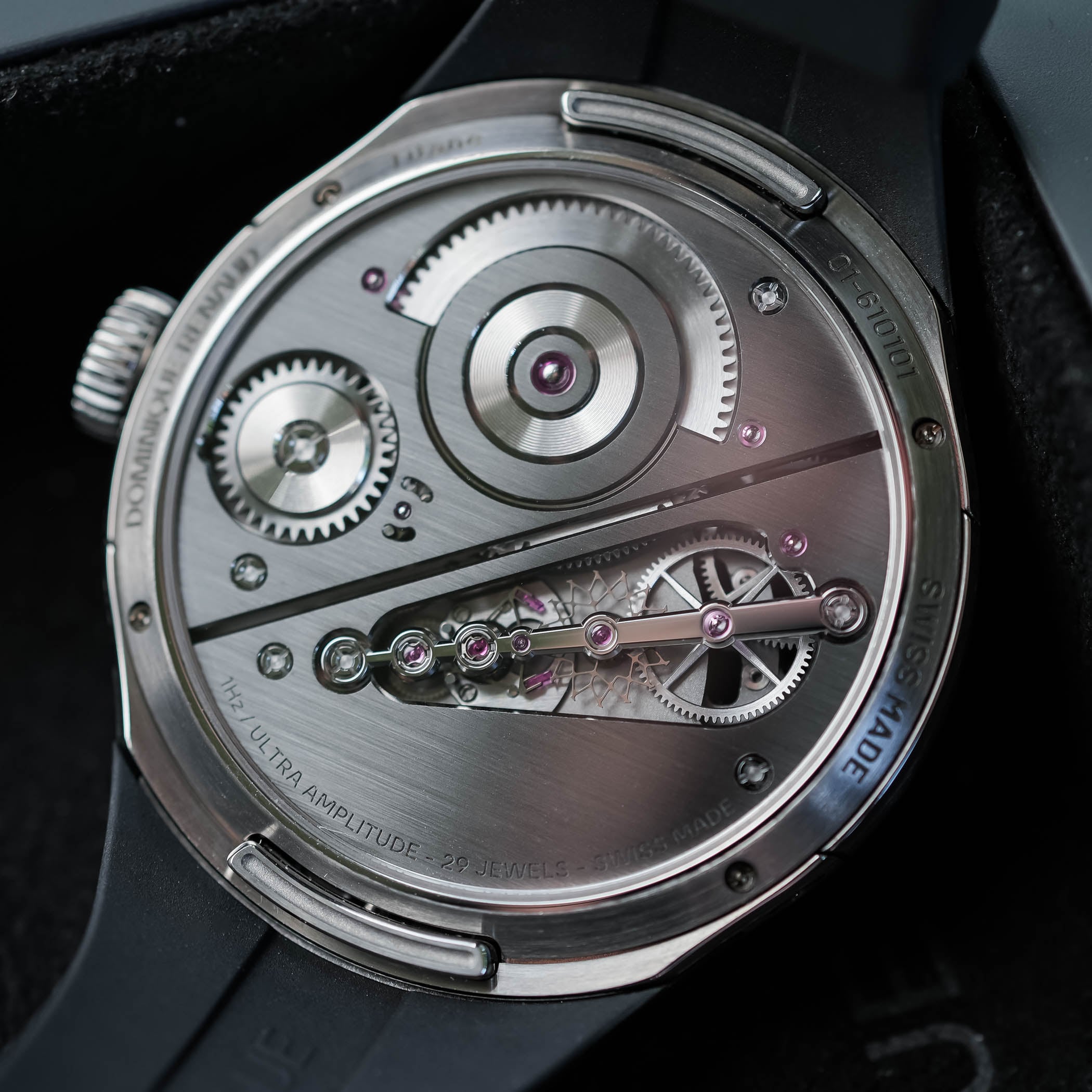
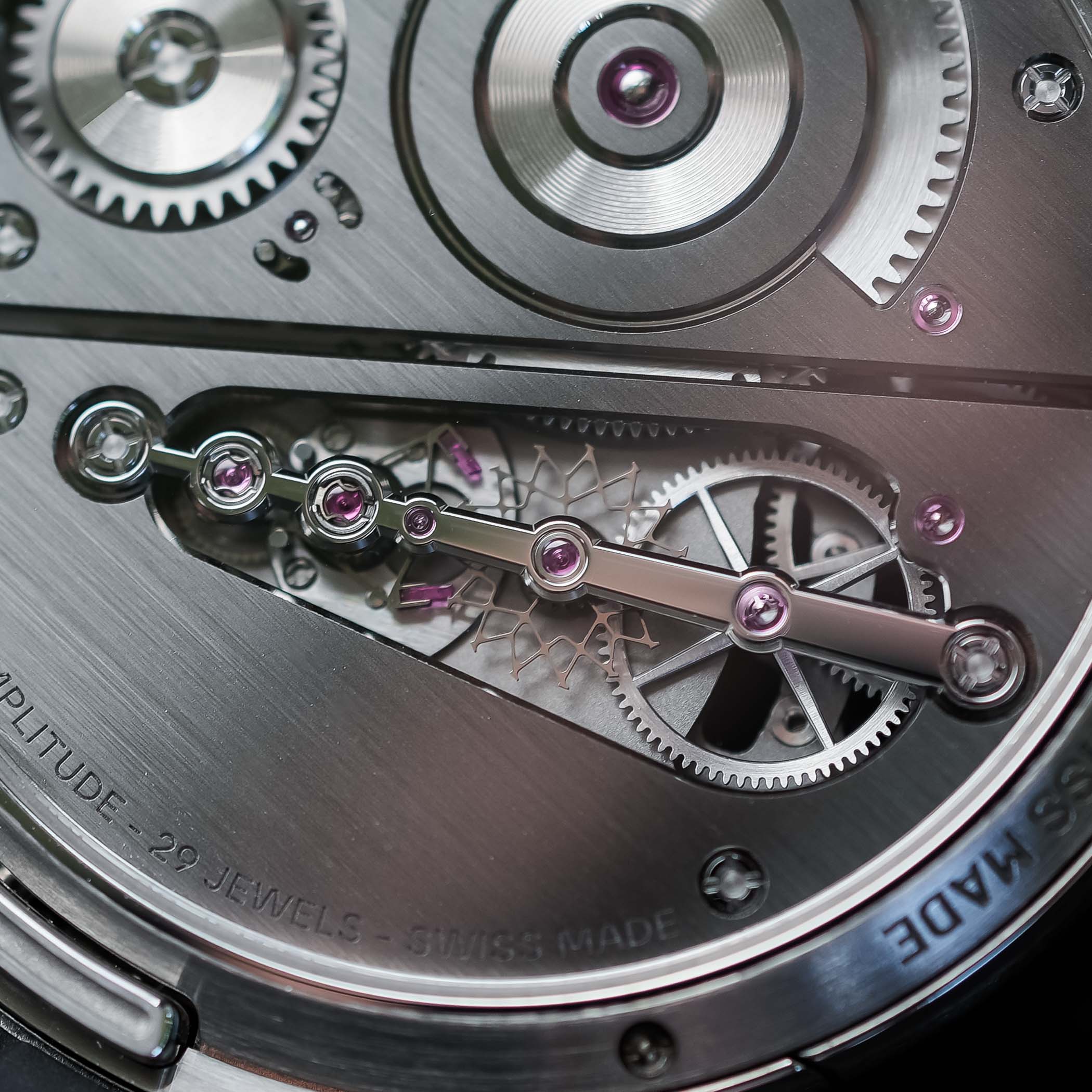
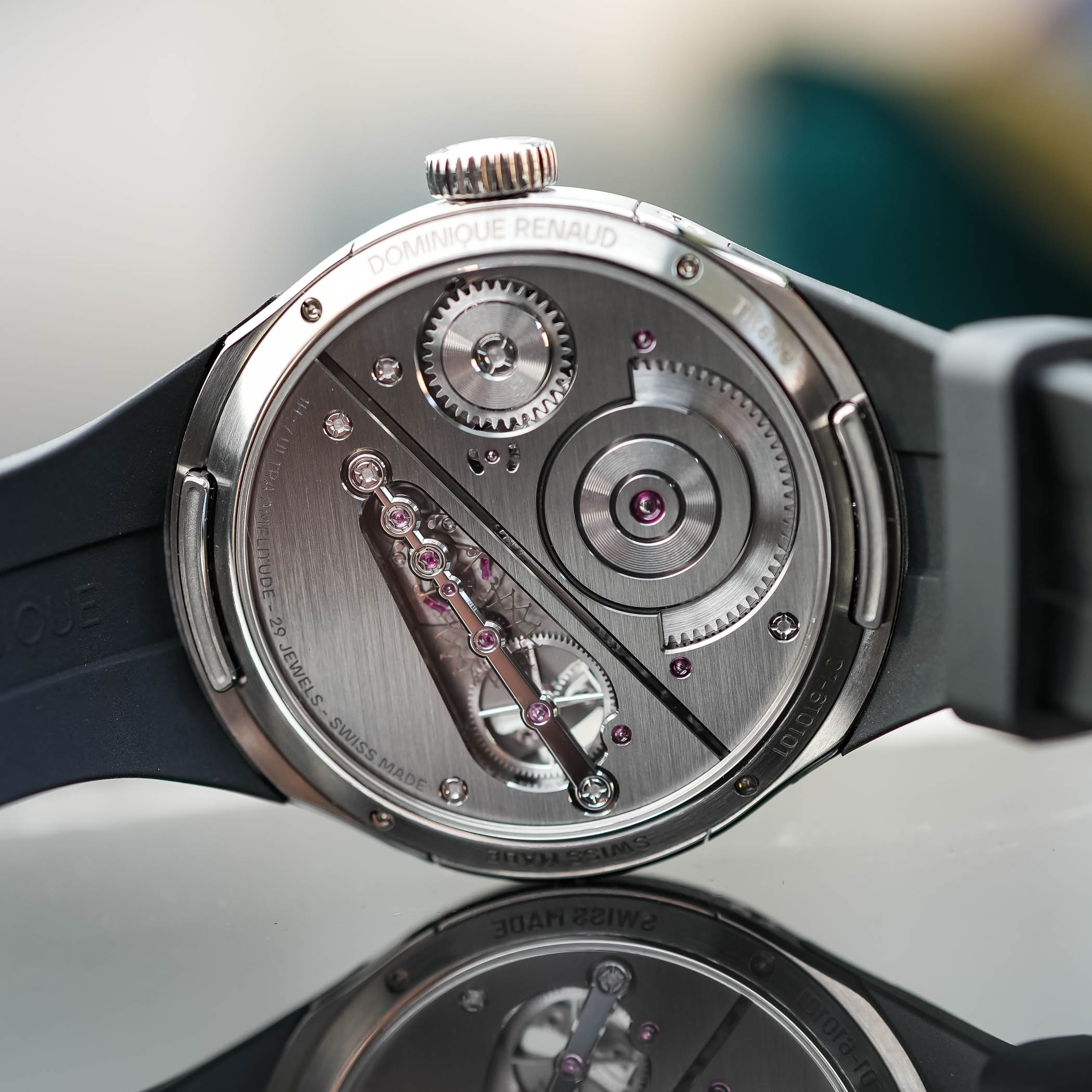
Turn the watch over, and the movement composition is even more restrained than the dial. Two large, straight-grained bridges frame the crown wheel, ratchet wheel, and escapement, which are revealed through a cut-out section in all their beauty. The polished, bevelled escapement bridge carries the balance assembly, the escapement, and the seconds wheel. The architecture is clean, geometric, and almost austere.
The Strap and Price
The Dominique Renaud Pulse 60 is worn on an integrated rubber strap that complements both its design and comfort. The interchangeable system with push-button release makes swapping straps straightforward, and both a pin buckle and triple-folding clasp are supplied.
The Dominique Renaud Pulse 60 is priced at CHF 49,000 (excluding taxes) in titanium and CHF 59,000 (excluding taxes) in pink gold and titanium. For more details, please visit www.dominiquerenaud.com.

1 response
Very nice and good to see the alternative approach to chronometry – and I love the simple-looking and elegant back side; not a fan of the gold/titanium version though. If I did not already have too many watches, I would be very tempted – though my bank manager might have a cardiac event.