
 Not all images were able to load for printing. Please close the print window and try again.
 The Urwerk UR-100V Lightspeed Ceramic, Poetic Time Measurement at the Speed of Light
One of the brand's signature wandering-hours watches becomes a mechanical illustration of the universe, housed in an innovative ceramic composite case.
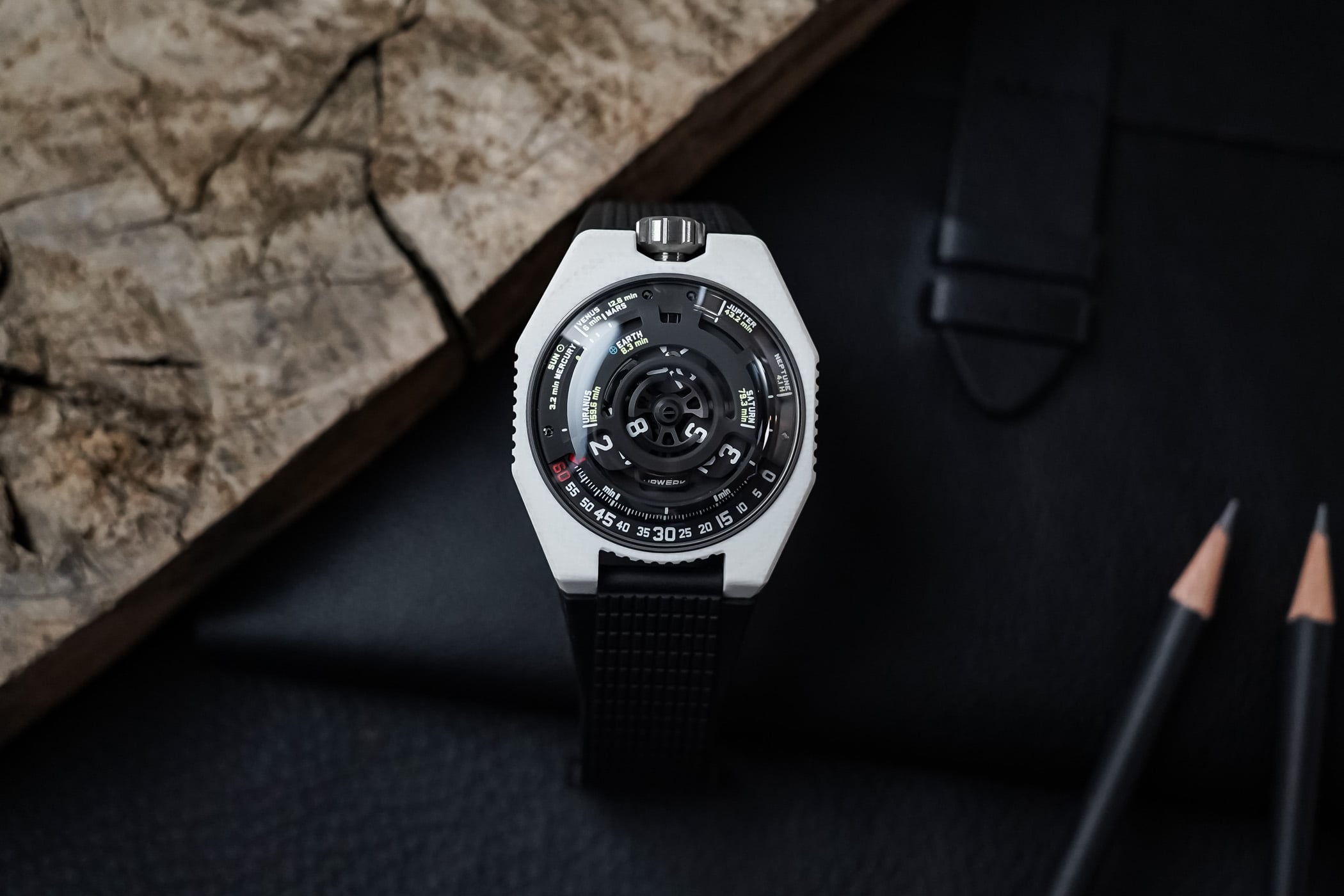
Since its debut in 2019, the UR-100 Series has become one of Urwerk‘s most approachable and recognisable creations. “Approachable” is, of course, a relative term in terms of price, yet it is true regarding wearability. The UR-100 features the brand’s signature wandering-hour satellite display, but unlike the more extravagant EMC, UR-120 or UR-230, it packages the indication into a compact, wearable case. Over the years, the UR-100 has appeared in gold, titanium, carbon, bronze, and various other interpretations, each featuring different materials or themes.
The UR-100V Lightspeed Ceramic, like the first UR-100V Lightspeed of 2024, rather than illustrating the Earth’s movement through space, as earlier SpaceTime models did, visualises something even more fundamental: the time sunlight requires to reach planets of our solar system. It remains unmistakably a UR-100, yet the execution is fresh, and even poetic.
The white Ceramic Case
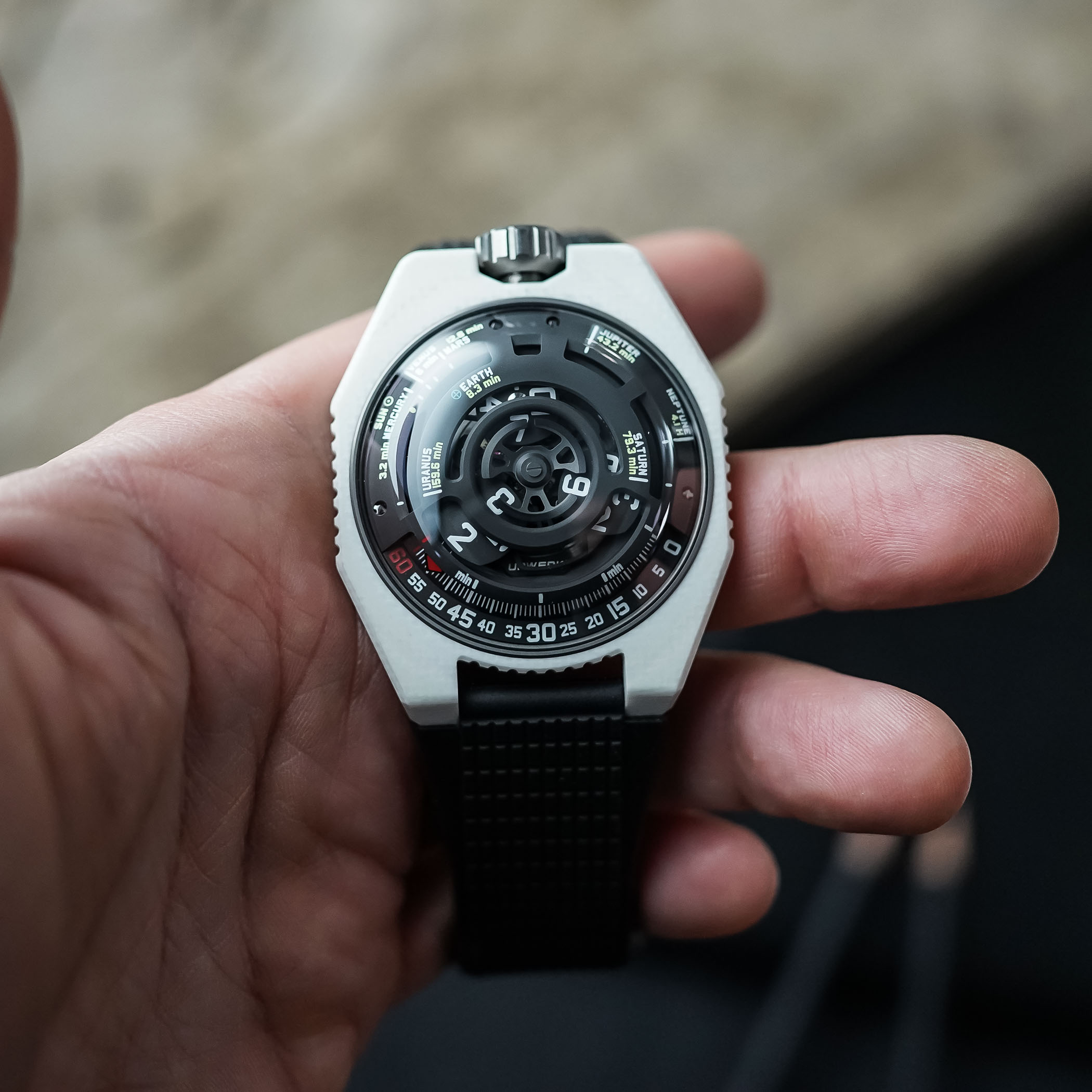
The familiar asymmetrical UR-100 case design remains intact, measuring 43mm wide, 51.7mm long and 14.55mm thick. These numbers suggest a large watch, but the curved profile, integrated rubber strap and crown positioned at 12 o’clock continue to make the UR-100 wear considerably better than expected. It sits naturally on the wrist, avoiding the awkward overhang often associated with unconventional case shapes. This time, however, the exterior is new to the series.
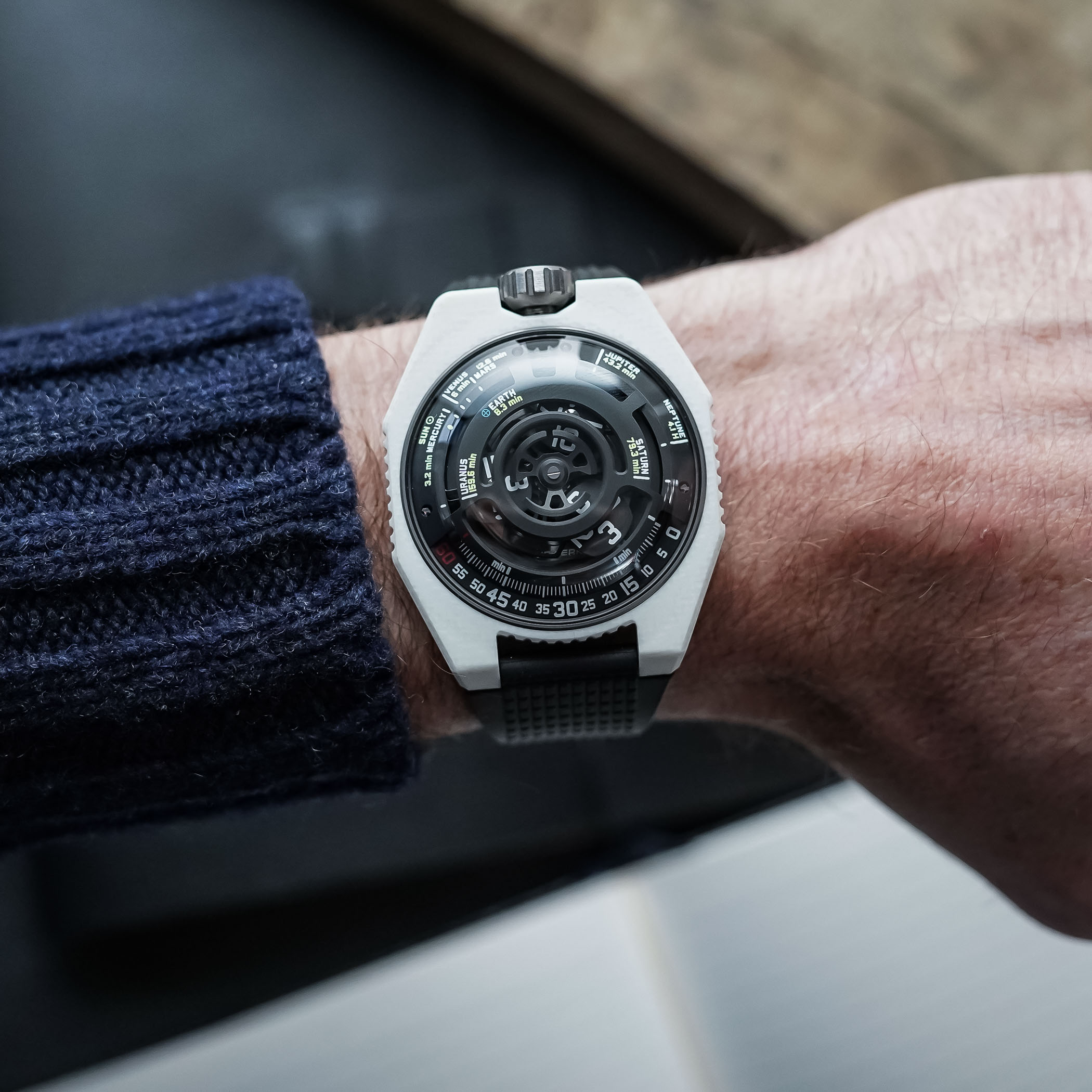
Not satisfied with conventional ceramic, which provides exceptional hardness but remains prone to fracture under severe impacts, the brand has developed its own composite, a combination of ceramic and layers of glass and carbon fibres embedded within a white polymer matrix. By integrating reinforcing layers, Urwerk has created a material that retains ceramic’s scratch resistance while improving its impact resistance.
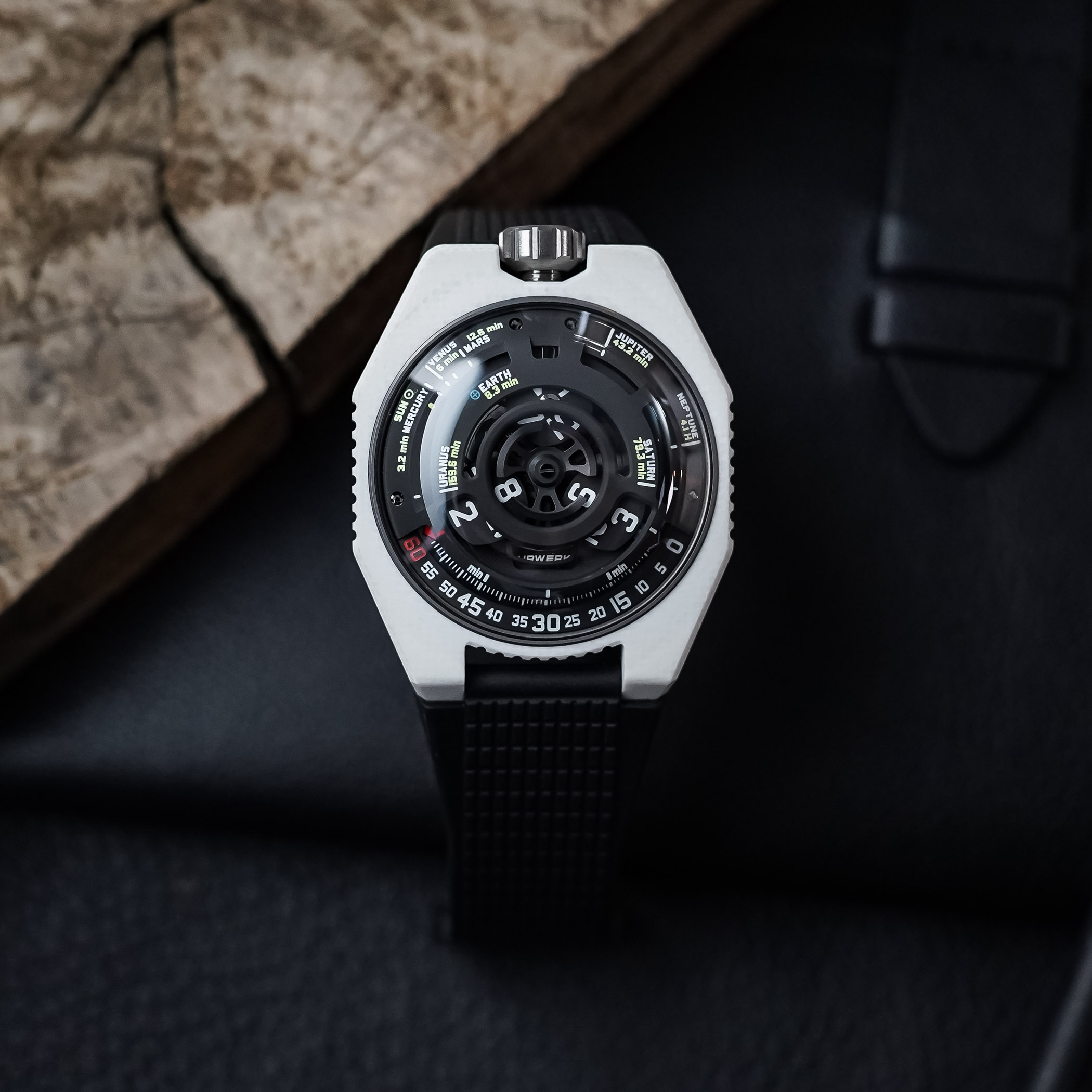
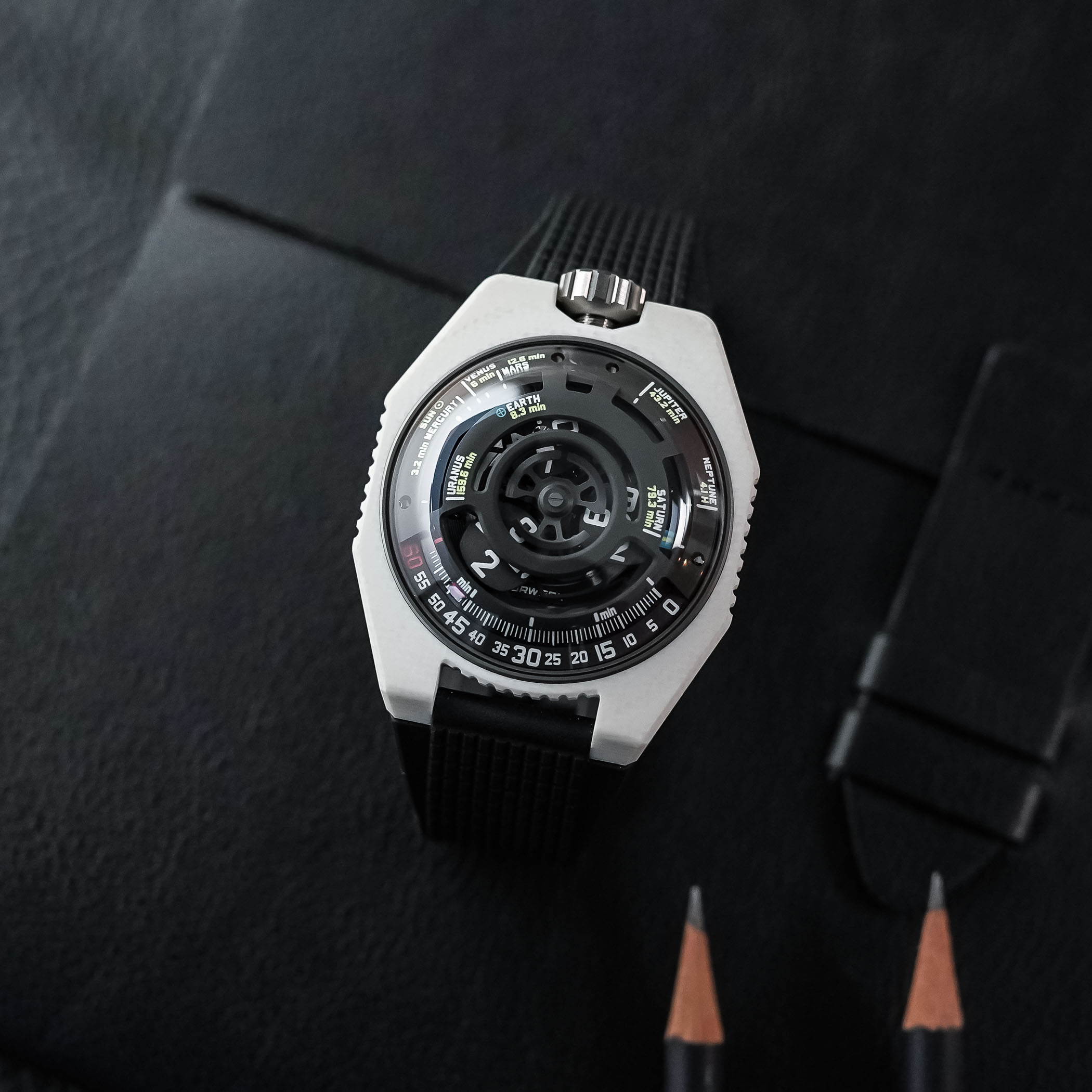
The result is interesting. Depending on the light, the layered construction reveals subtle silver-grey striations beneath the white surface, giving the case an appearance that feels almost organic. It isn’t glossy white or matte white; it constantly shifts between the two. Against the black dial opening, the contrast is quite dramatic. The caseback remains DLC-coated grade 5 titanium and reveals the movement through a large sapphire crystal.
The Wandering Hours, and Beyond
As before, time is indicated by three rotating satellite cubes bearing the hour numerals. Each satellite travels across a 60-minute 120-degree arc before disappearing, where the next hour immediately takes over.
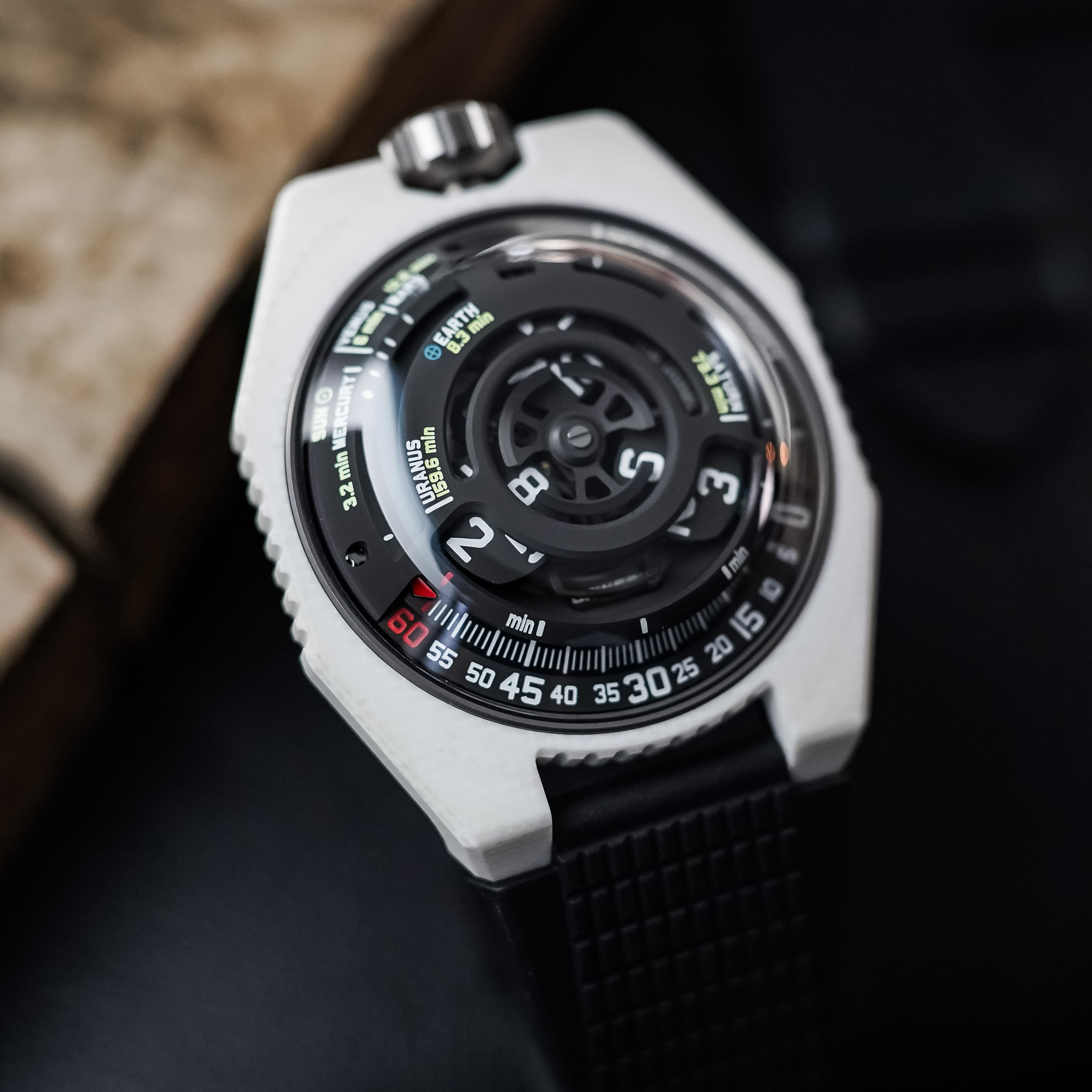
Earlier UR-100 models also displayed the distance Earth had travelled, both around its own axis and around the Sun. The UR-100 Lightspeed replaces these terrestrial calculations with something far more ambitious. Here, a photon, represented by the small blue and green hand attached to one of the carousel arms to complete a full turn in three hours, continues its journey around the dial and marks the times when sunlight reaches Mercury, Venus, Earth, Mars, Jupiter, Saturn, Uranus, and finally Neptune. Mercury appears after 3.2 minutes. Earth arrives at 8.3 minutes; Neptune lies more than four hours away in terms of light travel.

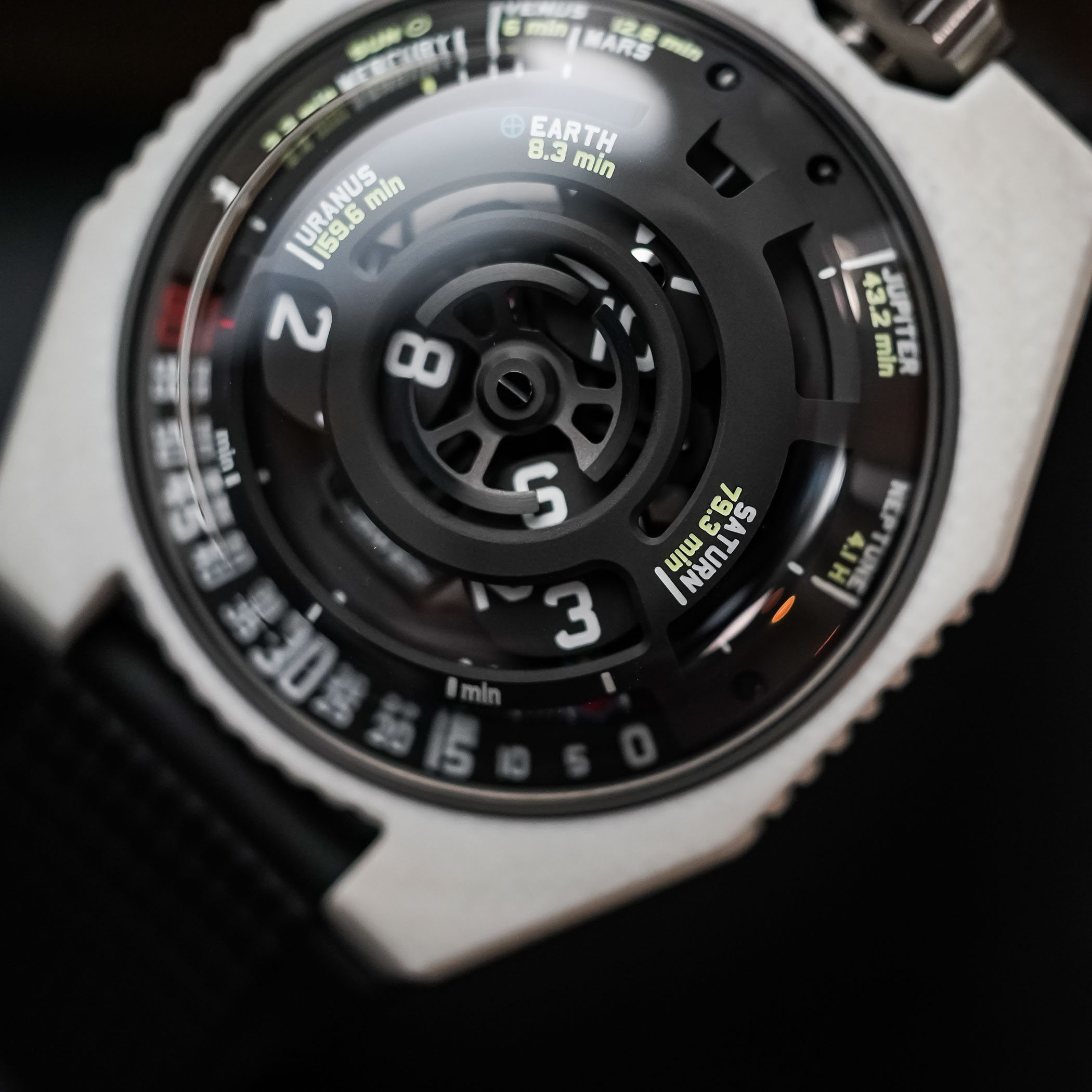
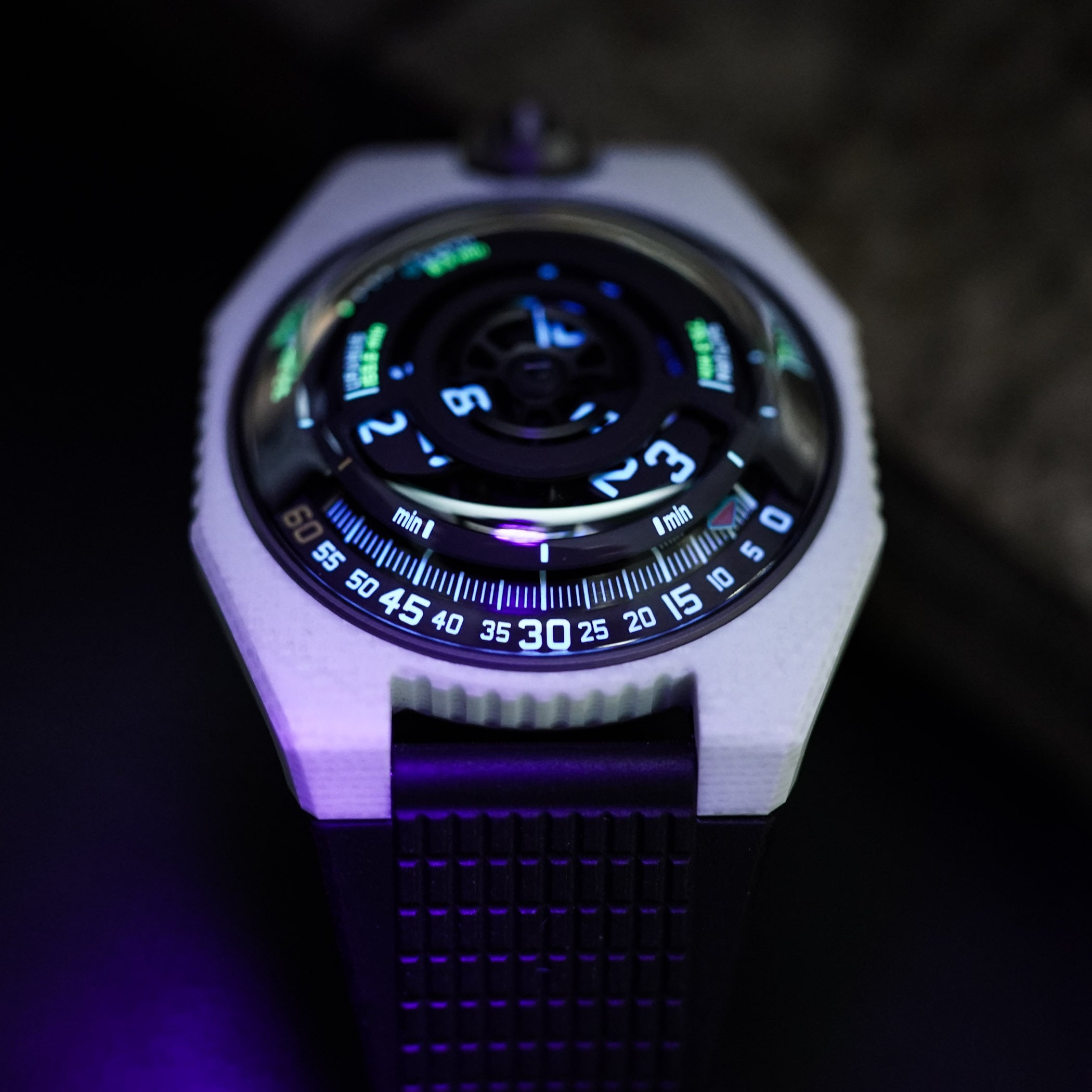
It is, admittedly, a complication with absolutely no practical purpose. But Urwerk has never designed watches solely for utility. The LS transforms scientific fact into a mechanical story. Looking at the dial becomes a reminder that everything we see in the universe is already history. Even sunlight reaching Earth left the Sun more than eight minutes ago. The execution remains remarkably clean despite the conceptual complexity, with hours and minutes painted with Super-LumiNova.
The Movement
The watch is powered by the automatic calibre UR-12.02, developed with Vaucher. It is much the same as used in previous UR-100 generations, featuring aluminium satellites mounted on beryllium-bronze Geneva crosses, and three ARCAP baseplates. The Windfänger system, Urwerk’s turbine regulator fitted to the black PVD-treated aluminium rotoro, remains. The air-resistance turbine limits rotor speed, aiming to reduce wear while improving long-term reliability.
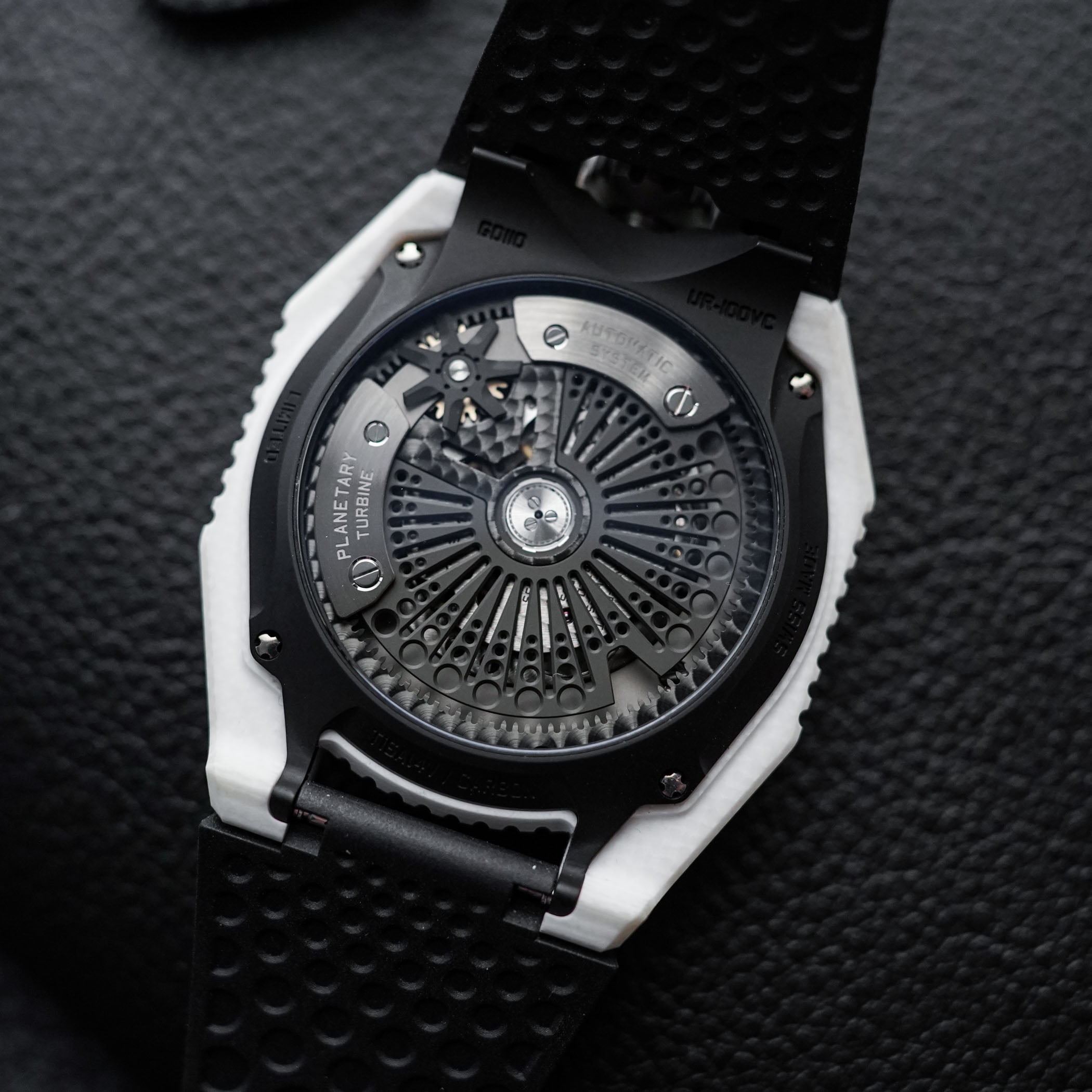
Operating at 28,800vph with a 48-hour power reserve, the movement is finished in the brand’s purposeful industrial style with circular graining, sandblasting, satin finishes and shot-blasting.
Thoughts and Price
Little has changed from the previous UR-100V Lightspeed version; here, the emphasis shifts towards material innovation and storytelling. The ceramic composite case is original, offering both technical advantages and a distinctive look. The astronomical display feels consistent with Urwerk’s philosophy; the brand once again encourages us to think differently about time and space.
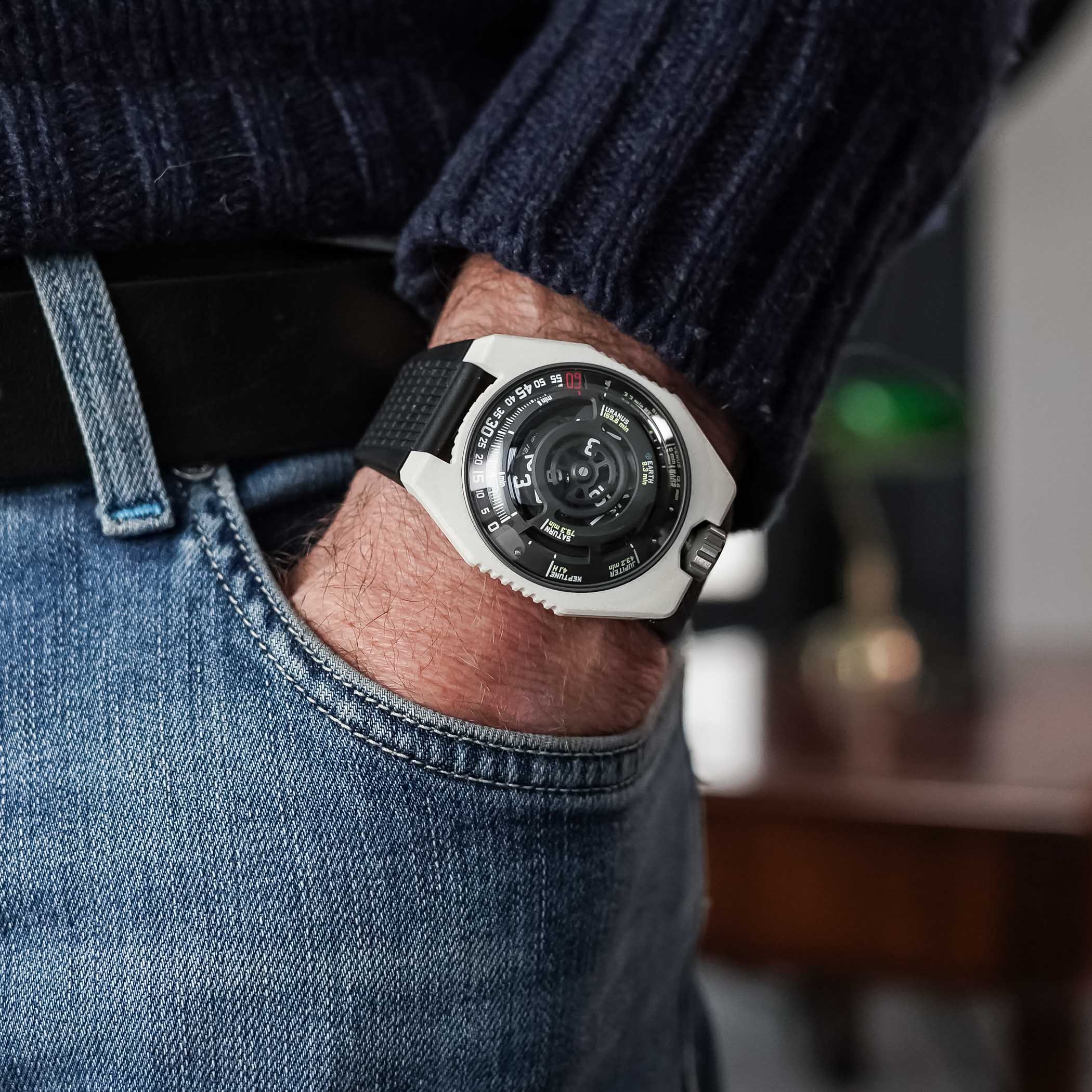
The UR-100V Lightspeed Ceramic design and its concept do not aim for universal acceptance. Still, if you love indie watchmaking at its most imaginative, the UR-100V Lightspeed Ceramic stands tall, and Urwerk continues to occupy a category almost entirely of its own. Priced at CHF 67,000 before taxes, it is one of the coolest interpretations of the well-established UR-100 family. For more information, please consult urwerk.com.