


 Not all images were able to load for printing. Please close the print window and try again.
 The MIH Gaïa Series III, and Why this Watch Matters
A meaningful blue dial tribute to 50 years of the museum's architectural and horological legacy.

After the now-cult-classic MIH Watch of 2005, an overtly minimalist Annual Calendar Chronograph developed by Ludwig Oechslin and Paul Gerber, and the Gaïa Watch series launched in 2019, the 2024 edition continues the museum’s approach to watchmaking. Indeed, before launching his own brand, Ochs und Junior, Oechslin was the curator of the Musée International d’Horologerie in La Chaux-de-Fonds and initiated the MIH Watch project. And even if we’re not looking at a novelty, we wanted to explore the latest chapter in the MIH story: the Gaïa Series III, a blue dial watch that captures the soul of La Chaux-de-Fonds, where architecture and time converge.
How It All Began
The Musée International d’Horlogerie (MIH) in La Chaux-de-Fonds hides within the city, half-submerged in concrete and silence. Inside, time seems to slow down. Light comes through narrow skylights; part museum, part cathedral, it was built into the rock to guard humankind’s long pursuit of measuring time.

It is within this semi-subterranean masterpiece of brutalist architecture, designed by Pierre Zoelly and Georges-Jacques Haefeli, that the story of the MIH Watch started in 2005, when curator Dr Ludwig Oechslin and Paul Gerber created a minimalist annual-calendar monopusher chronograph to fund restoration projects. Designed by Christian Gafner, the titanium-cased MIH Watch distilled Oechslin’s genius for reduction; its calendar used just nine additional parts. Approximately 100 were made per year until 2020, when production ended, and one exemplar found its place in the collection of MONOCHROME founder Frank.

In 2022, the MIH Watch returned as the Mechanik2, redesigned by Gafner. Still powered by the Valjoux 7750, it introduced a dotted chronograph track on the dial (the original had an aperture on the back for the function), a red-tipped hand, and sharper typography, taking MIH’s spirit of mechanical honesty beyond the museum walls. Meanwhile, within those same walls, a new chapter took shape.

Introduced in 2019, the Gaïa Watch, named after the museum’s annual Gaïa Prize, turned MIH’s architecture into a watch. Its geometric dials presented time through rotating discs. Series II followed in 2021 with a black dial; both funded the restoration of automata and historic clocks. In 2024, the museum celebrated the 50th anniversary of its building, and to mark the milestone, the MIH unveiled two new watches: the Gaïa 50th Anniversary Edition with a hand-guilloché silver dial by master artisan Georges Brodbeck, and the Gaïa Series III. It’s the latter we present to you today.
A Structure in Miniature
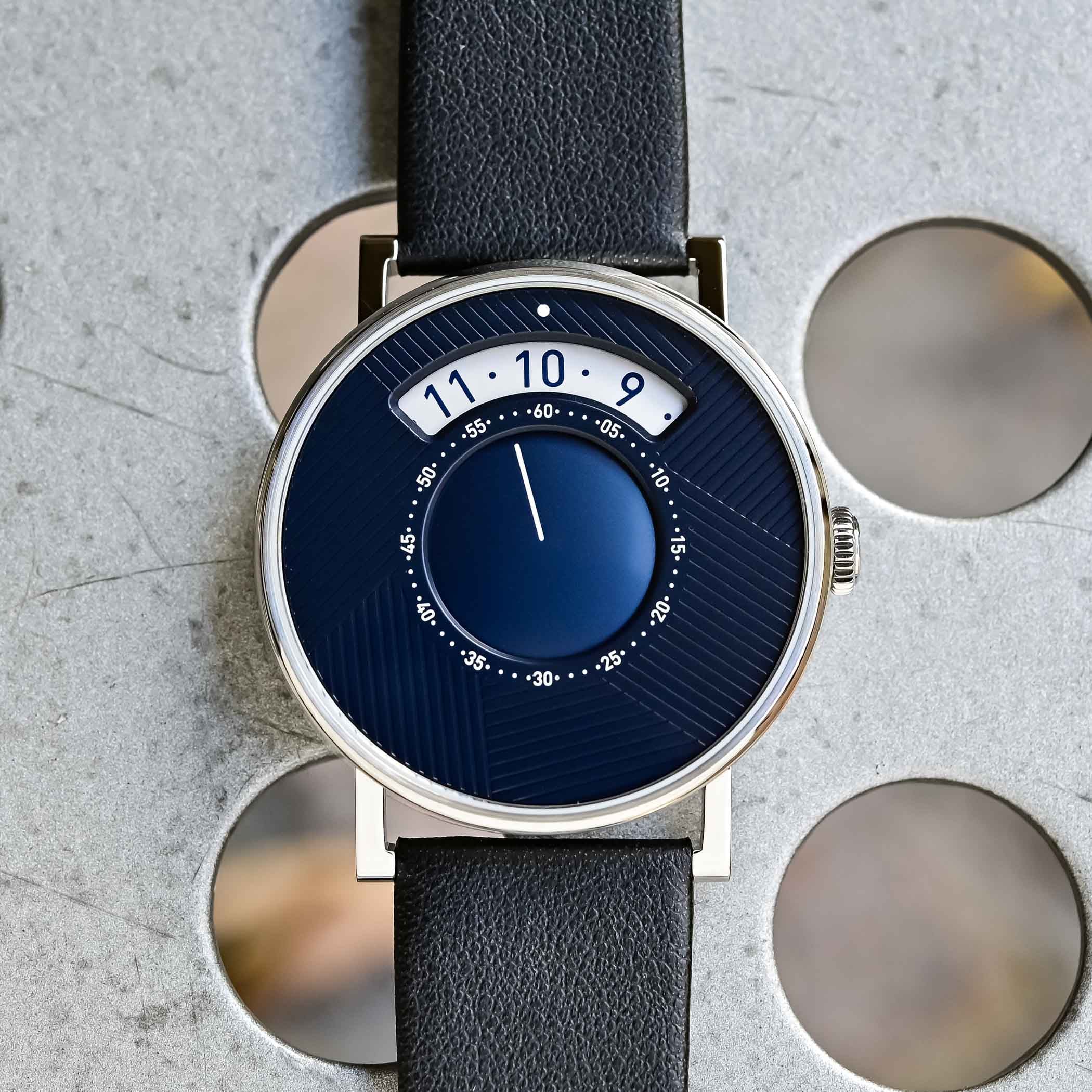
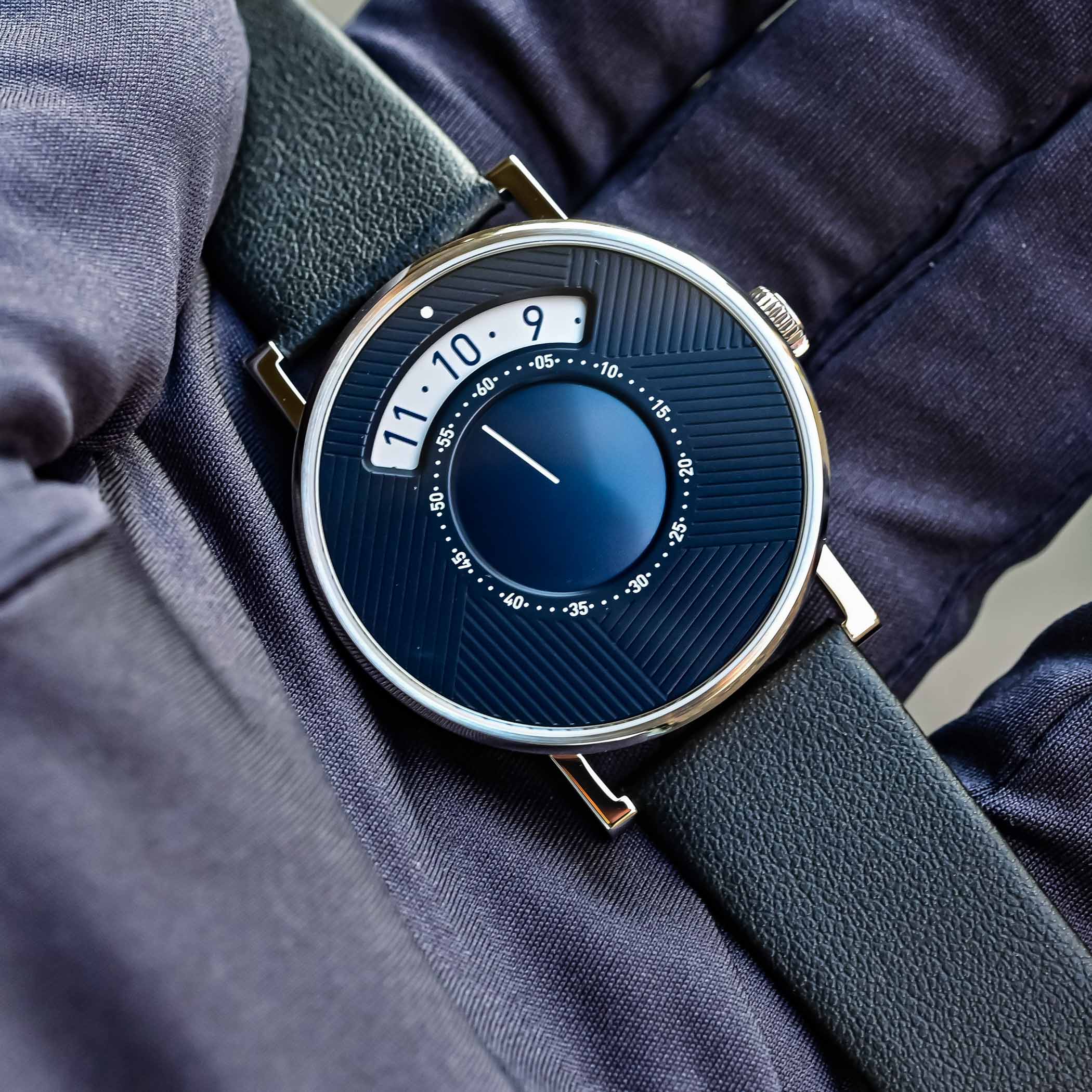
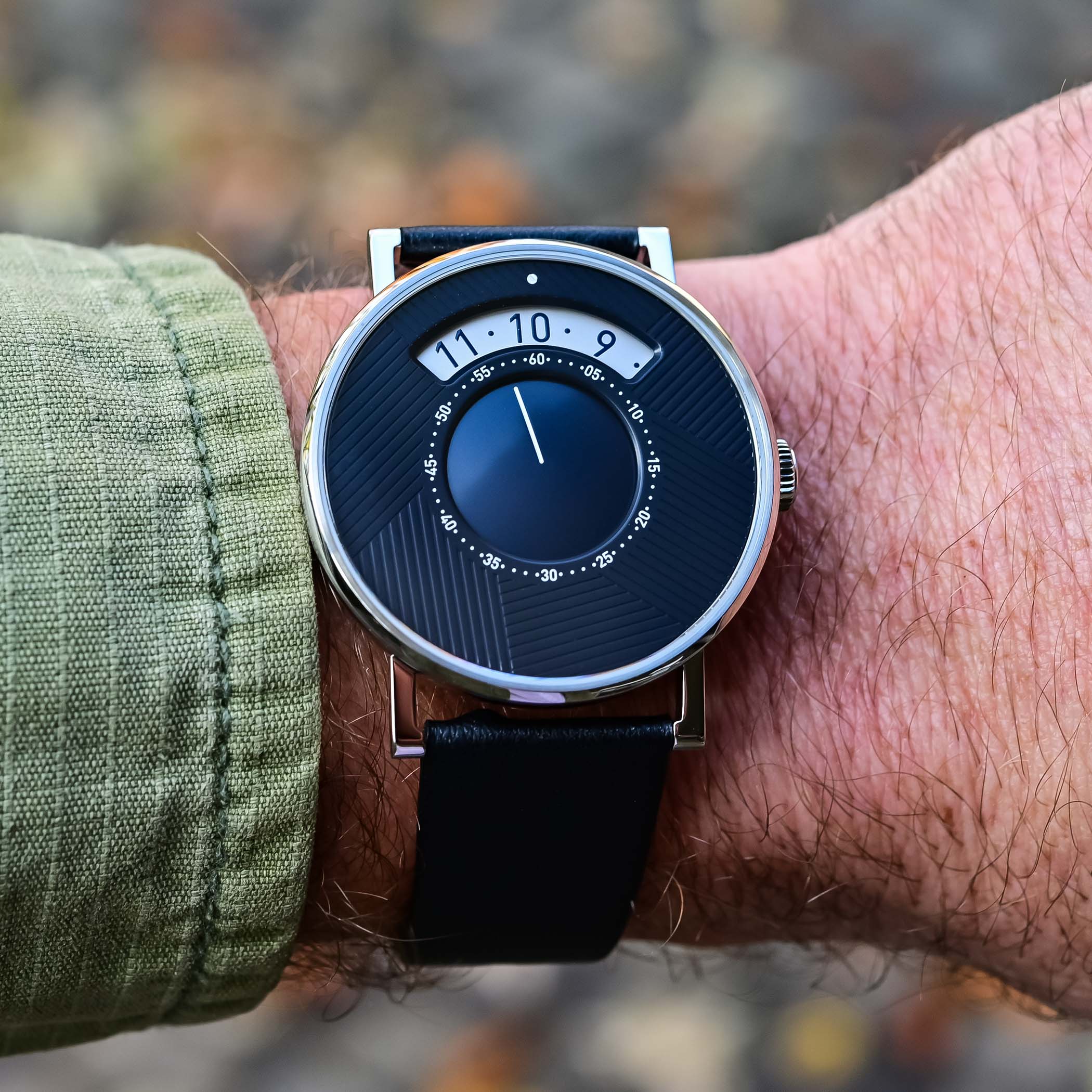
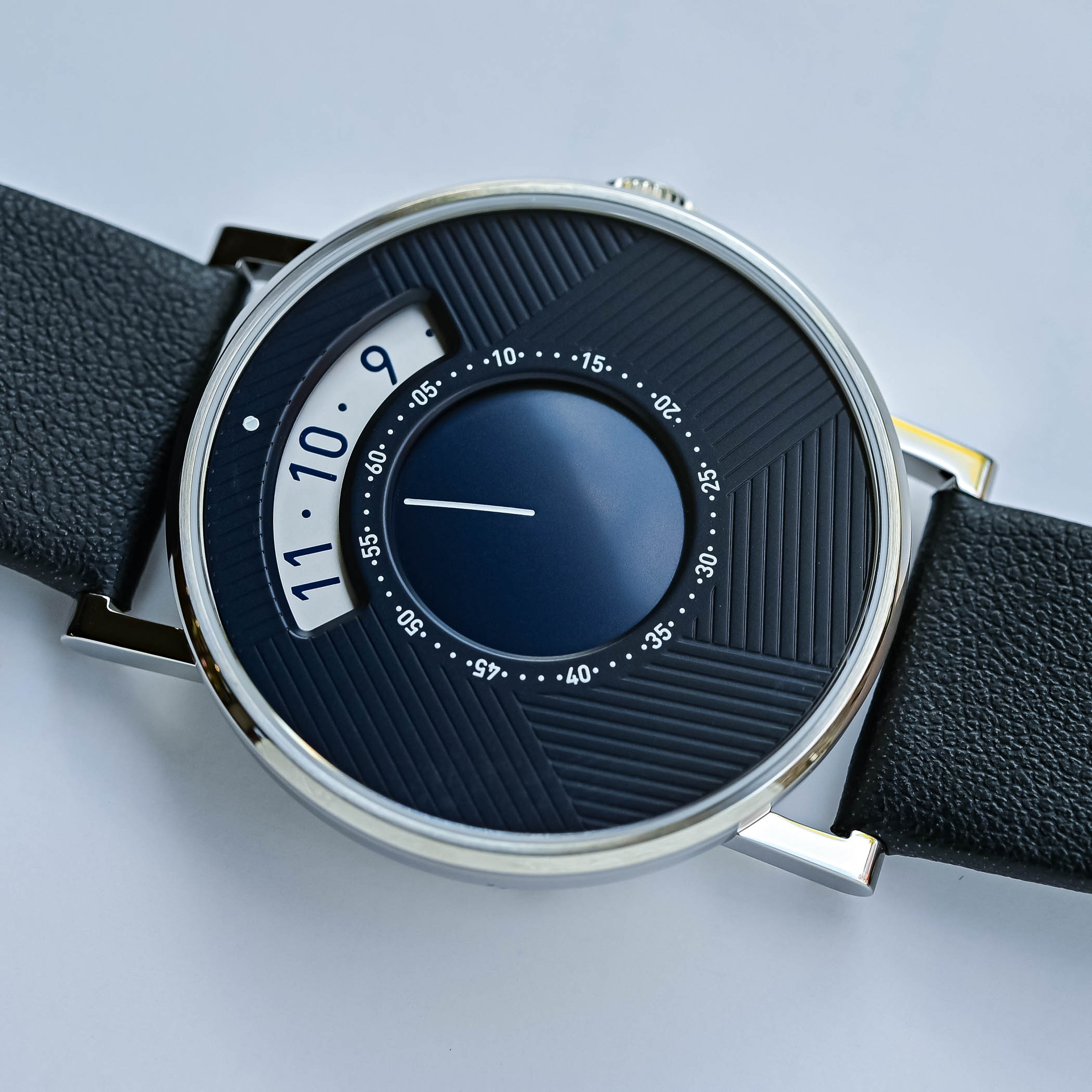
When you see the MIH Gaïa Series III, it feels very familiar; after all, it takes its cues from the watch introduced six years ago. The 39mm steel case, made by Stila SA, is all about proportion. The surfaces alternate between brushed and polished, with a feel that is architectural rather than decorative. It’s slim too, 9.74mm thick, and sits comfortably on the wrist. The design by XJC (Xavier Perrenoud’s studio) has matured over three iterations. The new lugs flow more naturally into the strap. The crown, engraved with “MIH”, sits flush without disrupting the watch’s balanced symmetry. The first thing that catches the eye, though, is the dial.
Concrete and Sky
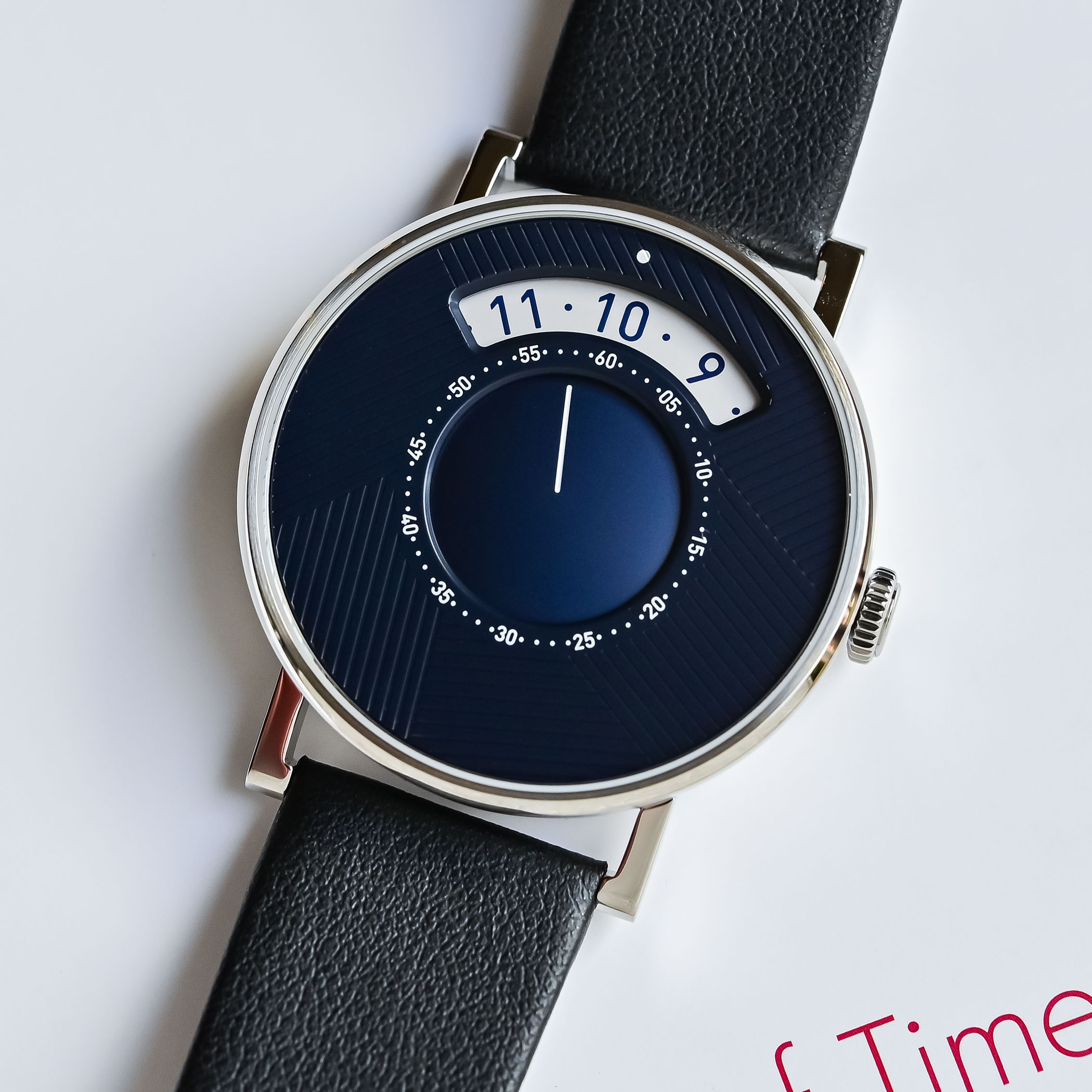
Under the sapphire crystal lies a blue so complex it seems to shift with every angle. The dial is calm, modern, and quietly lyrical. The colour is produced through an ALD (Atomic Layer Deposition) process by Positive Coating, a La Chaux-de-Fonds specialist. The coating is impossibly even, with a deep, saturated tone. Look closer, and you’ll see laser-engraved lines running parallel and perpendicular, like an abstract map. These are inspired by the formwork imprints still visible on the museum’s concrete walls. It’s a literal translation of architecture into horology, a surface born from pressure and of structure.
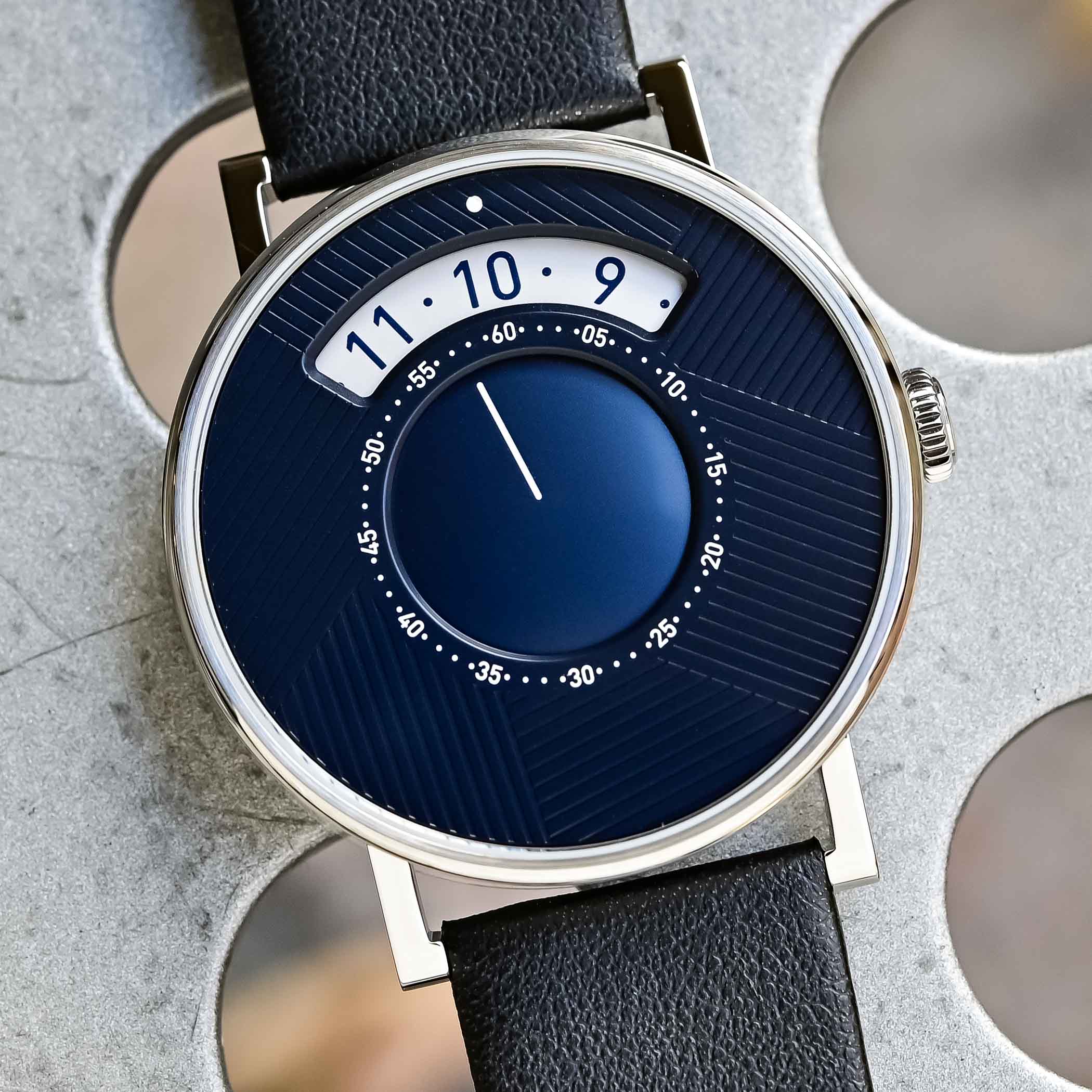
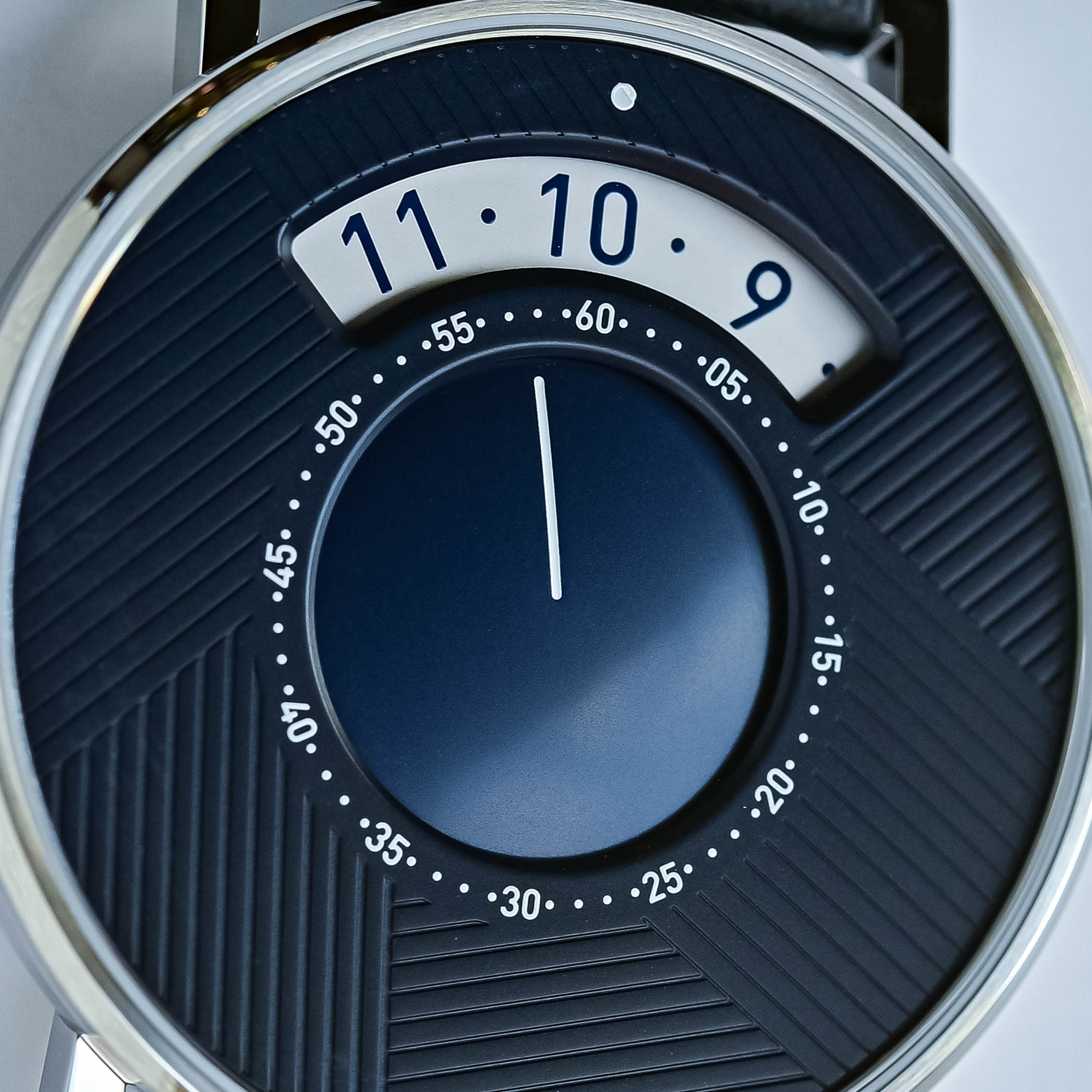
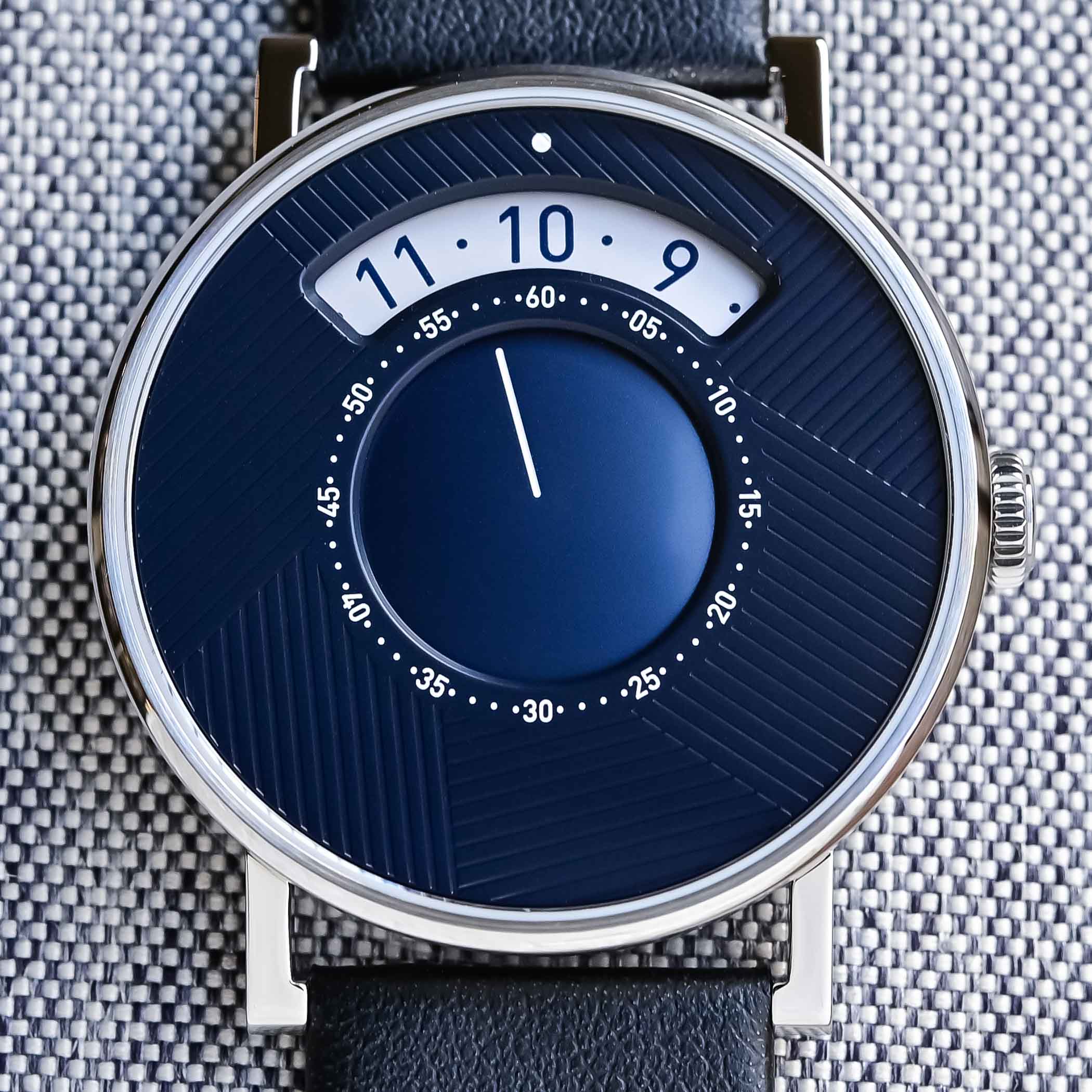
Time is displayed by a central rotating disc marking the minutes, while the hours appear through an arched aperture at the top of the dial. The typography is clean, almost Bauhaus-like, and perfectly legible. Reading it becomes second nature after a few moments. It’s a deliberately different rhythm, slower.
Inside the Machine
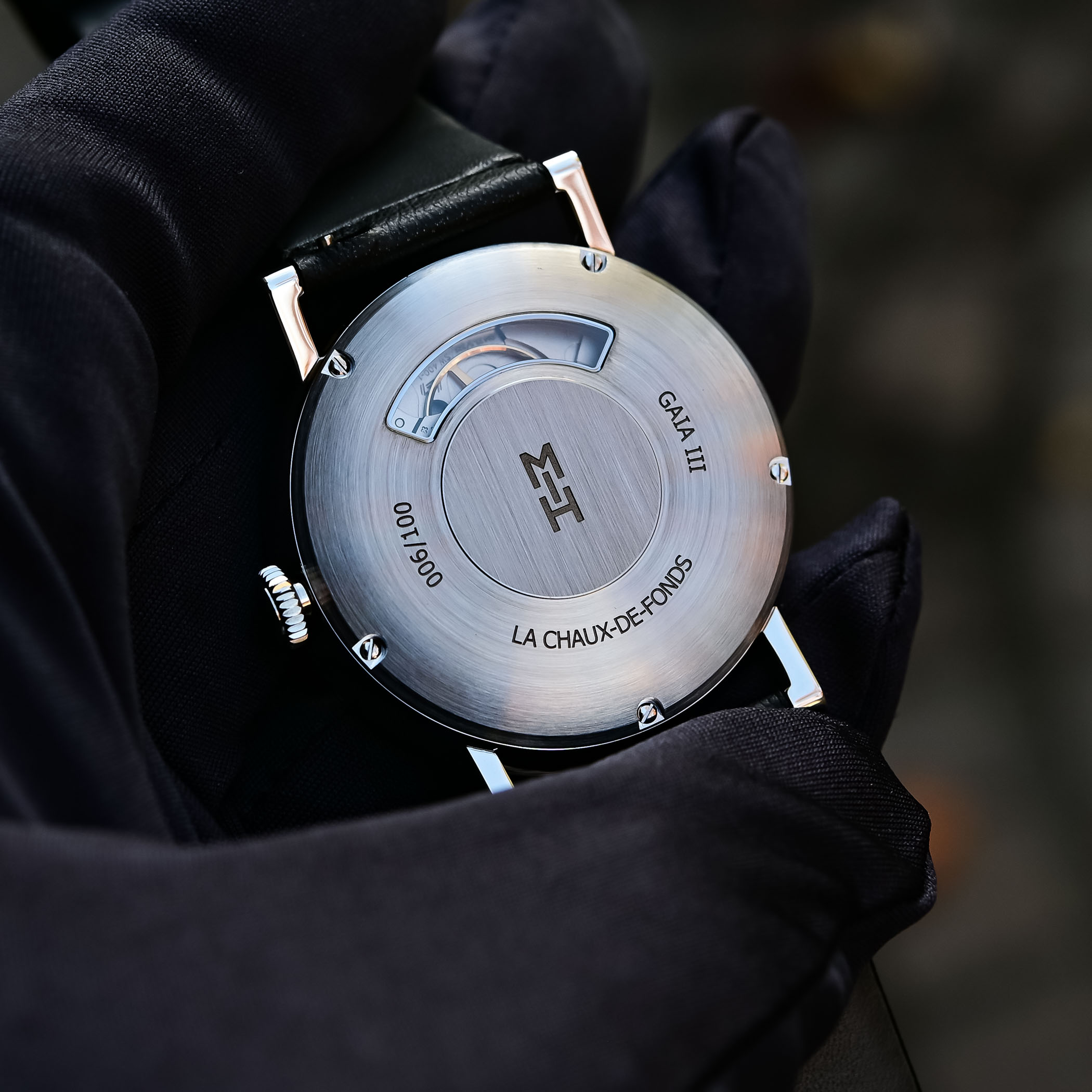
An engraved caseback with the inscriptions MIH Gaïa III, La Chaux-de-Fonds, Swiss Made, and the unique serial number, features a small aperture like the one dialside. The Sellita SW400-1 movement operates at 28,800 vibrations/hour and provides a 38-hour power reserve. The rotor is engraved “Musée International d’Horlogerie” in blue. The choice of movement, reliable, locally made, reflects the museum’s approach: celebrating the practical as much as the poetic.
Ethical and Local
The strap is made by Brasport SA, crafted from recycled apple waste, and the pin buckle, made by Cornu & Cie, is engraved with MIH’s exact geographical coordinates (47°06’03” N / 06°49’48” E), a nice touch that anchors the watch to its home.

Price and Availability
The MIH Gaïa Series III is limited to 100 pieces, priced at CHF 3,400 (excl. tax), available online at www.montremih.ch and directly from the MIH shop in La Chaux-de-Fonds. Proceeds from the Series III support the museum’s renovation and redesign of its permanent exhibition.

2 responses
This watch looks like the smallest bathroom scale ia have seen.
Good $300-400 watch for sure. I visited a museum past summer, amazing experience for sure. Sounds like it will closed for renovations for some time. Yet Sellita SW400, sorry I am not buying the story…..