


 Not all images were able to load for printing. Please close the print window and try again.
 The New Horage Molokini GMT Diver Collection
A fun, compact diver series to make summer feel closer, but still packed with serious watchmaking credentials.
Founded by Andreas Felsl and Tzuyu Huang in 2007, Horage approached watchmaking from an unconventional angle: rather than starting with design and sourcing movements, the company began by developing in-house calibres. Now Horage has a portfolio built around modular movement families, the automatic K1, the micro-rotor K2, the K-TOU with a tourbillon regulator and K-TMR micro-rotor tourbillon, and the recent COSC-certified K3 automatic (that debuted in the new DecaFlux three-hand sports watch), all engineered to deliver high-end specifications at comparatively restrained prices.
The K2 micro-rotor calibre, introduced in the Supersede GMT (2021), was later expanded to power several references, like the Lensman 2 Exposure, the Omnium and the updated Autark. K2 has become central to Horage’s identity: COSC-certified, with silicon components, and configurable for multiple complications, it underpins some of the most technically competitive sports watches in its segment. The new Molokini GMT Diver is the latest evolution: a more compact, original dive watch that retains K2 movement.
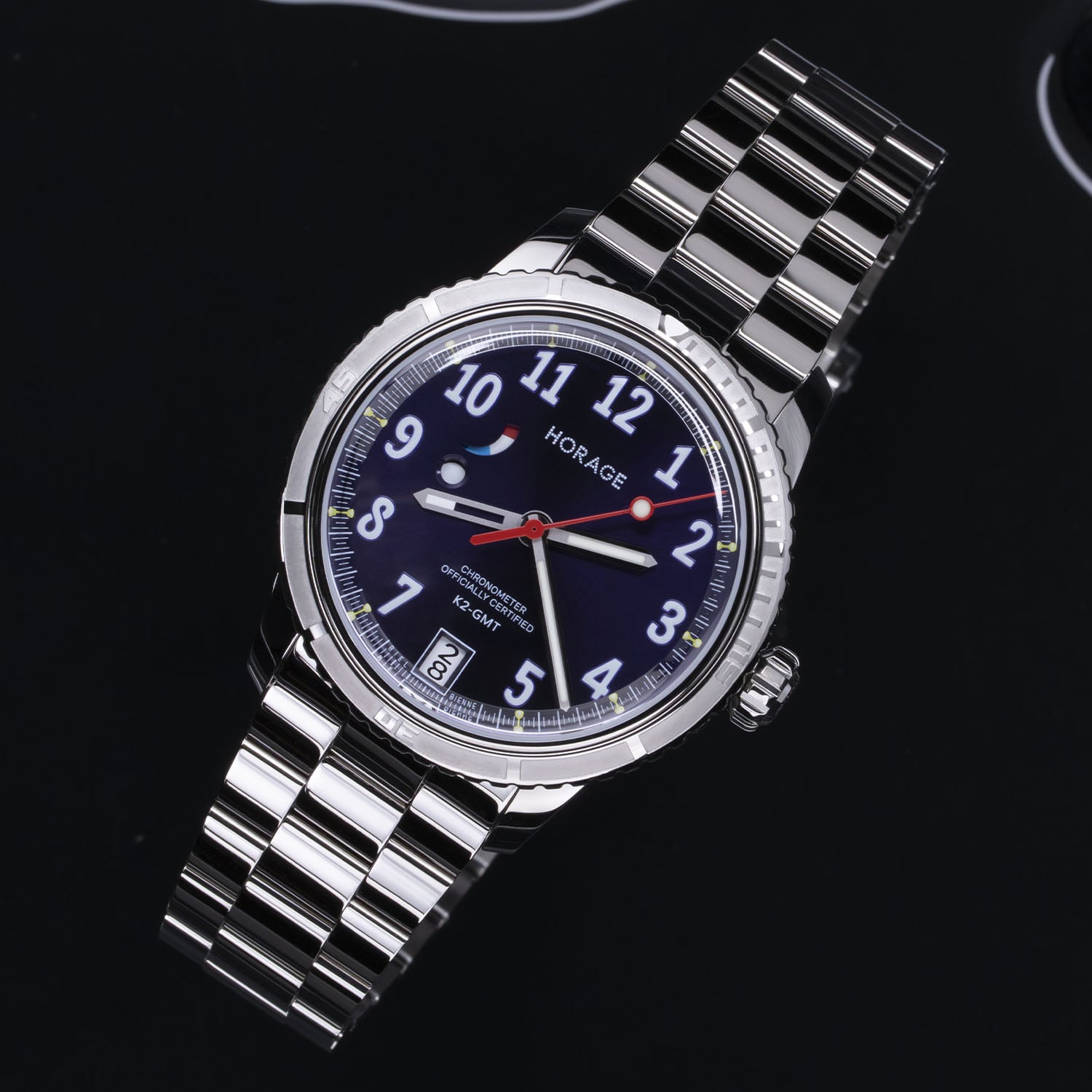
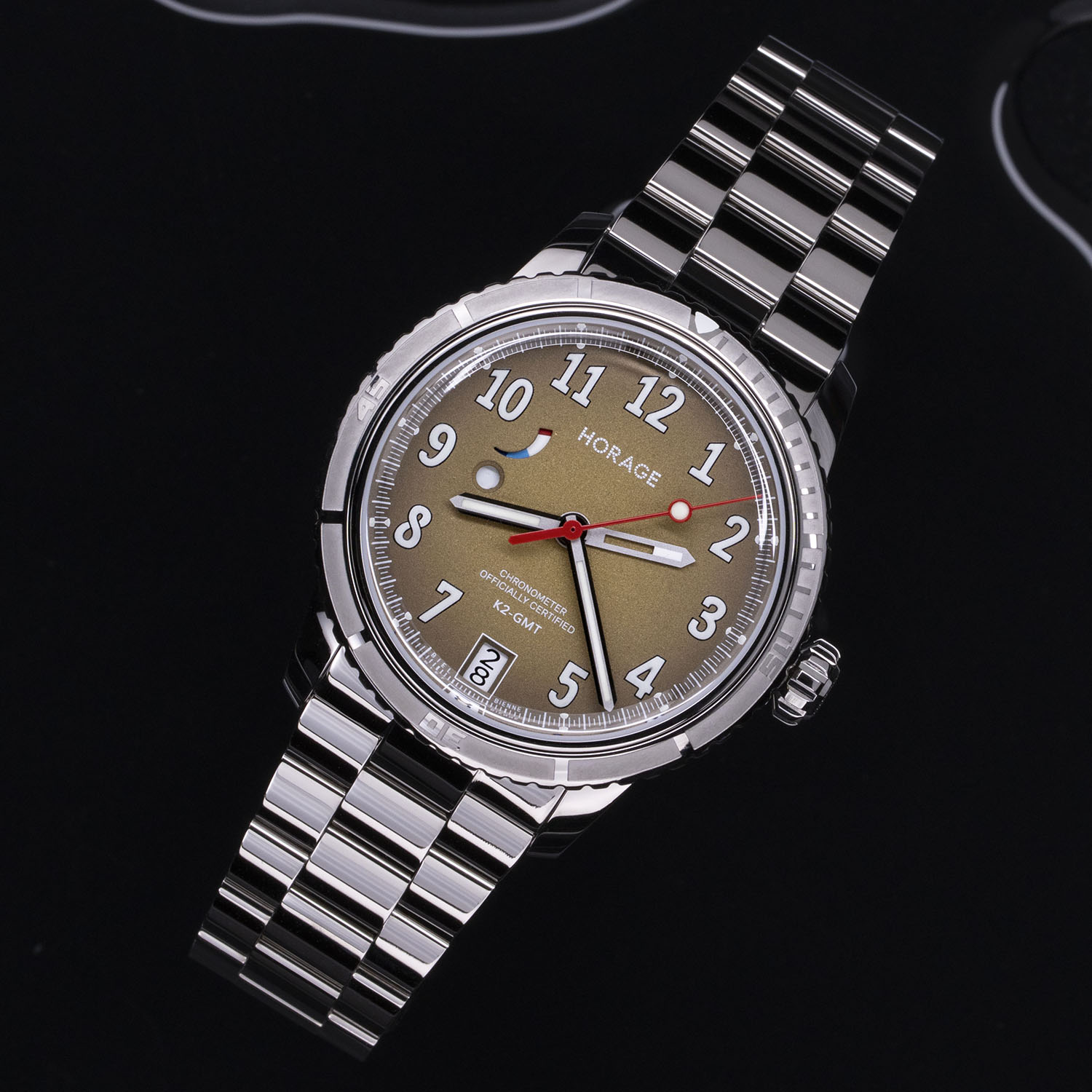
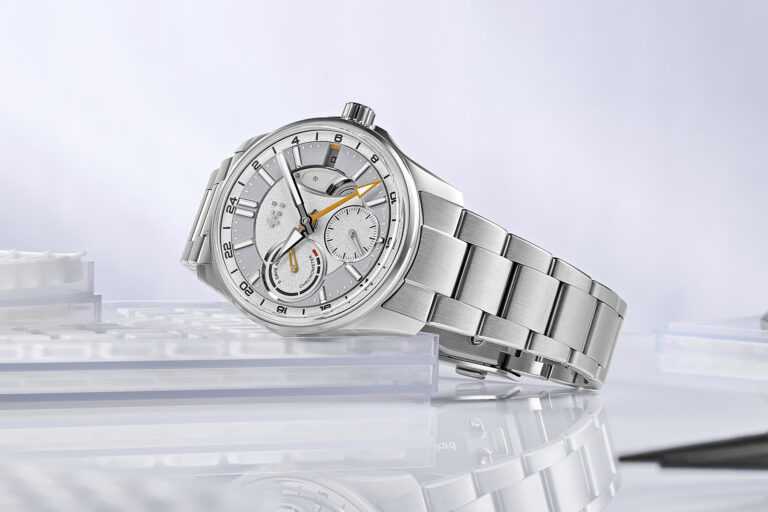
The Molokini (named after a popular snorkelling and diving spot, the Molokini Crater, located off the coast of Maui, Hawaii) is housed in a 38mm case made from 904L stainless steel, a material selected for its corrosion resistance and ability to take a high polish. At 9.65mm thick and 44.6mm lug-to-lug, the proportions are notably compact for an automatic GMT dive watch, made possible by the movement’s micro-rotor construction. The case features a unidirectional rotating timing bezel, a domed sapphire crystal with multi-layer AR coating, and a sapphire exhibition caseback. Water resistance is 200m, thus Molokini is a functional dive watch, not just a nominal sports model.
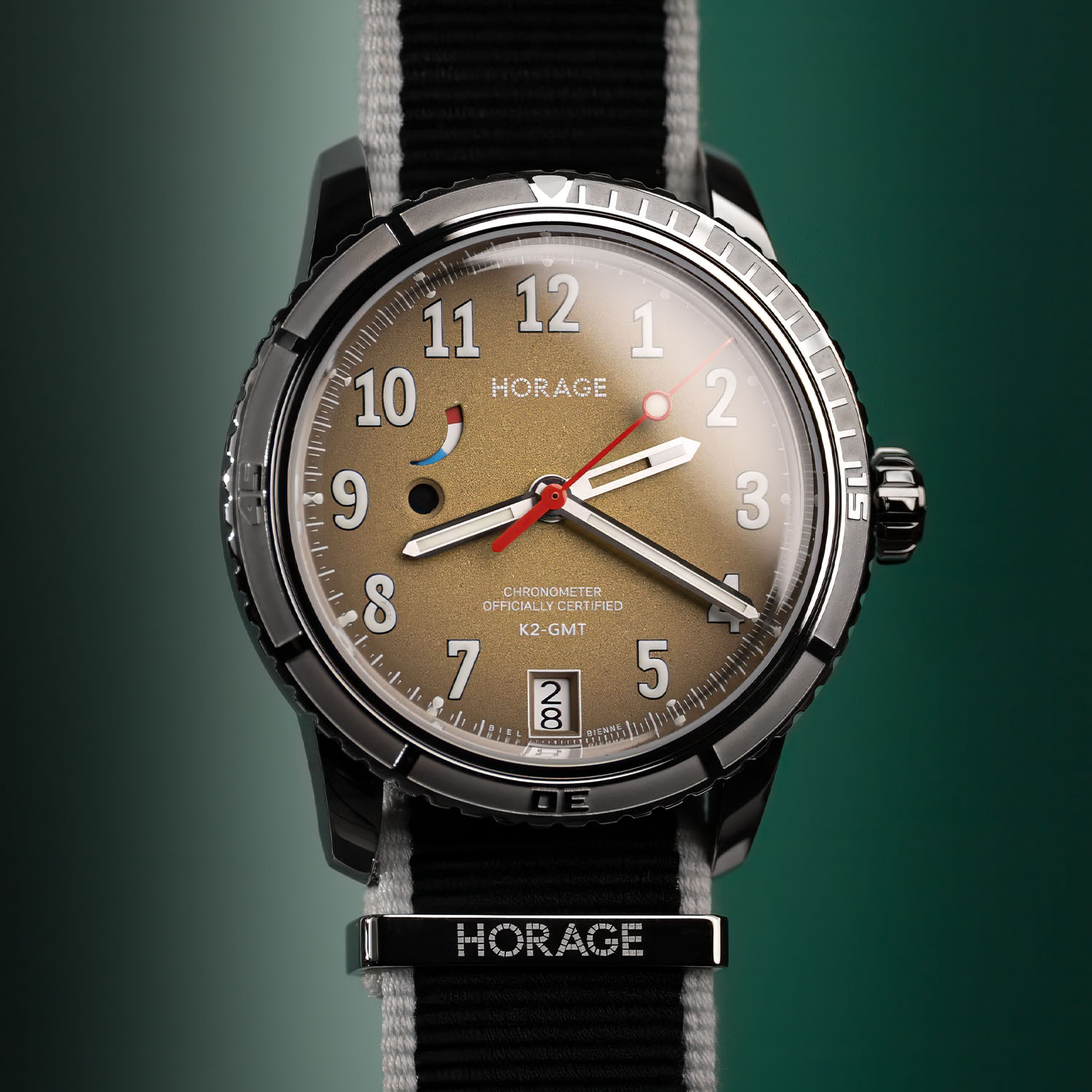
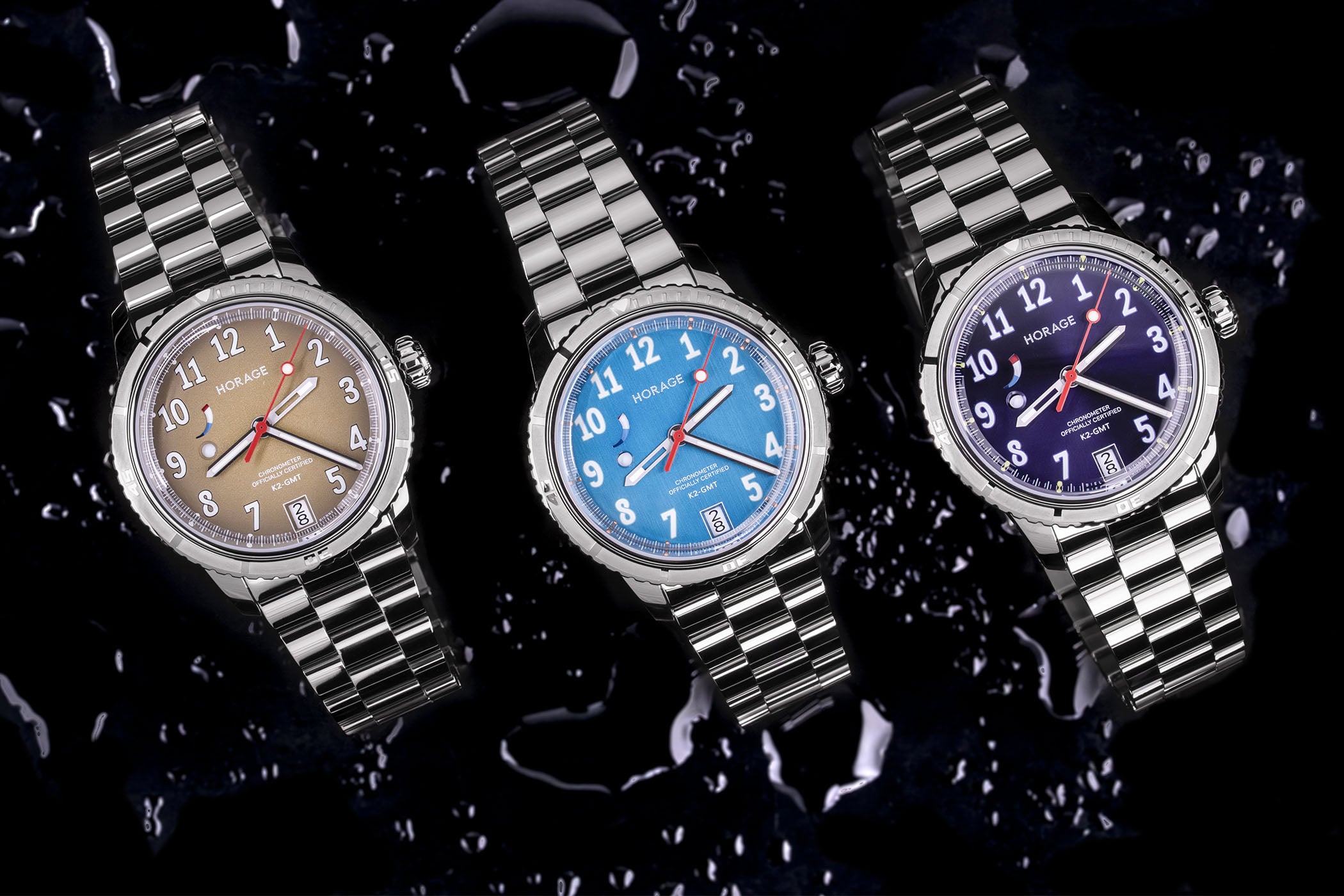
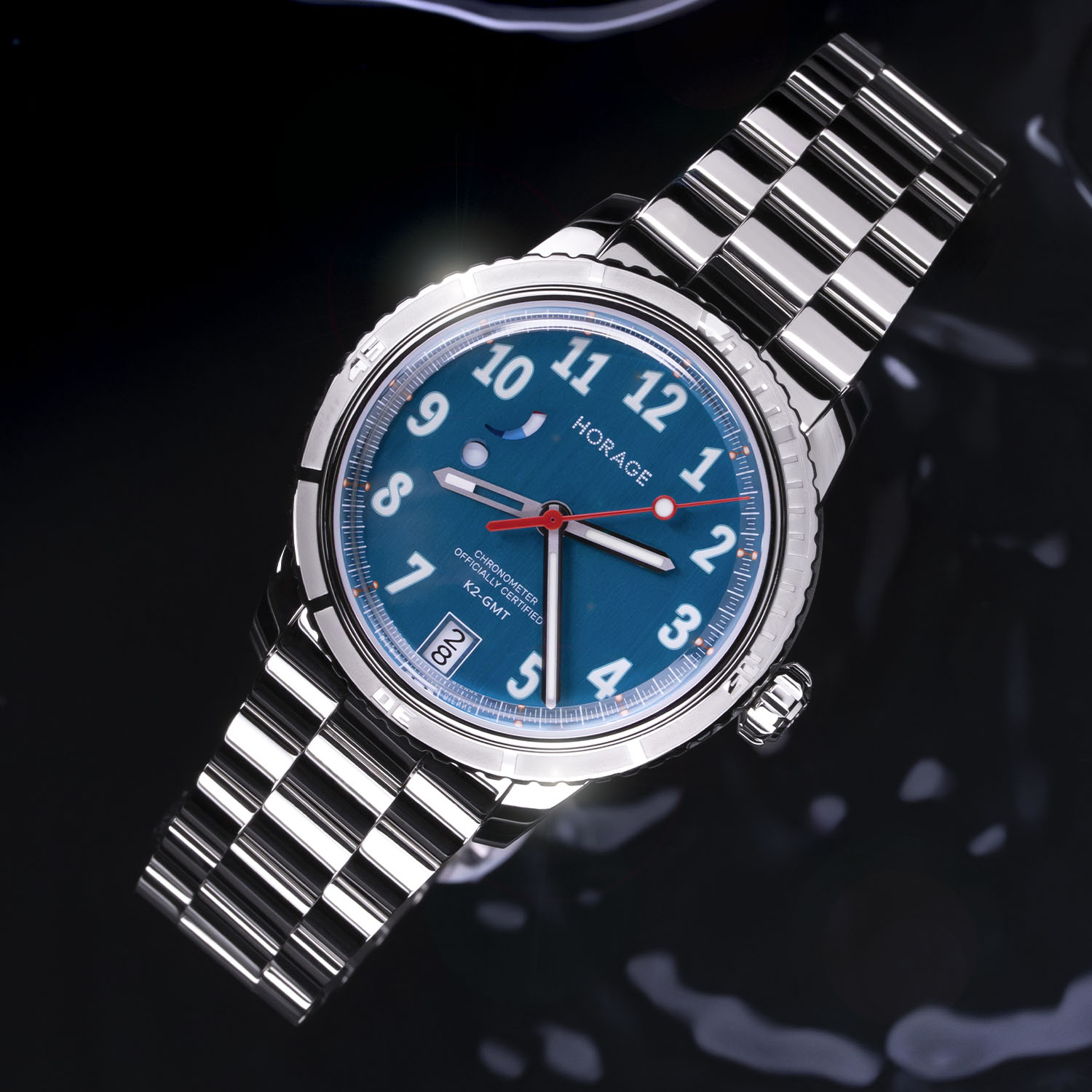
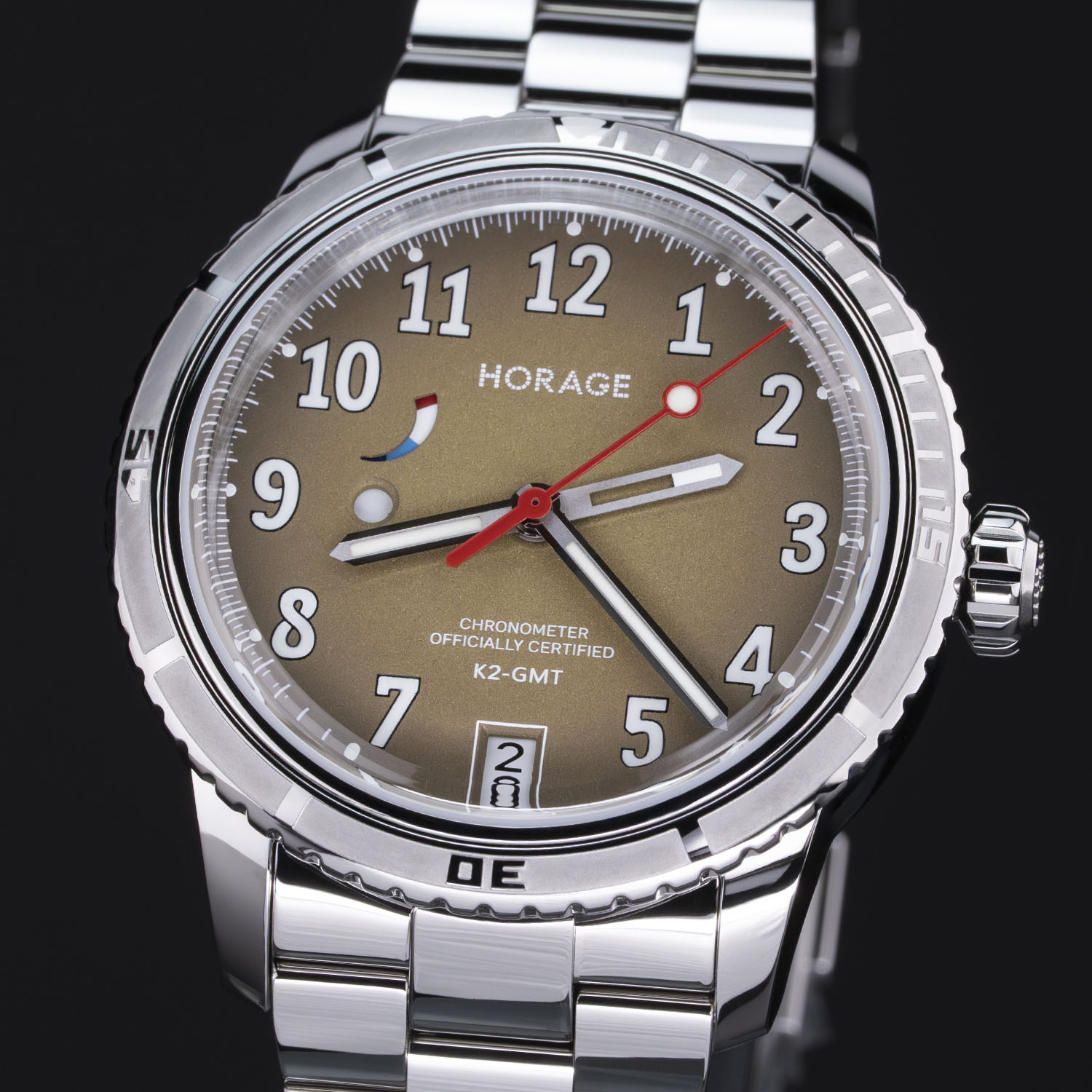
At launch, Horage offers three dial colours, Sand, Coral and Ocean, each with a distinct surface treatment. Instead of applied markers, the Molokini uses printed Arabic numerals filled with Super-LumiNova, contributing to a highly legible, slightly unconventional aesthetic. Despite the complications, the dial remains under control. Central hours, minutes and seconds are paired with a true traveller GMT, allowing the local hour hand to jump independently. A vertical big date is at 6 o’clock, while a day/night indicator at 9 o’clock and a power reserve display at 10 o’clock are executed as compact discs rather than traditional sub-dials.
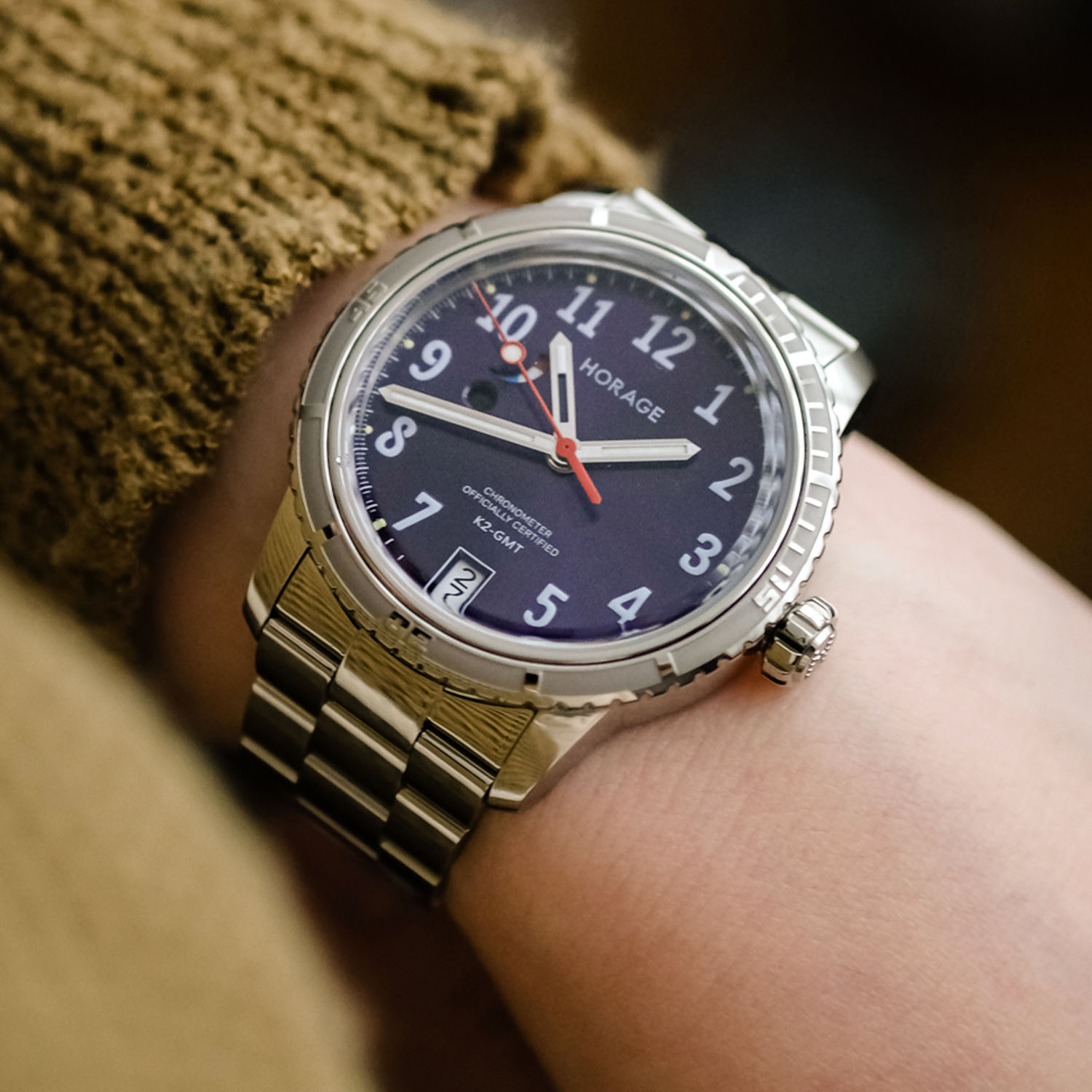
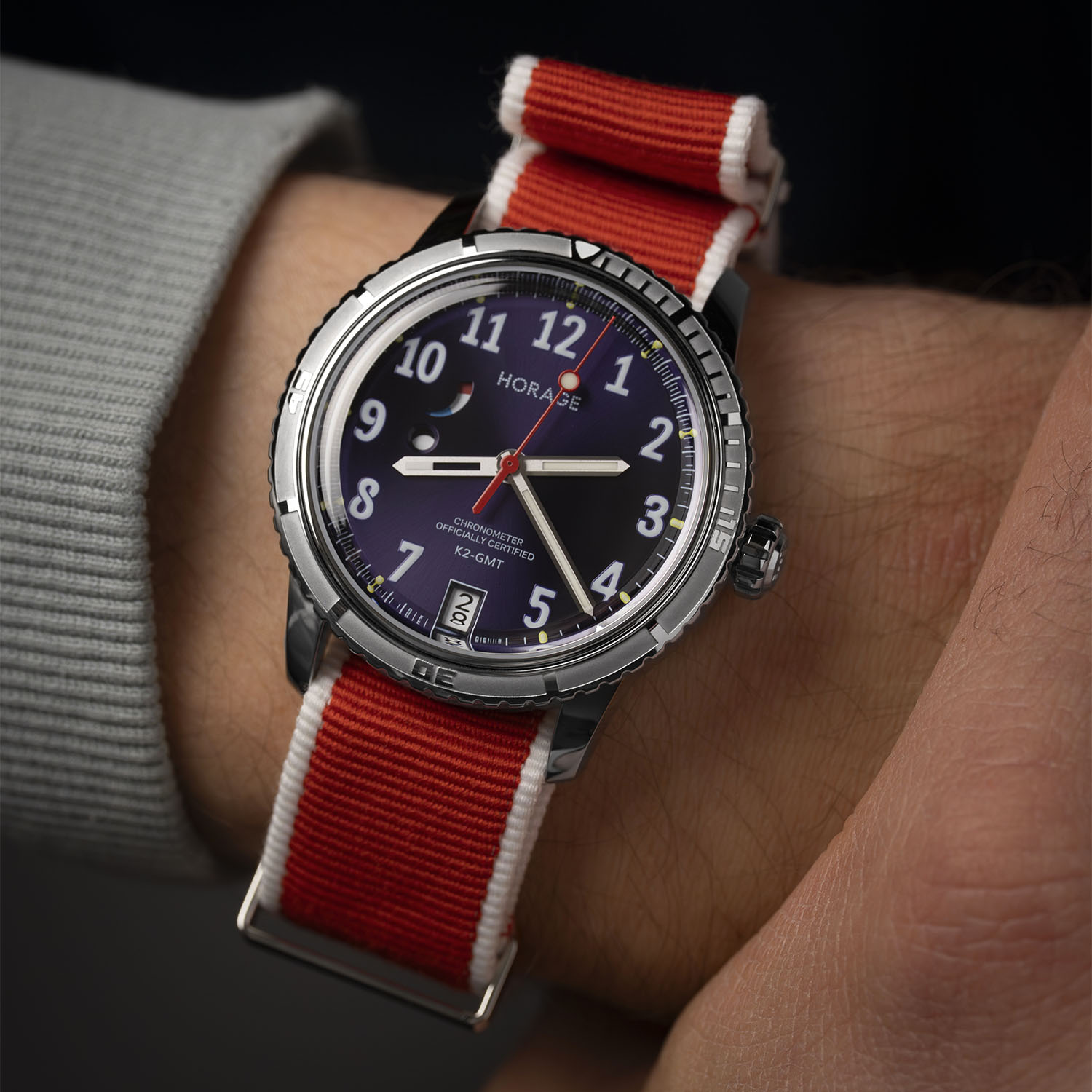
As mentioned, powering the Molokini is Horage’s in-house Calibre K2, an automatic micro-rotor movement measuring 3.6mm in height. The K2 operates at 28,800 vibrations/hour, delivers a 72-hour power reserve, and incorporates a silicon balance spring and escapement to improve resistance to magnetism and long-term stability. Regulation is achieved via a screw-balance system, and each movement is COSC-certified. The tungsten micro-rotor is gold-plated, and the movement is anthracite-finished.
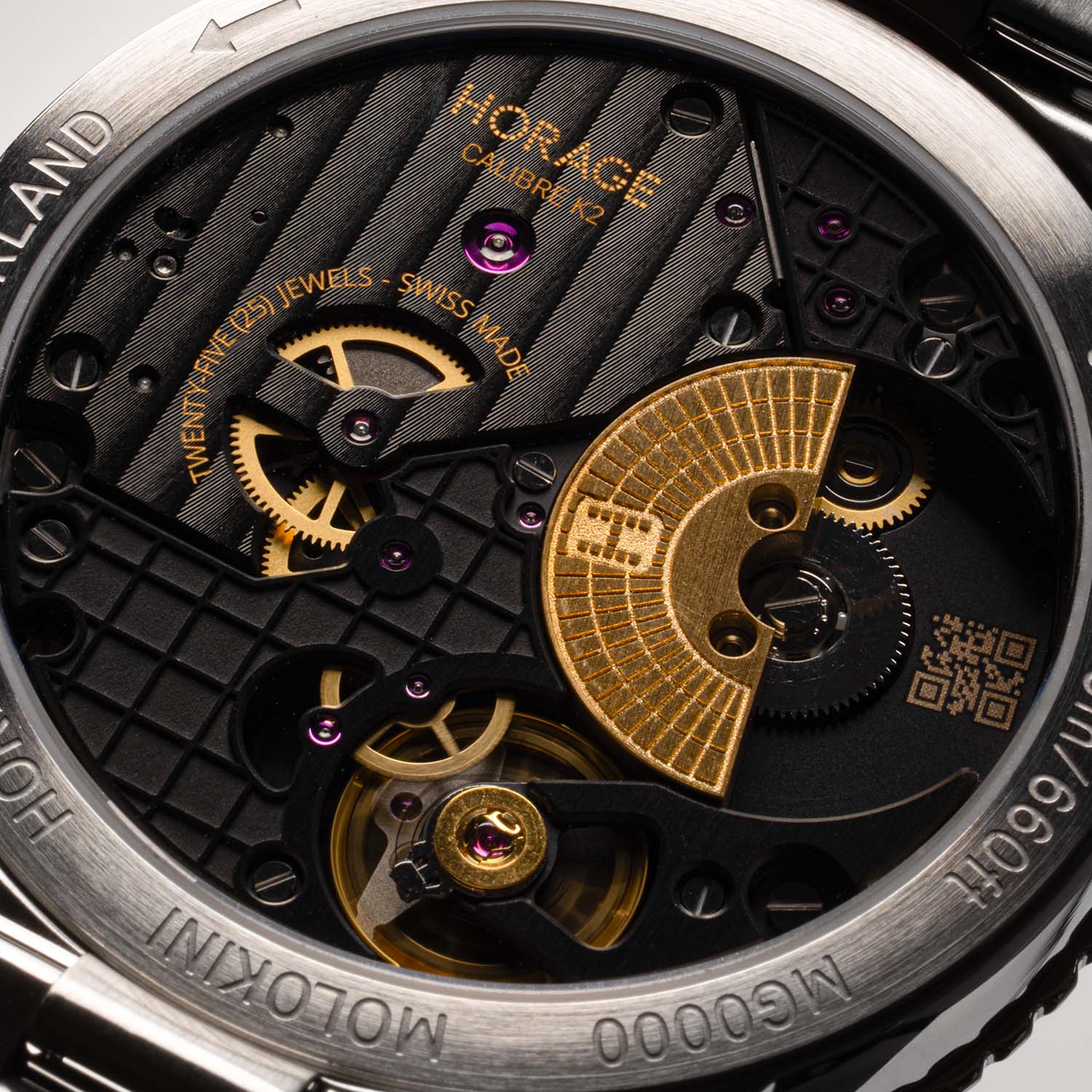
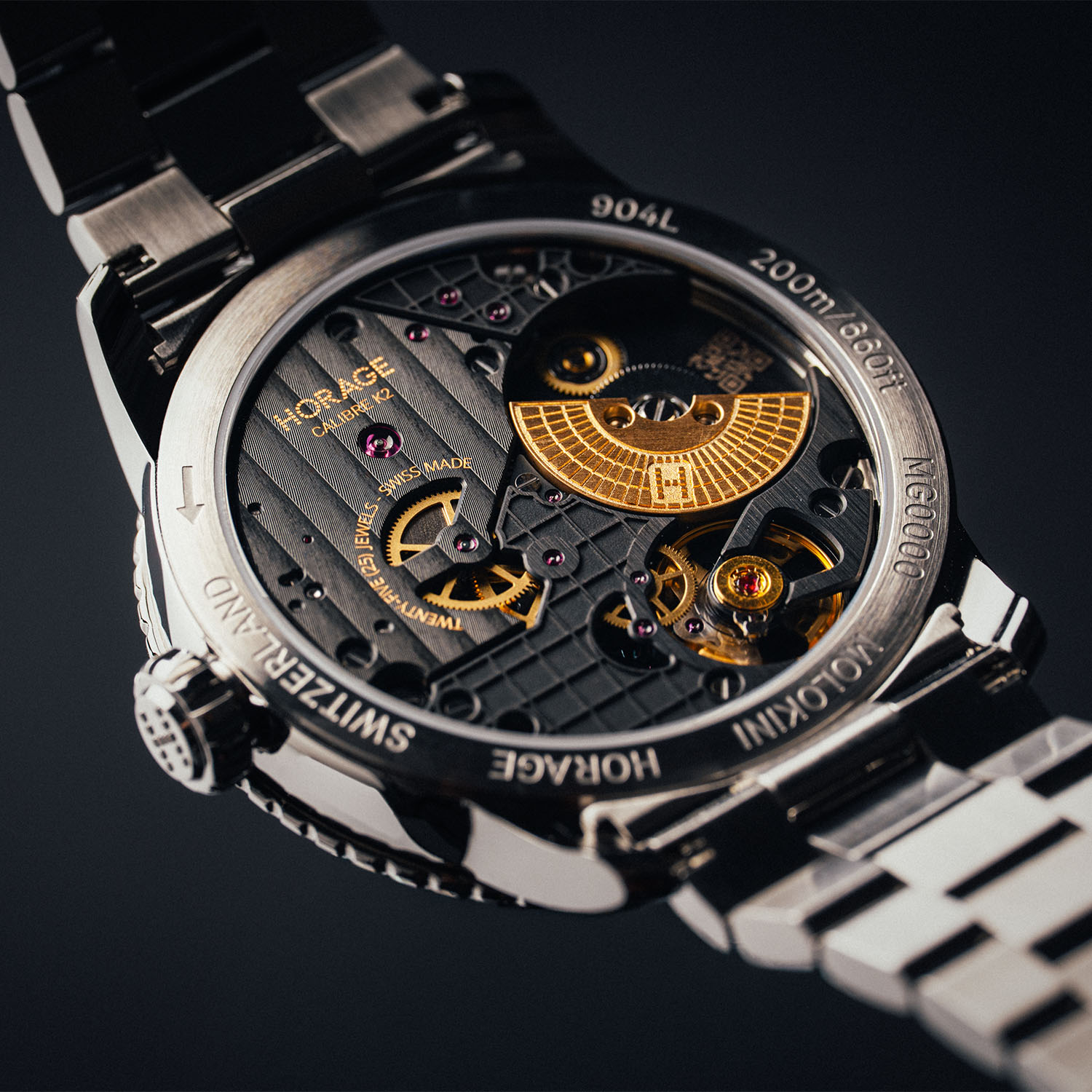
The Molokini is worn on a three-link 904L stainless steel bracelet fitted with HMAC (Horage Micro Adjustable Clasp) folding clasp, offering 10mm of tool-free micro-adjustment in 1mm increments. An additional “OTAN” fabric strap is included, available in white/black, white/sand or white/coral. Pricing is set at CHF 6,490, with a pre-order price of CHF 5,990 available from February 10 to February 28, 2026. Deliveries are scheduled to begin in early May 2026.
For more information, please visit www.horage.info.

9 responses
Horage has consistently released some of the best – if not the most – value-for-dollar watches on the market. What you get for the money is truly impressive. I just wish that their designs resonated with me more.
Exactly that. The dimensions, tech, story, everything is so compelling, but the designs leave me cold. Reading the article without seeing the pictures, I‘d think this is a must-have. But looking at it, I just don‘t feel it.
I like it.
I really like it. The water resistance is solid. They’re definitely not direct competitors, but in that price range you also have brands like Habring and Kudoke. When it comes to GMTs, though, my favorite is still the Grand Seiko quartz.
That’s a fair perspective, and we hear it from time to time.
Our design approach prioritizes proportion, comfort, and longevity over visual trends. We believe a high-end watch should age gracefully, feel balanced on the wrist, and remain interesting after many years of wear — not just in photos.
This kind of design is quieter, but it’s very deliberate.
As for innovations go Horage has mine and the industry’s total respect. However I believe the Engineer-led design is causing a NASA SYNDROME which is the mindset that ‘the Silicon Escapement is the beauty. And if the specs are world-class (904L steel, 72-hour power reserve, anti-magnetic), the watch should sell itself.’ The reality is that even Rolex and Patek Philippe have historically used external case makers and dial designers. Horage is trying to be “more Catholic than the Pope” and it’s making their watches look sterile and industrial. It’s a lost cause trying to be Intel and Apple at the same time. You need to pick your battles.
I agree with the other comments re. the Horage’s polarising design language – I really respect the tech and value for money that the brand offers but their designs consistently fall short for me.
It’s great that the Molokini has standard lugs and smaller dimensions, however, the bezel is way too thin, almost to the pony that it looks like an afterthought. It’d have been better/simpler to have a 24hr chapter ring under the sapphire, or perhaps increase the case size to 39.5 and have a wider bezel. Also, a fully polished case on a tool watch doesn’t make much sense to me – I think that a brushed case (ideally brushed Ti) would have worked better for the intended purpose of the watch.
I don’t see a 24-hour GMT scale here. Is the GMT hand 24-hour, or 12-hour? I’ve not heard of the latter being a thing. But all of the pics are consistent with it being 12-hour. Ah, and in fact I guess that the 9 o’clock day/night indicator is for the GMT hand, yes? That’s cool — I just have never seen a GMT like that.
A bit pricy for a relatively unknown brand