


 Not all images were able to load for printing. Please close the print window and try again.
 The Breguet Classique 7235, My Favourite Watch of the 250th Anniversary
It's everything a Breguet should be, just better than before.

As most of you might know by now, this year Breguet celebrated its 250th anniversary. And this highly important brand, whose founder has been instrumental in the development of modern watchmaking, has released rather incredible models all year long. It started with a deceptively simple Souscription model that won the GPHG 2025, followed by a pair of compact, vintage-inspired Type XX chronographs, a redefined version of the 10Hz watch with magnetic pivot and, last but certainly not least, the Experimentale 1 with its unprecedented magnetic escapement, a high-frequency tourbillon and a constant force device. And it will potentially surprise you, but my favourite release of the year isn’t one of these. This watch isn’t the most innovative or complex. What the Breguet Classique 7235 has, however, is a simply stunning design that pays tribute to the fundamentals of the Breguet style.
A tribute to the breguet style
What is the Breguet style? Well, this is something we discussed in length in this article and video, the so-called unmistakable signs that define what a Breguet was and still is. As you know, the brand Breguet was named after its founder, Abraham-Louis Breguet, one of the most (if not the most) important watchmakers of his time. Back in the late-18th and early-19th century, Abraham-Louis Breguet revolutionised watchmaking with innovations such as the tourbillon, the anti-shock device, the gong-spring and, more surprisingly, the souscription model, something that can be seen as the first implementation of a proper business model and branding in watchmaking.
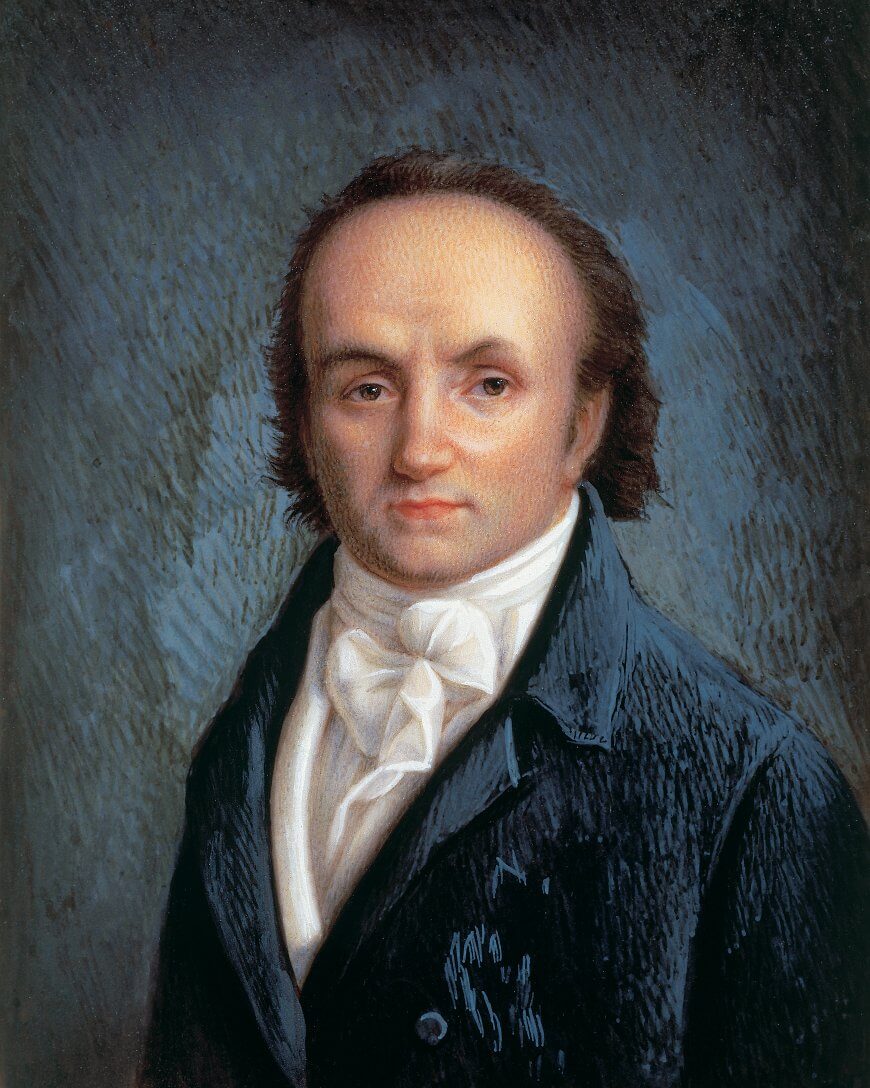
In order to establish his atelier as a brand, to fight counterfeiting and to make his watches instantly recognisable, A.L. Breguet created his own style, several design hallmarks that will become classics for the brand. Yet, there is a historical irony that needs to be understood: the style invented by Abraham-Louis Breguet was anything but “classic” at the time, but instead profoundly disruptive and innovative. When he moved to Paris in 1775, clock and pocket-watch faces were dense, cluttered and brimming with baroque ornamental touches that were not necessarily unsightly but lacked both coherence and identity. The Renaissance style was still clearly perceptible. English and French styles were distinct, while Swiss watchmaking had not yet found its feet.
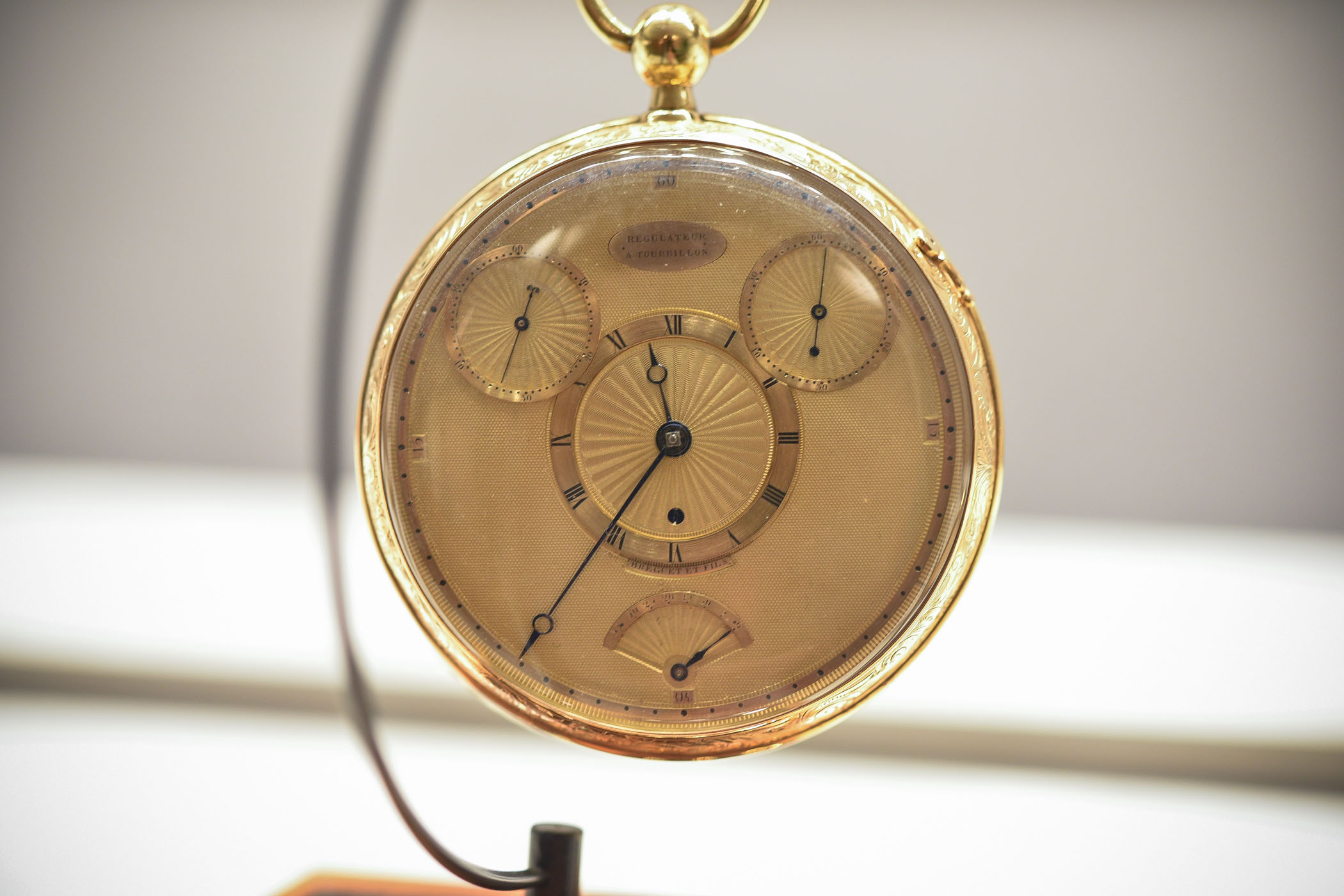
And this is where the genius of A.L. Breguet enters the equation. ALB was not just a great watchmaker. He was a businessman with a vision for his atelier. He went on forging a distinctive style for his watches, distinguished by its finesse, elegance, discretion and legibility. This was particularly evident on the dial side of his pocket watches, merging technical needs with stylistic standpoints, eliminating anything superfluous and emphasising legibility. He proceeded by sectors, playing on distinct levels, emphasised by the use of guilloché, a technique that was not necessarily widely used in watchmaking back then. Using multiple patterns of guilloché makes it possible to separate the indications, giving unprecedented clarity to the complex displays of many of his watches. Throughout a career spanning nearly 50 years of work, he maintained rigorous discipline and great constancy. Other distinctive elements were the famous Breguet hands, the Breguet numerals or the secret signature engraved on his dials, as a security measure to fight counterfeiting.
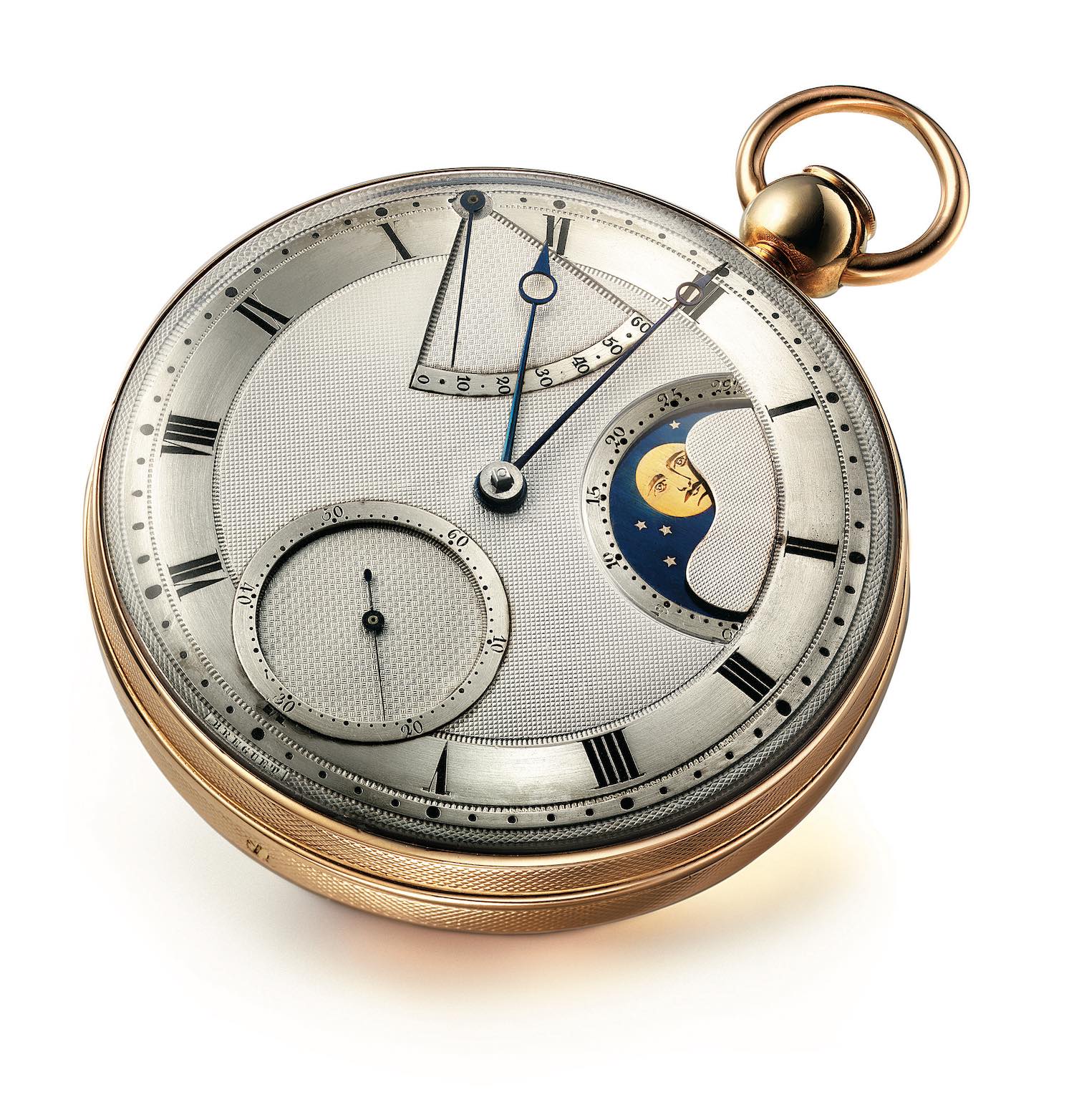
This Breguet style is perfectly embodied in watch No. 5 delivered on 14 March 1794. An outstanding timepiece, it was sold at the time to François Jourgnac Saint-Méard, a literary scholar renowned for his fine writing and a contemporary of Breguet. This pocket watch features a dial with a small seconds, a moon phase, and a power reserve, all clearly separated by guilloché patterns and sectors. This very watch has been the source of inspiration for the Breguet Classique 7235.
The Breguet Classique 7235
This watch, part of the 250th anniversary collection, somehow flew a bit under the radar. Having been released next to the Classique 7225, and part of a collection that includes highly technical watches, it feels a bit restrained and shy compared to the rest. Here, there is no innovative escapement or any major complication. What this watch is, however, is a tribute to what makes a Breguet visually unique. And, to me at least, this side of the brand is as important as its technical developments.
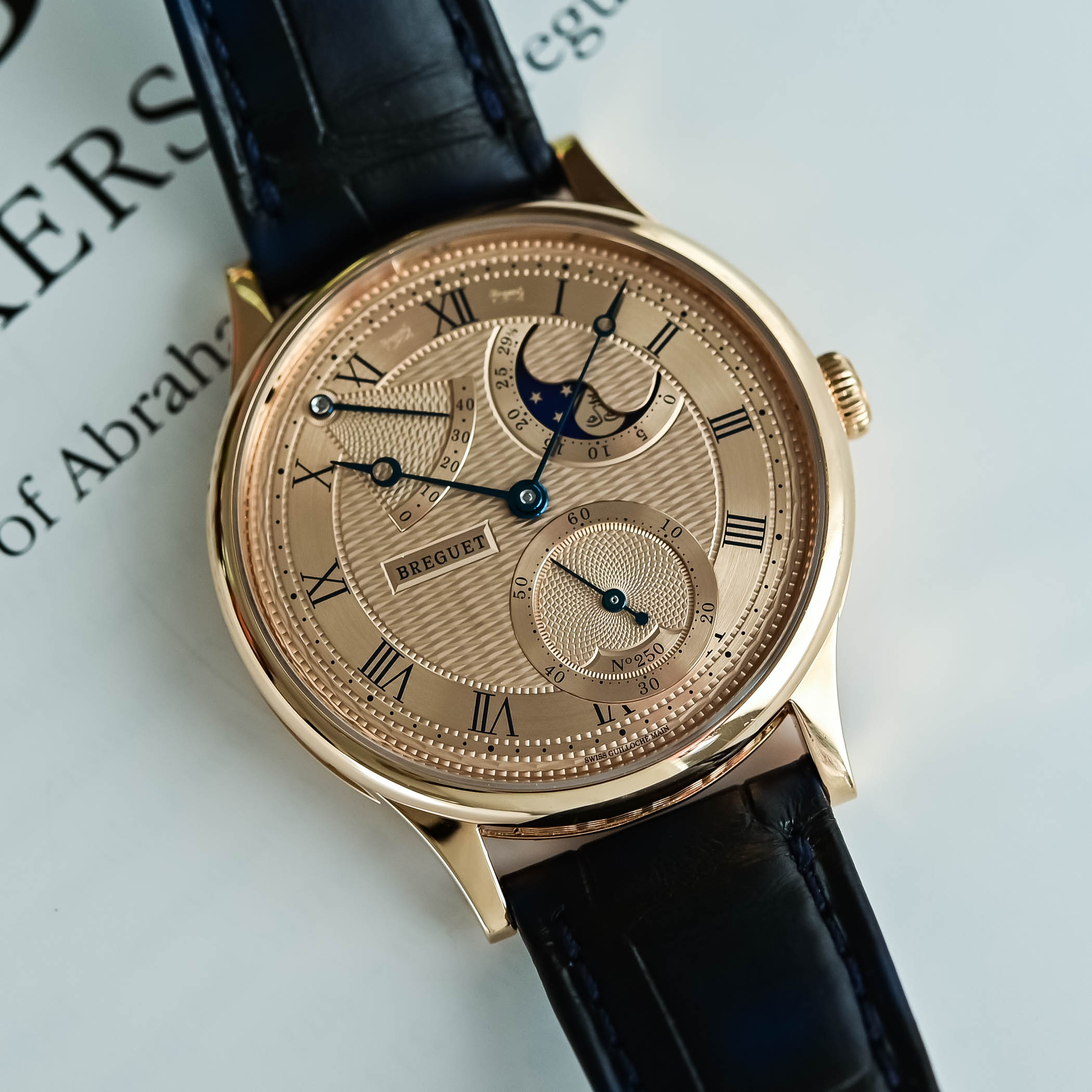
As such, the Classique 7235 is not strictly speaking a reproduction of the No. 5 pocket watch. Obviously, it is a wristwatch now and looking closely at the display, you’ll see some minor differences. To a certain extent, it felt at first like an evolution of the Classique 7137 Moon & Power Reserve. In a way, this isn’t entirely wrong. Both watches share the same inspiration, the base architecture of the movement is shared, and the display feels similar… At least, at first sight.
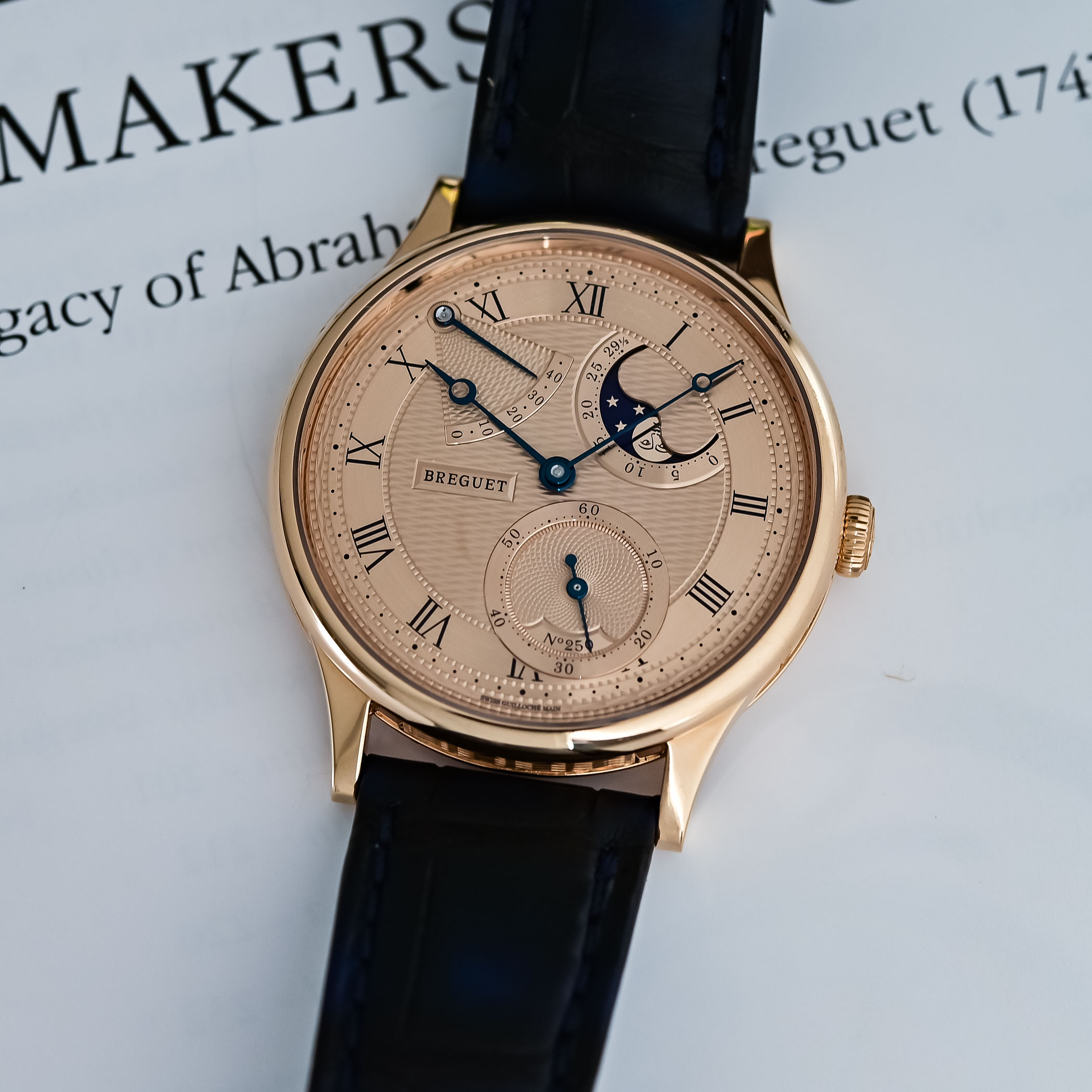
In fact, there’s not much in common between the 7137 and the new 7235, besides some of the indications and the technical base of the movement. It starts with an entirely different case, of course made of Breguet gold (the dedicated alloy of the 250th anniversary collection) and using the design introduced with the Souscription 2025 watch. With this celebratory collection, Breguet has created a new, more rounded and more ergonomic case that gets rid of the straight soldered lugs and the fluted caseband – two elements of style that have been central to the brand since its return under the guidance of Daniel Roth in the 1980s.
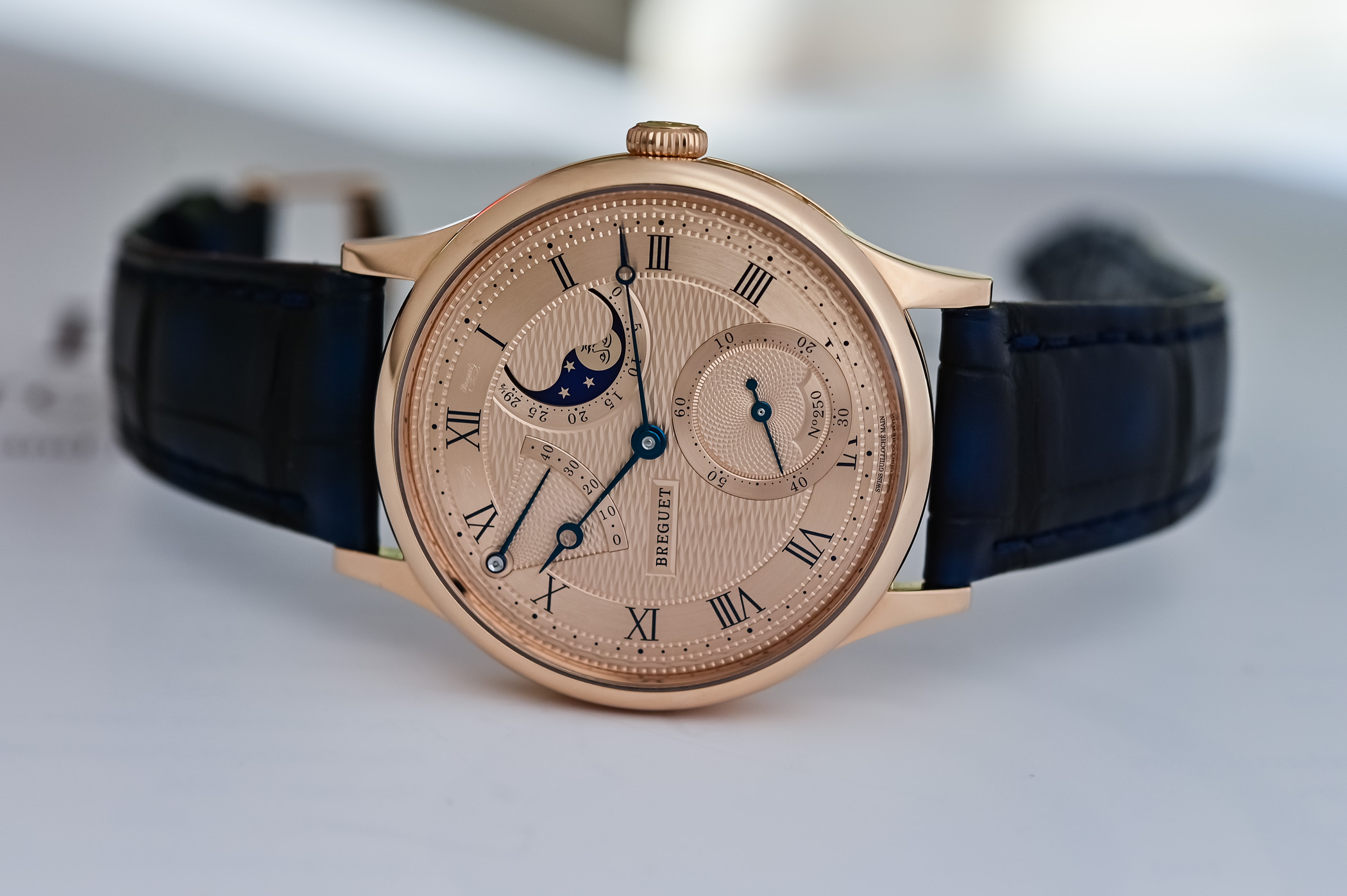
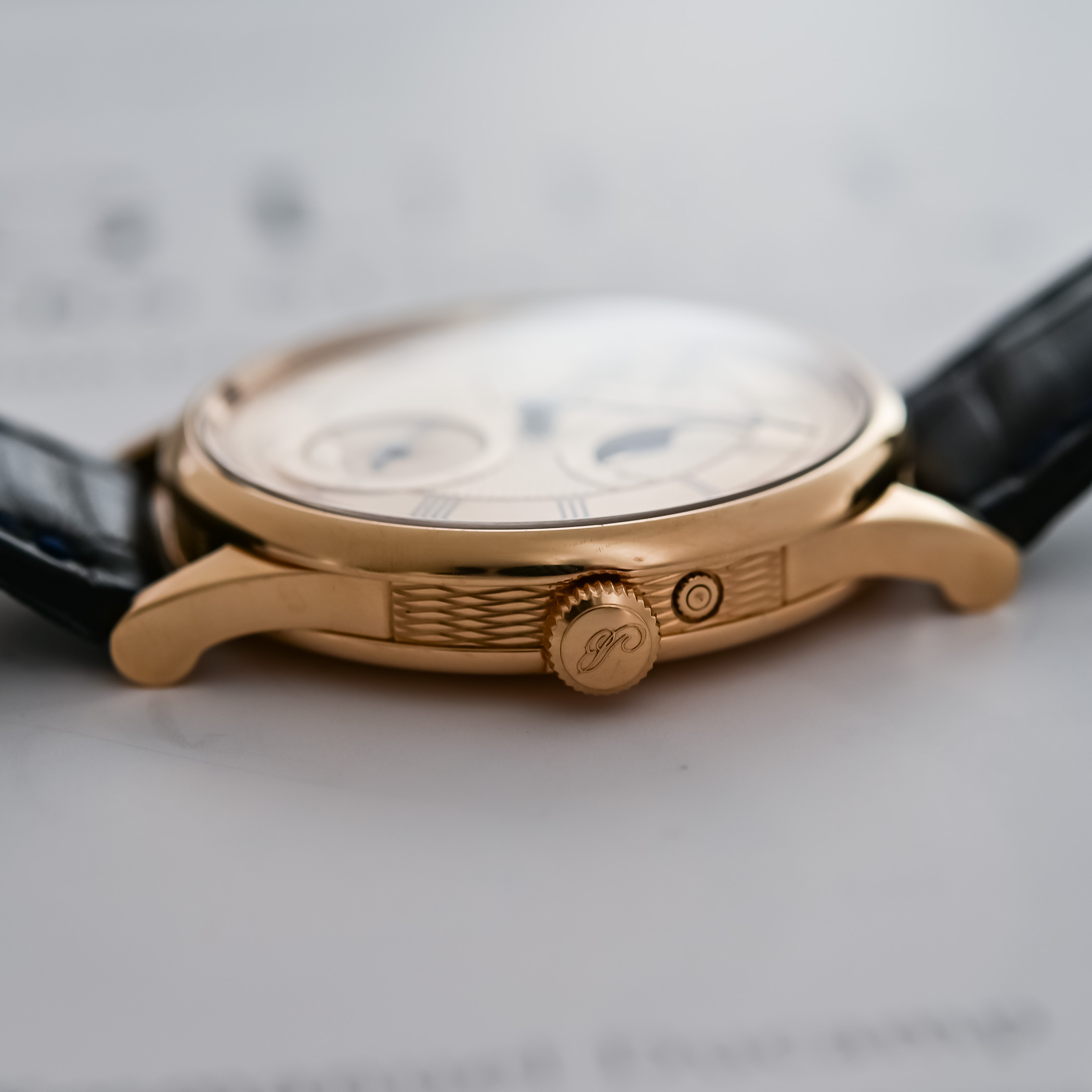
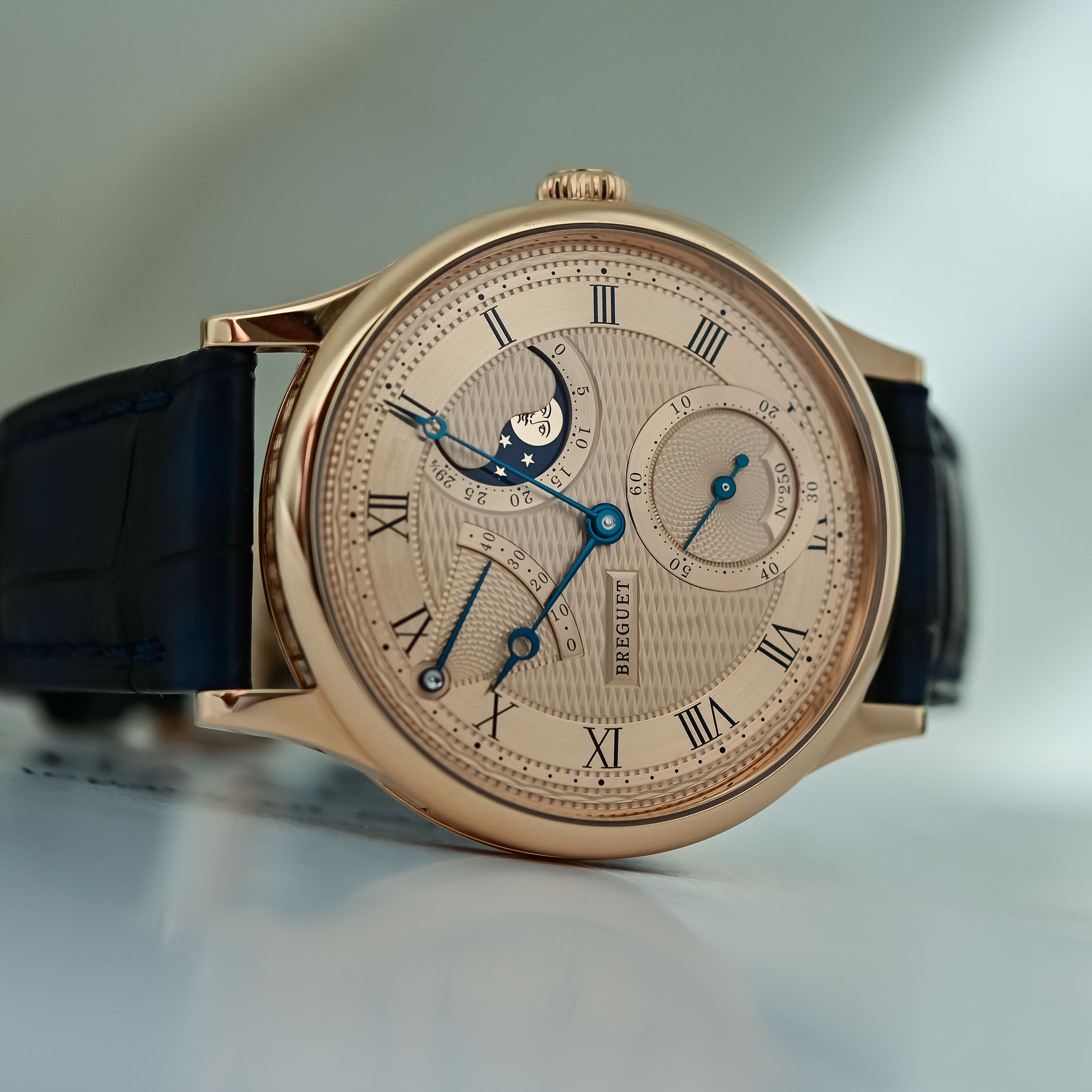
Measuring 39mm in diameter, the case of the Classique 7235 now has lugs classically integrated into the middle case. Paired with a more curved design and a lower centre of gravity, this is truly beneficial to the overall comfort. Next, framed by a polished domed bezel is a new spherical sapphire crystal, which adds a bit to the thickness of the watch (measured at 9.9mm) but adds a certain charm. Finally, instead of a vertically fluted caseband, the Classique 7235 opts for a hand-guilloché middle case using the anniversary’s “Quai de l’Horloge” motif.
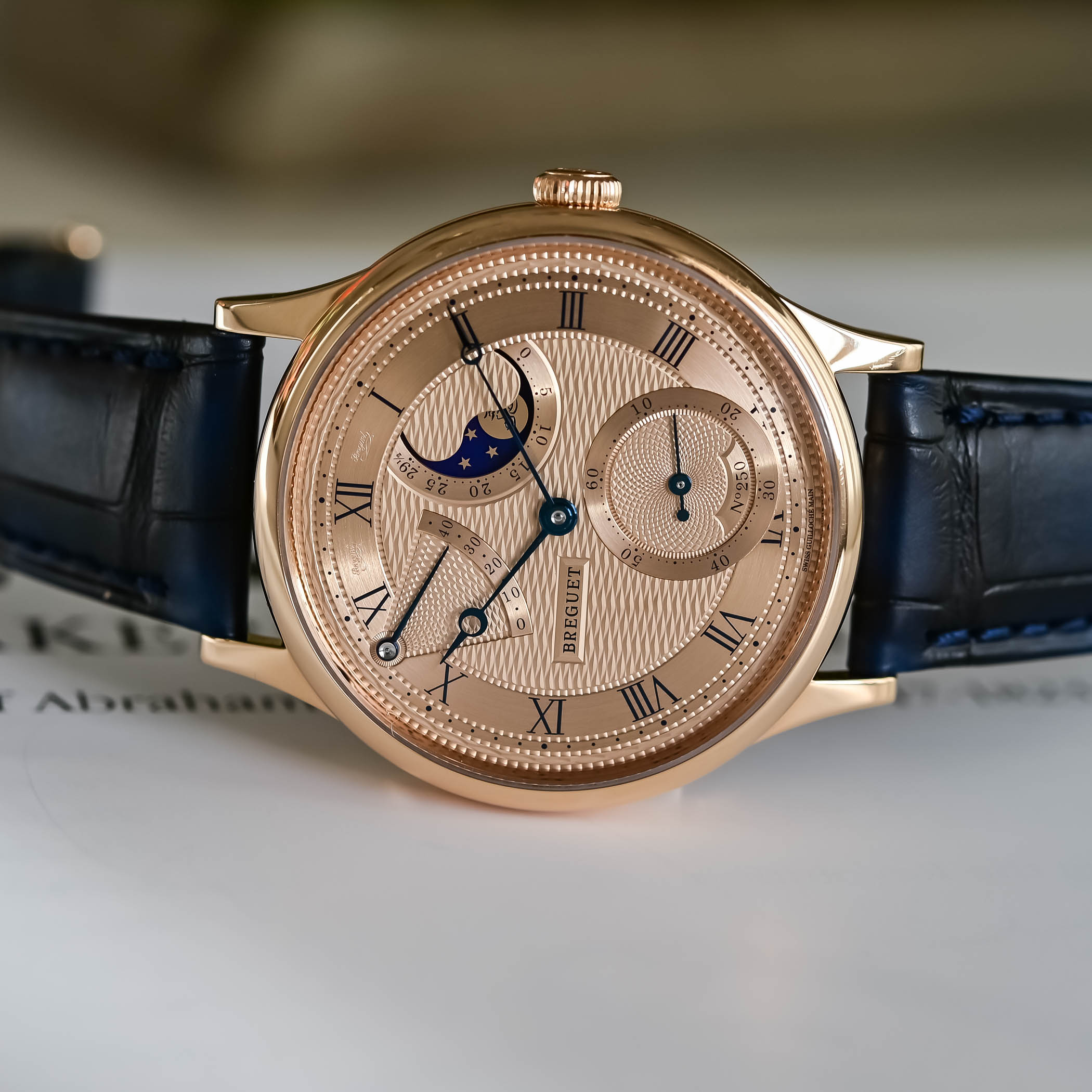
The dial of this watch is, without a doubt, the centre piece. Inspired by the No.5 pocket watch but not copying it entirely, it also marks a certain evolution compared to the Classique 7137, by replacing the date sub-dial with a small seconds and repositioning and reshaping the power reserve and moon phase indicators in a more elegant way. One of the most elegant watches ever, the No.5 pocket watch gives the Classique 7235 its two central hands, its power reserve between 10 and 11 o’clock, its moon phase at 2 o’clock and its small seconds, here lightly offset between 5 and 6 o’clock – a nod to many of Breguet’s historical timepieces on which the small seconds was rarely placed at 6 o’clock.
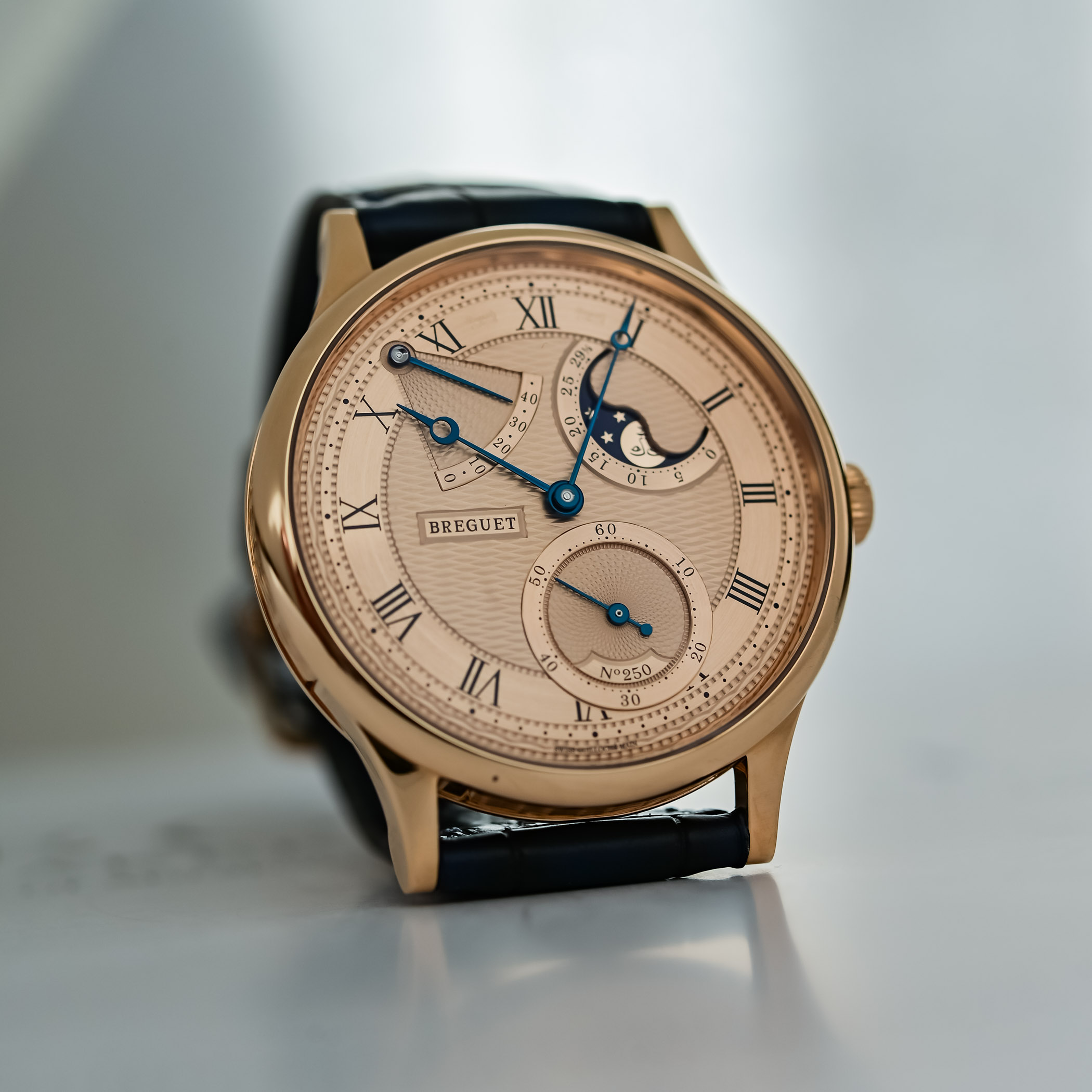
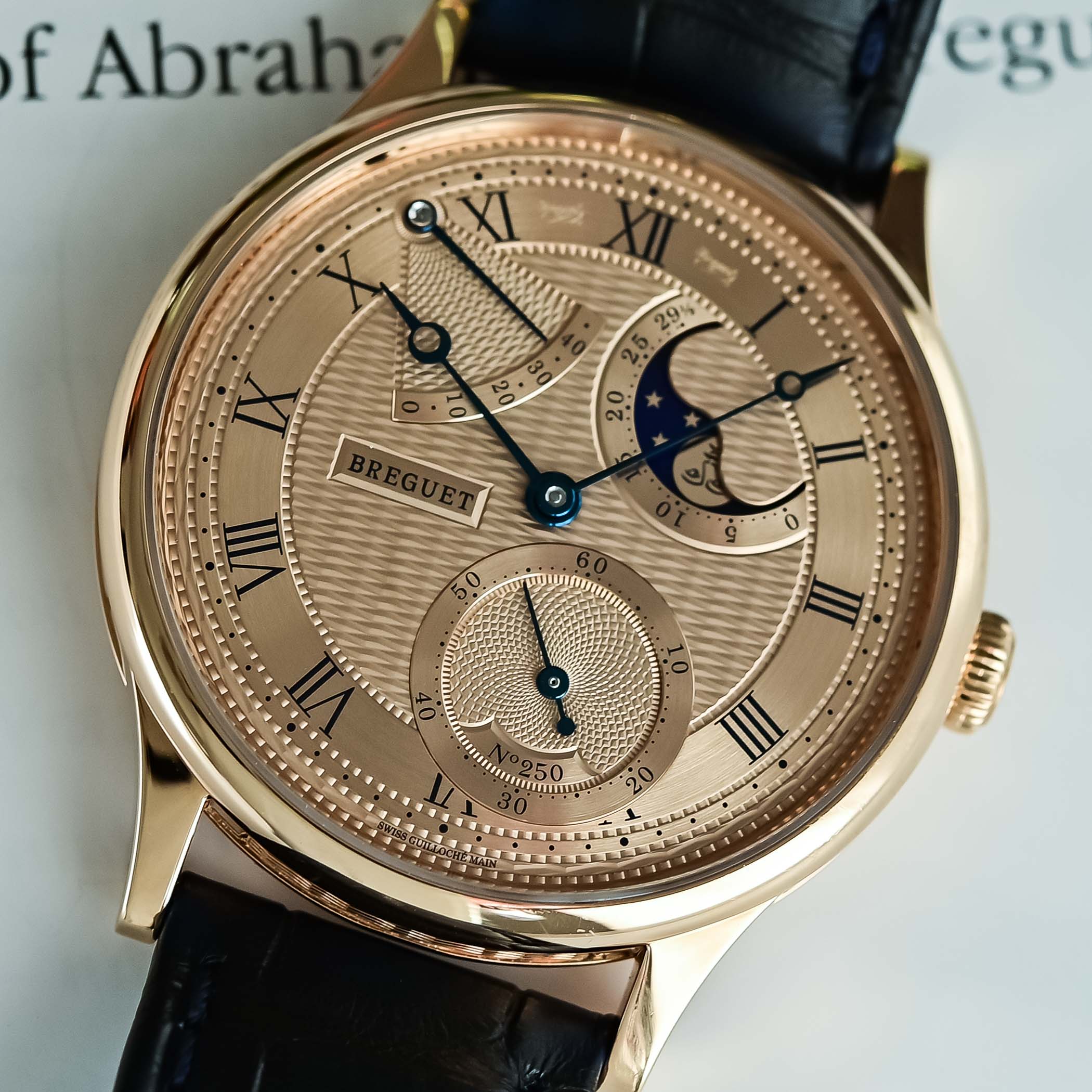
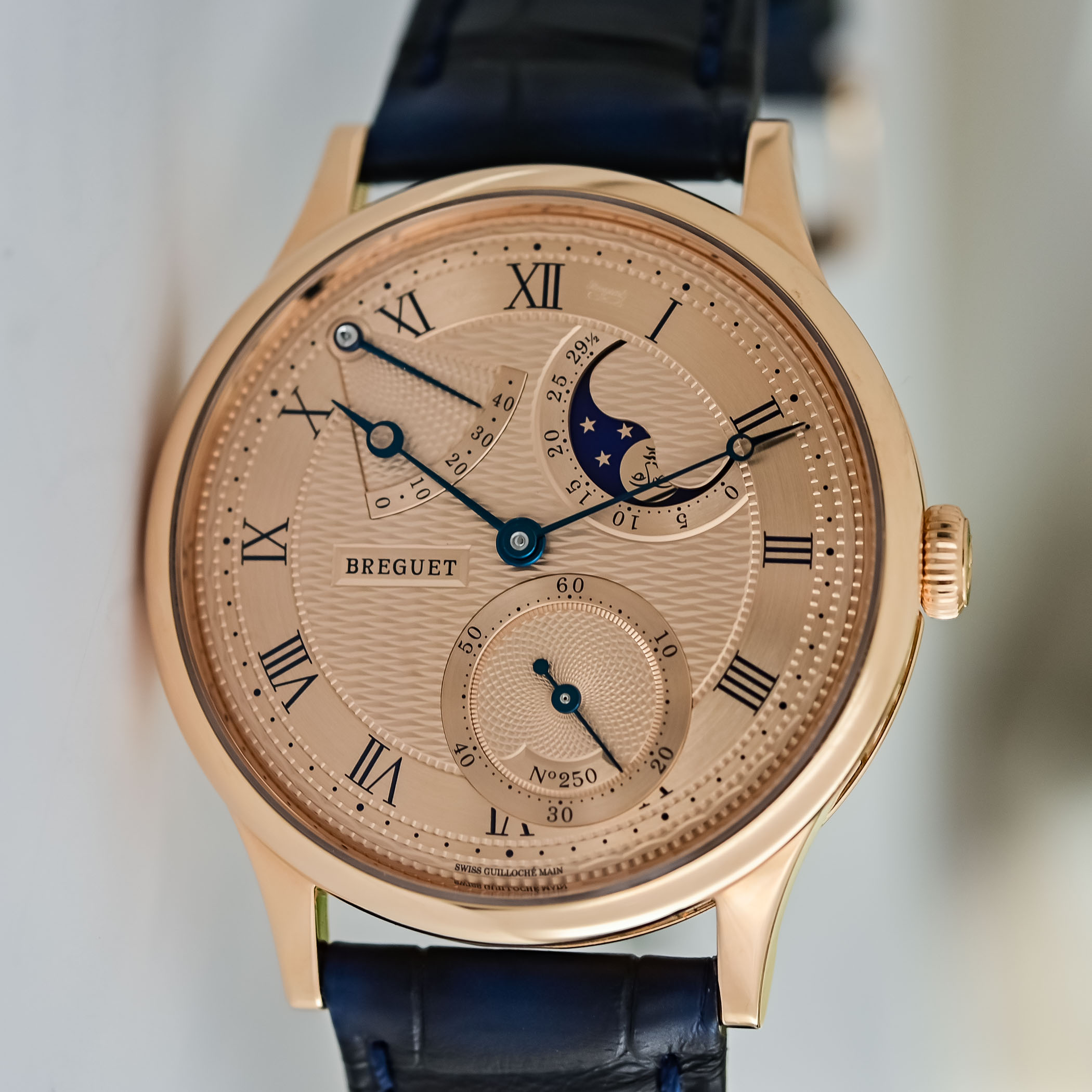
The dial, if novel in material and execution, couldn’t be more Breguet, though. A non-flat 18k Breguet gold base is used, since the 7235 has a bevelled dial like that of watch No. 5. It is thinner at the edges than in the centre, to give the dial a slightly sloping profile at the edge of the chapter ring, as well as a slimmer, lower bezel. The tone-on-tone style, more striking than usual on Classique models with silvered dials, remains particularly appealing and consistent with the case. The dial is centrally decorated with a straight “Quai de l’Horloge” hand-guilloche motif, while the small seconds and power-reserve sector, as well as the dial rim, feature the same pattern, but in a circular rendering. All indications are neatly separated by the use of satin-brushed inserts and straight guilloché sector lines. It’s all beautifully unbalanced and characterful, creating a dial full of charm and very Breguet indeed.
New in-house calibre
Inside the case of the Breguet Classique 7235 is a new movement, or at least a deeply updated version of a known architecture. The calibre 502.3.DRL relies on the same base as the calibre 502.3 DR.1 found in the Classique 7137. This thin automatic movement stands apart by the use of an offset oscillating weight, which opens up space for optimised distribution of the watch’s components. That said, the movement has been updated to accommodate the new display on the front and is now equipped with a silicon balance-spring. Running at a 3Hz frequency, it retains a 45-hour power reserve.
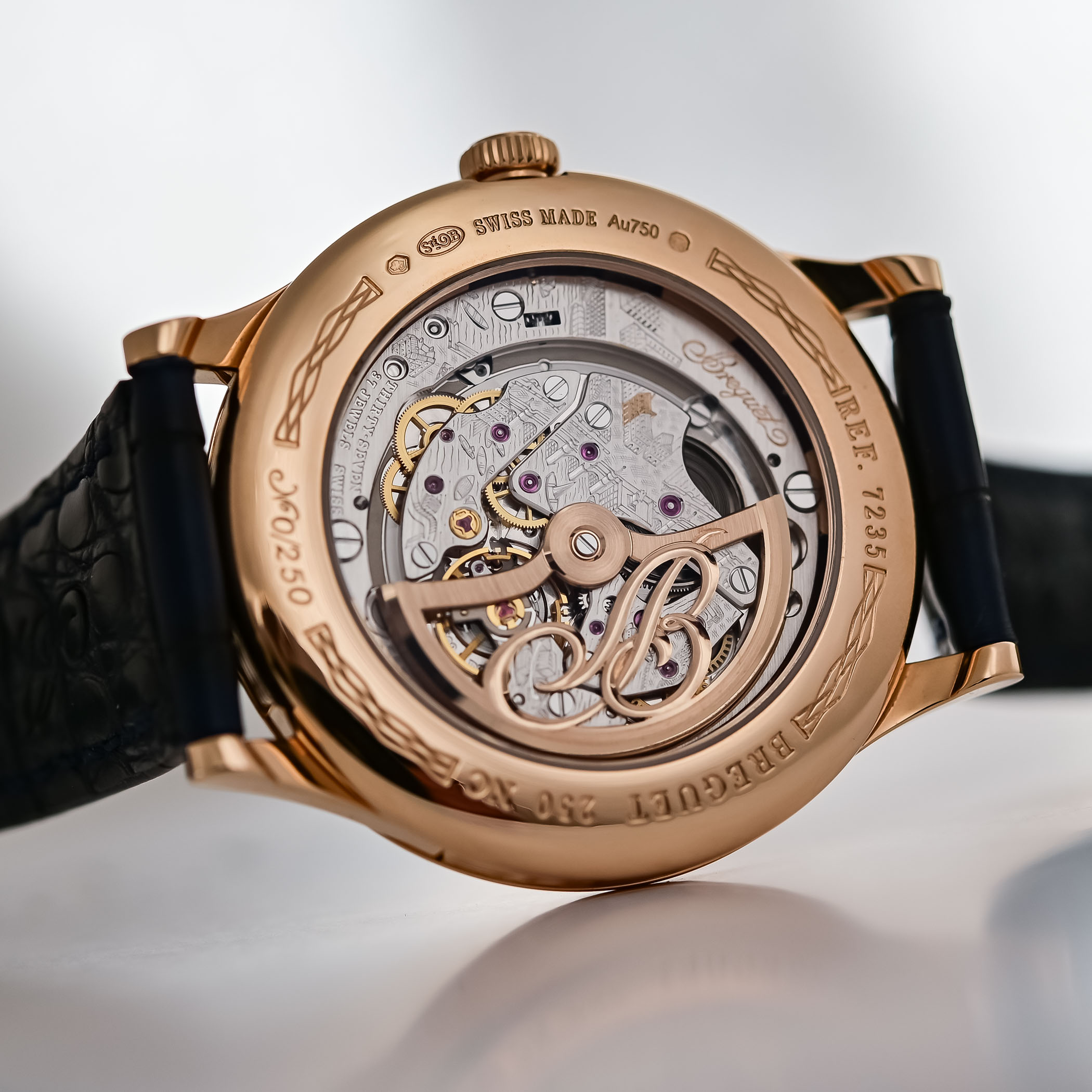
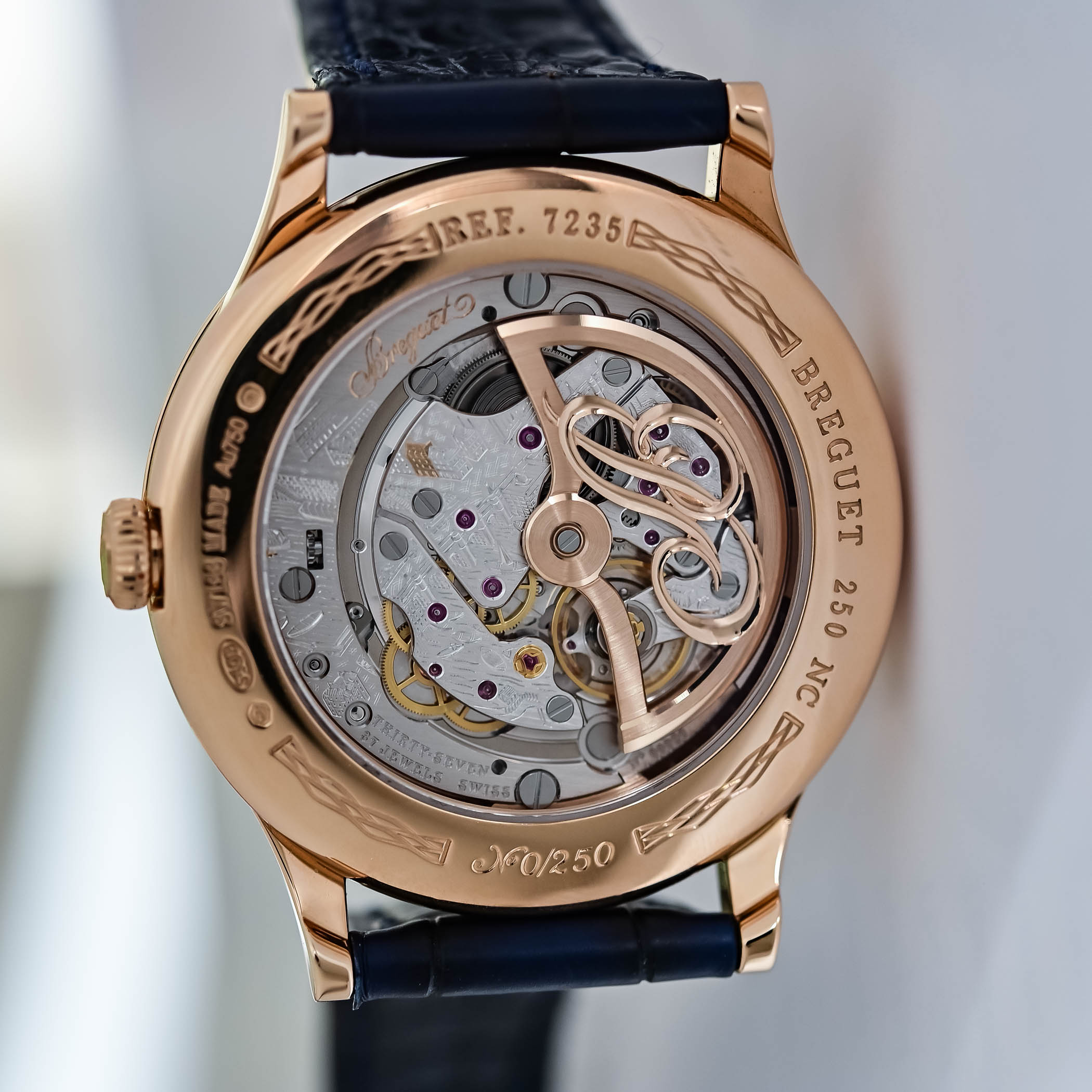
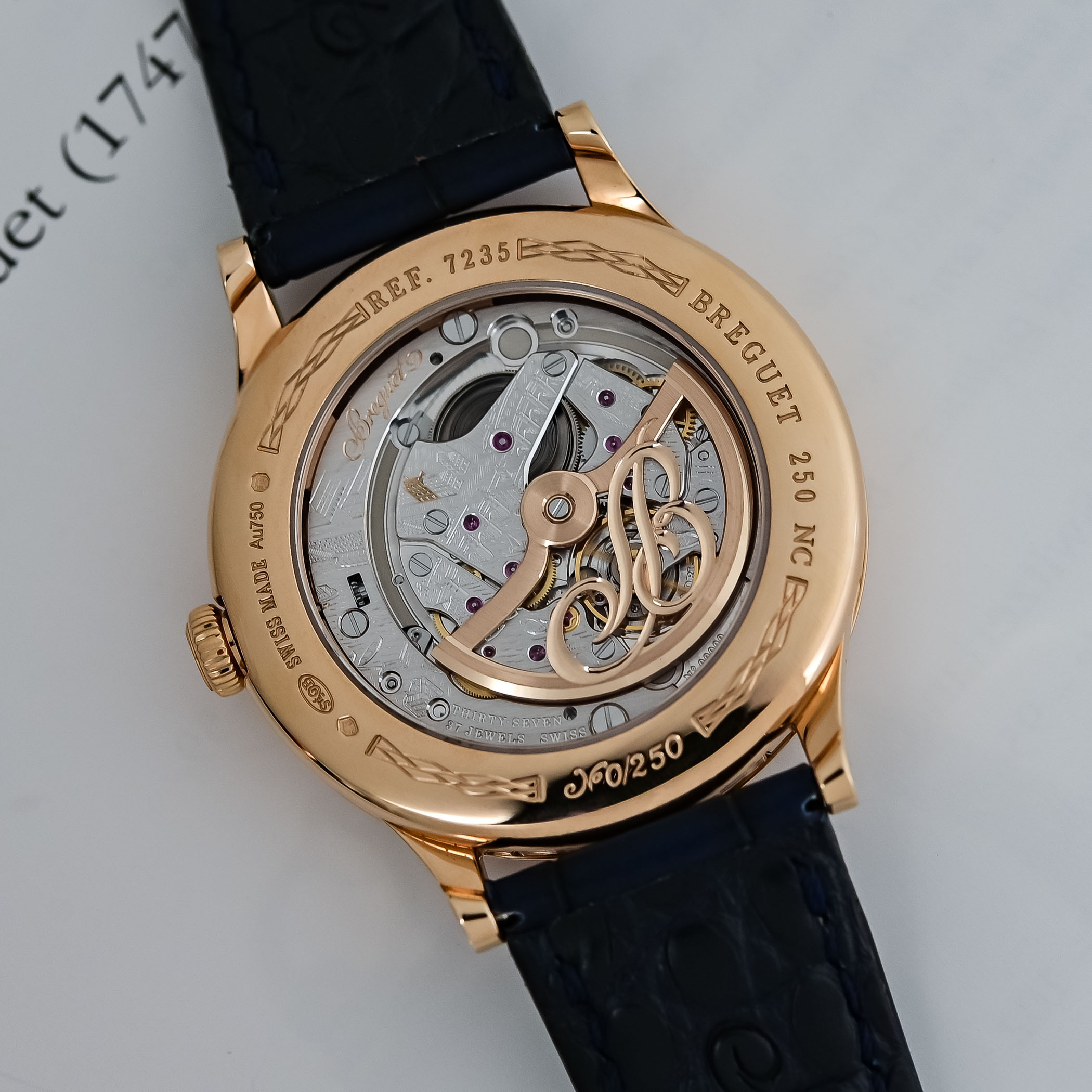
The back reveals a refined decoration. First, the movement is wound by a new gold oscillating weight, shaped like the B of Breguet. Also, the bridges have been hand-engraved with a view of a so-called “Turgot” map depicting the Quai de l’Horloge, where A.L. Breguet’s workshops were located.
Thoughts, availability & price
The Breguet Classique 7235 is not the most impressive watch of the 250th Anniversary collection. It isn’t particularly complicated, it doesn’t come with highly technical features, and unlike the Experimental 1 or even the Classique 7225, it doesn’t feature unprecedented innovations. It’s not a watch to impress on a technical level. However, I can’t help being truly fascinated by its design, elegance and consistency. It speaks to me in a number of ways, for its historical relevance and its nod to what made Breguet instantly recognisable. It is a truly handsome watch. And, after all, this is something equally important as the technicality of the movement.
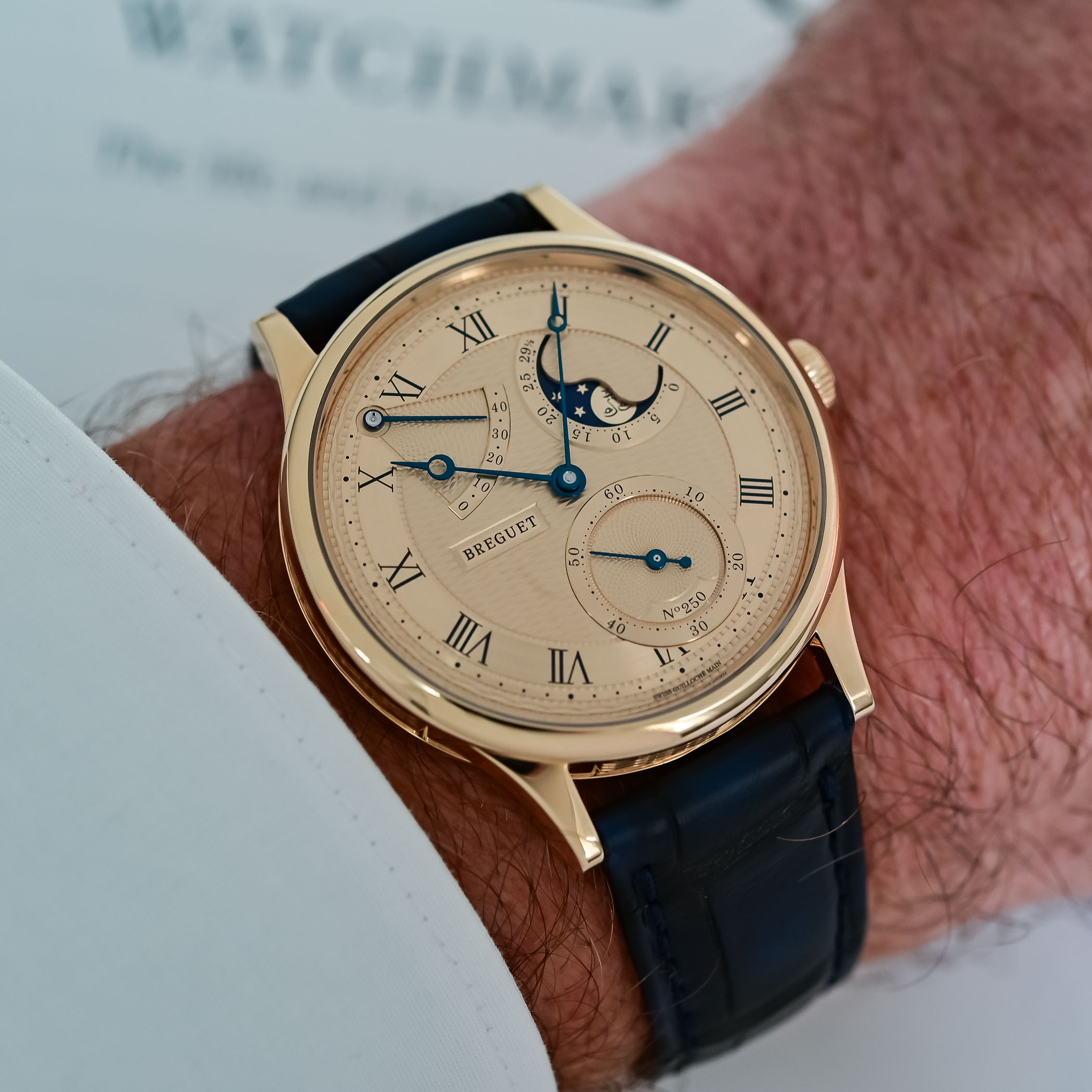
Worn on a blue alligator strap, the Breguet Classique 7235 is released as a numbered 250-piece limited edition, priced at CHF 65,000 (incl. taxes) or EUR 76,200 (incl. taxes). Quite a step price, to be fair. Now, I’m wondering if we will see more of this watch in the near future, maybe with a silvered dial, a different combination of guilloché patterns and a non-engraved movement, as part of the permanent collection. That’d be a great addition to the brand’s portfolio. For more details, please visit breguet.com.

1 response
Absolutely gorgeous watch ! No picture comes close to doing it justice. Seeing it in person, the light dancing across the guilloché is stunning.